No One Ever Told Me About the Mystery Number 6174
The Most Mysterious Number Ever Known
No One Ever Told Me About the Mystery Number 6174
The Most Mysterious Number Ever Known
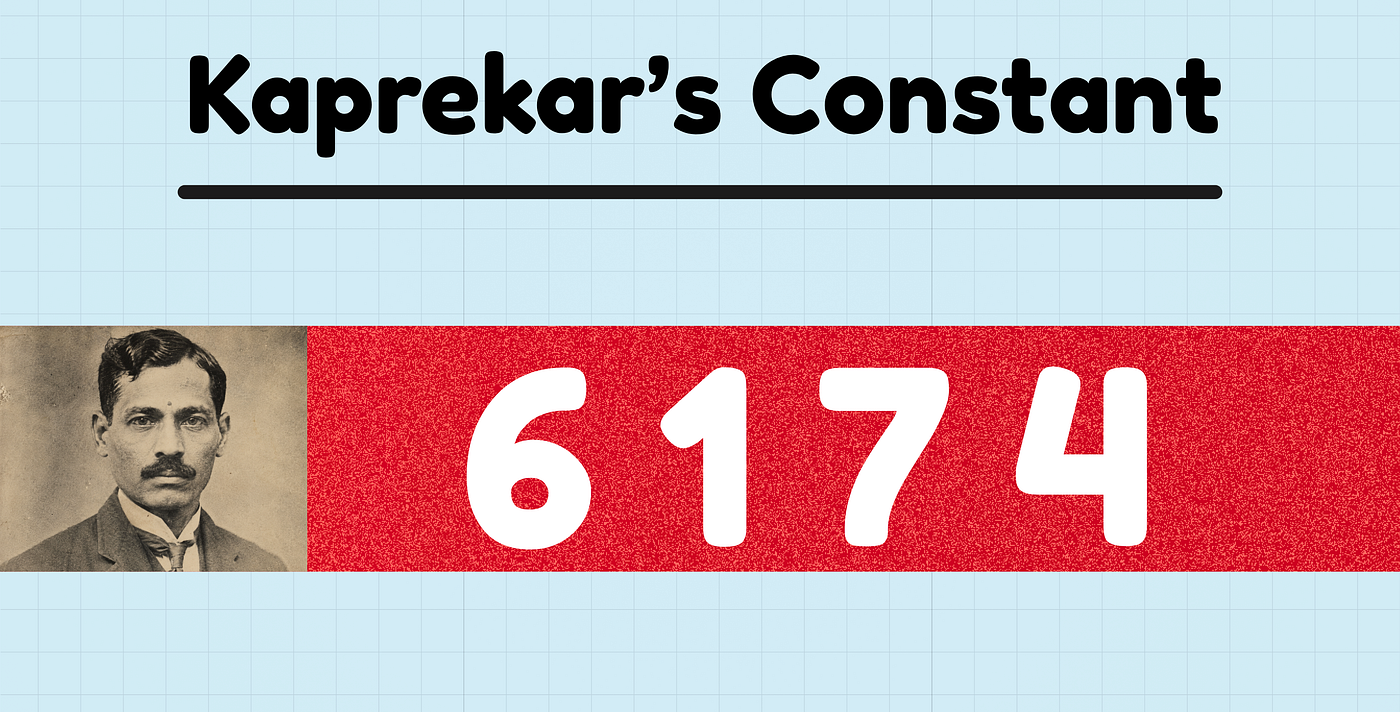
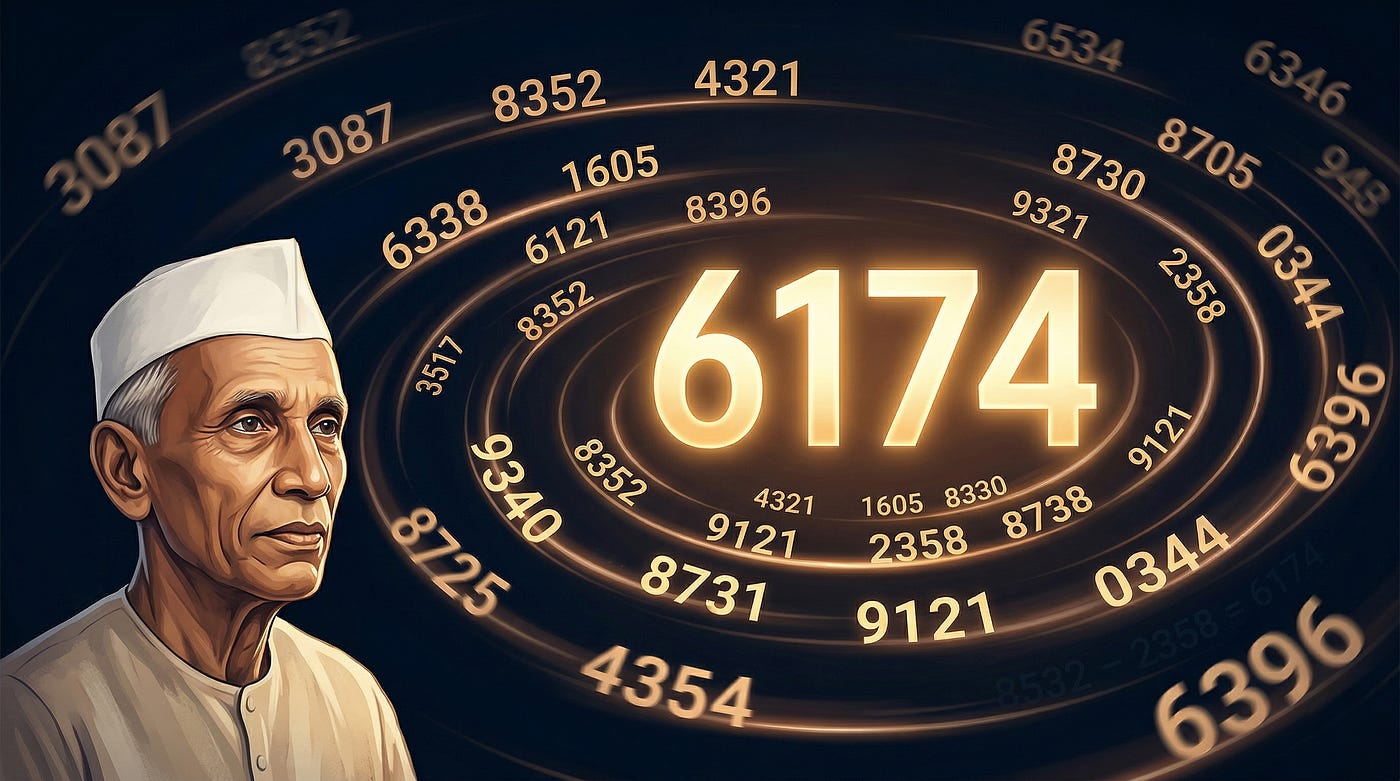
Image by the author
I recently came across a number I’d never heard of in my life.
That surprised me because unusual number patterns are the sort of thing I love reading and writing about.
Here’s it: Pick ANY four-digit number, perform a simple calculation a few times, and trust me, you’ll keep being drawn to a certain number.
This number is 6174, a number known as Kaprekar’s Constant.
What caught my attention wasn’t the number itself but a strange process associated with it.
When I started experimenting with that process, I found myself trying it again and again with different numbers just to see whether it would eventually fail, but it never did.
No matter which four-digit number I started with, I kept ending up at the same number.
The first few times, I assumed it was a coincidence. After all, mathematics is full of patterns that appear convincing until you test enough examples. But this one turned out to be far more stubborn than I expected.
This process begins with almost any four-digit number.
Rearrange its digits to form the largest possible number and then rearrange the same digits to form the smallest possible number. Subtract the smaller number from the larger one, and repeat the procedure with the result.
That doesn’t sound particularly exciting, but something interesting happens.
No matter where you start, the process keeps pulling you toward 6174.
Take the number 4321 for example.
The largest arrangement of its digits is 4321, while the smallest arrangement is 1234. Subtracting gives:

In the number, 3087, the largest arrangement is 8730, and the smallest is 0378. Their difference is 8352.
One more round gives:

This gives the Kaprekar’s constant.
Let’s try one more example.
Let’s work with the number 1000
This may not look promising because three of its digits are zeros, so it feels like there isn’t much you can do with it. But the same rules apply.
The largest number that can be formed from its digits is 1000, while the smallest is 0001. Subtracting the two gives

Now repeat the process.
The largest arrangement of 0999 is 9990, and the smallest is 0999. Their difference is:

Repeating the procedure once more gives

And then we have this:

At this point, I recognized the number immediately. We had already encountered 8532 in the previous example, and we know exactly where it leads:

In summary . . .

So you see, even a number like 1000 eventually ends up at 6174.
What surprised me wasn’t that it got there, but how quickly it happened.
Before trying it myself, I would have guessed that a number with three zeros would take a long and complicated route. Instead, it reached 6174 after only a few steps.
The more examples I tried, the harder it became to dismiss the pattern as a coincidence. Numbers that look completely different somehow keep converging on the same result.
Here’s something more interesting.
There is a three-digit version of this same phenomenon.
So, instead of 6174, the special number is 495.
The rules are exactly the same. Start with a three-digit number, rearrange its digits to form the largest and smallest possible numbers, subtract the smaller from the larger, and repeat the process.
Just as nearly every four-digit number eventually leads to 6174, nearly every three-digit number eventually leads to 495.
When I learned this, I couldn’t resist trying a few examples of my own.
For example, let’s begin with 927.
The largest number that can be formed from its digits is 972, while the smallest is 279. Subtracting gives

Now repeat the process:

And once more:

There we have it!

Just as 6174 acts as a destination for four-digit numbers, 495 plays the same role for three-digit numbers.
Kaprekar’s Constant, 6174, is one of the strangest numbers in mathematics. Discovered by Indian recreational mathematician D. R. Kaprekar, it has the curious property that a simple procedure applied to almost any four-digit number eventually leads to 6174.
Thank you for reading! If you like this article, please give a few claps, follow me, and don’t forget to subscribe to stay updated with my latest articles.
메타데이터
- post_id
- b154e70c45dc
- slug
- no-one-ever-told-me-about-the-mystery-number-6174-b154e70c45dc
- url
- https://medium.com/think-art/no-one-ever-told-me-about-the-mystery-number-6174-b154e70c45dc
- canonical_url
- https://medium.com/think-art/no-one-ever-told-me-about-the-mystery-number-6174-b154e70c45dc
- author_url
- https://medium.com/@mathsammie
- status
- ok
- fetched_at
- 2026-07-10 19:15:58