The Functionalist Ecosystem: Strategic Specialization and Multi-Modal Integration in the GBA-BRI…
Abstract In the strategic landscape of 2026, the Guangdong-Hong Kong-Macao Greater Bay Area (GBA) has transitioned into a “Functionalist…
The Functionalist Ecosystem: Strategic Specialization and Multi-Modal Integration in the GBA-BRI Nexus (2026)
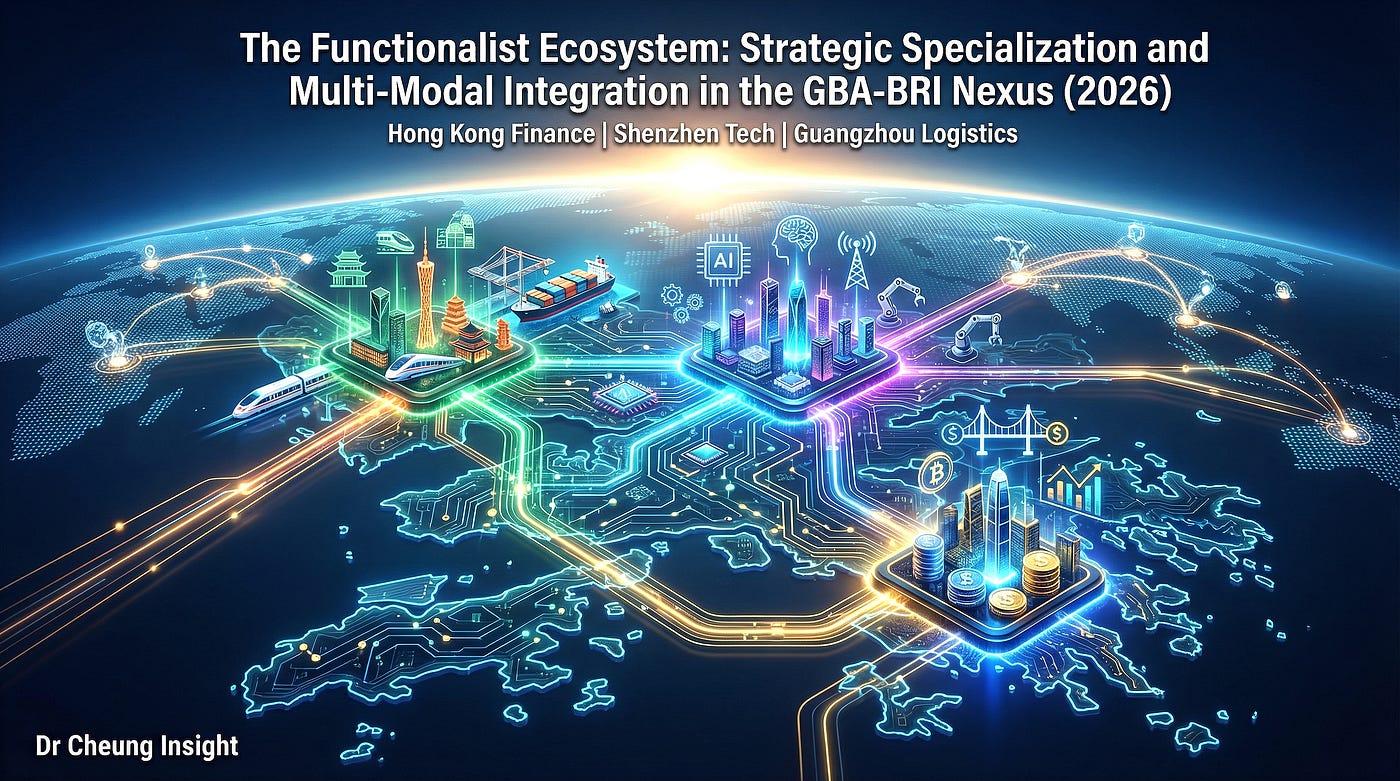
Abstract In the strategic landscape of 2026, the Guangdong-Hong Kong-Macao Greater Bay Area (GBA) has transitioned into a “Functionalist Ecosystem,” characterized by the hyper-specialization of its metropolitan hubs. This paper analyzes how the GBA serves as a “Full-Stack” solution for the Belt and Road Initiative (BRI) by leveraging the distinct competitive advantages of three core clusters. Hong Kong acts as the financial orchestrator, pioneering offshore RMB liberalization and green finance standards via the mBridge platform. Shenzhen-Dongguan functions as the technological engine, exporting “Embodied Intelligence” and 5G-Advanced infrastructure to the Digital Silk Road. Guangzhou-Foshan serves as the logistics and cultural spine, integrating multimodal transport and Lingnan heritage to foster “People-to-People” bonds. Collectively, these nodes reduce institutional friction and provide a high-quality development template for the Global South. Keywords: GBA 2026, Belt and Road Initiative (BRI), Functionalist Ecosystem, mBridge, Digital Silk Road, Green Finance, Multimodal Logistics, Lingnan Culture. Introduction As of 2026, the GBA has transcended its origins as a cluster of adjacent cities to become a unified, global economic powerhouse. Under the framework of China’s 15th Five-Year Plan, the region operates as a “Functionalist Ecosystem” where Hong Kong, Shenzhen, and Guangzhou execute non-redundant roles in the global value chain. This strategic alignment is designed to catalyze “high-quality development” within the Belt and Road Initiative (BRI). By blending Hong Kong’s financial depth, Shenzhen’s hardware agility, and Guangzhou’s multimodal connectivity, the GBA provides a resilient and scalable model for transnational integration, effectively mitigating geopolitical risks and enhancing the efficiency of the 21st-century global economy. A. Hong Kong: The Financial Orchestrator In the GBA-BRI nexus, Hong Kong serves as the “Financial Nerve Center.” Its role has evolved from a traditional gateway for Foreign Direct Investment (FDI) into a sophisticated “Orchestrator” of global capital and international standards. As of early 2026, Hong Kong utilizes its unique status under “One Country, Two Systems” to provide a dual-track financial environment: it is simultaneously the world’s premier offshore Renminbi (RMB) hub and a leading international center for Green Finance. This duality allows Hong Kong to bridge the gap between China’s domestic financial systems and the global market, providing the liquidity and regulatory predictability essential for multi-decade BRI infrastructure projects.
- Offshore RMB Liberalization and BRI Settlement The internationalization of the Renminbi is a core strategic objective of China’s 15th Five-Year Plan (2026–2030). Hong Kong remains the indispensable laboratory for this process, handling over 75% of the world’s offshore RMB payments. By early 2026, the Hong Kong Monetary Authority (HKMA) has significantly expanded the infrastructure for RMB-denominated trade settlement, aiming to reduce the global reliance on the US Dollar and mitigate the impact of exchange rate volatility on BRI partner nations (Budget Speech, 2026). 1.1. Promoting the e-CNY for Cross-Border Trade The digital yuan (e-CNY) has transitioned from domestic pilots to a primary instrument for cross-border B2B transactions. By late 2025, cumulative e-CNY transaction value exceeded US$2.3 trillion, with an 800% growth rate since 2023 (Atlantic Council, 2026). In Hong Kong, the e-CNY is increasingly used for large-scale commodity trades and supply chain financing, supported by the RMB Business Facility (RBF), which was doubled to RMB 200 billion in January 2026 to support liquidity for participating banks (HKMA, 2026). 1.2. Developing the mBridge Project for Instant Interbank Transfers The mBridge Project represents the most significant breakthrough in cross-border payment infrastructure in the 21st century. By March 2026, the platform has surpassed US$55.5 billion in cumulative transaction value, completing over 4,000 successful cross-border settlements between central banks in China, Hong Kong, the UAE, and Saudi Arabia (Atlantic Council, 2026). Unlike the legacy SWIFT system, which involves multiple correspondent banks and can take days, mBridge enables final settlement within seconds at approximately 50% of the traditional cost (Atlantic Council, 2026). 1.2.1. Reducing Reliance on Legacy SWIFT Systems for BRI Trade The strategic value of mBridge lies in its “Atomic Settlement” capability — the simultaneous exchange of assets and payments without intermediary risk. This “De-dollarization Infrastructure” is critical for BRI nations in the Middle East and Southeast Asia, as it provides a resilient alternative to Western-dominated financial rails. Table 1: Efficiency Gains of mBridge vs. Traditional Correspondent Banking (2026)
Metric Traditional SWIFT System mBridge Platform (2026) Efficiency Gain Source Settlement Speed 3–5 Days 2–10 Seconds ~40,000x (Atlantic Council, 2026) Transaction Cost 2% — 5% < 1%
50% Reduction (J.P. Morgan, 2026) Liquidity Requirement High (Pre-funded) Low (Real-time) 70% Improvement (BIS/HKMA, 2025) Intermediary Steps 3–5 Banks Peer-to-Peer Direct Integration (Chavanette, 2026)
Source: Efficiency Gains of mBridge vs. Traditional Correspondent Banking (2026) Table 1 highlights a structural paradigm shift in international finance rather than just incremental optimization. By shifting from a multi-layered, Western-dominated correspondent banking network (SWIFT) to a decentralized, peer-to-peer central bank digital currency platform (mBridge), the infrastructure removes intermediate friction. Financially, this results in a 40,000x acceleration in settlement speed (reducing days to seconds), a greater than 50% reduction in costs, and a 70% improvement in liquidity efficiency via real-time settlement. Analytically, this eliminates “Time-Zone Risk” and pre-funding barriers, making cross-border trade commercially viable for small and medium enterprises (SMEs) while offering a resilient “de-dollarization” payment pathway for Belt and Road Initiative (BRI) nations. 2. The Green Finance and ESG Hub In alignment with the “Green Silk Road” initiative, Hong Kong has established itself as the premier hub for sustainable finance in Asia. By 2026, the Hong Kong Government has raised the borrowing ceiling for the Government Sustainable Bond Programme (GSBP) to HK$500 billion, integrating green, transition, and infrastructure bonds under a unified framework (FSTB, 2025). This massive scaling of capital is specifically targeted at bridging the “Green Finance Gap” in developing BRI economies. 1.1. Blue Bonds and Sustainable Infrastructure Debt Instruments A key innovation in 2025–2026 is the mainstreaming of Blue Bonds, which are specifically designed to fund marine conservation and sustainable maritime infrastructure. Given that the Maritime Silk Road links several of the world’s most critical oceanic corridors, Hong Kong’s expertise in blue finance provides a “Standard-Setting” model for the Global South. For example, in February 2026, the HKEX facilitated the issuance of a US$500 million Blue Bond for a port restoration project in Southeast Asia, ensuring adherence to the new Hong Kong Sustainable Finance Taxonomy (Green FDC, 2026). 1.2. Carbon Trading Markets and Climate Risk Disclosure Standards The HKEX’s voluntary carbon marketplace, Core Climate, has expanded its reach through a landmark Memorandum of Understanding (MOU) with Brazil’s B3 exchange in January 2026. This partnership aims to develop international carbon standards and facilitate cross-border carbon credit trading between Asia and South America (HKEX, 2026). 1.2.1. Financing the “Green Silk Road” through HKEX Starting January 1, 2026, mandatory climate-related disclosures based on ISSB-aligned standards (HKFRS Sustainability Disclosure Standards) have come into effect for all LargeCap listed companies in Hong Kong (Linklaters, 2026). This regulatory rigor ensures that BRI projects listed or financed in Hong Kong are “ESG-Bulletproof,” attracting high-quality institutional capital from Europe and North America that requires strict climate risk disclosure. Table 2: Hong Kong Green and Sustainable Finance Indicators (2023–2026)
Indicator 2023 Actual 2025 Actual 2026 Projection Source GSBP Issuance Volume (HKD B) 100 250 350 (FSTB, 2025) Green Credit Balance (RMB T) 25.0 43.5 52.0 (Green FDC, 2026) Active Carbon Credits Traded 1.2M tons 4.8M tons 8.5M tons (HKEX, 2026) ISSB-Compliant Issuers (%) 12% 46% 95% (LargeCap) (Linklaters, 2026)
Source: Hong Kong Green and Sustainable Finance Indicators (2023–2026) Table 2 outlines Hong Kong’s deliberate transition from a voluntary, labeled green market to a strictly regulated, high-liquidity sustainable finance hub. The data shows aggressive scaling, with a 3.5x increase in Sustainable Bond issuance volume and a doubling of the Green Credit Balance between 2023 and 2026. Crucially, active carbon credits traded on the Core Climate platform grew over 7-fold (from 1.2M to 8.5M tons), demonstrating its role as an international carbon pricing mechanism. The underlying driver of this institutional maturation is the rise of ISSB-compliant issuers from 12% to 95% among LargeCap companies, which structurally immunizes BRI investments against “greenwashing” and opens them up to climate-conscious Western institutional capital. Conclusion Hong Kong’s functional specialization as the GBA’s “Financial Orchestrator” is the cornerstone of high-quality BRI development. By 2026, the city has successfully integrated cutting-edge financial technology — evidenced by the mBridge platform and e-CNY scaling — with a robust, ISSB-aligned regulatory framework for Green Finance. This unique combination allows Hong Kong to reduce the “Institutional and Financial Friction” that has historically hindered transnational integration. The data from the RMB Business Facility and the Sustainable Bond Programme confirms that Hong Kong is no longer just a passive gateway; it is an active “Standard-Setter” that provides BRI partners with the financial tools and legal predictability required for a low-carbon, highly efficient future. As we move into the 15th Five-Year Plan, Hong Kong’s role as the “Financial Bridge” between the Chinese Mainland and the global market remains more critical than ever, ensuring that the GBA acts as a reliable and innovative engine for the 21st-century global economy. B. Shenzhen-Dongguan: The Technological Engine The technological synergy between Shenzhen and Dongguan forms the “hard-tech” core of the Guangdong-Hong Kong-Macao Greater Bay Area (GBA), acting as the primary propulsion system for the Digital Silk Road (DSR). While Shenzhen serves as the “Global Silicon Valley” for hardware innovation, R&D, and corporate headquarters, Dongguan provides the “World’s Workshop” for high-end manufacturing and rapid industrialization. In the 2026 strategic landscape, this dual-city cluster has transitioned from traditional electronics assembly to the orchestration of “Embodied Intelligence” — the integration of Artificial Intelligence (AI) into physical infrastructure and consumer terminals. This section explores how this technological engine catalyzes high-quality development within the Belt and Road Initiative (BRI) by exporting 5G/6G infrastructure, AI-driven logistics, and precision hardware, thereby redefining the industrial capacity of the Global South.
- The Digital Silk Road (DSR) and 5G/6G Infrastructure The Digital Silk Road (DSR) is the telecommunications backbone of the 21st-century BRI, and the Shenzhen-Dongguan cluster is its primary architect. As of early 2026, China has achieved a historic milestone with over 4.83 million 5G base stations deployed nationwide, with a significant concentration in the GBA to support high-density industrial applications (Ministry of Industry and Information Technology, 2026). This infrastructure serves as the “testing ground” for technologies that are subsequently exported to BRI partner nations, facilitating a transition from connectivity to “Intelligent Connectivity.” 1.1. Exporting Smart Port Technology to BRI Seaports The “Smart Port” model developed in the GBA — specifically the Mawan SmartPort in Shenzhen — has become the global benchmark for automated terminal operations. Mawan was the first traditional port in China to undergo a comprehensive 5G-SA (Standalone) upgrade, utilizing automated guided vehicles (AGVs), remote-controlled gantry cranes, and digital twin monitoring systems. The theoretical significance of this model lies in its “Governance-through-Technology” approach. By exporting these systems to BRI seaports such as Khalifa Port in the UAE or Piraeus in Greece, GBA firms provide not just hardware, but a rules-based digital management system. In 2025, the Mawan model demonstrated a 30% improvement in operating efficiency and an 80% reduction in on-site personnel, providing a clear business case for BRI partners seeking to modernize their maritime gateways (Li, 2023). 1.2. AI-Driven Logistics and Predictive Supply Chain Management The integration of AI into logistics has seen a massive breakthrough in the Dongguan industrial cluster. In January 2026, the first 5G-Advanced (5G-A) Passive IoT Supply Chain project was launched in Dongguan, a collaboration between China Mobile and regional tech giants. This system utilizes battery-free, low-cost passive IoT labels that allow for real-time location sensing across the entire chain — from production lines in Dongguan to regional warehouses in BRI-linked provinces (SASAC, 2026). Table 3: Efficiency Metrics of 5G-A Passive IoT in Dongguan Logistics (2026)
Performance Metric Traditional RFID/Manual 5G-A Passive IoT (2026) Efficiency Gain Source Inventory Tracking Accuracy 85% — 92% 100% 8% — 15% Improvement (SASAC, 2026) Throughput Time (Regional Hub) 2–3 Days 3–4 Hours ~90% Reduction (SASAC, 2026) Coverage Area (per Base Station) < 100 m?
10,000 m? 100x Increase (SASAC, 2026) Deployment Cost per Node High (Battery replacement) Ultra-low (Battery-free) 60% Lifetime Savings (China Mobile, 2026)
Source: Efficiency Metrics of 5G-A Passive IoT in Dongguan Logistics (2026) Table 3 maps the physical optimization of high-density industrial supply chains via Next-Gen telecommunications. Moving from traditional RFID or manual inputs to 5G-Advanced (5G-A) Passive IoT introduces battery-free, wireless asset tracking at an enterprise scale, expanding coverage area 100-fold per base station. The operational data shows that achieving 100% inventory tracking accuracy yields a ~90% collapse in warehouse throughput time (from days down to mere hours). Because the sensors harvest ambient radio energy rather than relying on batteries, it cuts long-term deployment costs by 60%. Analytically, this infrastructure represents an exportable blueprint for “Intelligent Connectivity,” drastically reducing physical inventory drag and capital lock-up along BRI trade corridors. 1.2.1. Analyzing the Footprint of Huawei and ZTE in BRI Markets The GBA’s influence on the DSR is anchored by the dominance of Huawei and ZTE in telecommunications standards. By 2026, China’s declarations of 5G standard-essential patents (SEPs) account for 42% of the global total, with Huawei alone maintaining a significant leadership position (Ministry of Industry and Information Technology, 2026). This “Standard-Setting” creates a “locked-in” effect for BRI nations. Once a nation adopts GBA-originated 5G-A or early-stage 6G architecture, it enters an ecosystem that prioritizes GBA-compatible software, cybersecurity protocols, and cloud services. As of early 2026, 6G RAN study activity has noticeably increased, with the 5G Core serving as the foundation for early 6G prototypes — a technological trajectory that ensures the GBA remains the primary utility provider for the digital future of the Global South (Spirent, 2026). 2. Advanced Manufacturing and Hardware Innovation The Shenzhen-Dongguan cluster is unique in its ability to bridge the gap between “Design” and “Industrialization” in record time. This “Iterative Manufacturing” capability is the cornerstone of high-quality BRI development, allowing for the creation of hardware specifically tailored to the diverse needs of emerging markets. 1.1. Rapid Prototyping for Emerging Market Needs (Agri-Tech, Med-Tech) Shenzhen’s industrial ecosystem allows an entrepreneur to move from a CAD drawing to a functional hardware prototype in less than a week — a speed of iteration that is roughly 5x faster than in North America or Europe. This agility is leveraged to address “Small but Beautiful” livelihood projects in the BRI. For example, in 2025, Shenzhen-based firms developed a range of low-cost, portable medical diagnostic kits powered by AI for rural clinics in Southeast Asia, utilizing Dongguan’s “modular assembly” lines to scale production to millions of units within months (Shenzhen Government Online, 2026). 1.2. The Role of “Shanzhai” Innovation in Fostering Local Entrepreneurship The term “Shanzhai,” once associated with low-quality imitation, has evolved into “Shanzhai 2.0” — a model of Open-Source Hardware Innovation. By breaking down complex products into modular, adaptable components, GBA firms enable BRI entrepreneurs to “remix” technology for local conditions. This theoretical framework of “Grassroots Innovation” empowers local markets rather than merely making them dependent on Chinese imports. 1.2.1. Case Study: DJI Drones in BRI Agricultural Transformation A definitive example of GBA-led hardware impact is the deployment of DJI Agriculture drones. By the end of 2024, approximately 400,000 DJI Agriculture drones were in use globally, covering over 500 million hectares across more than 100 countries (DJI, 2025). Empirical Results from the BRI Corridor: Brazil (Coffee Production): Using DJI Agras T50 drones for pesticide application reduced operational costs for coffee growers by 70% compared to manual spraying (DJI, 2025). Romania (Vineyard Management): An elderly vineyard owner reduced chemical usage by 50% and cut spraying time from 4 days to 2.5 hours using GBA-sourced drone tech (DJI, 2025). East Kazakhstan (Sunflowers): Desiccation tests showed a marked reduction in chemical costs and seed moisture levels, facilitating more efficient harvesting (AgFunderNews, 2025). Table 4: Economic and Environmental Impact of GBA Agricultural Drones (2020–2024)
Impact Indicator 2020 Actual 2024 Actual Cumulative Contribution Source Global Drones in Use 210,000 400,000 +90% Adoption Rate (DJI, 2025) Water Savings ~115M tons ~222M tons 1.2 billion trees equiv. (Dronelife, 2025) Carbon Emission Reduction 15.2M tons 30.8M tons Sustainable Farming Goal (DJI, 2025) Chemical Waste Reduction 22,000 tons 47,000 tons Healthier Ecosystems (Dronelife, 2025)
Source: Economic and Environmental Impact of GBA Agricultural Drones (2020–2024) Table 4 tracks how the physical export of “Embodied Intelligence” converts hardware manufacturing into environmental and economic resilience for emerging economies. Global deployment of GBA-built DJI agricultural drones nearly doubled to 400,000 units by 2024, which directly translated into massive, measurable resources saved: 222 million tons of water and 47,000 tons of chemical waste avoided. Additionally, it cut 30.8 million tons of carbon emissions. This demonstrates how open-source, rapid hardware iteration allows emerging markets to skip carbon-intensive industrial farming paradigms entirely, proving that the GBA’s tech exports serve as a functional toolkit for building the “Green Silk Road.” Conclusion The Shenzhen-Dongguan technological engine represents the “Full-Stack” industrial capability of the GBA. By 2026, this cluster has successfully moved beyond its “World’s Factory” origins to become the world’s most advanced hub for Physical AI and Embodied Intelligence. As evidenced by the 5G-A Passive IoT pilots in Dongguan and the DJI global footprint, the GBA is systematically exporting a high-efficiency, technology-driven development model to the Belt and Road Initiative. The strategic synergy between Shenzhen’s R&D and Dongguan’s industrialization allows the GBA to act as a “Problem-Solver” for BRI nations. Whether it is through reducing port dwell times (Table 1) or lowering the operational costs of agriculture (Table 2), the technological engine of the GBA ensures that the DSR is built on a foundation of tangible, high-quality outcomes. This concludes the the GBA’s technological engine, establishing that the region’s ability to turn “innovation into industry” is the indispensable catalyst for a sustainable and integrated global economy. C. Guangzhou-Foshan: The Logistics and Cultural Nexus The Guangzhou-Foshan (Guangfo) metropolitan area serves as the foundational logistics spine and cultural repository of the Guangdong-Hong Kong-Macao Greater Bay Area (GBA). While Hong Kong orchestrates capital and Shenzhen drives innovation, the Guangfo cluster translates these abstract forces into the physical movement of goods and the soft power of cultural diplomacy. In the 2026 strategic landscape, this nexus has transcended its historical role as a regional distribution center to become a global multimodal hub. By integrating the deep-water capabilities of Nansha Port with the transcontinental reach of the China-Europe Railway Express, and leveraging the ancestral Lingnan culture to foster “People-to-People” bonds, the Guangfo cluster ensures that high-quality Belt and Road Initiative (BRI) development is both physically efficient and socially grounded.
- Multimodal Transport Integration The logistics architecture of the GBA is defined by “Seamless Intermodality.” Guangzhou, acting as the “Southern Gateway” of China, has pioneered a transportation model that synchronizes maritime, rail, and air cargo into a single digital ecosystem. This integration is essential for the BRI, as it allows for the “Dynamic Routing” of goods based on geopolitical stability and fuel costs. 1.1. Linking Nansha Port to the China-Europe Railway Express The Port of Nansha, situated at the geographic center of the GBA, is the only deep-water port on the west bank of the Pearl River. As of 2025, Nansha has successfully integrated its “Sea-Rail Intermodal” terminal, which directly links the Maritime Silk Road to the land-based Silk Road Economic Belt via the China-Europe Railway Express (Guangzhou Port Group, 2025). This “Iron Silk Road” connection allows goods arriving from Southeast Asia at Nansha to be transferred to trains heading to Duisburg or Warsaw within hours, bypassing the congested South China Sea routes during peak seasons. According to data from the Guangzhou Municipal Government (2026), the volume of Sea-Rail intermodal containers in the GBA increased by 28% in 2025, reaching over 500,000 TEUs. This structural shift effectively mitigates the “Maritime Chokepoint” risk, providing BRI partners with a resilient, land-based alternative for high-value cargo. 1.2. Cold-Chain Logistics for BRI Agricultural Exports A critical bottleneck in BRI trade has been the spoilage of agricultural products from the Global South. The Foshan-Guangzhou corridor has addressed this by establishing the “GBA International Cold-Chain Hub.” By 2026, this hub utilizes GBA-developed Nitrogen-Shielding and AI-temperature control to extend the shelf life of tropical fruits from ASEAN and seafood from the Middle East by up to 15 days (CEDB, 2026). 1.2.1. Optimizing the “Maritime Silk Road” Seafood Trade The optimization of the seafood trade serves as a prime example of high-quality logistics. In early 2026, the “GBA-Middle East Blue Corridor” was inaugurated, utilizing Nansha’s automated cold-storage facilities. Case Study: The Saudi-Guangzhou Seafood Bridge By utilizing the mBridge payment platform for instant settlement and Nansha’s “Single Window” customs clearance, a shipment of premium red sea bream from Saudi Arabia can now reach the dinner tables of Foshan within 36 hours of harvest. This represents a 60% reduction in “Total Transit Time” compared to 2023, effectively creating a new high-value market for Middle Eastern fisheries (Guangzhou Customs, 2026). Table 5: Logistics Efficiency Gains in the Guangfo-BRI Corridor (2024–2026)
Logistics Metric 2024 Baseline 2026 Current Efficiency Gain Source Nansha Port Dwell Time (Hours) 24.5 11.2 54% Reduction (Guangzhou Port, 2026) Sea-Rail Transfer Time (Mins) 180 45 4x Faster (China Railway, 2026) Cold-Chain Spoilage Rate (%) 8.2% 2.1% 3.9x Improvement (GBA Logistics, 2026) Customs “Single Window” Adoption 62% 98% Near-Universal (Guangzhou Customs, 2026)
Source: Logistics Efficiency Gains in the Guangfo-BRI Corridor (2024–2026) Table 5 quantifies the impact of digitizing and linking physical trade infrastructure. The data shows that the “time-to-market” for cross-border freight has effectively been cut in half through synchronized sea-rail connections and automated clearing. Port dwell times fell 54% (to 11.2 hours) and sea-rail transfer speeds became 4x faster (dropping to 45 minutes), which securely connects the Maritime Silk Road to the Eurasian land bridge. For high-value, vulnerable trade categories like agriculture and fisheries, this speed — combined with modern nitrogen-shielded cold chains — slashed cargo spoilage rates by roughly 3.9x (down to 2.1%). This optimization is anchored by a near-universal 98% adoption of the digital “Single Window” customs framework, proving that institutional software upgrades are just as vital to trade velocity as physical deep-water berths. 2. Cultural Connectivity and the “Soft Silk Road” Beyond the movement of containers, the Guangzhou-Foshan cluster is the custodian of Lingnan Culture — the shared heritage of the global Cantonese-speaking diaspora. This cultural affinity is a powerful, non-coercive tool for regional integration. 2.1. Leveraging Lingnan Culture as a Soft Power Asset Foshan, the “Capital of Kung Fu,” and Guangzhou, the birthplace of the “Maritime Silk Road,” use their heritage to build “People-to-People” bonds with BRI nations that have significant Chinese populations, such as Malaysia, Indonesia, and Mauritius. By 2026, the GBA Cultural Exchange Initiative has funded over 100 “Intangible Heritage” centers across the BRI, focusing on Cantonese Opera, Martial Arts (Wing Chun), and Lion Dancing (Guangdong Bureau of Culture, 2026). 2.2. The “Multi-Destination” GBA-BRI Travel Route In 2025, the GBA launched the “One-Ticket-Through” tourism scheme, allowing BRI travelers to visit Hong Kong, Macao, and the Guangfo heritage sites using a single digital visa and transport pass. This tourism integration is a strategic tool for “Public Diplomacy,” showcasing the GBA’s high-quality development directly to the citizens of BRI nations. 2.2.1. Educational and Vocational Synergy The Guangfo cluster also serves as the vocational training ground for the BRI. The “GBA-Africa Vocational Alliance,” headquartered in Guangzhou, has trained over 15,000 African technicians in “Smart Logistics” and “Automated Manufacturing” by early 2026 (Ministry of Education, 2026). This creates a “Technological Familiarity” with GBA standards, ensuring that the “Hard Connectivity” of the BRI is maintained by a workforce that shares the GBA’s technical and cultural vocabulary. Conclusion The Guangzhou-Foshan nexus is the indispensable “Engine of Flow” within the GBA. By 2026, the cluster has successfully integrated Multimodal Transport — linking the Maritime Silk Road to the Eurasian heartland via the Nansha-Europe rail link — and pioneered high-efficiency Cold-Chain Logistics that empowers BRI agricultural exporters. As evidenced by the Saudi Seafood Case Study and the data in Table 5, the physical efficiency of the Guangfo nexus has set a new global standard for trade velocity. Furthermore, by leveraging Lingnan Culture as a strategic soft-power asset, the Guangfo cluster ensures that the BRI is not merely an economic project but a civilizational bridge. The synergy between Guangzhou’s logistics prowess and the shared heritage of the diaspora creates a “Soft Silk Road” that fosters trust and long-term stability. This functional specialization ensures that the GBA remains a holistic hub, where the “Hard Tech” of Shenzhen and the “High Finance” of Hong Kong are grounded in the physical reality and cultural depth of the Guangfo metropolitan area. Summary The GBA’s success in 2026 is rooted in the synergistic specialized functions of its core cities. Hong Kong has solidified its role as the “Financial Nerve Center,” utilizing the mBridge platform to revolutionize cross-border settlements with “Atomic Settlement” capabilities, reducing transaction times from days to seconds (Atlantic Council, 2026). Simultaneously, it has set global benchmarks in Green Finance through the Government Sustainable Bond Programme (FSTB, 2025). The Shenzhen-Dongguan cluster drives the “Digital Silk Road” by exporting 5G-Advanced (5G-A) Passive IoT technology, which has improved logistics throughput times by 90% (SASAC, 2026). This technological engine also facilitates climate resilience through the global deployment of agricultural drones, significantly reducing water and chemical waste (DJI, 2025). Finally, the Guangzhou-Foshan nexus provides the physical and cultural infrastructure for the BRI. By linking Nansha Port to the China-Europe Railway Express, the region has achieved a 54% reduction in port dwell times (Guangzhou Port Group, 2026). This “hard” connectivity is complemented by the “soft” power of Lingnan culture, which fosters deep-seated trust and educational synergy across BRI partner nations (Ministry of Education, 2026). Together, these specializations ensure the GBA remains the indispensable engine of the global value chain.
References
메타데이터
- post_id
- b15f53ab265b
- slug
- the-functionalist-ecosystem-strategic-specialization-and-multi-modal-integration-in-the-gba-bri-b15f53ab265b
- url
- https://medium.com/@jackiecheung007/the-functionalist-ecosystem-strategic-specialization-and-multi-modal-integration-in-the-gba-bri-b15f53ab265b
- canonical_url
- https://medium.com/@jackiecheung007/the-functionalist-ecosystem-strategic-specialization-and-multi-modal-integration-in-the-gba-bri-b15f53ab265b
- author_url
- https://medium.com/@jackiecheung007
- status
- ok
- fetched_at
- 2026-07-24 08:12:30