Introducing Photon–Fluid Hybrid Computing
A Bio-Inspired Architecture for Adaptive, Energy-Aware, and Reconfigurable Computation
Introducing Photon–Fluid Hybrid Computing
A Bio-Inspired Architecture for Adaptive, Energy-Aware, and Reconfigurable Computation
Abstract
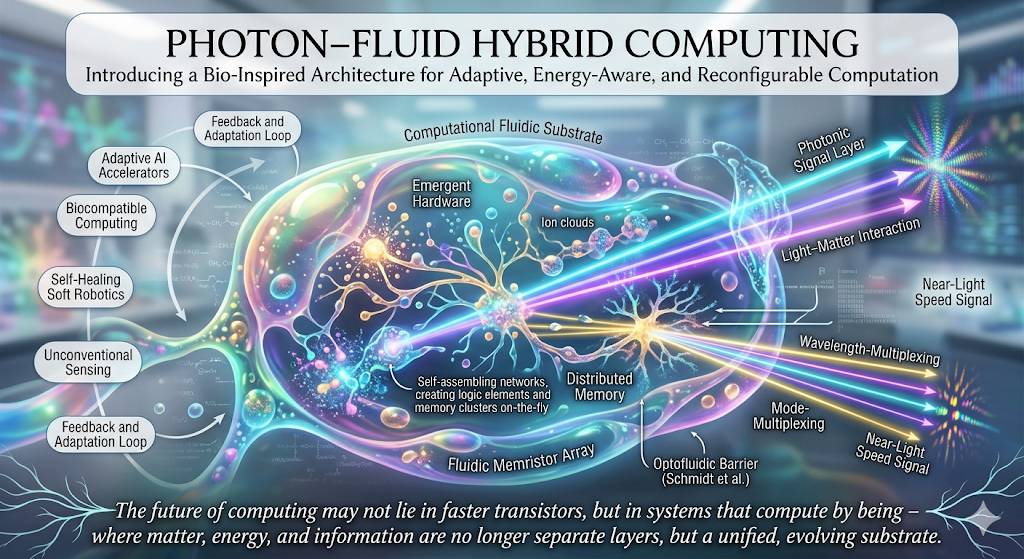
Photon–Fluid Hybrid Computing (PFHC) is a visionary paradigm that unites optical signal processing with dynamic fluidic substrates into a single computational medium. Inspired by biological cells (which co-locate DNA, enzymes, and metabolites in one liquid environment), PFHC embeds memory, processing, and I/O in a reconfigurable fluidic material. In such a system, photons (light signals) carry data at near-light speed with minimal loss, while the fluid substrate contains responsive particles or ions that form logic elements on-the-fly. This architecture leverages breakthroughs in Photonics, Microfluidics and Neuromorphic Engineering to move beyond rigid silicon circuits. Notably, recent experiments have built hydrogel-based fluidic “memristor” arrays that emulate synapses and perform pattern recognition. Such results hint at PFHC’s promise: combining the low-loss, high-bandwidth nature of photonics with the self-organization and adaptability of fluidics to achieve energy-efficient, fully distributed computation.
1. Introduction
Current computers suffer from strict hardware/software separation and fixed circuitry. Traditional silicon chips route electrons through static transistor networks, requiring constant clocking and data shuttling. In a von Neumann architecture, every memory access and logic operation incurs energy overhead (the so-called memory bottleneck). By contrast, biology demonstrates an integrated model: a single cell contains its program (DNA), processors (molecular machines), energy systems and storage all in a liquid milieu. Cells compute, adapt and self-heal without separate “memory chips.” For example, Guo et al. developed a confined-hydrogel fluidic memristor array that showed neuron-like plasticity and even solved image-classification tasks. This experiment highlights that a fluidic medium can inherently store and process information. Drawing on these insights, PFHC explores fluidic, bio-inspired computation, augmented by photonic signaling. The goal is to break the rigid separation of today’s chips and create a unified, adaptive compute substrate.
2. Conceptual Framework
PFHC consists of two tightly interacting layers:
2.1 Fluidic Computational Substrate
The core medium is a reconfigurable fluid — a liquid filled with programmable particles or ions. Imagine a microfluidic volume containing colloidal nanoparticles, magnetic beads, ionic droplets or polymer gel domains, each of which can change state. External fields (electric, magnetic, optical or mechanical) tune these elements. For instance, tiny particles might switch between conductive/non-conductive states, or droplets might merge and split. The result is that the fluid itself becomes the hardware: transient connections form logic gates, flow patterns implement operations, and chemistry encodes data. In PFHC, there is no distinction between “processor” and “memory”: the medium stores bits as spatial or chemical states and simultaneously performs computation via its internal dynamics.
For example, Guo et al. built a 10×10 hydrogel fluidic memristor array that naturally combined memory and processing. In that system, ionic configurations in a gel acted as resistive memory elements, yet they also interacted dynamically to process signals. Similarly, in PFHC the fluid substrate would serve as:
- Emergent Hardware: Logic structures (e.g. switches, gates, channels) form on-demand by assembly of particles or flows.
- Distributed Memory: Information is encoded in the configuration of the fluid (e.g. particle positions, chemical gradients, refractive index patterns).
- Execution Environment: Computation occurs through physical processes in the fluid (pressure-driven flows, diffusion, chemical reactions).
This unified design is analogous to in-memory computing, but implemented in a physical, wet medium. By co-locating everything in one substrate, PFHC can inherently parallelize and adapt.
2.2 Photonic Signal Layer
The second layer is optical. Data enters, traverses, and exits the fluid as light. Photons encode bits via intensity, phase, frequency or polarization. Crucially, photonic signals face almost no resistive losses: unlike electrons in metal wires, light in optical waveguides dissipates negligible heat. Multiple wavelengths can multiplex data (WDM), and different modes can carry parallel channels. In fact, recent analyses show photonic neural networks can use wavelength- or mode-multiplexing to perform massively parallel operations. The result is ultrafast, high-bandwidth communication across the fluid medium.
Moreover, photonic links drastically cut energy costs. Optical transmission generates far less heat, easing cooling requirements. For example, one study found that co-locating analog memory with photonic computing reduced power by ~26× versus a traditional digital design. In PFHC, optical components (lasers, modulators, detectors) would be integrated around the fluid container. Light might be injected via micro-LEDs or fiber, and collected by integrated photodiodes. Such integration is already demonstrated in photonic lab-on-chip devices: Llobera et al. fabricated a polymer chip with a solid-state light emitter aligned to microfluidic waveguides. The figure below shows a schematic of a photonic lab-on-chip (light emitter, waveguide and fluidic channel) that exemplifies this hybrid approach.
Figure 2: Example of a photonic lab-on-a-chip (from Llobera et al.). A solid-state light source (blue) is embedded in a polymer chip and coupled to fluid-filled micro-channels via optical waveguides. This illustrates how photonic components (LED, lenses, fiber) and fluidics can be integrated on one platform.
3. Operational Model
3.1 Dynamic Circuit Formation
In PFHC there are no fixed circuits. Instead, computation structures grow and dissolve dynamically in response to input signals. An external stimulus (optical, electrical, magnetic, etc.) reconfigures the fluid, causing components to assemble into logic elements. For example, by focusing patterned laser light onto the fluid, one can induce local heating and flows that act like “virtual walls.” Schmidt et al. demonstrated this with an optofluidic setup: a structured light pattern creates reconfigurable fluidic barriers that steer particles on demand. These light-defined barriers effectively play the role of microfluidic gates (see Figure 1). When the input changes, the pattern is altered and the circuit dissolves into the bulk fluid, ready for a new configuration. In this way, PFHC allows on-the-fly creation of tailored circuit topology: circuits “grow” where needed and vanish when done, unlike fixed silicon masks.
Figure 1: Reconfigurable optofluidic barrier formed by photothermal heating (adapted from Schmidt et al.). The dashed blue region shows a light-induced “barrier” in a fluid channel, created by focusing lasers on an absorbing surface. Fluid flows (black arrows) around the virtual barrier, demonstrating how structured light can dynamically define circuit paths in the liquid.
3.2 Computation via Light–Matter Interaction
Once the circuit is formed, computation proceeds through physics. Light passing through the fluid is modulated by the medium’s current state. For example, if the fluid has a pattern of particles or refractive-index changes, an incoming beam will scatter, diffract or shift phase accordingly. These transformations implement analog mathematical operations (akin to matrix-vector products or convolution kernels). In essence, the fluid–light interaction is itself the computer: no digital switching is needed. This is analogous to optical reservoir computing, where a physical medium (often glass fiber) processes input streams by its natural dynamics. Here the “reservoir” is a fluid that carries information in its wave or flow patterns. By judiciously designing the fluid response (e.g. with nanoparticles or pigments), one can program specific computational functions. Although this is largely theoretical today, it is consistent with how optical computing principles can be applied in a hybrid photonic–fluidic context.
3.3 Distributed Memory and State Encoding
PFHC blurs the line between CPU and RAM. The state of the computation is stored in the fluid itself: for example, a specific arrangement of particles or a concentration gradient can encode a data bit. Chemical states (pH, ion concentration, oxidation state) are also memory. Because the fluid can hold these states persistently until reconfigured, it effectively acts as both processor and memory simultaneously. In practical terms, this means the system has no separate “storage chip”; the memory is distributed throughout the medium. Such co-localization is similar to what occurs in neuromorphic devices or in-memory computing chips. It also introduces intrinsic redundancy: multiple fluid elements can represent the same data, enabling self-repair.
3.4 Feedback and Adaptation Loop
PFHC naturally forms a closed feedback loop. In each cycle:
- Input Stage: An external stimulus (user input, sensor data) is converted to an optical or electrical signal.
- Fluidic Reconfiguration: This signal triggers the fluid substrate to change its configuration (reorganising particles, creating flow channels).
- Optical Computation: Light is sent through the fluid, which processes the signal via light–matter interactions and produces an output pattern.
- Output Sensing: Detectors read out the optical pattern or other signals from the fluid.
- System Update: Based on the output, the control system adjusts the next inputs or fluid control fields.
This is very much like a biological feedback system. In fact, one can implement learning algorithms in the loop. For example, in a reservoir computing experiment, a fluidic memristor array was trained by iteratively feeding inputs and reading outputs. Guo et al. used a hydrogel memristor array to recognize handwritten digits: electrical pulses (inputs) were applied to the fluid network, the ionic dynamics transformed the signals, and the outputs were used to adjust the next inputs. After training, the system classified digits with ~89% accuracy. This shows that fluidic networks can be part of an adaptive computing loop. In PFHC, similar training loops could adapt the fluid configuration over time to optimize performance.
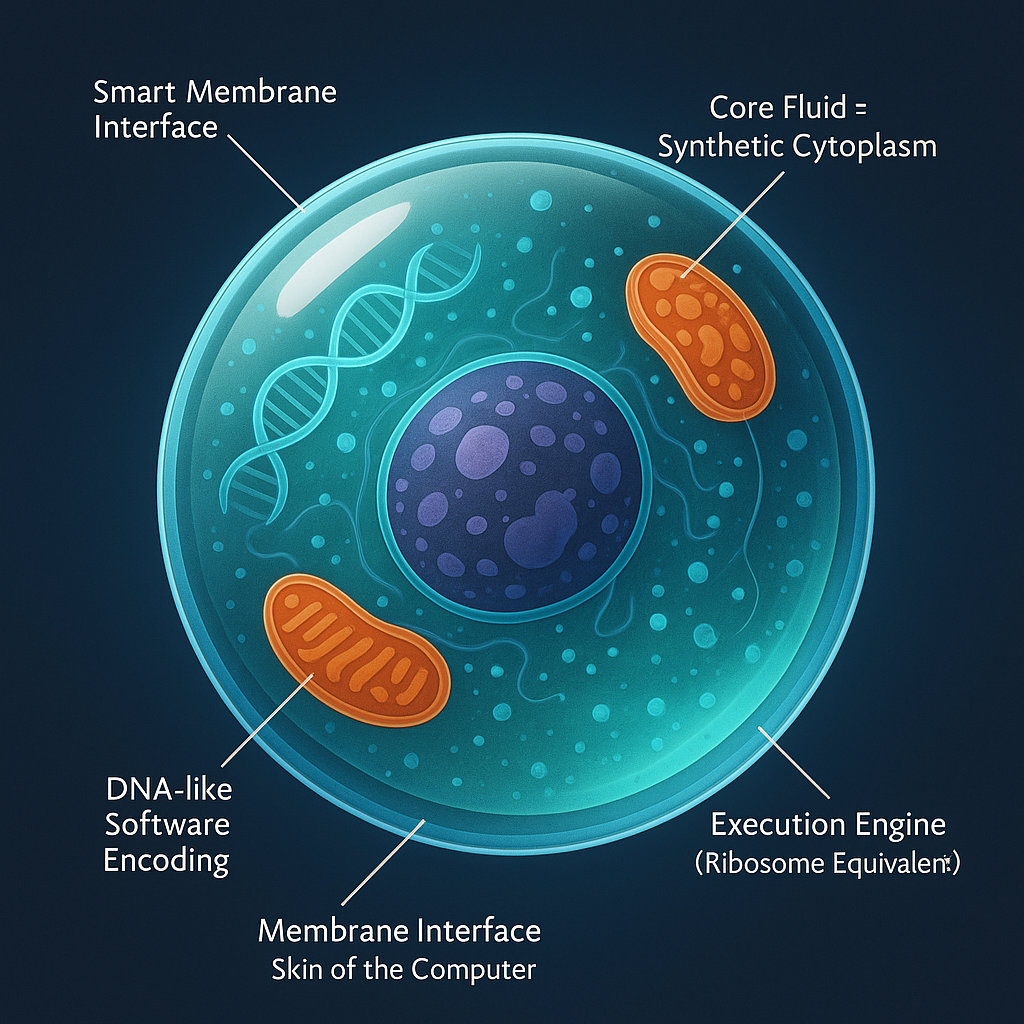
4. Bio-Cellular Analogy
PFHC is often compared to a biological cell. Below is a conceptual mapping:

This analogy guides design principles. For instance, like a cell, PFHC co-locates processing and storage and operates in an event-driven manner. It also suggests using “membrane” sensors (light/EM/chemical) at the boundary, just as cells have receptors. While not literal biology, these parallels help conceptualize the hybrid architecture.
5. Energy Model
5.1 Advantages
PFHC has inherent energy-saving features. First, photonic communication vastly reduces resistive losses: light travels in optical media with essentially no Joule heating. Second, fluidic computation can be passive or thermodynamically driven: once configured, flows and reactions proceed without active switching power. In other words, PFHC can be event-driven and local. For example, computation only consumes energy when inputs arrive or when reconfiguration occurs (similar to neuronal firing).
Some quantitative examples: An analysis found that using in-place analog memory in a photonic neural chip cut energy usage by ~26× compared to a conventional SRAM-based design. Likewise, optical computing avoids the cooling overhead of silicon. Taken together, PFHC could approach biological efficiency: cells consume only ~10⁻¹⁴ Joule per operation, whereas digital logic is millions of times worse.
5.2 Constraints
That said, PFHC also incurs costs. Maintaining the fluid state may require energy for control (pumps, fields or temperature gradients). Fluids tend to diffuse or settle, so active stabilization is needed. Generating and detecting optical signals also uses power (lasers, modulators, photodetectors are not free). Moreover, if external fields (electric/magnetic) are used to tune the fluid, those fields consume energy. In practice, the overall energy efficiency is architecture-dependent, not medium-dependent; it hinges on how well we exploit the passive physics and minimize control overhead.
6. Comparative Analysis
A high-level comparison of PFHC versus conventional silicon computing highlights the trade-offs:

In summary, PFHC trades some precision and stability for parallelism and adaptivity. Photonic signals keep speed high, but the fluid’s slower flow/chemical timescales and noise may limit raw throughput.
7. Implementation Challenges
7.1 Nanoscale Control
Realising PFHC faces formidable hurdles. Manipulating a complex fluid at micro/nanoscale with precision is extremely hard. Existing microfluidics can route liquids with microscale valves, but programming billions of particles to form logic gates is beyond current technology. As Guo et al. point out, fluidic systems are often “amorphous” and difficult to fabricate reliably. Achieving deterministic particle assembly or precise refractive-index patterning in liquid would require new materials and control hardware.
7.2 Noise and Stochasticity
Fluids are inherently noisy. Brownian motion, thermal fluctuations, and turbulence can scramble small signals. Maintaining a stable state (especially at molecular scales) requires error tolerance or constant correction. Noise also limits precision: while digital silicon can ensure “0” vs “1” exactly, fluid states will have variability. Designing PFHC thus entails robust error mitigation (e.g. redundancy or self-correcting circuits).
7.3 I/O Encoding and Decoding
Converting between conventional data and the fluidic domain is non-trivial. Inputs must be translated into light or fields that reconfigure the fluid, and results must be sensed optically or chemically. Developing interfaces (sensors, modulators) that operate reliably in a reactive liquid environment is a major engineering task. For instance, reading a bit encoded in ionic concentration might require precision optical spectroscopy or microelectrodes.
7.4 Scalability
Perhaps most critically, current fluidic prototypes are orders of magnitude slower and larger than electronic chips. Even the Stanford droplet computer — an iconic fluidic logic system — operates far slower than a transistor CPU. Scaling PFHC to millions of “logic elements” is a daunting challenge. Each liquid “component” tends to be larger than a transistor, and coordinating them at high speed may be infeasible. Thus, PFHC is unlikely to replace silicon directly; instead, it might augment it for niche tasks.
8. Potential Applications
Even with these challenges, PFHC could excel in specialized domains where adaptability and efficiency outweigh raw speed:
- Adaptive AI Accelerators: PFHC’s true parallelism and analog dynamics suit neural networks. Photonic neuromorphic chips already target AI; adding fluidic reconfigurability could allow on-chip learning and self-optimization. For example, photonic neural nets can deliver petaFLOPS/mm² using wavelength multiplexing, and PFHC could take advantage of that scale.
- Biocompatible Computing: Liquid-based processors would naturally interface with biology. Medical implants or drug-delivery controllers could be made from biocompatible fluids, enabling in-vivo sensing and processing. (Fluidic memristors might directly interact with biological ions, for instance.)
- Self-Healing and Soft Robotics: In a shape-changing robot, embedded fluidic circuits could reroute computation around damage. The fluid’s self-healing nature (leaks seal, broken components float to periphery) provides fault-tolerance. PFHC could underpin truly soft, reconfigurable controllers that morph their own hardware.
- Unconventional Sensing: A sensor network that learns and adapts in the field (e.g. in space or harsh environments) could use PFHC. Instead of a fixed circuit board, such a sensor would constantly reconfigure to respond to unpredictable inputs, similar to how living organisms adapt.
- Scientific Platforms: Fluidic computing could revolutionize laboratory automation. Imagine “intelligent” reaction vessels that compute optimal mixing strategies on-the-fly by shaping internal flows. This merges computing with chemical engineering.
9. Research Directions
Key research frontiers for PFHC include:
- Hybrid Architecture Design: How to best combine PFHC modules with conventional silicon? For example, using PFHC as a front-end processor or co-processor for specific tasks.
- Optical–Fluidic Co-Design: Developing simulation and fabrication methods that treat optics and fluids together. Integrated photonic-fluidic chips (sometimes called “optical microfluidics” or PhLoCs) are an active area.
- Control and Programming Methods: New programming paradigms (probably biological or chemical in nature) are needed. For instance, algorithms for self-assembly control, fluidic reinforcement learning, or chemical genetics (programming particle behavior via DNA strands).
- Materials and Device Innovation: Creating switchable particles (e.g. photochromic nanoparticles, magneto-rheological fluids, ionic gels) that can reliably implement logic functions. Also exploring nanoscale fluidic components (nanopores, droplet circuits) for higher density.
- Neuromorphic and Reservoir Computing: Leveraging insights from neuroscience: fluidic hardware naturally implements spiking and analog dynamics. Research could focus on using PFHC as physical reservoirs or spiking networks, linking to Neuromorphic Computing.
- Synthetic Biology Interfaces: Eventually, PFHC might blend with synthetic cells: lab-engineered cells or vesicles that compute. Bridging living and artificial computing media could open new hybrid possibilities.
10. Conclusion
Photon–Fluid Hybrid Computing represents a bold departure from traditional architectures. By treating computation as a material process, it challenges the assumption that chips must be solid-state. Instead, PFHC asks: what if the medium itself were alive with computation? While many components remain speculative, research in optofluidics, nanofluidic memristors, and neuromorphic photonics is rapidly advancing. In the foreseeable future we may see hybrid systems where silicon logic coexists with reconfigurable fluidic circuits and light-based interconnects. These systems would not replace all computers, but they could excel in tasks that benefit from adaptation, parallelism and energy awareness.
Ultimately, PFHC is not just a new type of chip — it’s a new way of thinking about intelligence. Rather than imposing discrete logic gates, we let the physics and chemistry do the computing, adjusting the rules on-the-fly. This mirrors nature’s approach, where form and function co-evolve. As one perspective on future computing suggests, the greatest advances might come not from squeezing more transistors onto a chip, but from integrating matter, energy and information into a unified, dynamic substrate.
The future of computing may not lie in faster transistors, but in systems that compute by being — where matter, energy, and information are no longer separate layers, but a unified, evolving substrate.
메타데이터
- post_id
- b16b63b5da41
- slug
- introducing-photon-fluid-hybrid-computing-b16b63b5da41
- url
- https://medium.com/@mdamirshohail786/introducing-photon-fluid-hybrid-computing-b16b63b5da41
- canonical_url
- https://medium.com/@mdamirshohail786/introducing-photon-fluid-hybrid-computing-b16b63b5da41
- author_url
- https://medium.com/@mdamirshohail786
- status
- ok
- fetched_at
- 2026-06-23 17:05:31