Our Warmer Earth is Slowing Down
The length of a day was always dictated by the Moon, the Sun, and air temperature. Now meltwater is slowing its spin.
Our Warmer Earth is Slowing Down
The length of a day was always dictated by the Moon, the Sun, and air temperature. Now meltwater is slowing its spin.

Photo by Greg Rosenke on Unsplash
Sometime around 2029, for the first time in the history of timekeeping, the clocks that run the planet may have to subtract a second instead of adding one. The minute that ends that day would last fifty-nine seconds. No leap second has ever been removed, only inserted, and the software that timestamps financial trades, synchronizes data centers and steers satellites has never once been asked to count backward. The reason is not some quirk of the cosmos. It is the meltwater pouring off Greenland and Antarctica, redistributing the planet’s mass and slowing its spin. Duncan Agnew, a geophysicist at the Scripps Institution of Oceanography, put the conclusion plainly in the title of his 2024 paper in *Nature*: ‘A global timekeeping problem postponed by global warming’.
At the same time, the headline writers are getting it wrong. Every few months a version of the same story circulates, promising that the days are stretching toward twenty-five hours, as if we might soon wake up with an extra hour to fill. The grain of truth inside it has been buried under a confusion of timescales that have nothing to do with one another. Untangling them turns out to be more interesting than the clickbait, because at every scale, from billions of years to the next election cycle, the length of an Earth day has been a negotiation with the climate. The twenty-four-hour day is not a constant handed down by physics. It is an agreement — and we have just changed the terms.
The Moon, pulling the brake
Photo by NASA on Unsplash
Let’s start with the part that the headlines get right. The Moon raises tides in the oceans, and the water dragged across the sea floor and against the continents generates friction. That friction acts as a brake on the spinning Earth, bleeding rotational energy out of the planet. That angular momentum has to go somewhere, however, so what the Earth loses from its spin the Moon gains in its orbit, drifting away from us. Laser ranging to reflectors left on the lunar surface measures the retreat with absurd precision, 3.82 centimeters per year, about the rate your fingernails grow.
The day lengthens as the Moon recedes, but the bookkeeping is subtler than the brake alone would suggest. Reconstructing the spin of the ancient Earth from eclipse records reaching back to 720 BC, Stephenson, Morrison and Hohenkerk found that the mean solar day has been growing at about 1.8 milliseconds per century. Tidal friction by itself should be slowing us faster, by roughly 2.3 milliseconds per century. The Earth is braking less than the Moon demands, and the missing deceleration comes mostly from the planet still rebounding upward where the great ice sheets of the last glaciation once pressed it down, an effect that pulls mass toward the rotation axis and speeds the spin back up. Even the textbook story of lunar braking already has the fingerprints of ice and climate on it.
Run that 1.8 milliseconds per century forward and the arithmetic is bad news for anyone hoping for a longer day. Adding a single hour to the day at this rate takes something in the order of two hundred million years. The headline is not lying about the direction of travel. It is lying about the arrival time. The twenty-five-hour day belongs to a world without an Antarctic ice sheet and probably without us, and it has nothing to say about your Tuesday.
Why the day is twenty-four hours, and not eighteen
Photo by Mark Vihtelic on Unsplash
Here is the question the headlines never ask. If the day has been lengthening for billions of years and is still lengthening now, why is it exactly twenty-four hours? Why not eighteen, or thirty? A number that specific looks less like the midpoint of a smooth slide and more like something that got stuck.
It did. In 2023, Hanbo Wu, Norman Murray and colleagues published the answer in Science Advances, and it runs through the atmosphere. The Sun does not only pull on the Earth gravitationally. It heats the air, and the heated air swells on the daylit side and contracts at night, a bulge of high pressure that chases the Sun around the planet. This is the atmospheric thermal tide, a pressure wave circling the globe once a day with a strong twelve-hour overtone. And because the Sun’s gravity tugs on that bulge of displaced air, the thermal tide produces a torque of its own, pushing the rotation in the opposite direction to the lunar brake.
The Moon slows the Earth down. The Sun-warmed atmosphere speeds it back up.
For most of history the lunar brake wins easily, by a factor of eleven. But an oscillating system has a natural frequency, and the atmosphere is no exception. Air can support a free wave that travels westward around the planet, and when the length of the day drifts close to twice the period of that wave, the thermal forcing falls into resonance with it, like a child’s swing pushed at exactly the right moment. The push grows enormous. Wu’s team, running two independent climate models, found that the resonant period of today’s atmosphere sits remarkably close to half the current day, 12 hours, a coincidence too neat to be coincidence.
For hundreds of millions of years the Earth’s spin was not winding down. It was locked, held in place by the warmth of its own air.
Around 2.2 billion years ago, as the lunar brake stretched the day toward this resonance, the thermal tide rose up to meet it and the two torques cancelled. The day stopped lengthening. It froze near 19.5 hours and stayed there, by Wu’s best estimate, for the better part of a billion years, only breaking free as conditions shifted and drifting on to the twenty-four hours we keep today. The figure below shows the trace of that captivity, the long plateau where the day refused to grow.

Length of the solar day across geologic time. Black points are direct counts of daily growth bands in fossils and tidal sediments, and the green squares are inferred from cyclostratigraphy. The data between roughly 2,000 and 1,000 million years ago cluster near 19 to 20 hours, the long plateau where the day stopped lengthening. The solid horizontal line marks today’s 24 hours. The black curve is the best-fit model including both lunar and thermal tides, while the dash-dotted curve keeps only gravitational tides. The dashed curve takes the full model but switches the thermal tide off, and it runs off the top of the plot toward a present-day length of about 65 hours, the day we would keep without the warmth of the atmosphere holding the spin short. Data: Science Advances, 2023, CC BY 4.0.
The most startling number in the paper is the one you cannot see on the plot, because it runs off the top of the scale. Switch the thermal tide off entirely in the model and today’s day would be not twenty-four hours but more than sixty-five. The short day we live by is a gift of the warm atmosphere. And the strength of that thermal tide depends on temperature, because a hotter atmosphere is a differently shaped resonator with a different natural frequency. The length of the day and the temperature of the air are bolted together at the level of physics.
That insight is older than Wu’s models. In 1987, Kevin Zahnle and James Walker first proposed the resonance lock, and they already saw its escape hatch. The cleanest way to break the Earth out of the trap, they wrote, would be an abrupt global warming of three to five degrees, enough to shift the atmosphere’s resonance and release the day to grow again. The notion that warming the air could move the planet’s rotation was on the table almost forty years ago. Wu’s contribution was to show, with modern circulation models, that the mechanism holds.
Our hand on the scale
Photo by Nathanaël Desmeules on Unsplash
If the temperature of the air shaped the Earth’s spin across deep time through the slow lever of the thermal tide, we are now moving it by a faster and cruder route. We are re-labeling the mass of the planet.
When the ice sheets of Greenland and Antarctica melt, the water does not stay at the poles. It spreads across the world’s oceans, and a disproportionate share of it ends up bulging around the equator, where the planet is already widest. Mass moves away from the rotation axis. A spinning figure skater who extends her arms slows down for exactly this reason, and so does the Earth. Agnew quantified the effect using satellite gravity measurements sensitive enough to weigh the redistributed water from orbit, and found that polar melt has been slowing the planet’s rotation faster than before.
The twist is that this is not the only thing happening to the spin, and the two effects pull in opposite directions. Deep inside the planet, the liquid core has been slowing for about fifty years, and to conserve angular momentum the solid shell of mantle and crust we live on has been speeding up. That acceleration is why leap seconds have nearly vanished from our lives. As Levine, Tavella and Milton note in their 2023 review of the problem in Metrologia, the length of the day began to decrease at almost the same moment the leap-second system was switched on in 1972. Twenty-three leap seconds were added between 1972 and 1999. Only a handful have followed since.
The core’s acceleration was carrying us toward an unprecedented event, the first negative leap second, somewhere in the middle of this decade. Then the meltwater intervened. By braking the spin, polar melt has partly counteracted the core’s acceleration and pushed that reckoning back by about three years, from the mid-2020s toward 2029. The figure below traces the two futures, the one the core alone was steering us into and the one global warming has bought us.
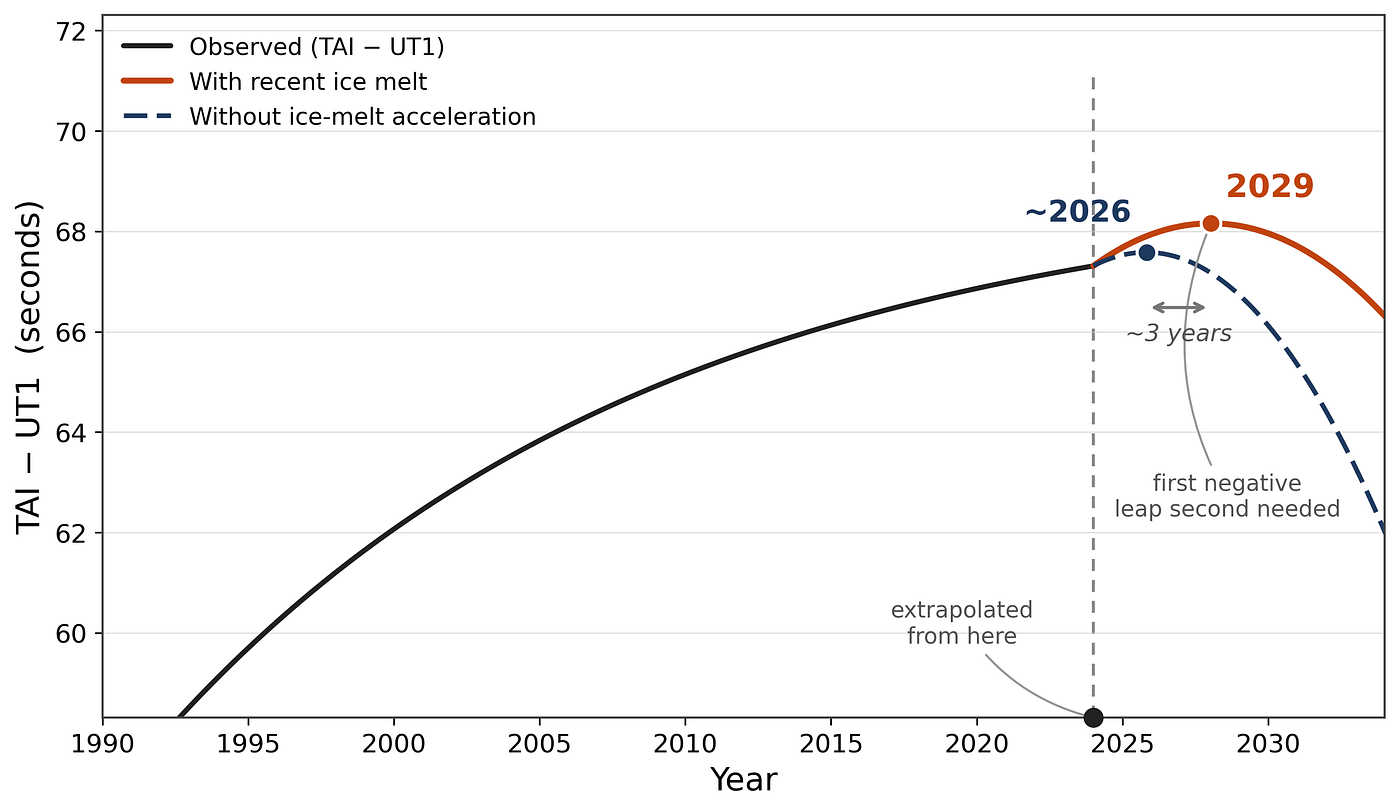
Schematic based on Agnew (2024). TAI is International Atomic Time, the steady tick of caesium clocks. UT1 is time read from the Earth’s actual rotation. Their difference grew for decades as the spinning Earth ran slow, then plateaued as the core sped the surface back up. A negative leap second is needed when the difference turns downward. Without the recent acceleration of polar melt, that turn would arrive around 2026. With it, near 2029. Source: Nature, 2024. Created by the author with Python.
It is a strange kind of reprieve. A negative leap second has never been added, never tested, never survived by the global timing infrastructure that now underpins everything from power grids to stock exchanges. Levine and his colleagues are blunt about the risk. Many systems can absorb an extra second, and almost none are built to lose one. The clocks that run civilization were designed on the assumption, true for fifty years, that time only ever needs catching up, never holding back. Climate change has not merely raised the seas and shifted the rains. It has reached inside the definition of the second.
The instrument that measures the air
Photo by Luis Cortes on Unsplash
I spend my working life inside time series of the atmosphere, the reanalysis archives and assimilation systems that stitch millions of measurements into a single coherent picture of wind, temperature and pressure. The whole edifice runs on the assumption that every clock feeding it agrees, that a timestamp means the same thing in Edinburgh and in Boulder and aboard a satellite passing over the Pacific. A second gained or lost in the wrong place propagates through the equations as a phantom velocity, a wind that was never there.
There is a vertigo in following this story to its end. I measure the temperature of the air for a living, and the literature keeps telling me that the temperature of the air is what decided, across two billion years, how long a day would be. The thing I study turns out to be the thing that sets the clock I study it with. And now the same variable, nudged a few tenths of a degree by us, is about to force the people who keep the world’s time to do something they have spent half a century insisting would never be necessary. The first time humanity takes a second back from the clock, it will be because we left too much heat in the air.
메타데이터
- post_id
- b1724d464080
- slug
- our-warmer-earth-is-slowing-down-b1724d464080
- url
- https://medium.com/the-new-climate/our-warmer-earth-is-slowing-down-b1724d464080
- canonical_url
- https://medium.com/the-new-climate/our-warmer-earth-is-slowing-down-b1724d464080
- author_url
- https://medium.com/@bobzeraus
- status
- ok
- fetched_at
- 2026-06-13 07:35:29