10 Common DMAIC Mistakes First-Time Green Belts Make (And How to Avoid Them)
The DMAIC methodology is the backbone of every successful six sigma green belt project. It provides a structured roadmap to identify…
10 Common DMAIC Mistakes First-Time Green Belts Make (And How to Avoid Them)
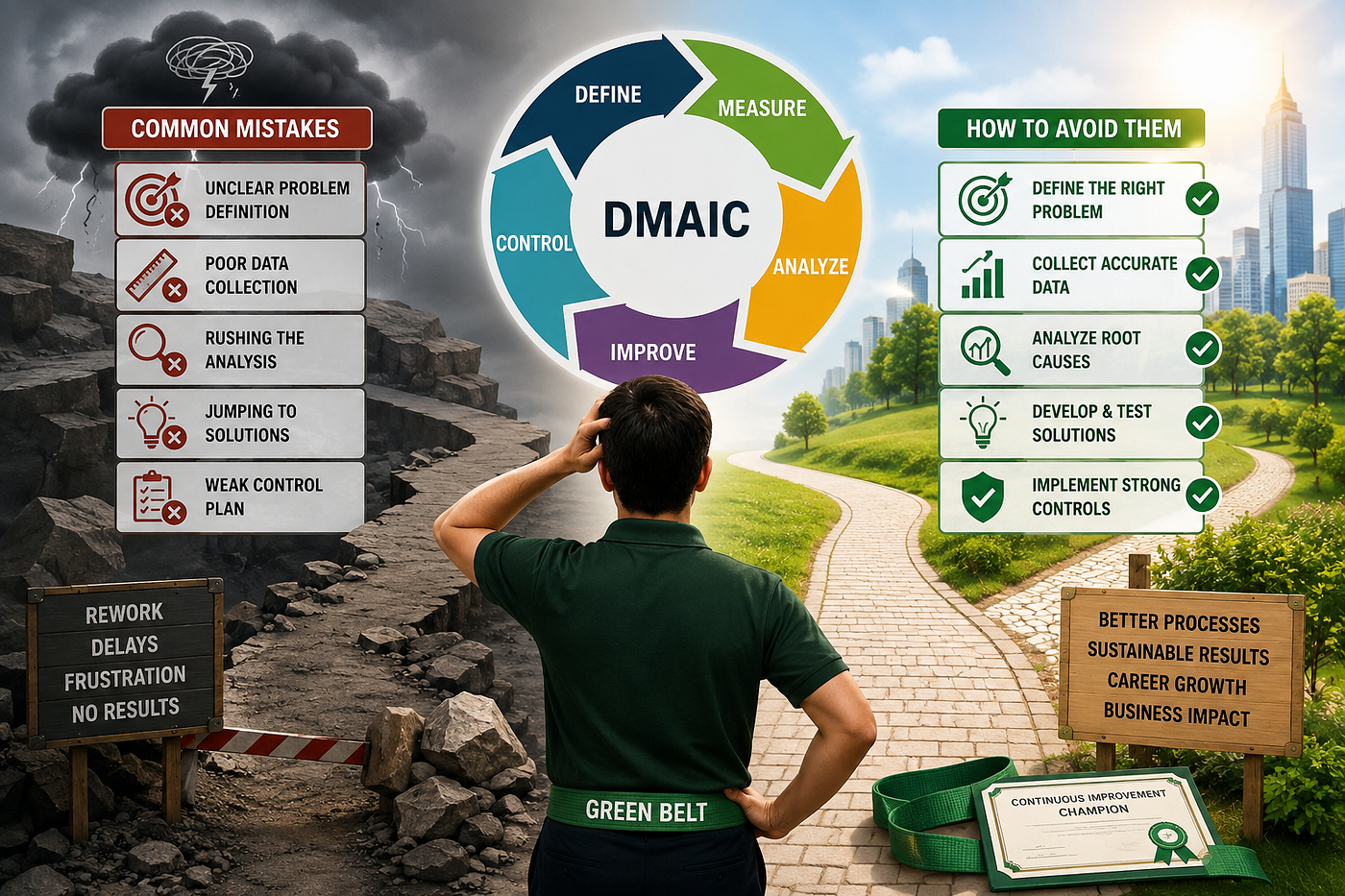
The DMAIC methodology is the backbone of every successful six sigma green belt project. It provides a structured roadmap to identify problems, measure performance, analyze root causes, implement improvements, and sustain long-term results. However, while the framework looks straightforward on paper, many first-time Green Belt professionals struggle when applying it in real business situations.
Whether you work in manufacturing, IT, healthcare, logistics, banking, retail, or service industries, your first Six Sigma project can feel overwhelming. New Green Belts often encounter roadblocks that delay projects, reduce confidence, and sometimes lead to unsuccessful implementations.
The good news is that these mistakes are avoidable. By understanding where beginners typically go wrong, you can complete your projects with greater confidence and deliver measurable improvements.
If you’re planning to build practical expertise through a structured six sigma green belt program in Chennai, learning these lessons before starting your first project can save significant time and effort.
What Is DMAIC?
DMAIC stands for:
- 🎯 Define
- 📊 Measure
- 🔍 Analyze
- ⚙️ Improve
- ✅ Control
This five-phase methodology helps organizations solve business problems using facts, statistical analysis, and continuous improvement techniques rather than assumptions.
Every six sigma green belt professional uses DMAIC to improve quality, reduce defects, eliminate waste, increase customer satisfaction, and improve operational efficiency.
Although the framework is logical, each phase has common pitfalls that beginners frequently encounter.
Why First-Time Green Belts Make Mistakes
Most first-time Green Belts understand the theory but have limited experience applying Six Sigma tools to real-world processes.
Some common reasons include:
✔ Rushing through project phases
✔ Collecting incorrect or incomplete data
✔ Poor stakeholder communication
✔ Lack of statistical knowledge
✔ Jumping directly to solutions
✔ Ignoring process validation
These challenges don’t indicate failure — they’re part of the learning journey. Proper training, mentoring, and hands-on project experience make a significant difference.
Mistake #1: Defining the Problem Too Broadly
The Define phase sets the direction for the entire project.
Many beginners choose problems such as:
❌ Improve customer satisfaction
❌ Reduce manufacturing defects
❌ Increase productivity
These objectives are far too broad.
Instead, successful Green Belts define measurable and specific problems such as:
✅ Reduce invoice processing errors from 8% to 2%.
✅ Decrease machine downtime by 20%.
A clear project scope prevents unnecessary delays and keeps the team focused.
Mistake #2: Collecting the Wrong Data
Many first-time Green Belts assume that all available data is useful.
Unfortunately, poor-quality data leads to poor decisions.
Common mistakes include:
📉 Using outdated records
📉 Measuring inconsistent parameters
📉 Recording incomplete observations
📉 Ignoring data validation
Reliable measurements are essential before moving into statistical analysis.
Always verify:
- Data source
- Measurement system
- Sample size
- Collection frequency
- Accuracy
Without trustworthy data, the entire DMAIC project becomes unreliable.
Mistake #3: Confusing Symptoms with Root Causes
One of the biggest mistakes beginners make is solving symptoms instead of actual problems.
Example:
Problem:
Customer complaints are increasing.
Symptom:
Late deliveries.
Possible Root Cause:
Poor production scheduling.
If the team only focuses on delivery speed without identifying why delays occur, the issue will eventually return.
Useful tools include:
✔ Fishbone Diagram
✔ 5 Whys Analysis
✔ Pareto Chart
✔ Process Mapping
Root cause analysis is where a six sigma green belt professional creates the greatest value.
Mistake #4: Skipping Statistical Analysis
Many beginners rely on opinions instead of evidence.
Statements like:
“I think this machine causes defects.”
or
“Employees believe this process is slow.”
are not sufficient.
Six Sigma encourages data-driven decision-making through tools such as:
📈 Histogram
📈 Scatter Diagram
📈 Control Charts
📈 Hypothesis Testing
📈 Regression Analysis
📈 Capability Analysis
These tools help confirm whether suspected causes genuinely affect process performance.
Mistake #5: Implementing Improvements Too Quickly
Excited Green Belts often rush directly into implementation.
However, every proposed improvement should first be tested.
Instead of implementing company-wide changes immediately:
✔ Conduct pilot testing.
✔ Measure before-and-after performance.
✔ Gather employee feedback.
✔ Validate expected improvements.
Small experiments reduce risk while increasing confidence in the final solution.
Mistake #6: Ignoring Stakeholder Communication
Even technically correct solutions can fail if employees are not involved.
Common communication mistakes include:
❌ Limited management updates
❌ Poor collaboration
❌ Lack of employee participation
❌ Unclear project objectives
Successful Green Belts communicate throughout every DMAIC phase.
When stakeholders understand the project’s purpose, they are more willing to support process improvements.
Mistake #7: Weak Control Plans
Many beginners believe the project ends after improvements are implemented.
Actually, the Control phase determines long-term success.
Without proper controls:
⚠ Processes slowly return to previous performance.
⚠ Defects increase again.
⚠ Improvements disappear over time.
Strong control plans include:
✔ Standard Operating Procedures
✔ Process Monitoring
✔ Control Charts
✔ Visual Dashboards
✔ Periodic Audits
✔ Employee Training
Continuous monitoring ensures improvements remain sustainable.
Mistake #8: Overlooking Customer Requirements
Every improvement project should focus on customer expectations.
Some Green Belts become overly focused on internal metrics while forgetting customer needs.
Before starting any project, identify:
- Critical-to-Quality (CTQ) requirements
- Customer expectations
- Service levels
- Quality standards
Customer-focused improvements create greater business value.
Mistake #9: Poor Project Documentation
Documentation often feels tedious, but it plays a critical role in Six Sigma.
Proper documentation allows organizations to:
📂 Share best practices
📂 Train future employees
📂 Support audits
📂 Measure long-term success
Maintaining organized project records also demonstrates professional competence during certification reviews.
Mistake #10: Trying to Complete Everything Alone
First-time Green Belts sometimes hesitate to ask for help.
Successful Six Sigma projects are collaborative.
Work closely with:
👨💼 Process Owners
👩🔬 Subject Matter Experts
📊 Data Analysts
🏭 Production Teams
👨💻 Quality Managers
Experienced mentors provide valuable insights that prevent costly mistakes.
If you’re pursuing six sigma green belt training in Chennai, choosing a program that includes instructor guidance and practical project mentoring can significantly improve your learning experience.
Real-Life Example
A manufacturing company experienced increasing product rejection rates.
A newly certified Green Belt initially believed machine calibration caused the problem.
Instead of replacing equipment immediately, the DMAIC methodology was followed.
During analysis:
✔ Process mapping revealed inconsistent raw material handling.
✔ Data analysis showed defects increased during specific supplier batches.
✔ Root cause analysis confirmed material variation — not machinery — was responsible.
The company changed supplier quality inspection procedures and reduced defects by more than 35%.
This project succeeded because the team trusted the DMAIC process rather than assumptions.
How Proper Six Sigma Green Belt Training Prevents These Mistakes
Practical training bridges the gap between theory and application.
An effective six sigma green belt program should provide:
✅ Live instructor-led sessions
✅ Real industry case studies
✅ Practical DMAIC projects
✅ Statistical tool demonstrations
✅ Minitab exposure
✅ Project mentoring
✅ Exam preparation
These elements help learners confidently manage improvement projects across different industries.
If you’re looking for structured Six Sigma Green Belt training with expert guidance, practical learning, and project-based mentoring, explore the professional certification programs offered by ICEQBS at **https://iceqbs.org/. The programs are designed to help professionals apply DMAIC effectively and build real-world process improvement skills in Chennai**.
Conclusion
Every first-time Green Belt encounters challenges, but the most successful professionals learn from common mistakes before they become costly.
A well-executed DMAIC project requires more than understanding the five phases — it demands disciplined problem definition, accurate data collection, root cause analysis, stakeholder collaboration, controlled implementation, and continuous monitoring.
By avoiding these ten common mistakes, you’ll improve project outcomes, build confidence, and become a more effective process improvement professional.
Remember, Six Sigma is not simply about using tools — it’s about making better decisions based on facts, analysis, and continuous improvement.
❓ Frequently Asked Questions (FAQ)
1. What is DMAIC in Six Sigma?
DMAIC is a five-phase problem-solving methodology consisting of Define, Measure, Analyze, Improve, and Control. It provides a structured approach for improving business processes and reducing defects.
2. Why do first-time Green Belts struggle with DMAIC?
Most beginners struggle because they lack practical project experience, collect poor-quality data, define problems too broadly, or skip important analytical steps.
3. Is statistical knowledge necessary for a Six Sigma Green Belt?
Yes. While advanced statistics are not always required, understanding basic statistical tools helps Green Belts make evidence-based decisions throughout the DMAIC process.
4. How can I improve my DMAIC project success?
Focus on accurate problem definition, reliable data collection, root cause analysis, stakeholder communication, pilot testing, and continuous monitoring after implementation.
5. Where can I learn practical Six Sigma Green Belt skills?
Professionals seeking hands-on learning, expert mentoring, and real-world project experience can explore Six Sigma Green Belt certification programs through ICEQBS at **https://iceqbs.org/**.
📢 Call to Action
Ready to build practical process improvement skills and confidently lead DMAIC projects? Enroll in a professionally guided Six Sigma Green Belt certification program with ICEQBS. Visit **https://iceqbs.org/ to explore expert-led training, real-world projects, and certification support in Chennai**.
메타데이터
- post_id
- b1863d5bb3aa
- slug
- 10-common-dmaic-mistakes-first-time-green-belts-make-and-how-to-avoid-them-b1863d5bb3aa
- url
- https://medium.com/@iceqbs2026.dac/10-common-dmaic-mistakes-first-time-green-belts-make-and-how-to-avoid-them-b1863d5bb3aa
- canonical_url
- https://medium.com/@iceqbs2026.dac/10-common-dmaic-mistakes-first-time-green-belts-make-and-how-to-avoid-them-b1863d5bb3aa
- author_url
- https://medium.com/@iceqbs2026.dac
- status
- ok
- fetched_at
- 2026-08-18 20:57:22



