The Sand in the Hourglass
A Canadian’s perspective on supporting a Japanese family through the final goodbye.
The Sand in the Hourglass
A Canadian’s perspective on supporting a Japanese family through the final goodbye.
Photo by Annie Spratt on Unsplash
The story of my father-in-law begins far from his motherland of Japan. Takeo (Kenny) Sawaguchi was born in Hamburg, Germany, in 1942. His father, a diplomat at the Japanese Consulate, was part of a clandestine group that issued life-saving immigration papers to German Jews. By the time Kenny was born, his family was caught in the rough winds of history. Fleeing the firebombing of Operation Gomorrah, his mother was sent home through Russia with two infants while pregnant with a daughter. His father, meanwhile, was captured by the Russian Army and never seen again.
For decades, I heard these stories, but my personal connection to the family was defined by the man himself — a businessman, father, grandfather, and lover of life. Unlike the horror stories of in-law relations I’d heard from friends, my two decades with Kenny and his wife, Shizuko, were defined by mutual respect. Kenny was a force of nature: a 77-year-old who ran 5K daily, volunteered at marathons, and was the life of every party.
But life is fragile. A simple fall while returning from an izakaya led to years of medical decline. By the end, visits to his rest home — often limited by COVID-19 restrictions — were heavy, if not gut-wrenching. The man who once ran businesses in India and Canada eventually stopped responding to conversation. For the last several months of his life, he no longer recognized his own family.
When the end became unavoidably near, the cultural divide surfaced. In Japan, death is a reality one meets with fatalism, and often, families avoid proactive planning. When I suggested we look into funeral arrangements, I was met with shock and even resistance. “We don’t plan for a person’s death,” my wife insisted. Leaning on the Western philosophy of “planning for the worst and hoping for the best,” I made a silent decision to gently nudge them toward a more practical path. It was my hope that the family could make necessary decisions before the suffocating burden of grief truly set in.
The final gathering was profound. The rest home room, usually a place of sterile, clinical formality, transformed. Family traveled from across the region, bringing with them a mix of solemnity and surprising humor. In an unusual moment of spontaneity, my wife — while trying to make everyone comfortable — lined up onigiri across her father’s bedding like a picnic. We played Édith Piaf, his favorite music, and respected everyone’s space in the tiny chamber.
As I looked around that room, I felt the vibration of a family held together by love, doing their best to stay upbeat while the sand in Kenny’s hourglass ran out. All his grandchildren put aside their corporate responsibilities to travel to his rest home in Yokosuka to say goodbye. Kenny’s sister — who had made that same harrowing journey to Japan in her mother’s womb — invested in an expensive taxi ride to be at her brother’s side. There were smiles and a bit of laughter; the energy in the room was palpable, noted by the caregivers as they glanced into the space filled by one of their favorite patients’ families.
As evening approached, everyone said their final goodbyes, as Kenny wasn’t expected to last through the night. My wife and mother-in-law remained to keep him company until his final breath. My daughter broke into tears as we left, but she soon recovered, stoically conversing with her aunt as we drove toward Tokyo, leaving her grandfather in trusted hands. The long ride home gave us the space to share memories and begin navigating the practical realities that follow a death.
Part 2: The Okuribito and the Anatomy of Farewell
Navigating the rituals, my faux pas, and the absurdities of a traditional Japanese funeral.
In the West, we often distance ourselves from the physical reality of death. In Japan, the process is communal, tactile, and deeply ritualized. My introduction to this was through the Okuribito — traditional mortuary artisans.
We met the Okuribito in an annex of the funeral home. The young men and women, dressed in black suits and ties, had spent over an hour manipulating my father-in-law Kenny’s body to ensure he could lie flat — a process they performed with the steady, respectful grace of master craftsmen. They invited us into the room, and for a moment, the atmosphere felt less like a funeral and more like a collaboration. We helped wash Kenny’s hair, chose the color of his lipstick, and tied the white cords of his burial robe and cotton boots.
We swabbed his lips with his favorite sake before the Okuribito led us in a moment of silence. They provided a walking cane, a sheet of paper coins to pay any toll gates, and an ancient traveler’s hat to place in the coffin to assist Kenny on his journey.
When my daughter, who had remained stoic until then, finally burst into tears as our family lifted Kenny into the casket, it was the first time the reality of the loss truly broke through my own composure. The process of preparing the body was a bitter taste of reality, yet it offered a profound path to emotional healing. I have spoken to many long-time expatriates planning to live the remainder of their lives in Japan, and many agree that the Okuribito preparation is the most comforting option for their families.
The following day, the cremation at the Yokosuka Public Crematorium was a masterclass in efficiency and tradition. We were granted nine minutes for a final farewell before the casket was sealed, allowing us to place personal cards, flowers, and mementos inside. My wife’s family is spiritual but not religious; the absence of religious formality was new to me, yet it did not hinder the pragmatic purpose of this private family ceremony.
The casket was loaded into the chamber, and the door was firmly shut. Kenny’s portrait and death certificate were placed prominently before the portal, and we stood in reverent silence. As the chamber ignited, a quiet, communal gasp rippled through us.
We were then kindly guided to a waiting room by our funeral director. We waited in silence, sharing tea prepared by my wife and nibbling on chocolates brought by my sister-in-law. After 45 minutes, we were called back for the kotsuage — the ritualized bone-picking ceremony.
We were led to a room where the remains lay on a sterile stainless steel tray, not unlike those found in a restaurant kitchen. It contained the remnants of Kenny’s skeleton and a white ceramic urn. We lined up in pairs, each of us using oversized chopsticks to select a piece of bone and place it into the urn. Standing there, I realized I was the only person in the room not holding Buddhist prayer beads.
“Which one should we choose?” my wife asked. We carefully selected what appeared to be Kenny’s collarbone and transferred it to the urn.
The technician finished the process by placing the remaining bones, commenting on each piece as if teaching an anatomy class. To fit the entirety of his remains, he had to break down the larger pieces with a blunt instrument; the sound was grating and visceral. I could feel knots in my stomach as the technician completed his brutal work and expertly swept the remaining ash into the urn, ensuring not a single fragment was left behind.
He then remarked that there were more bones than usual for an 84-year-old, a sign that Kenny had been remarkably healthy for his age. (This appears to be standard protocol, as associates of mine have experienced the same clinical commentary at other Japanese funerals.)
The white urn was placed in a box with a traditional white cord. The heavy box was handed to my brother-in-law, the portrait to Kenny’s widow, and we followed the funeral director to the parking lot. My mother-in-law carried the portrait before her as we moved through the early morning sun.
It was in these moments of high tension that I realized I will always be a gaijin here. When I tried to take charge of the “logistics,” I stumbled. I asked the funeral director for the portrait’s box, which she had held in her hands. I then attempted to assist my mother-in-law in putting Kenny’s image away — a mistake, as the portrait is strictly meant to be held by a loved one. Finally, I opened the back of my vehicle and gestured for the urn, treating it like cargo rather than the solemn passenger it was.
My brother-in-law looked at me in horror and breathed, “Noooooooo.”
I flushed with embarrassment, knowing the list of my cultural missteps had just grown longer, but I also realized deep in my heart that I would be forgiven by my generous wife and extended family. The faux pas were quickly overlooked and corrected, and we drove to my mother-in-law’s home in Miura.
Even in the midst of these cultural blunders, light found a way in. Later that day, my mother-in-law asked me to help clear out Kenny’s study. My father-in-law was a serious businessman, a disciplined athlete, and a loving father, but he was also wonderfully quirky. He’d spend hours on the beach searching for lost treasures.
We ended up carrying a six-foot stuffed alligator and a shell-encrusted painting to my car — the “treasures” of a man who loved anything he could get for free. Driving away with a giant alligator’s tail sticking out of my trunk felt like a perfect summary of my life here in Japan: a constant, moving collision of the sacred and the absurd.
I remembered a conversation with Kenny years ago, over a cup of sake. “I’ve got a nice family,” he had said. Standing there, exhausted but part of this deeply traditional, deeply loving unit, I finally understood just how right he was.
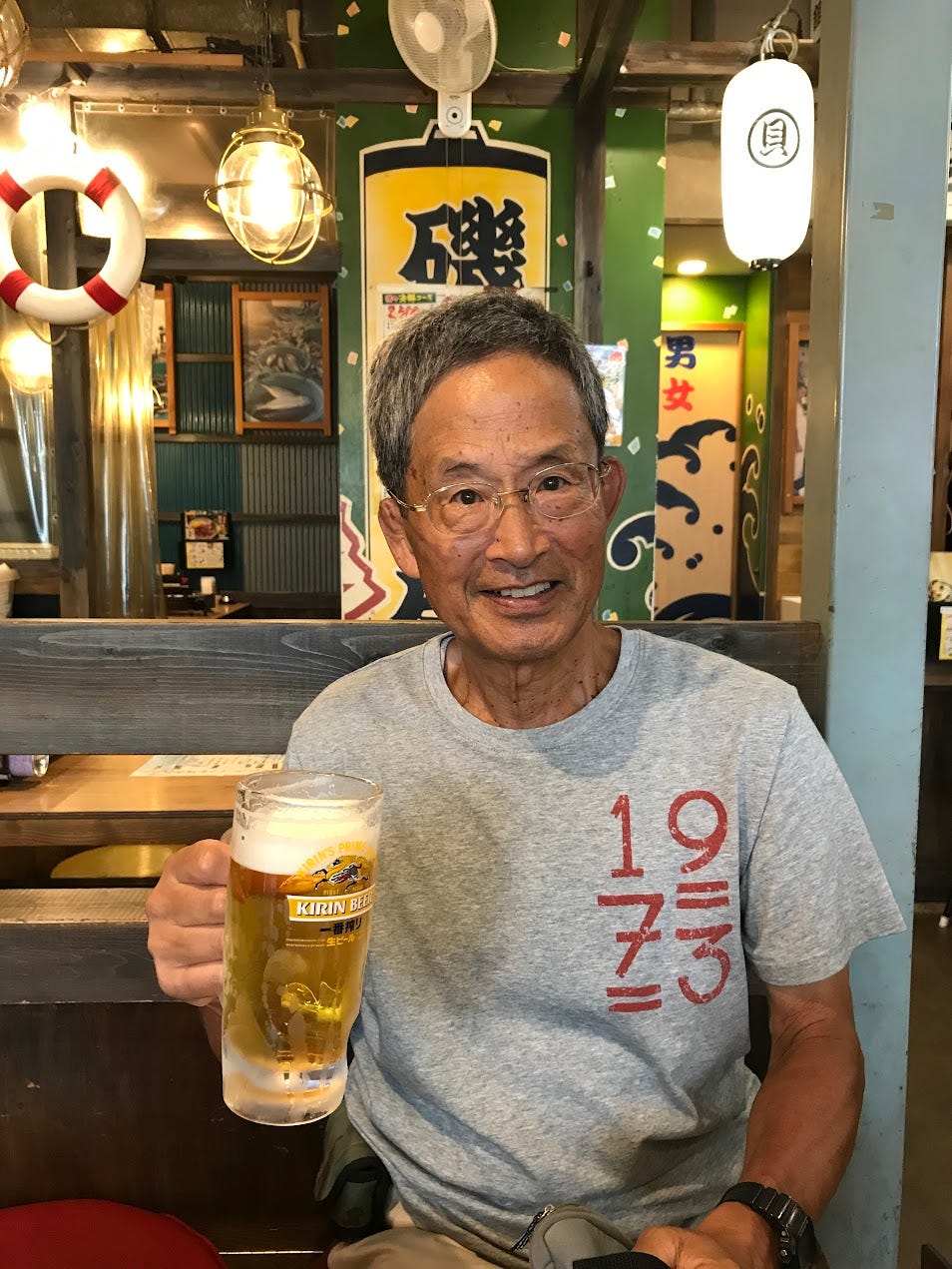
Kenny (Takeo) Sawaguchi celebrating after a 10K Road Race, photo by Mako Sawaguchi.
메타데이터
- post_id
- b18ee51a44da
- slug
- the-sand-in-the-hourglass-b18ee51a44da
- url
- https://medium.com/the-memoirist/the-sand-in-the-hourglass-b18ee51a44da
- canonical_url
- https://medium.com/the-memoirist/the-sand-in-the-hourglass-b18ee51a44da
- author_url
- https://medium.com/@gcampbell_23488
- status
- ok
- fetched_at
- 2026-07-11 10:04:19