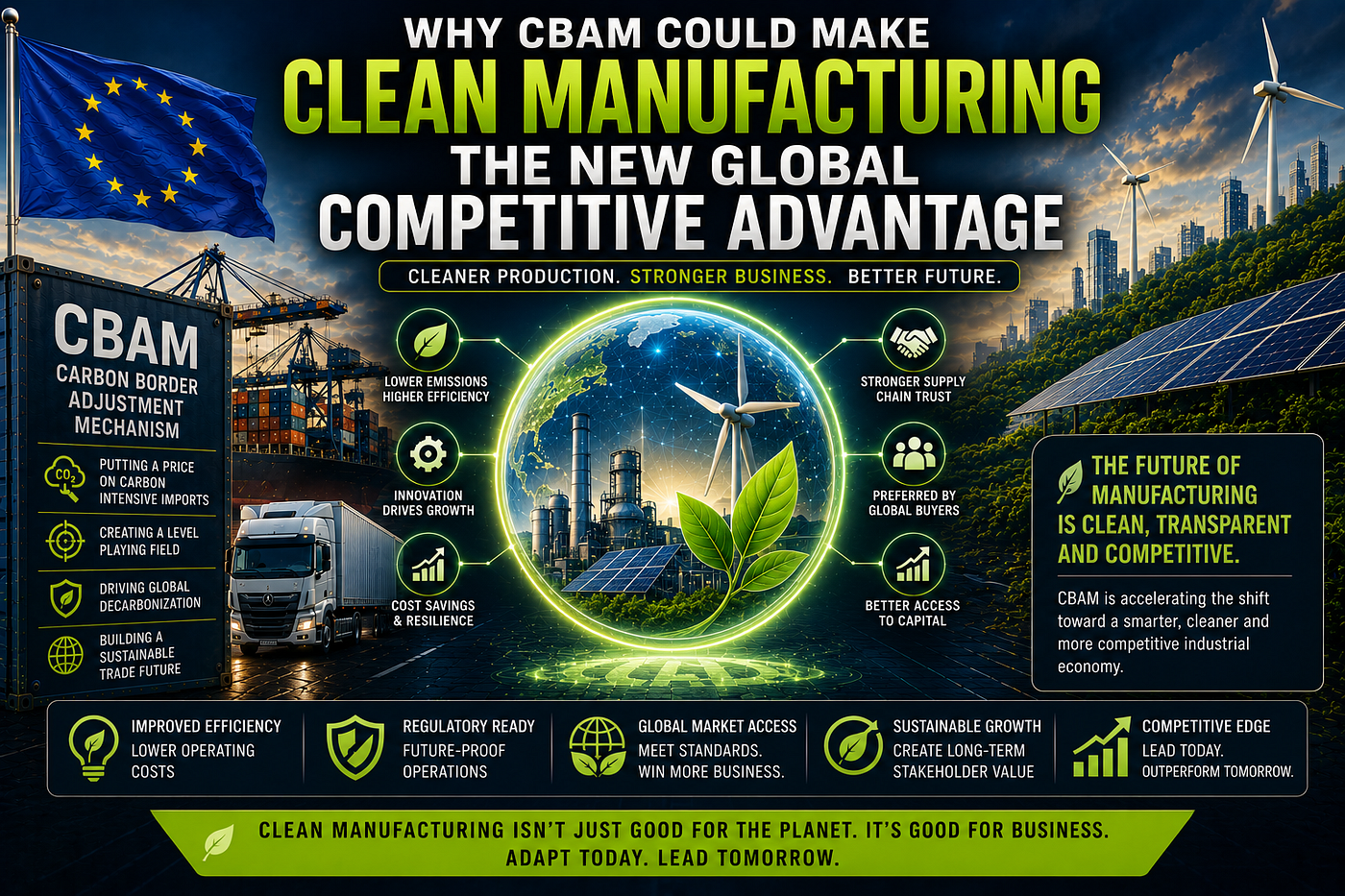
Why CBAM Could Make Clean Manufacturing the New Global Competitive Advantage
For decades, manufacturers competed using a familiar formula.
Why CBAM Could Make Clean Manufacturing the New Global Competitive Advantage
For decades, manufacturers competed using a familiar formula.
Lower costs.
Higher productivity.
Faster delivery.
Larger scale.
These factors helped determine which companies succeeded in global markets and which struggled to survive.
Today, another competitive factor is rapidly emerging.
Carbon efficiency.
And the European Union’s Carbon Border Adjustment Mechanism, known as CBAM, is helping accelerate that transformation.
Most discussions about CBAM focus on reporting requirements and carbon disclosures.
Businesses talk about compliance systems, emissions calculations, verification processes, and regulatory obligations.
All of those topics are important.
But they may not represent the most significant long-term impact.
The bigger story is how CBAM could reshape the economics of manufacturing itself.
For the first time, lower-carbon production is beginning to gain measurable economic value in international trade.
That changes incentives.
And whenever incentives change, industries change.
History provides countless examples.
When automation improved productivity, manufacturers invested heavily in robotics.
When quality standards became essential, businesses redesigned production systems.
When digital technologies improved efficiency, companies embraced digital transformation.
The same pattern may now be unfolding around carbon efficiency.
The reason is simple.
Markets reward what they value.
For many years, carbon emissions remained largely invisible in commercial transactions.
A buyer purchasing industrial products could compare price, quality, delivery schedules, and technical specifications.
But emissions were rarely part of the competitive equation.
CBAM is helping change that.
As emissions become more visible, they become more relevant.
As they become more relevant, businesses begin managing them more actively.
And as businesses manage them more actively, innovation accelerates.
This process has the potential to transform manufacturing in profound ways.
Companies seeking lower emissions often discover opportunities to improve efficiency.
Energy waste becomes easier to identify.
Production processes become easier to optimize.
Resource utilization improves.
Operational performance strengthens.
What begins as an environmental objective frequently produces economic benefits as well.
This is one reason why many executives are starting to rethink the relationship between sustainability and competitiveness.
Historically, some viewed sustainability initiatives primarily as costs.
Today, many are beginning to see them as investments.
An investment that improves efficiency.
An investment that reduces risk.
An investment that strengthens customer relationships.
An investment that enhances future competitiveness.
CBAM reinforces this perspective because it links environmental performance more directly to commercial outcomes.
The implications extend throughout industrial supply chains.
Manufacturers increasingly need visibility into emissions generated by suppliers, transportation providers, and production facilities.
This encourages greater transparency.
Greater transparency improves decision-making.
Better decisions improve performance.
The result is often a more resilient organization.
Customers are responding to these changes as well.
Large corporations increasingly seek suppliers capable of providing reliable environmental data.
They want confidence in emissions reporting.
They want transparency regarding production processes.
They want partners prepared for future regulatory environments.
Companies capable of meeting these expectations gain advantages.
Not because regulations require it.
But because customers value it.
This distinction is important.
Market-driven advantages are often more powerful than compliance-driven advantages.
Technology is accelerating the shift.
Artificial intelligence is helping organizations analyze manufacturing data more effectively.
Advanced sensors are improving operational visibility.
Digital monitoring platforms are making emissions tracking more accurate.
Automation is reducing waste and improving resource efficiency.
Together, these technologies are creating a new generation of manufacturing capabilities.
The companies adopting them early may gain substantial benefits.
Lower operating costs.
Higher efficiency.
Stronger transparency.
Improved resilience.
Enhanced customer trust.
These advantages tend to compound over time.
The broader economic implications are significant.
Regions capable of supporting low-carbon manufacturing may attract increasing investment.
Access to renewable energy may become a strategic advantage.
Industrial clusters focused on efficiency and transparency may become more competitive globally.
The geography of manufacturing could gradually evolve.
This does not mean traditional competitive factors disappear.
Cost remains important.
Quality remains important.
Innovation remains important.
But carbon efficiency is becoming another variable in the equation.
And as its importance grows, manufacturers will adapt accordingly.
Investors are paying attention.
Many financial institutions increasingly evaluate how companies prepare for long-term structural changes.
Organizations investing in modern production systems, energy efficiency, transparency, and emissions management often appear better positioned for future market conditions.
That perception can influence access to capital and investor confidence.
The organizations benefiting most from CBAM may not necessarily be those with the largest sustainability departments.
They may be the companies that integrate sustainability directly into operational strategy.
The companies that view carbon efficiency as business efficiency.
The companies that view transparency as a competitive asset.
The companies that view modernization as an opportunity rather than a requirement.
Those organizations are likely to discover that lower-carbon manufacturing is not merely about environmental responsibility.
It is about operational excellence.
It is about strategic positioning.
It is about building capabilities aligned with the future direction of global trade.
History suggests that every major industrial transition creates new leaders.
The companies that embrace change early often gain advantages that persist for years.
CBAM may represent the beginning of another such transition.
A transition where clean manufacturing becomes increasingly associated with efficient manufacturing.
Where transparency becomes increasingly associated with trust.
And where carbon performance becomes increasingly associated with competitiveness.
If that future emerges, CBAM will be remembered for far more than emissions reporting.
It will be remembered as one of the forces that helped make clean manufacturing one of the most important competitive advantages in the global economy.
The companies preparing today may become the industrial leaders of tomorrow.
CTA
Subscribe to Genecapsule for expert insights on CBAM, ESG, sustainability, AI, climate innovation, and the future of global business.
메타데이터
- post_id
- b1b2e985592d
- slug
- why-cbam-could-make-clean-manufacturing-the-new-global-competitive-advantage-b1b2e985592d
- url
- https://medium.com/@anandv_62921/why-cbam-could-make-clean-manufacturing-the-new-global-competitive-advantage-b1b2e985592d
- canonical_url
- https://medium.com/@anandv_62921/why-cbam-could-make-clean-manufacturing-the-new-global-competitive-advantage-b1b2e985592d
- author_url
- https://medium.com/@anandv_62921
- status
- ok
- fetched_at
- 2026-06-15 20:49:13