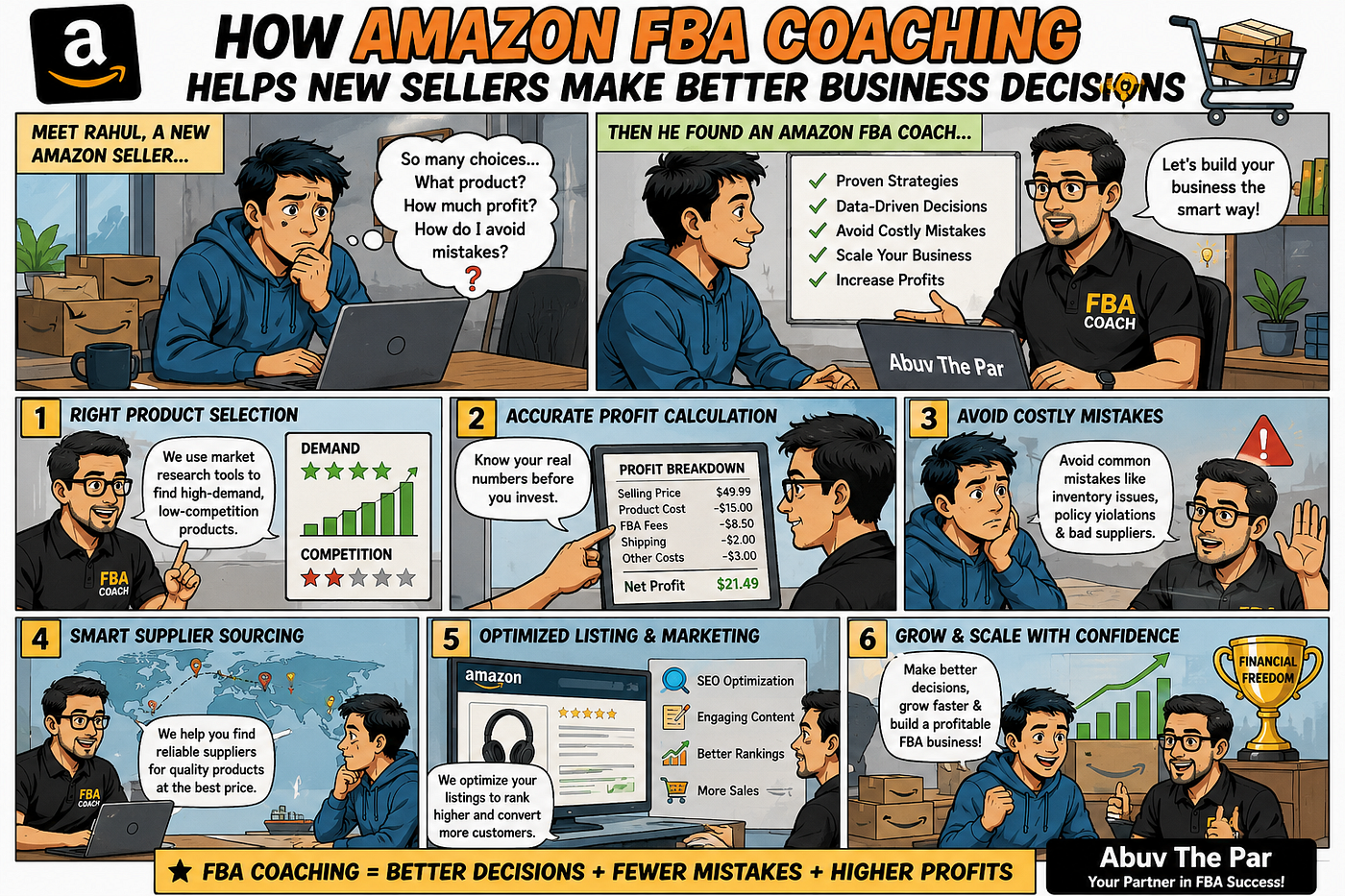
Amazon FBA Seller Mistakes to Avoid: 15 Costly Errors Beginners Make
Starting an Amazon FBA business can look simple: find a product, send inventory to Amazon, create a listing, and wait for sales. In…
Amazon FBA Seller Mistakes to Avoid: 15 Costly Errors Beginners Make
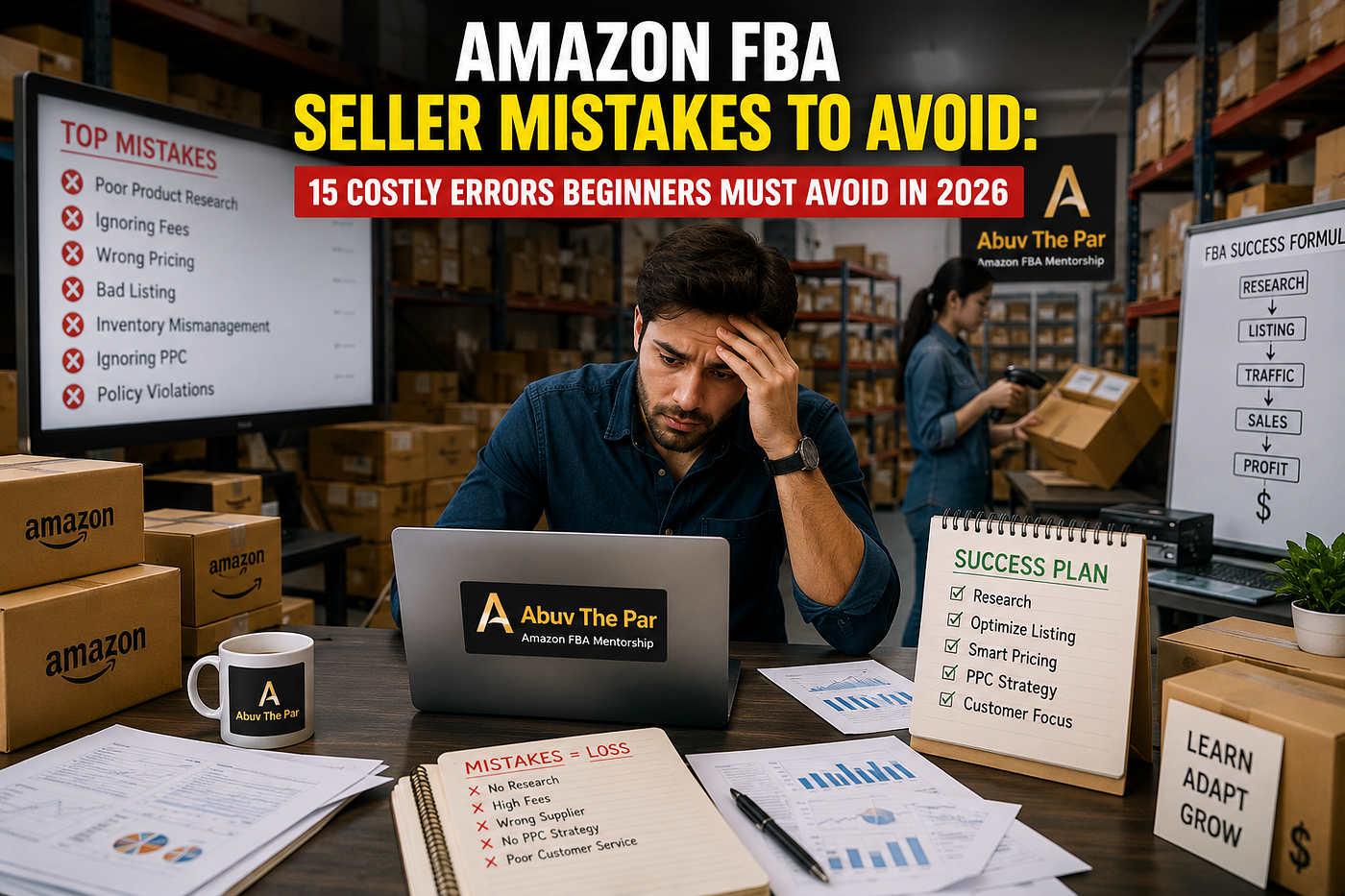
Amazon FBA Seller Mistakes to Avoid: 15 Costly Errors Beginners Make
Starting an Amazon FBA business can look simple: find a product, send inventory to Amazon, create a listing, and wait for sales. In reality, beginners can lose money long before they understand where the problem started.
The biggest Amazon FBA seller mistakes are usually not caused by one dramatic failure. They come from small decisions — choosing the wrong product, underestimating fees, ordering too much inventory, ignoring Amazon policies, or spending on advertising without understanding the numbers.
In 2026, sellers also need to pay closer attention to changing fees, inventory economics, listing quality, advertising efficiency, and account health. Amazon itself has continued changing its fee structure and seller programs, so old FBA advice should not automatically be treated as current advice.
If you’re learning Amazon FBA through resources such as Abuv The Par, the goal should not be simply to start selling quickly. The goal is to avoid expensive mistakes before committing your money.
What Are the Most Common Amazon FBA Seller Mistakes?
Here are 15 costly mistakes beginners should understand before launching an FBA product.
1. Choosing a Product Based on Personal Preference
One of the most common mistakes is choosing a product because you personally like it.
Your preference does not prove market demand. Before investing, research search demand, competition, pricing, reviews, sales potential, product differentiation, and estimated profit.
Better approach: Validate the market first and choose a product based on evidence rather than emotion.
2. Calculating Profit Without Amazon Fees
A product that costs $10 and sells for $25 does not automatically produce a $15 profit.
You may have referral fees, FBA fulfillment costs, storage, shipping, advertising, returns, product preparation, and other expenses.
Current seller guidance strongly emphasizes calculating profitability after the complete FBA fee structure rather than looking only at purchase price versus selling price.
Better approach: Calculate your expected net profit before placing your first inventory order.
3. Ordering Too Much Inventory
Beginners sometimes believe buying thousands of units will automatically reduce costs and increase profits.
It can do the opposite.
If sales are slower than expected, your cash becomes trapped in inventory while storage costs continue. Older inventory can also create additional financial pressure.
Better approach: Start with a controlled quantity and use real sales data to improve future purchasing decisions.
4. Ignoring Product Research Competition
High demand alone is not enough.
A product can have strong search volume but still be difficult to enter because established brands have better reviews, stronger listings, larger advertising budgets, and loyal customers.
Better approach: Evaluate both demand and competitive difficulty before choosing a product.
5. Launching Without Understanding Your Target Customer
Another common Amazon FBA mistake is creating a product listing without clearly understanding who will buy it.
If you don’t know your customer’s problem, your title, images, bullets, and advertising may fail to communicate the product’s value.
Better approach: Study customer reviews and competitor listings. Look for recurring complaints and unmet needs that your product can solve.
6. Creating a Weak Product Listing
A great product can struggle if the listing is poor.
Low-quality images, incomplete product information, unclear benefits, keyword stuffing, and inaccurate attributes can hurt visibility and conversions. Amazon’s Seller Forums specifically highlight missing information, poor images, keyword stuffing, and incorrect category selection as common listing problems.
Better approach: Build the listing for humans first, then optimize it naturally for Amazon search.
7. Treating Keywords as the Entire SEO Strategy
Keywords matter, but repeating “Amazon FBA” or a product keyword everywhere does not create a good listing.
Search engines increasingly depend on relevance, context, customer satisfaction, and useful content.
Better approach: Use relevant search terms naturally in the title, bullets, description, and backend fields while keeping the content readable.
8. Spending Too Much on PPC Too Early
Amazon PPC can generate sales, but advertising without understanding conversion rate, margins, ACoS, TACoS, search terms, and break-even points can quickly consume your budget.
Better approach: Know your break-even advertising numbers before aggressively scaling campaigns.
Don’t assume more clicks automatically mean more profit.
9. Ignoring Negative Keywords
A campaign can receive clicks from searches that have little chance of converting.
If sellers never review search-term performance, they may continue paying for irrelevant traffic.
Better approach: Regularly review search terms and identify irrelevant or unprofitable traffic.
10. Going Out of Stock
Stockouts can become more than an inventory problem.
When a product stops being available, you can lose sales momentum and potentially weaken organic visibility. Recent seller discussions and industry analysis repeatedly identify inventory imbalance — both overstock and stockouts — as a major source of lost money.
Better approach: Create an inventory forecast before launch and establish a reorder point based on actual sales velocity and lead time.
11. Ignoring Amazon’s Policies
This is one of the most dangerous mistakes.
A seller may have a profitable product but still face listing restrictions, suppression, or account-health problems if the business violates Amazon’s policies.
Examples include prohibited claims, trademark issues, inaccurate product information, or category requirements.
Better approach: Understand the relevant Amazon policies before sourcing and listing the product — not after receiving a warning.
12. Selling a Product Without Checking Restrictions
A profitable-looking product is not necessarily a product you can immediately sell.
Some brands, categories, and products may require approval or additional documentation.
Better approach: Check selling eligibility before purchasing inventory. Buying stock first and discovering that you cannot sell it can turn a profitable idea into dead inventory.
13. Ignoring Product Reviews and Customer Feedback
Reviews are not just social proof.
They can reveal exactly what customers like, dislike, misunderstand, or want improved.
If several customers complain about the same feature, packaging problem, size issue, or missing information, that is valuable product research.
Better approach: Review customer feedback regularly and use legitimate insights to improve your product and listing.
14. Trying to Launch Too Many Products at Once
Beginners sometimes launch multiple products because they believe diversification automatically reduces risk.
In practice, it can divide your capital, attention, advertising budget, and inventory management capacity.
Better approach: Start with a manageable product portfolio. Learn the system, understand your numbers, then expand.
15. Confusing Revenue With Profit
This may be the most expensive mindset mistake.
A seller can generate $20,000 in Amazon sales and still have disappointing profit after product costs, FBA fees, advertising, returns, shipping, taxes, and other expenses.
Revenue tells you how much money came through the business.
Profit tells you whether the business actually worked.
That distinction should influence every major decision — from product selection to advertising and inventory purchasing.
How Beginners Can Avoid Amazon FBA Mistakes
Before investing in inventory, use a simple five-step process:
Step 1: Validate the product. Research demand, competition, pricing, reviews, and differentiation.
Step 2: Calculate the complete economics. Include product cost, shipping, Amazon fees, advertising, returns, and other relevant expenses.
Step 3: Check selling eligibility and compliance. Make sure the product and category can legally and practically be sold through your account.
Step 4: Build a conversion-focused listing. Use accurate information, strong images, clear benefits, and relevant keywords without keyword stuffing.
Step 5: Start small and measure. Use actual sales, conversion, advertising, inventory, and customer-feedback data to decide what to change next.
This approach is more sustainable than simply copying another seller’s product or following outdated Amazon FBA advice.
Final Thoughts
Amazon FBA is not necessarily difficult because the business model is complicated. It is difficult because beginners can spend real money before they understand the economics.
The best Amazon FBA sellers do not try to eliminate every possible risk. They identify the risks that can seriously damage the business and control them before investing heavily.
If you’re considering Amazon FBA in 2026, focus first on product research, true profitability, inventory planning, listing quality, PPC control, and Amazon policy compliance.
And remember one simple rule:
Don’t ask only, “How much can I sell?” Ask, “How much will I actually keep after every cost?”
That mindset can prevent many of the most expensive Amazon FBA seller mistakes — and it is a much better foundation for building a sustainable Amazon business.
메타데이터
- post_id
- b1bf5823bf93
- slug
- amazon-fba-seller-mistakes-to-avoid-15-costly-errors-beginners-make-b1bf5823bf93
- url
- https://medium.com/@integritypropertymgtnyk/amazon-fba-seller-mistakes-to-avoid-15-costly-errors-beginners-make-b1bf5823bf93
- canonical_url
- https://medium.com/@integritypropertymgtnyk/amazon-fba-seller-mistakes-to-avoid-15-costly-errors-beginners-make-b1bf5823bf93
- author_url
- https://medium.com/@integritypropertymgtnyk
- status
- ok
- fetched_at
- 2026-08-18 07:12:45