A Natural History of Limpets, Part 3: The Shore That Never Settles
From barnacle belts to limpet grazing fronts, rocky shores shaped by disturbance taught ecologists how communities are built and undone.
A Natural History of Limpets, Part 3: The Shore That Never Settles
From barnacle belts to limpet grazing fronts, rocky shores shaped by disturbance taught ecologists how communities are built and undone.
Not a member ? Read this story for free here .
This episode of A Natural History of Limpets was initially published on Substack. The first two episodes stayed close to the animal and its shell: the limpetization of mollusc body plans, and the elegant efficiency of cone-shaped shells in a world of constraints. This one walks back out from the individual specimen to look at the environment that bears down on it: the shore itself, and how this specific environment shaped the whole field of scientific ecology, the science of interaction.
A warning is in order. When the scale shifts from organism to ecosystem, complexity becomes overwhelming very fast. The constraints pile up, and they apply to systems whose components multiply in turn. The diversity of methods deployable to make sense of all this branches out accordingly: descriptive zonations, exclusion experiments, mosaic models, long-term monitoring, each adapted to a different facet of the same problem. This episode is dense, denser than the previous ones, and I hope it does some justice to the abundance of research that has gone into reading rocky shores. If we still find it so hard to draw a coherent picture of this teeming explosion of life that intertidal ecology represents, it is probably because its grand laws have yet to be discovered.

The limpets, the barnacles, and the spatial discrimination of communities on rocky shores environments. Photo: JF Cudennec.
Two coves
Late March equinoctial spring tides on the Breton coast always feel different. After a winter of rain, storms and light depletion, it’s one of the first opportunities to wander again on the shore without having to wear heavy raincoats, boots and bib-and-braces. It’s also the period when seaweeds start to explode, covering the rocks that were stripped bare by winter storms.
The first cove we cross is barely visible under the vegetation: Fucus spiralis higher up, Fucus vesiculosus next, the bladder-studded fronds of Ascophyllum nodosum draped across the boulders, maybe the lower fringe edged with the dark fronds of Laminaria. You have to step carefully here, as everything underfoot is slick. The air smells of iodine and warm wrack, and if the weather is calm, you can even hear periwinkles and limpets slowly grazing under the canopy. This is the coast that postcards advertise.
Round the headland, a few hundred metres further at most, the world has emptied out. Bare granite scoured pale by spray. White sheets of barnacles (Semibalanus, Chthamalus) stitched across the rock. In the lower pools, a few opportunistic tufts of Corallina or ephemeral green algae add a bit of colour on these barren rocks. Limpets are still there, scattered widely and conspicuous now without algae to hide them.
These two environments coexist under the same latitude and are bathed by the same water mass. The main character of this series, the common limpet Patella vulgata I introduced two episodes ago is present in both places. So what makes the difference?


Left : the shore is dominated by pink coralline algae and barnacles, Barra, Borve Point (Outer). © Mike Burrows, SAMS. Right : the shore is dominated by fucoid algae (Ascophyllum, Fucus sp.) Loch Amhlasaraidh, North Uist. © Mike Burrows, SAMS.
When you start thinking about the structuration of shore ecosystems, three types of issues rapidly arise, and the science of the last century has answered them in roughly that order. The first is vertical: why does a given species sit at one height on the rock and not five centimetres higher or lower? The answer may not be that simple. The second is temporal: how does any patch of rock evolve through time, and what forces keep it from getting there? The third is horizontal: why do two sites at the same height, under the same water, end up looking nothing alike. That is the question my two coves are asking. All these are pertinent ecological problems, and they all have different answers. The trouble is that the answers are tightly entangled, and you can rarely resolve one without dragging in the others. Let’s start with the first one.
The vertical axis: a briefly tidy world
For most of the twentieth century, the answer to the vertical question was physical (or, as a biologist would put it, abiotic). The tides set the primary rule: how long the rock stays underwater and how long it bakes in the sun drives everything else. In the 1940s and 1950s, Anne and Alan Stephenson walked rocky shores from South Africa to the Arctic and produced the scheme that still appears in every textbook: three universal zones (supralittoral, mediolittoral, infralittoral), each with its characteristic assemblage of specifically adapted organisms, structuring shores worldwide just like climatic belts. Descriptive ecology at its triumphant best.

Vertical zonation of organisms on a rocky shore.Source : theoutershores.com
But the maps left one question dangling, for anyone who had already noticed these belts: why are these so clearly defined? Why does this species stop here, exactly, and not five centimetres higher? The first serious answer came in 1961, on the Scottish island of Cumbrae, where Joseph Connell took a pair of fine forceps to a pair of barnacle species that divided the rock between them. Chthamalus stellatus sat high on the shore; Balanus balanoides (now Semibalanus) dominated below. The classical explanation was physiology: each species lives where it can tolerate the local conditions. Connell removed each species from carefully mapped plots and watched. The upper limit of Balanus, it turned out, was indeed physiological: out of water too long, the animal dies. But the lower limit of Chthamalus was not. Remove Balanus from the lower zone, and Chthamalus spread happily downward. The boundary was not set by physical tolerance but by a larger neighbour outcompeting it. Even the textbook example of vertical zonation turned out to be, in part, biotic.

Coexistence of Balanus and Chtamalus. When Balanus are taken out, Chtamalus reveal their fundamental niche by occupying it. Source : Huneman (2019). Between explanans and explanandum: biodiversity and the unity of theoretical ecology.
The temporal axis: a limpet’s job
In 1960, Nelson Hairston, Frederick Smith and Lawrence Slobodkin asked a deceptively simple question: why is the world green? If herbivores were limited only by the plants they feed on, they argued, they should strip landscapes bare. The fact that vegetation persists implies that something is keeping herbivores in check, and they proposed that this something is predation: predators regulate herbivores, herbivores regulate plants. The direction of control runs from the top, inverting the intuitive picture of a food web built up from primary producers.
The experimental test for the intertidal world came six years later, on the rocky coast of Washington State, where Robert Paine had decided to find out what would happen if you simply removed the top of a food web. The site was Mukkaw Bay, on the outer Olympic Peninsula, a stretch of basalt exposed to the full weight of the North Pacific swell. The predator was Pisaster ochraceus, the ochre sea star, nemesis of mussels, barnacles and limpets. Paine staked out a plot, and for five years he showed up at low tide to throw every Pisaster he could find as far as his arm could manage. A neighbouring plot was left untouched as a control.

Pisaster ochraceus is a major predator of the mussel Mytilus californianus in the intertidal zone. Photo by Dave Cowles, Goodman Creek, WA, July 2002
The result is one of the cleanest experiments in ecology. Without Pisaster, the mussel Mytilus californianus spread across the plot in a dense monoculture, overgrowing barnacles and shading out algae, and local diversity fell from fifteen species to eight. A predator that made up only a tiny fraction of the biomass was holding the entire architecture of the community in place. Paine called Pisaster a keystone species: like the central stone of an arch, it bears little of the structure’s mass but keeps it from collapsing.
On my local temperate shore, there is no Pisaster. There is, however, an animal that graze the rock from below, and the question is what it is doing to the arch. In natural ecosystems, unlike in architecture, the forces that shape the structure do not always come from above.

A “grazing front” : limpet appears to have a structuration effect on the spatial repartition of organisms on the rocky shore. But is it that simple ?
To follow that question, we must step back to the beginning of the temporal cascade: what happens when a piece of rock is laid bare. Within days, a film of diatoms and cyanobacteria spreads across the surface, thin enough to be invisible from a metre away, thick enough to feel under your fingers and slick under your boot. This biofilm is both the first food source and a chemical signal: cypris larvae of barnacles, drifting in the plankton, settle preferentially on live surfaces already coated with it. The sequence runs from bare rock to biofilm to barnacles.
From there, paths diverge. On wave‑battered rock, mussel larvae settle onto the barnacle crust, fasten themselves with byssal threads and, in a few years, overgrow it into the kind of mussel sheet Paine described. On more sheltered surfaces, sporelings of fucoid algae establish on the same crust and grow into a canopy of Fucus or Ascophyllum that shades out competitors. Either state is structurally stable: pioneers give way to dominants, and once a dominant holds the surface, little seems able to dislodge it. This is the kind of endpoint we intuitively recognise from terrestrial ecology: the “mature” forest in which succession has run its course.
Where does our candidate keystone, the limpet, enter this story? Patella vulgata is a broadcast spawner: in autumn, adults release eggs and sperm into the water column, the larvae drift for a few weeks and most die. Those that survive settle in response to chemical cues from crustose red algae such as Lithothamnion, the pink encrusting layer on the floors of damp pools and shaded crevices. A newly metamorphosed limpet, smaller than a pinhead, would not survive five minutes on exposed rock.
As soon as it reaches one or two millimetres in shell length, it leaves the pools and starts to wander across open surfaces. The same hydrodynamic regime that filtered out most of its siblings in the plankton now defines how the adults are distributed: paradoxically, the highest densities of Patella vulgata are found on the most wave‑exposed, apparently barren shores. Limpets favour bare rock, and they help to maintain it. Cause and consequence blur into each other, as they often do in trophic networks.
They do so with a specialised weapon: the radula, a tongue‑like ribbon of teeth tipped with goethite, an iron mineral that makes them some of the strongest biological materials known. The radula sweeps across the rock like a rasp, scraping and ingesting the biofilm but also the microscopic sporelings of macroalgae from which canopies of Fucus or Ulva would otherwise grow, and even newly settled mussels and barnacle recruits. Limpets feed on the film, and everything in it at the wrong size goes with it.
The experimental proof, as usual, came from exclusion. In 1978, Jane Lubchenco set up limpet-free plots on the rocky shores of New England. Cages and copper barriers kept limpets and snails out of marked squares. First came Ulva and Enteromorpha, the bright green ephemeral algae that recruit fast and grow faster; within weeks, the cleared squares were carpeted in them. Then Fucus, slower but more persistent, established itself underneath and eventually took over. Add limpets back at high density, and the trajectory reversed: algae receded, barnacles proliferated, the rock returned to the scraped state.
The starfish at Mukkaw Bay kept mussels off the rock so that everything else could live there. The limpet on a temperate shore does something parallel but one tier down: it keeps the substrate clear of the species that would otherwise smother it.
The temporal axis, continued: when the arch never settles
Mature mussel beds are incredibly dense: mussels gradually see their growth rates declining, tending to dwarf morphs as the space tightens. Attaching their byssus threads to their neighbours, being packed over larger areas, the mussels that form these beds are slowly getting more and more vulnerable to wave action.
A winter storm hits the coast, and the entire sheets of mussels are torn loose. Brown macroalgae, with their seasonal growth pattern, are washed onto the beaches in thick mats, shortly colonised by clouds of flies and sandhoppers. In both cases, the rock beneath them returns to bare rock, ready to start the cascade over again. Look closely at any wave-battered shore, and what looks like a uniform community resolve into a mosaic: patches of bare rock, patches at every stage of recovery, mature patches about to be destroyed.

Mussels, limpets and different species of barnacles, all competing for space.
This was Wayne Sousa’s insight in 1979, on the boulder fields of Ellwood Beach in southern California. Sousa noticed that the cobbles on the shore came in different sizes, and that different sizes carried different communities. The smallest cobbles were turned over by every passing storm; whatever managed to settle on them was scoured off before it could flourish, and their algal cover stayed sparse. The largest boulders, conversely, never moved. The first species to colonise them (usually the red alga Gigartina canaliculata) held the surface against all comers and gradually excluded everyone else, dominating in a low-diversity monoculture. Diversity peaked, surprisingly, on the boulders of intermediate size: large enough to be stable for months at a time, small enough to be flipped by the biggest storms once or twice a year. Just enough disturbance to keep the competitive dominants from sweeping the board, not enough to prevent colonisation in the first place.
Connell, the same Connell who had taken his forceps to barnacles two decades earlier, generalised this into a hypothesis a year before Sousa’s paper appeared. His 1978 article Diversity in tropical rainforests and coral reefs argued that species diversity in many ecosystems is highest under intermediate regimes of disturbance: neither too rare nor too frequent, neither too mild nor too catastrophic. Disturbance, in this view, is not the antithesis of community structure but one of its conditions. Who could have suspected that the tide pool of your childhood was, all along, neoliberal at heart, replaying Schumpeter’s doctrine of creative destruction every winter?

Ecological succession coupled with systematic perturbation can lead to very high local biodiversity.
This was a quiet but decisive break with an older idea. Frederic Clements, in the 1910s and 1920s, had described plant communities as quasi-organisms developing through successional stages toward a stable end point: the climax, the mature community in equilibrium with its climate. A community gradually grows up and matures: the idea was intuitive, almost teleological. On the exposed shore, that picture cannot survive contact with the data: a mosaic of patches, each on its own clock, none individually stable, the whole structurally stable only at the scale of the landscape. No climax to be seen here: the shore does not mature, it churns.
The temporal answer thus turns out to have two layers. Inside any patch, the cascade runs: bare rock to biofilm to barnacles to mussels or fucoids, kept open if grazed, but not necessarily. Across many patches, disturbance reshuffles the deck just often enough that the community at landscape scale is a moving average of states no single square metre will ever stay in for long. The keystone is not holding up one arch but a population of arches in different stages of falling down and going back up.
The horizontal axis: but only where the waves keep hitting
Notice where the story I have been telling actually takes place. The basalts that face the open North Pacific, the boulders hammered by Californian swell, the wave-exposed shores of New England. The keystone-species concept, the cascade, the mosaic, the intermediate disturbance hypothesis, all of it was assembled from data collected on some of the most violent shores in the world.
This is where the horizontal question I left open at the start comes back. Walk back into the first cove from the opening of this episode, the one buried under Fucus and Ascophyllum, and you find a community that looks, on the face of it, like a counter-example. There is no scraped rock, no mosaic of patches, no visible mussel monoculture; there is a closed canopy of brown algae, and a handful of limpets, stuck into vertical surfaces or at the edges of pools. Has the keystone slipped out of its arch?
Look more carefully. What divides the two coves is not whether the limpet is doing its job, but whether it is winning the fight it is doing it in. On the exposed shore, the radula keeps the surface clear: every spore that lands on the rock, every barnacle recruit, every sporeling of Fucus is grazed off before it can establish. The canopy never closes because the limpet does not let it. On the sheltered shore, the same animal is performing the same behaviour, but the calculation that determines whether grazing keeps pace with settlement has tipped the other way. Sporelings of fucoid algae settle in greater numbers, grow faster in less turbulent water, and reach a size at which the radula can no longer touch them. Once a few fronds anchor, they shade and sweep the surface around them, and the next cohort of sporelings settles in their protection. The canopy closes not because the limpet has left the rock, but because, at this level of disturbance, it cannot graze fast enough to prevent closure.

This limpet is doing its best, but under the fucoid canopy, the grazing pressure is simply too low. Photo : JF Cudennec.
The keystone, on this coast, is no longer the limpets, but has been replaced by the canopy. Competition for light and space has overtaken predation as the organising force.
British ecologists worked this out in detail. Jack Lewis, in his 1964 book The Ecology of Rocky Shores, mapped these regimes systematically across the British coastline. Steve Hawkins and Richard Hartnoll spent much of the 1980s on the experimental follow-up: remove the limpets from a moderately exposed shore, and the fucoids invade within months, replacing the barnacle-dominated community with an algal one. Add them back, or wait for them to recolonise, and the canopy can be pushed back open. Stuart Jenkins and his collaborators showed in the 1990s that the position of the tipping point depends on a small number of measurable variables: limpet density, wave exposure, recruitment supply. The same coast can flip from one state to the other within a few seasons when those variables shift. Except at the extreme points of the exposure gradient, where physics overrules biological process, what drives the shore community is which of two candidate keystones wins its fight for dominance. In some contexts it is the limpet, managing highly productive patches of biofilm; in others it is the fucoid canopy, building a structurally complex three-dimensional habitat. Two answers, set by the horizontal axis along which wave energy distributes itself.
The keystone is not a species
This is precisely the kind of relational thinking that Mary Mills, Michael Soulé and Dan Doak insisted on in 1993, when they published a quietly devastating papers in conservation biology. The keystone-species concept in ecology and conservation: a critical review surveyed two decades of post-Paine literature and noted, with some exasperation, that the term had become almost unusable. Every charismatic predator was called a keystone. Ecosystem engineer became a synonym of a keystone. The concept had inflated until it meant little more than “important”, detaching itself from the specific architectural metaphor Paine had offered. Mills, Soulé and Doak’s correction was simple and severe: a keystone species is not a property of the species. It is a property of the species in a regime of forces.
The limpet is the textbook illustration of what they meant. It is the keystone of certain rocky intertidals because, in those places, the articulation of waves, competition and recruitment combines to make its grazing decisive. Where the geometry shifts, the same animal is still pressing on the same blocks, but the arch no longer takes its weight from where it pushes. The two coves at the start of this episode are two outcomes of the same fight, fought by the same animal, under two regimes of force. All these layers of complexity have pushed ecologists toward increasingly sophisticated statistical tools, able to describe which factors matter where and when. But description is not the same as understanding: we are still far from a small set of general rules that would let us predict how these shores will reorganise under new kinds of disturbance.
And here we finally approach the concept of functional diversity. Biodiversity is too often imagined as a collection of brightly coloured organisms, and too rarely as a web of functions, interactions and fluxes. As the French ecologist Robert Barbault put it, biodiversity is a delicately woven fabric in which each species is a thread. Remove one, and the probability is high that nothing happens. Keep removing them, and the whole web eventually collapses, with all the functions it once held. I am not speaking in metaphors here: the collapse is happening before our eyes.
Walk back through the two coves with all of this in mind. You’ve learned from the last episode to notice the humble limpet, and you notice it everywhere now. But maybe you can now also notice what changes is what surrounds it: the height on the shore, the swell rolling in or not, the rate at which sporelings settle and grow to form a canopy. Try to look at the different patches and visualize the rate at which storms reshuffle the deck. Maybe you have already started to notice how different shell morphologies line up along these environmental gradients.
Reading the shore means reading its geometry, and each species is just one of its lines, not its centre. This implies, somewhat inconveniently, that there is no single “natural state” of a rocky shore to preserve. Instead, there is a set of regimes in which the same actors play out different roles. On this kind of coast, conservation is less about protecting a snapshot than about maintaining the conditions that allow a process to unfold.
Want another layer of complexity? We are only scratching the surface. My work focuses on reading growth lines in limpet (and other mollusc) shells to reconstruct their life histories and the environmental parameters that shaped them: a method known as sclerochronology (a rather jargon-heavy term, you can imagine my stress when it comes to pronounce it in conferences, as a non-native English speaker). More specifically, my speciality within this already narrow field is applying these methods not to shells collected directly from living environments, but to those found in shell middens: anthropogenic accumulations formed over decades, centuries, or even millennia of mollusc gathering and disposal. The shores of Brittany I have been describing may therefore not be shaped solely by natural biotic and abiotic factors, but also by long-term human pressure (or perhaps these should count as biotic impacts?).
By regulating the regulators, humans have had a deeper impact on ecosystems than simply removing specimens. As we have seen, cascading effects across ecosystems can begin well before what modern biology would classify as overexploitation. Humans have been part of these ecosystems for hundreds of millennia, and their influence should not be underestimated. My work tries to capture this entanglement: to redraw the relationship between humans and the ecosystems we inhabit, and to better understand the trajectories of our socio-ecological systems.
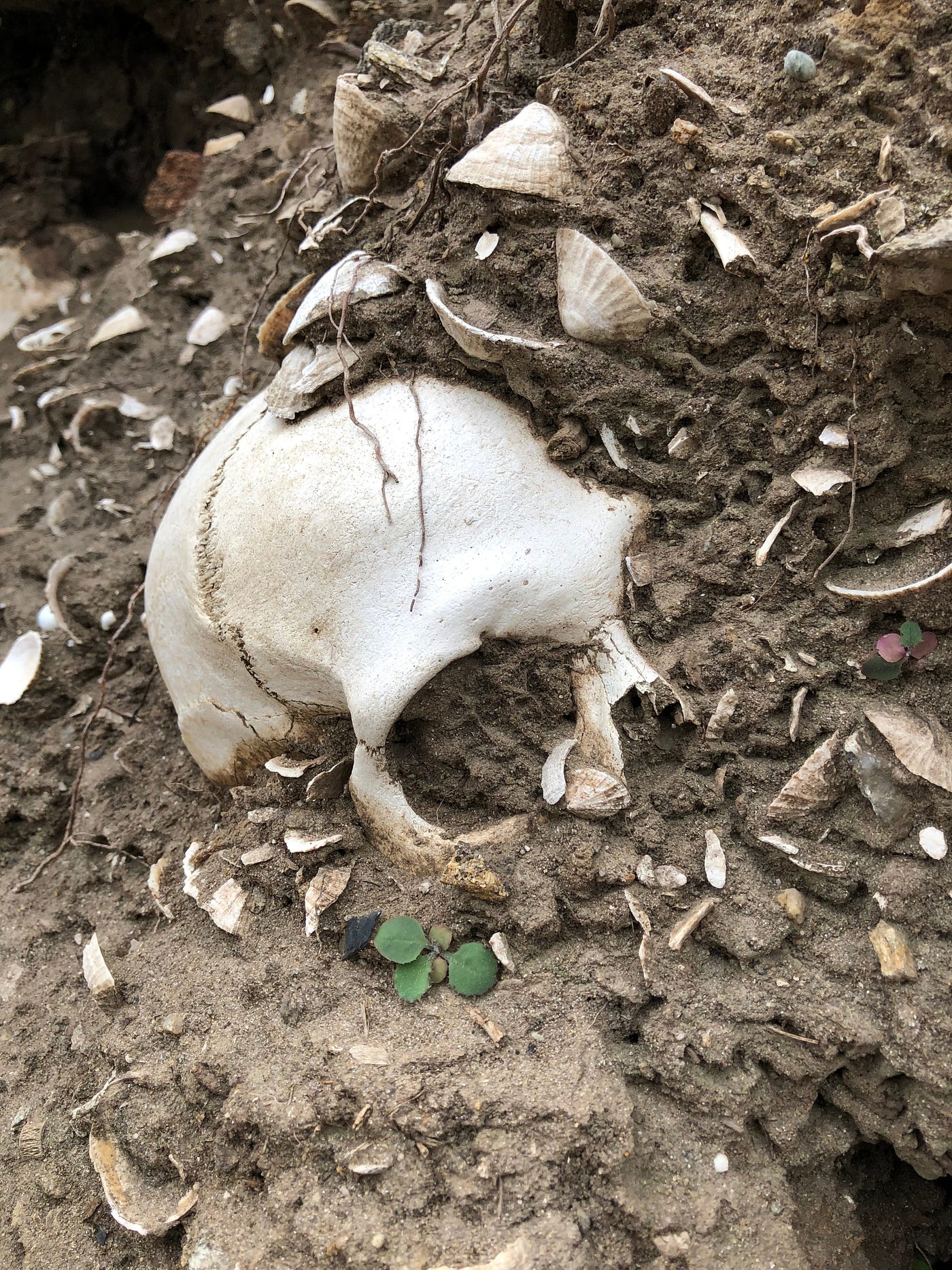
My work involves the study of shell middens, anthropogenic accumulation of collected and disposed shells. This skull was discovered in a early medieval cemetary, directly digged into an older midden. Beniguet island, France. Photo : JF Cudennec.
If you made it this far through different axes of ecological constraint and the slow reshuffling of an entire research field, I respect that. The next episode will stay on the ecological side of the limpet world, with even more complexity ahead. The next layer of constraints will not be the surrounding species or the harsh physical consrtraints, but how limpets, as a grazing species, are shaped by competition. Competition between different limpet species and competition within a single species. We will see how this small mollusc clears out its own little garden patch, and defend it against intruders. Humans and ants have been practising agriculture for millennia. Maybe limpets also invented gardening ?
If you enjoyed this one, the best thing you can do is subscribe so you don’t miss the next installments, share this with someone who might appreciate a 3000-word argument about why a single starfish thrown into the sea reorganised modern ecology, or leave a comment below.
메타데이터
- post_id
- b1c2c2ea78cf
- slug
- a-natural-history-of-limpets-part-3-the-shore-that-never-settles-b1c2c2ea78cf
- url
- https://medium.com/@jf.cudennec/a-natural-history-of-limpets-part-3-the-shore-that-never-settles-b1c2c2ea78cf
- canonical_url
- https://medium.com/@jf.cudennec/a-natural-history-of-limpets-part-3-the-shore-that-never-settles-b1c2c2ea78cf
- author_url
- https://medium.com/@jf.cudennec
- status
- ok
- fetched_at
- 2026-06-09 15:37:30