The Core Emotion Framework: A User Manual for Your Emotional Operating System
What if your emotions weren’t broken — you just never learned to read the instructions?
The Core Emotion Framework: A User Manual for Your Emotional Operating System
What if your emotions weren’t broken — you just never learned to read the instructions?
You know that feeling. The one where you’re stuck in a loop, overthinking a conversation for hours. Where anxiety shows up as a knot in your stomach before you even know what you’re worried about. Where you know what you should do, but something keeps you locked in place.
Most of us have spent our whole lives treating emotions like weather — something that just happens to us. Good days, bad days, moods that strike without warning.
But what if that’s wrong?
What if your inner world runs on a system — a predictable, learnable Operating System — and you’ve just been guessing at the controls?
The Map We’ve Been Missing
For over a century, psychology has been fighting a quiet war. One side says emotions are hardwired biological reflexes — pre-programmed circuits that fire when triggered. The other side says emotions are stories we tell ourselves, socially constructed narratives shaped by culture and language.
Both are partly right. And both have left people stuck with vague advice like “feel your feelings” or “just think positive” that sounds nice but doesn’t actually tell you how.
The Core Emotion Framework (CEF) cuts through this by proposing something radical: emotions are functional movements — internal transformations — that can be mapped, measured, and mastered.
Think of it like learning to drive. Before you knew how a car worked, you pushed pedals and turned the wheel and mostly got where you were going through trial and error. But once you understood the mechanics — the relationship between the accelerator, the brake, the transmission — driving became something you could consciously control.
The CEF provides that same clarity for your inner world.
Your Three Brains
Here’s where it gets interesting: you don’t have one brain. You have three interconnected processing centers, each with its own intelligence, its own agenda, and its own way of communicating:
The Head (your cognitive center) handles logic, analysis, and navigation. It’s the part that can tell you this is just a minor work meeting, not a life-threatening situation.
The Heart (your relational center) manages connection, openness, and boundaries. It’s where you feel safe or threatened, included or isolated.
The Gut (your somatic center) drives action, momentum, and survival instincts. It’s the part that clenches, relaxes, or urgently tells you to move.
These three centers aren’t metaphors. They correspond to real neural networks — the 86 billion neurons in your brain, the 40,000 sensory neurons in your heart, and the 100 million neurons in your gut. They’re in constant communication, but they speak different languages.
The Head speaks words. The Heart speaks feeling. The Gut speaks sensation.
No wonder we get confused.
The Ten Operators: Your Emotional CPU Instructions
Within this three-part architecture, the CEF identifies ten core functions — think of them as your emotional “CPU instructions.” These operators are the irreducible building blocks of every emotional experience you’ve ever had.
The Head Center (Cognitive Processing)
Sensing — Raw perception. The scanning, listening, and detection of what’s happening around you. When you walk into a room and intuitively pick up on the mood, that’s Sensing at work.
Calculating — Analysis and pattern recognition. Weighing options, comparing outcomes, running the mental math. This is where you think through possibilities before acting.
Deciding — Commitment to action. The moment you stop analyzing and choose. This operator is often “silenced” in anxiety — stuck in Calculating without the ability to move forward.
The Heart Center (Relational Flow)
Expanding — Openness, warmth, connection. Widening your emotional aperture to include others. This is Barbara Fredrickson’s “broaden-and-build” state — where positive emotions expand your resources.
Constricting — Boundaries, focus, protection. Narrowing attention and establishing limits. This isn’t “bad” — it’s essential for maintaining integrity and avoiding overwhelm. Problems arise only when it gets stuck on.
Achieving — The drive to manifest, excel, and complete. This is your capacity to turn intention into coordinated action. It’s the “juggling” operator that manages competing demands.
The Gut Center (Action Momentum)
Arranging — Organization, prioritization, structure. Creating order from chaos, breaking large goals into manageable steps.
Appreciating — Recognition of value, savoring, gratitude. The ability to genuinely enjoy what’s good without immediately moving on to what’s next.
Boosting — Energy surge, momentum, activation. The “engine” that turns intention into forward motion. This operator amplifies the intensity of others.
The Baseline Operator
Accepting — Integration, release, presence. This is the most critical operator and the one most people neglect. Accepting isn’t resignation or passivity — it’s the conscious choice to acknowledge what is before trying to change it. It’s the calibration point that prevents burnout.
Why This Matters: The Problem of Fusion
Here’s where things get practical.
In a healthy system, these operators function like skilled team members — they activate when needed, hand off tasks smoothly, and stand down when the job is done.
But when you’ve never learned to distinguish them, they become “fused.” One operator’s activation involuntarily triggers another. You can’t activate Sensing without also triggering Constricting. You can’t feel Expanding without also feeling a surge of Boosting that quickly burns out.
This fusion is the source of most psychological stuckness.
Anxiety — Often a “Calculating-Deciding” fusion. The system is stuck in analytical mode, processing threats, but the Deciding operator that would allow commitment to a course of action is silenced. You’re running mental simulations without ever landing on a choice.
Depression — Often involves a silencing of the Boosting operator. The energy to act is inaccessible, creating a loop where lack of action reinforces the sense of being stuck.
Relationships — When one person reaches out from the Heart (Expanding) but the other responds from the Head (Calculating), you get a Center-Operator mismatch. “I’m trying to connect with you” meets “Let me analyze the problem.” No wonder we feel misunderstood.
The GPAP: A Practical Case Study
Consider the “GoodPerson Anxiety Pattern” (GPAP) — a structural configuration I’ve observed in clinical and organizational contexts.
In this pattern:
Expanding (relational warmth, desire to connect) becomes fused with Calculating (analysis of what’s needed, scanning for expectations). The result: a person who is chronically scanning social environments, trying to figure out what’s expected, desperate to please and avoid judgment.
Meanwhile, Deciding (commitment to self-boundary) and Boosting (surge energy for action) are suppressed. The system is stuck in a high-arousal prediction loop without the capacity to act on its own behalf.
This looks like:
- Difficulty saying “no”
- Chronic anxiety about how you’re perceived
- Over-explaining and over-apologizing
- Feeling responsible for everyone else’s emotions
- Being praised as “so nice” while feeling empty
Traditional therapy might explore childhood origins or cognitive distortions. And those are valuable. But the CEF suggests that until you identify and detangle the structural configuration — the mechanical fusion of operators — the pattern will persist regardless of insight.
This is why “knowing what’s wrong” doesn’t always fix it. You can understand the GPS route perfectly, but if the transmission is stuck in neutral, you’re not going anywhere.
The 7-Step Detangling Protocol
So how do you actually fix this?
The CEF offers a practical, step-by-step approach:
-
Identification — Name the specific operators that are locked together. “Okay, I’m noticing Constricting in my chest and Calculating in my head, but Deciding feels offline.”
-
Somatic Location — Where in your body is this living? Head (forehead, eyes, upper spine)? Heart (chest, lungs, arms)? Gut (abdomen, hips, legs)?
-
Aperture Adjustment — Use 0–10 scaling to consciously modulate the intensity. Can you soften Constricting from an 8 to a 4? Can you gently nudge Boosting from a 2 to a 5?
-
Bilateral Movement — Use directional movement to interrupt the circuit. Sometimes physical motion — a rocking side to side, a walking pattern, a physical turning — can break the neural lock.
-
Sequential Decoupling — Fire operators in sequence, not simultaneously. Practice activating Expanding while keeping Constricting at zero. Prove to your nervous system that these functions can be independent.
-
Acceptance Integration — Use the Accepting operator to ground the system. Release, soften, return to baseline. This isn’t resignation — it’s the strategic reset before the next move.
-
Agility Testing — Intentionally shift to a different center to verify flexibility. Can you move from Heart work to Head work to Gut work without a glitch?
This sounds abstract, but it’s remarkably concrete in practice. Each operator has a specific somatic signature — a felt sense in the body that becomes identifiable with practice. This isn’t about believing; it’s about noticing.
The Evidence Base (and the Limits)
Jamel Bulgaria is an independent researcher, and it sounds like the CEF is currently undergoing open validation through the Open Science Framework (OSF). Pilot studies (N=39) and phase 1 (N=826) have shown something interesting: people can distinguish between their reflexive responses and their idealized responses in terms that map to the ten operators.
The preliminary data shows significant “action-opinion divergence” — people report that what they actually do in stressful situations differs from what they believe they should do, and these differences consistently map to specific operators.
Amano et al. (2026) demonstrated that AI-derived facial valence estimates have test-retest reliability patterns that align with the CEF’s architecture. The integrated stability coefficient (ICC 0.94) across individuals provides a robust benchmark for what the CEF calls the “Accepting baseline” — the stable, trait-like capacity to recalibrate.
But let me be clear: the framework remains a falsifiable working hypothesis. It will be confirmed or disconfirmed by large-scale confirmatory factor analysis and cross-cultural discrimination studies. The Open Validation Program (hosted on OSF) is designed to test whether the ten-factor structure actually emerges from data.
If it doesn’t, the framework fails. That’s how science works.
What This Means for You
You don’t need to become an expert in affective architecture to benefit from this perspective.
Here’s the core insight:
Your inner experience is structured. It follows patterns. Those patterns can be learned, mapped, and changed.
You’re not at the mercy of random moods. You’re not “bad at feelings.” You’re running a complex system without having read the manual.
The path isn’t to eliminate difficult emotions — it’s to develop “operator agility.” The capacity to feel anger without being consumed by Constricting. To access sadness without losing all Boosting. To experience anxiety without getting trapped in a Calculating-Deciding loop.
This means:
- Journaling — Start by noticing which operators are active in your daily experience. “Today I noticed Constricting in my shoulders during the meeting, followed by Calculating as I replayed the conversation.”
- Somatic Scanning — Take five minutes to scan your body. Where is there tension? Where is there ease? What centers feel “online” and what feels “offline”?
- Targeted Strengthening — Identify an underused operator and practice activating it. If you’re chronically in Calculating, practice Deciding. If you’re stuck in Constricting, practice Expanding. Small, conscious experiments.
The Bigger Picture
The CEF has implications beyond individual psychology.
In artificial intelligence, it provides a structural architecture for modeling synthetic affect. By implementing operators as computational transformations, AI systems can move beyond sentiment classification to genuine functional modeling of internal states.
In institutional governance, the framework maps onto organizational systems. The same operator failures that cause individual stuckness — silenced Deciding, overactive Constricting, chronic Calculating without action — also explain why institutions become paralyzed, rigid, or self-destructive.
In psychotherapy, the CEF offers a meta-modality that can reframe existing approaches. CBT engages Calculating and Deciding. DBT works with Expanding, Constricting, and Accepting. EMDR harnesses Sensing and Arranging to facilitate integration.
The framework doesn’t replace these modalities — it provides a common language for understanding what they’re doing and why they work.
A Simple Place to Start
You don’t need to memorize all ten operators today.
Just start noticing one thing: the difference between sensation and interpretation.
Sensing is raw perception — the tightness in your chest, the racing of your thoughts, the heaviness in your legs. It’s the data, before you’ve decided what it means.
Calculating is interpretation — “This tightness means I’m anxious because I’m going to fail, and if I fail, I’ll be rejected, and that would be unbearable.”
Most of us fuse these two steps. We feel a sensation, and before we’ve even identified it, we’ve built a catastrophic story around it.
Try this today: when you feel something uncomfortable, pause. Notice the sensation. Name the center where it’s living. Identify the operator that’s active. And then notice the story you’re attaching to it.
This one practice — separating sensation from interpretation — is the foundation of operator independence. It’s the first step from being controlled by your emotions to skillfully working with them.
The Road Ahead
The Core Emotion Framework is still a young model. The validation program is ongoing. Questions remain.
But the core insight — that emotions can be mapped as functional operators, that psychological stuckness is structural fusion, that health is operator agility — offers a path forward that traditional therapy and self-help often miss.
You’re not broken. Your system isn’t broken. You just never learned to read the instructions.
The good news? The instructions exist. The manual is being written. And unlike the vague advice you’ve been given before, this one tells you exactly what to do, where to place your attention, and how to practice.
It’s not about “feeling better.” It’s about understanding the mechanics of what you feel, so you can make conscious choices rather than being driven by patterns you never named.
That’s the promise of the Human Operating System.
The CEF is a structural-constructivist framework under open validation. The ten-operator model remains a falsifiable hypothesis, subject to empirical confirmation or disconfirmation through ongoing factor-analytic and cross-cultural research. The validation program is hosted on the OSF and welcomes independent replication efforts.
Note: If you’re a researcher interested in replicating these findings, Jamel’s full replication protocol is available through the CEF Main Archive on Hugging Face, Zenodo, and PhilPeople. All materials are open-source and provided under CC BY 4.0.
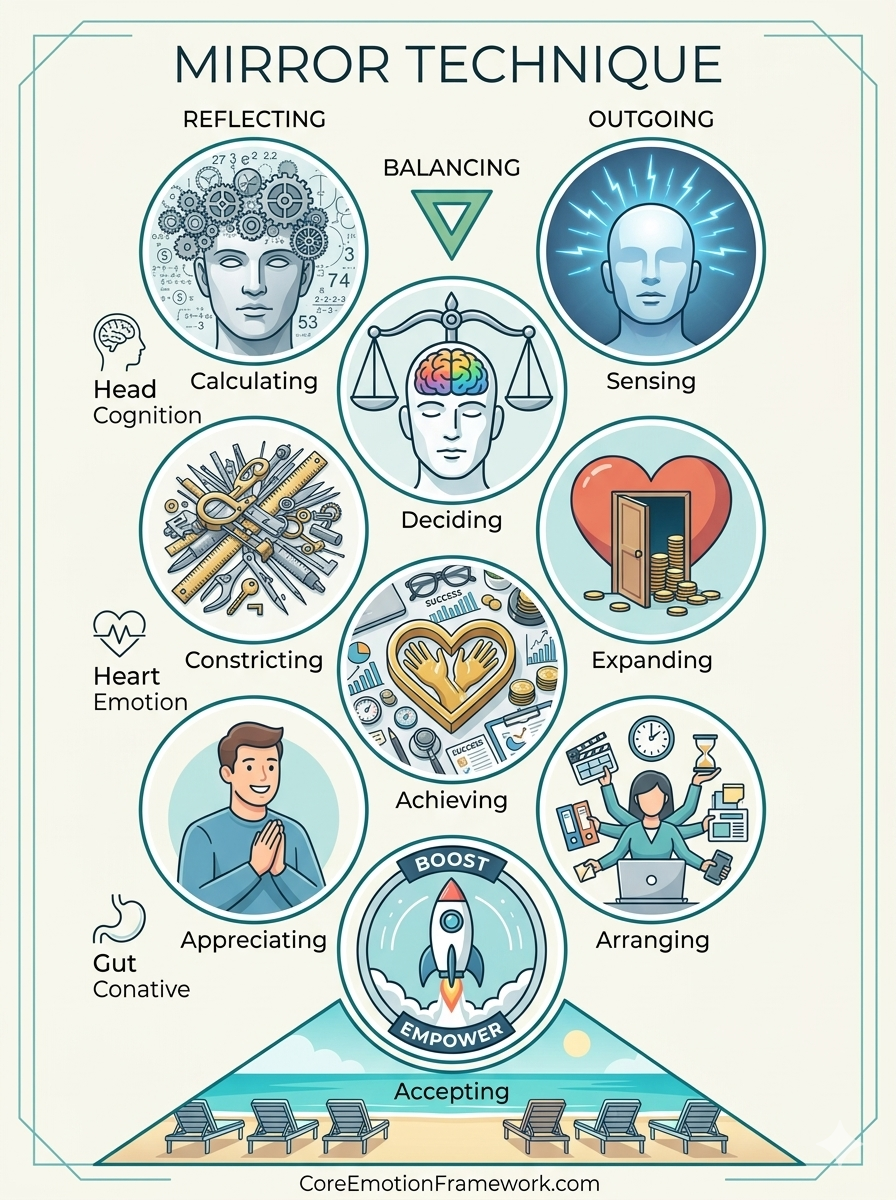
3 x 3 + 1 — the human OS
메타데이터
- post_id
- b1ca538a9f49
- slug
- the-core-emotion-framework-a-user-manual-for-your-emotional-operating-system-b1ca538a9f49
- url
- https://medium.com/@miraarden/the-core-emotion-framework-a-user-manual-for-your-emotional-operating-system-b1ca538a9f49
- canonical_url
- https://medium.com/@miraarden/the-core-emotion-framework-a-user-manual-for-your-emotional-operating-system-b1ca538a9f49
- author_url
- https://medium.com/@miraarden
- status
- ok
- fetched_at
- 2026-07-13 17:48:35