Shopify ecommerce integration with O2VEND WMS
Boost eCommerce efficiency with Shopify and O2VEND: automated inventory updates, precise stock tracking, faster order fulfillment, and…
Shopify ecommerce integration with O2VEND WMS
Boost eCommerce efficiency with Shopify and O2VEND: automated inventory updates, precise stock tracking, faster order fulfillment, and seamless warehouse control.
In today’s fast-paced *e-commerce* world, managing your inventory efficiently is one of the biggest challenges for online businesses. When you run a Shopify store and also use a WMS (Warehouse Management System) like O2VEND, the goal is simple: seamless synchronization of stock, orders, and fulfillment so you never oversell or face stock mismatches.
This blog explains how this integration works, why it’s important, and how real-time inventory sync keeps everything accurate and up-to-date.
What Is Shopify + O2VEND Integration?
Shopify + O2VEND integration connects your Shopify eCommerce store directly with O2VEND’s Warehouse Management System (WMS) and Inventory Management System to create a seamless, automated data flow between sales and operations.
When integrated
- Orders sync instantly — Every order placed on Shopify automatically appears in O2VEND for processing and fulfillment.
- Inventory stays aligned — Stock levels update in real time across both systems, ensuring accurate availability.
- Returns and adjustments reflect automatically — Any sales, returns, or stock corrections update everywhere without manual effort.
This end-to-end connection eliminates manual data entry, reduces errors, and prevents overselling. It ensures your Shopify storefront always displays accurate stock levels while enabling faster, more reliable order fulfillment.

Real-Time Inventory Sync Between Shopify and O2VEND
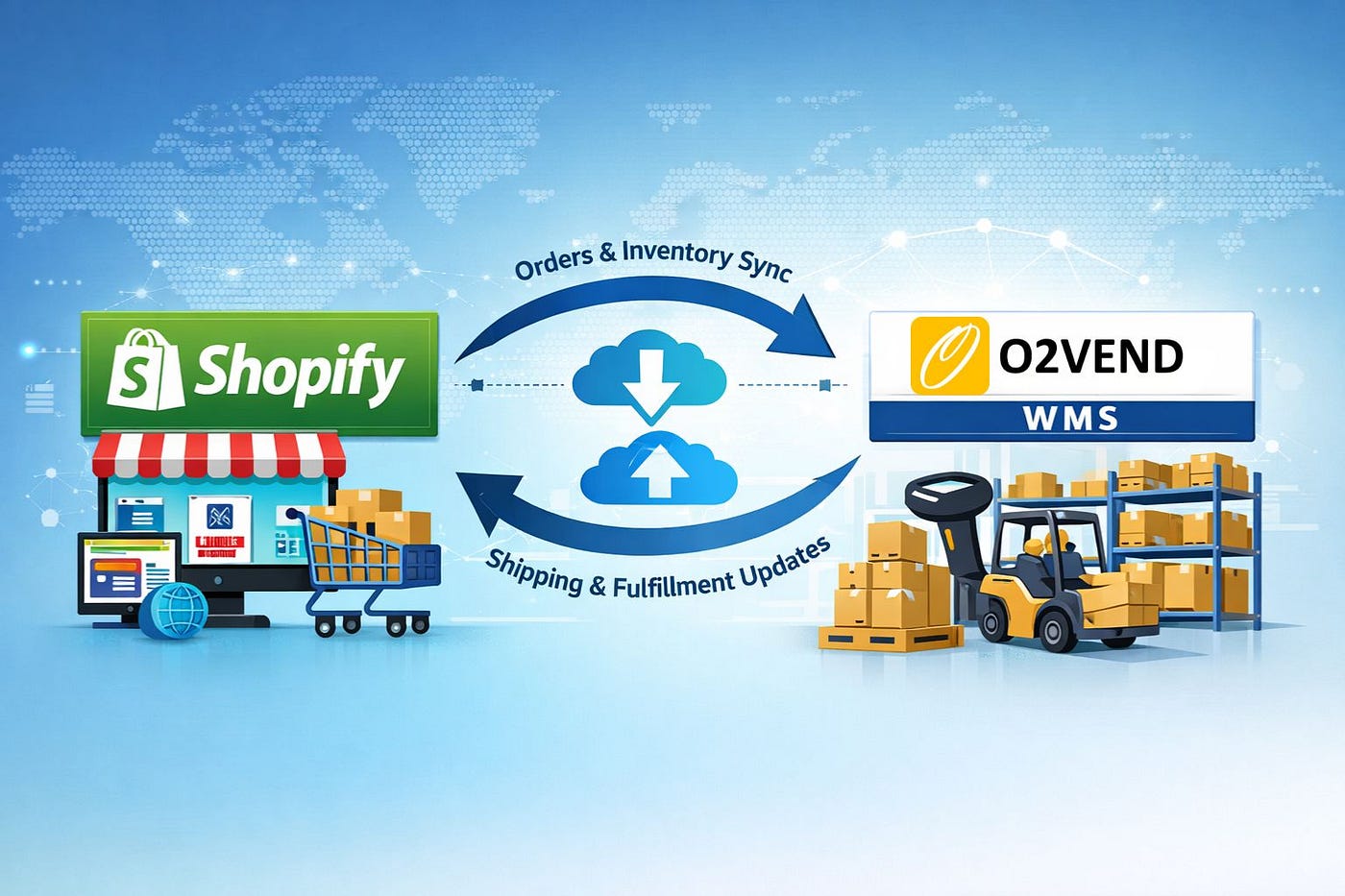
Real-time inventory synchronization is the backbone of a successful eCommerce and warehouse integration. When Shopify is connected with O2VEND WMS, both systems continuously communicate to keep stock levels accurate across all sales channels.
When a product is sold on Shopify, the system automatically reduces the available quantity for that specific SKU. Because O2VEND is integrated, the updated stock level is instantly reflected inside the WMS. This ensures your warehouse team always works with accurate, up-to-date inventory data.
Similarly, when new stock is received, adjusted, or cycle-counted inside O2VEND, the updated inventory levels are immediately pushed back to Shopify. Your online store reflects the correct availability without any manual updates.
This two-way, real-time sync helps businesses:
- Prevent overselling and stockouts.
- Maintain accurate product availability online.
- Reduce manual inventory reconciliation.
- Improve order fulfillment accuracy.
- Build customer trust through reliable stock visibility.
Stock Adjustments & Returns
Inventory management is not limited to sales transactions. Operational changes such as returns, restocking, damage write-offs, and manual corrections directly impact stock accuracy. With a seamless integration between Shopify and O2VEND, inventory remains synchronized across both systems in real time.
When products are returned or restocked within O2VEND, updated stock levels automatically reflect in Shopify, ensuring accurate availability for online shoppers. Likewise, if inventory adjustments are made directly in Shopify — such as emergency corrections or administrative updates — O2VEND instantly aligns its warehouse counts to maintain operational consistency.
This robust two-way synchronization eliminates discrepancies, reduces overselling risks, improves fulfillment accuracy, and provides complete inventory visibility across all channels. Regardless of where stock changes originate, your inventory data remains aligned, reliable, and ready to support scalable growth.
How to Configure Shopify Sales Channel in O2VEND
- Configuring the Shopify sales channel in O2VEND is the first step toward seamless eCommerce operations. By enabling this integration, you can sync orders in real time, manage inventory centrally, and streamline fulfillment from a single platform.
- Before starting the setup, ensure that the Shopify sales channel is activated for your account. If it is not enabled, contact O2VEND Support to request activation.
- Once enabled, you can proceed to create the sales channel in the Back Office and complete the configuration to connect your Shopify store successfully.
Key Benefits of Shopify + O2VEND Integration
Integrating your eCommerce platform with your warehouse management system creates a seamless operational ecosystem. Here’s how this integration drives efficiency and business growth:
No More Manual Inventory Updates
Manual stock management often leads to delays, data mismatches, and costly errors. With automated synchronization between Shopify and O2VEND, every sale, return, or stock adjustment updates instantly across systems. This eliminates spreadsheets, reduces human error, and saves valuable operational time.
Prevents Overselling
Real-time inventory visibility ensures your online store reflects actual warehouse stock. When inventory levels update automatically, customers only see what’s truly available. This prevents overselling, reduces cancellations, and protects your brand reputation.
Faster Order Fulfillment
Orders placed on Shopify flow directly into O2VEND without manual intervention. Warehouse teams receive instant picking and packing instructions, enabling quicker dispatch. The result: shorter fulfillment cycles, improved delivery timelines, and better customer satisfaction.
Better Reporting & Analytics
When both systems share live data, reporting becomes more accurate and reliable. Businesses gain clearer insights into sales trends, stock turnover, reorder planning, and demand forecasting — enabling smarter, data-driven decisions.
Stock Visibility
Accurate inventory synchronization is essential to prevent stock mismatches, overselling, and fulfillment delays. By following these best practices in Shopify, businesses can maintain real-time inventory accuracy and ensure seamless operations across systems.
What is a Warehouse Management System (WMS)?
A Warehouse Management System (WMS) is a software solution designed to manage, control, and optimize daily warehouse operations. It provides complete visibility of inventory from the moment goods enter the warehouse until they are shipped to customers. By automating and streamlining processes, a WMS helps businesses improve accuracy, efficiency, and overall supply chain performance.
Why a WMS is Important
In today’s competitive commerce environment, businesses must handle high order volumes, multiple sales channels, and increasing customer expectations. Managing inventory manually or through spreadsheets often leads to stock mismatches, delays, and operational inefficiencies. A WMS eliminates these challenges by offering real-time tracking, organized storage management, and automated workflows.

get start
Core Functions of a WMS
A Warehouse Management System (WMS) streamlines inventory, receiving, picking, and shipping operations with real-time accuracy and automation. It improves warehouse efficiency, reduces errors, and provides actionable insights for better business decisions.

WMS in an eCommerce Environment
In an e-commerce environment, a Warehouse Management System (WMS) integrated with platforms like Shopify automatically updates inventory levels whenever a product is sold, ensuring accurate and real-time stock visibility across all sales channels. This prevents overselling, reduces manual errors, and keeps inventory data consistent between online stores and warehouse operations. By connecting order processing, picking, packing, and shipping in one streamlined workflow, a WMS improves efficiency, speeds up fulfillment, and enhances the overall customer experience as the business scales.

demo
Location and Sub-Location Management in a Warehouse Management System (WMS)
Location and sub-location management is one of the most powerful capabilities of a Warehouse Management System (WMS). Instead of managing inventory as a bulk quantity in a single storage area, a WMS creates a structured, hierarchical layout of the entire warehouse. This structured approach improves visibility, accuracy, speed, and operational control.
1. Structured Warehouse Hierarchy
A well-configured WMS divides the warehouse into multiple logical levels:
Warehouse — The overall facility (e.g., Warehouse A, Warehouse B).
- Zone — Sections categorized by product type, temperature, movement speed, or process (e.g., Fast-Moving Zone, Cold Storage Zone).
- Aisle — Physical walking lanes between racks.
- Rack — Storage structures placed along aisles.
- Shelf — Horizontal storage levels within racks.
- Bin — The smallest storage unit where products are physically placed.
Example Location Code:
Warehouse A → Zone 2 → Aisle 5 → Rack B → Shelf 3 → Bin 12Each product in the system is assigned to a specific bin location. This eliminates ambiguity and ensures every unit has a clearly defined storage position.
Why Structured Location Management Matters
Precise Product Placement
Every SKU is assigned a fixed or dynamic bin location. This ensures:
- Clear visibility of where each item is stored
- Reduced misplacement
- Easier tracking of batch, lot, or serial numbers
This is especially critical for businesses handling high SKU volumes, apparel variants, electronics, or FMCG products.

Faster Picking and Retrieval
When an order is placed (for example, from platforms like Shopify or other eCommerce channels), the WMS instantly generates a pick list showing the exact bin location.
Instead of searching manually, staff follow a guided path:
- Go to Zone 2
- Walk to Aisle 5
- Locate Rack B
- Pick from Shelf 3, Bin 12
This structured navigation significantly reduces picking time and improves operational efficiency.
Reduced Searching Time
Without sub-location management, workers waste time scanning multiple racks. With barcode-enabled bin locations:
- The system verifies the correct bin before picking
- Scanning confirms accuracy
- Errors are detected instantly
This minimizes delays and prevents order fulfillment mistakes.

Final Thought
Integrating Shopify with O2VEND WMS transforms eCommerce operations by automating inventory management, streamlining order fulfillment, and providing real-time stock visibility. With structured location management, accurate tracking, and synchronized data, businesses can prevent overselling, reduce errors, and scale efficiently while delivering a seamless customer experience. This integration ensures your online store and warehouse operate as one cohesive, efficient system.

signup
메타데이터
- post_id
- b1dc86aca60f
- slug
- shopify-ecommerce-integration-with-o2vend-wms-b1dc86aca60f
- url
- https://medium.com/@santhiya8151/shopify-ecommerce-integration-with-o2vend-wms-b1dc86aca60f
- canonical_url
- https://medium.com/@santhiya8151/shopify-ecommerce-integration-with-o2vend-wms-b1dc86aca60f
- author_url
- https://medium.com/@santhiya8151
- status
- ok
- fetched_at
- 2026-06-29 01:02:39