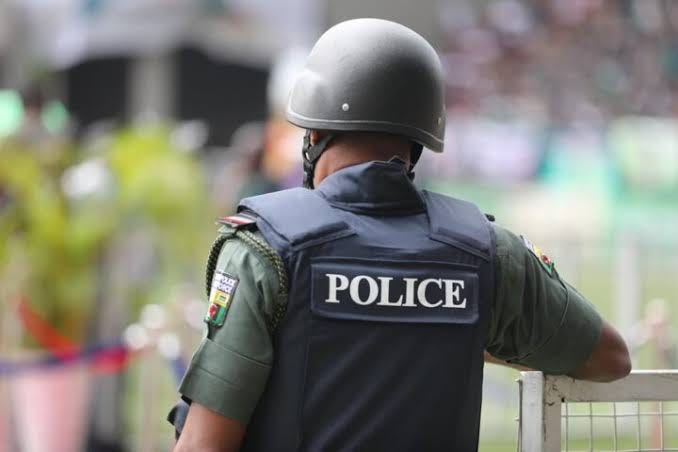
Like Nigeria is like America… but where is our Federal Republic?
We proudly call ourselves The Federal Republic of Nigeria, just as they are called The United States of America.
Like Nigeria is like America… but where is our Federal Republic?
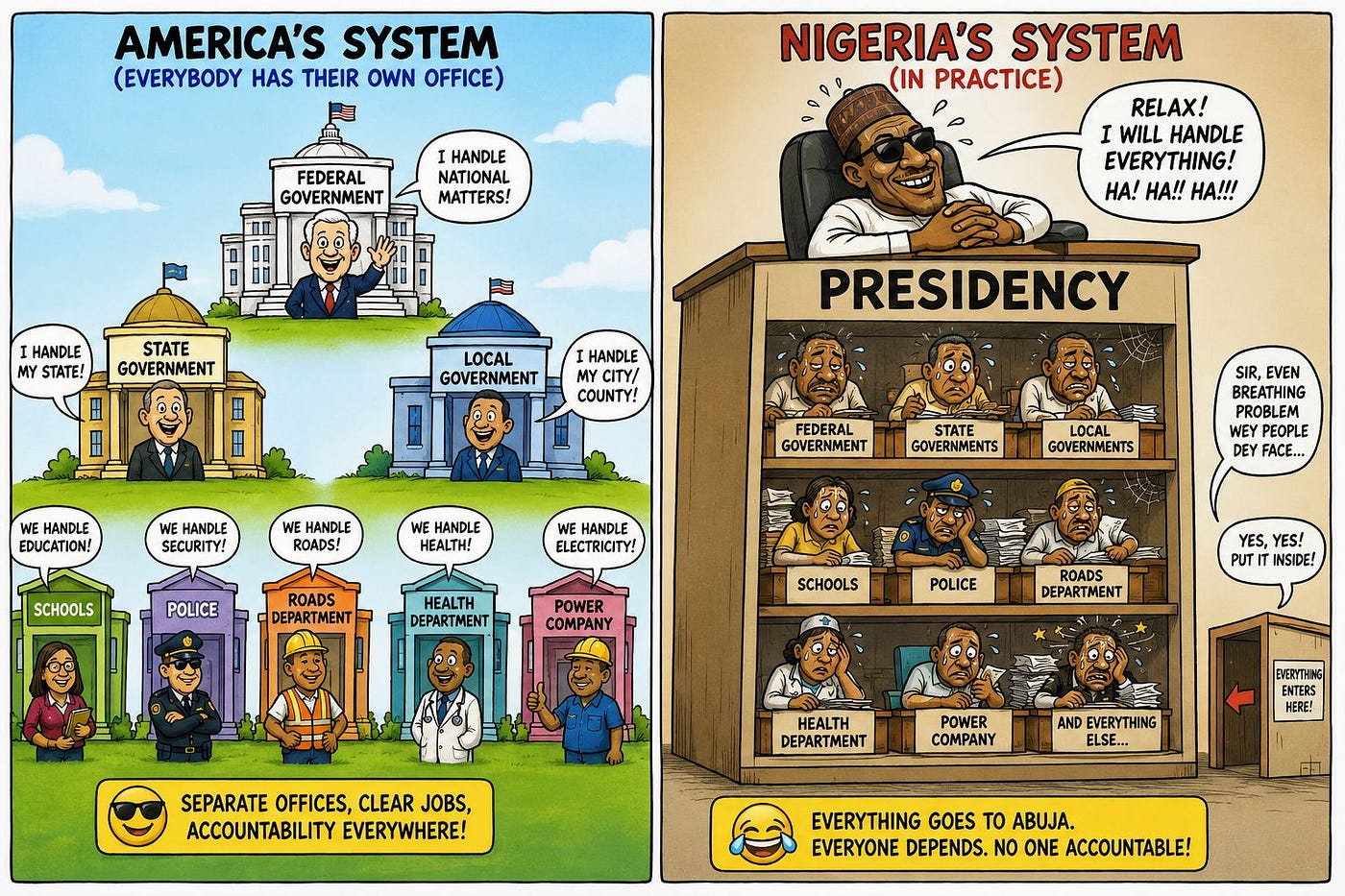
We proudly call ourselves The Federal Republic of Nigeria, just as they are called The United States of America.
Federal Republic. United States.
Nigeria. America.
FRN. USA.
Sit with those names for a moment, both point to the same design principle: power distributed, not concentrated. The federal government handles national issues; states and local governments hold substantial authority over what directly affects their people.
Yet in Nigeria, practice keeps contradicting identity.
Insecurity, bad roads, unemployment, power shortages, failing schools, poor healthcare; every problem somehow lands on Abuja’s desk, and every complaint somehow becomes the President’s job.
Why?
What happened to the states, constitutionally recognized as federating units in their own right? What happened to local governments, created specifically to bring governance closer to the people? Why has the Presidency become the default destination for public frustration, while governors and local government chairmen so often escape the same scrutiny?
A federation cannot function if every solution is expected to come from the centre.
This isn’t an accident of culture, it has structural roots. Nigeria’s federalism has been steadily hollowed out since the military era, when decades of centralized command-and-control governance reshaped how power flowed between Abuja, the states, and local government. Even after the return to democracy in 1999, much of that centralizing instinct survived in the constitution itself: an Exclusive Legislative List that gives the federal government sole authority over a long list of critical matters, a revenue allocation formula that channels the bulk of national income through Abuja before it trickles down, and a local government system whose funding and autonomy are still, in practice, controlled by state governors rather than the communities they’re meant to serve.
So when Nigerians instinctively look to Abuja first, they’re not simply misreading the constitution, they’re responding to a system that has, for decades, behaved exactly like a unitary state wearing a federal name tag. The names haven’t matched the practice for a long time. But that history explains the habit; it doesn’t excuse it, and it doesn’t mean the habit can’t be broken.
Governors receive substantial monthly allocations from the Federation Account, in addition to internally generated revenue that varies widely by state. Yet the federal government absorbs the sharpest public criticism, while state-level performance on health, education, agriculture, security infrastructure, and local roads often escapes the same intensity of public accounting.
Ask the average Nigerian to name their state’s health commissioner, or to describe what their state assembly has passed this year, and the answer is often silence. Ask the same person about the President’s latest policy, and they will start telling you how they are already critizing it. That asymmetry of attention is itself a symptom of the problem and it lets underperformance at the state level hide in plain sight.
Local governments that are meant to handle primary healthcare, local roads, sanitation, markets, and grassroots development have become largely invisible across much of the country. Local government elections are frequently uncompetitive or delayed for years; chairmen are sometimes effectively appointed rather than elected in any meaningful sense; and local government funds are frequently absorbed into joint state-local accounts with little transparency about how they’re spent.
This means the tier of government closest to daily life, the one meant to fix the primary health centre, clear the drainage, and maintain the local market is often the weakest and least accountable of the three. Citizens end up skipping over it entirely, going straight to the state or federal government for problems local government was designed to solve.
This centralizing of responsibility is quietly corrosive. When citizens stop questioning governors, governors grow less accountable. When governors stop empowering local governments, grassroots development stalls. And when every expectation flows to Abuja, every other tier learns it can shift responsibility upward and face no consequence.
It becomes a self-reinforcing cycle: weak local government drives citizens to state government; weak state accountability drives citizens to the federal government; and an overloaded federal government becomes the scapegoat for failures that were never fully within its constitutional remit to fix alone.
Nigeria’s development problems cannot be solved by the Presidency alone.
True federalism means states taking real ownership of economic development, infrastructure, education, healthcare, security collaboration within constitutional limits, and prudent management of the resources already available to them. Some states have shown what’s possible when this ownership is taken seriously, building independent revenue bases, running functional state health insurance schemes, or maintaining road networks without waiting on federal intervention. These aren’t miracles; they’re evidence that the model can work when a state government chooses to act like one.
It also means citizens holding governors, state assemblies, and local officials to the same standard they hold the President, asking for state budgets to be published and explained, attending town halls, engaging state assembly representatives, and treating local government elections as seriously as presidential ones.
This isn’t about letting the federal government off the hook, it must still lead on national matters like defence, monetary policy, foreign affairs, and the frameworks that hold the federation together. But a federation only works when every tier performs its assigned role, and right now, two of the three tiers are largely coasting on the attention deficit of the third.
So perhaps the question isn’t just “What is Abuja doing?”
Perhaps it should also be:
What is the state government doing? What is the local government doing? And are we demanding accountability from every elected official, or only the one in Aso Rock?
Nigeria proudly carries the title Federal Republic. It’s time to live the principle behind it governance, responsibility, and accountability shared across every level, not parked in one office.
Only then does Nigeria start functioning as the federation it was designed to be.
메타데이터
- post_id
- b1e4bb43fa33
- slug
- like-nigeria-is-like-america-but-where-is-our-federal-republic-b1e4bb43fa33
- url
- https://medium.com/@IamJomarJ/like-nigeria-is-like-america-but-where-is-our-federal-republic-b1e4bb43fa33
- canonical_url
- https://medium.com/@IamJomarJ/like-nigeria-is-like-america-but-where-is-our-federal-republic-b1e4bb43fa33
- author_url
- https://medium.com/@IamJomarJ
- status
- ok
- fetched_at
- 2026-08-16 06:55:14