How to build agentic CX frameworks: transitioning from static to agentic workflows
No single AI model will handle your strategy, planning and design. To drive product design, we need to focus on foundational design needs…
How to build agentic CX frameworks: transitioning from static to agentic workflows
No single AI model will handle your strategy, planning and design. To drive product design, we need to focus on foundational design needs and workflows.
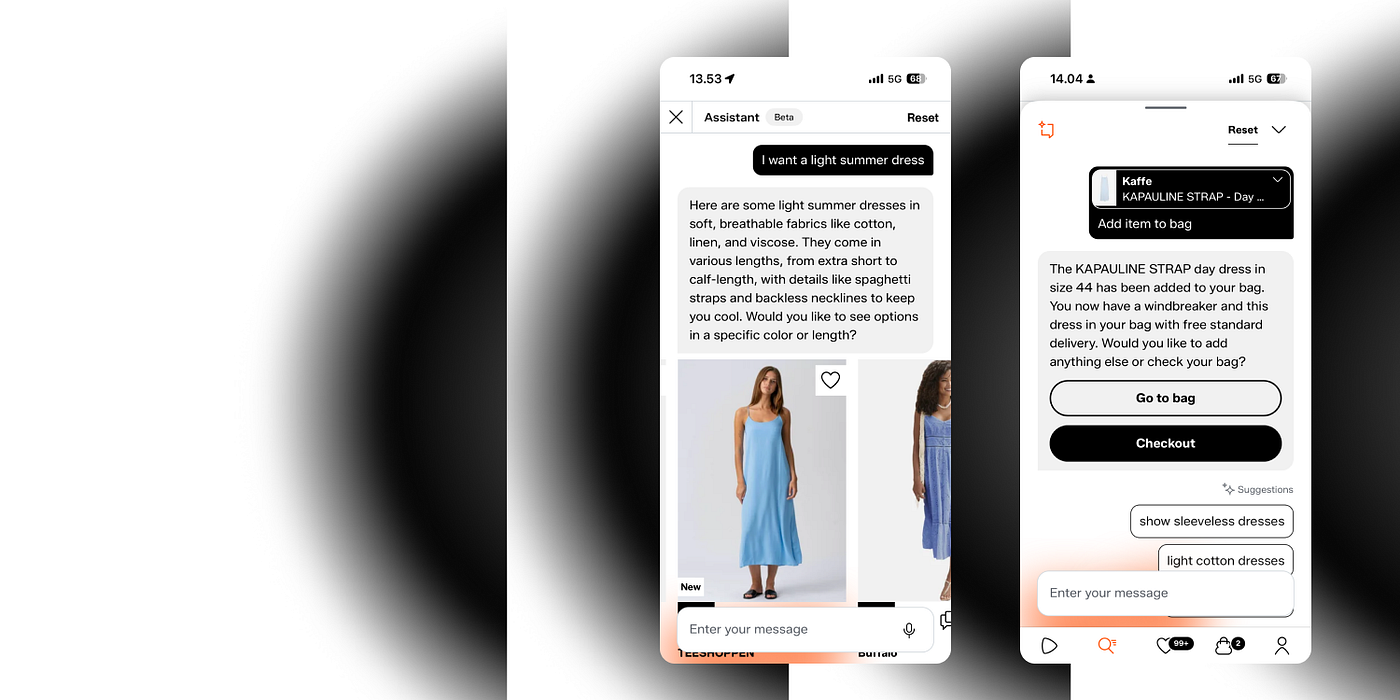
As AI agents become the new apps and operating systems, the very nature of digital experiences is changing, forcing a fundamental rethink of product design and development.
Product designers are no longer focusing on shaping interfaces and journeys. They’re increasingly shaping behavioural systems and creating experiences that can act on behalf of a user in a controlled and meaningful way. This does not reduce the role of design — it expands it.
To answer the burning questions facing design today, we need to move away from hype talk and chasing the latest AI design tool. There doesn’t exist a magical AI model that does the strategy setting, priority planning, and key design and development decisions for you. Instead, we need to move towards addressing the foundational needs and requirements of product design and development teams working in the age of agents.
Agents change the scope for product design and development
With emerging agentic capabilities, the nature of the digital experiences themselves is changing significantly. Product designers are not designing static interfaces and journeys, but rather, personalised autonomous or semi-autonomous experiences in which all the key elements of the customer experience can turn into changing and modifiable variables.
Concretely, user interface (UI), user experience patterns (UX), content (e.g. products, information etc.), data (e.g. customer behavioural data, product data etc.) and AI models (LLMs, classic recommendation models, etc.) turn into variables that together, as a dynamic combination, create the customer-facing experience. With agents, some of these CX variables can become invisible to humans, only relevant for other agents operating under the hood.
However, for agentic experiences, these are not the only variables that matter. To design systems that can proactively act on behalf of people, we also need to account for agentic features such as:
- State — what is happening right now in a task or journey
- Memory — what the agent retains over time about the customer, context and previous interactions
- Tools and actions — what the agent can actually do in the world: search, compare, and process information, create, recommend, transact, escalate or coordinate with other systems
- Goals — what the agent is optimising for
- Policies and guardrails — what the agent is allowed to do, when it needs approval, and when control must return back to the human
- Feedback loops and evaluation — how the system and the team learn what works and what doesn’t
In short, the CX variables can be tuned to create alternative versions of the experience using different combinations of variables and their values. As a simple example, to optimise your app experience, you might choose to change the UI module composition and UX pattern, but still use the same content, AI model version and customer behavioural data to power the experience. Or you might tweak the UX pattern and the AI model, e.g. through prompting, but leave UI and data as they are. Or, you might choose to simplify a part of the customer journey by distilling UI, UX, behavioural data, model and agentic features into a single pressable customer-facing prompt that then triggers an autonomous agent with a particular skill set, allowing it to interface directly with other agents without those interactions being visible to humans.
A framework for creating dynamic agentic experiences
The key design question in agentic experiences is no longer only: “what should the customer see, experience and interact with?” It’s also a question of what the system should know, remember, decide, do, optimise for, explain, defer and escalate.
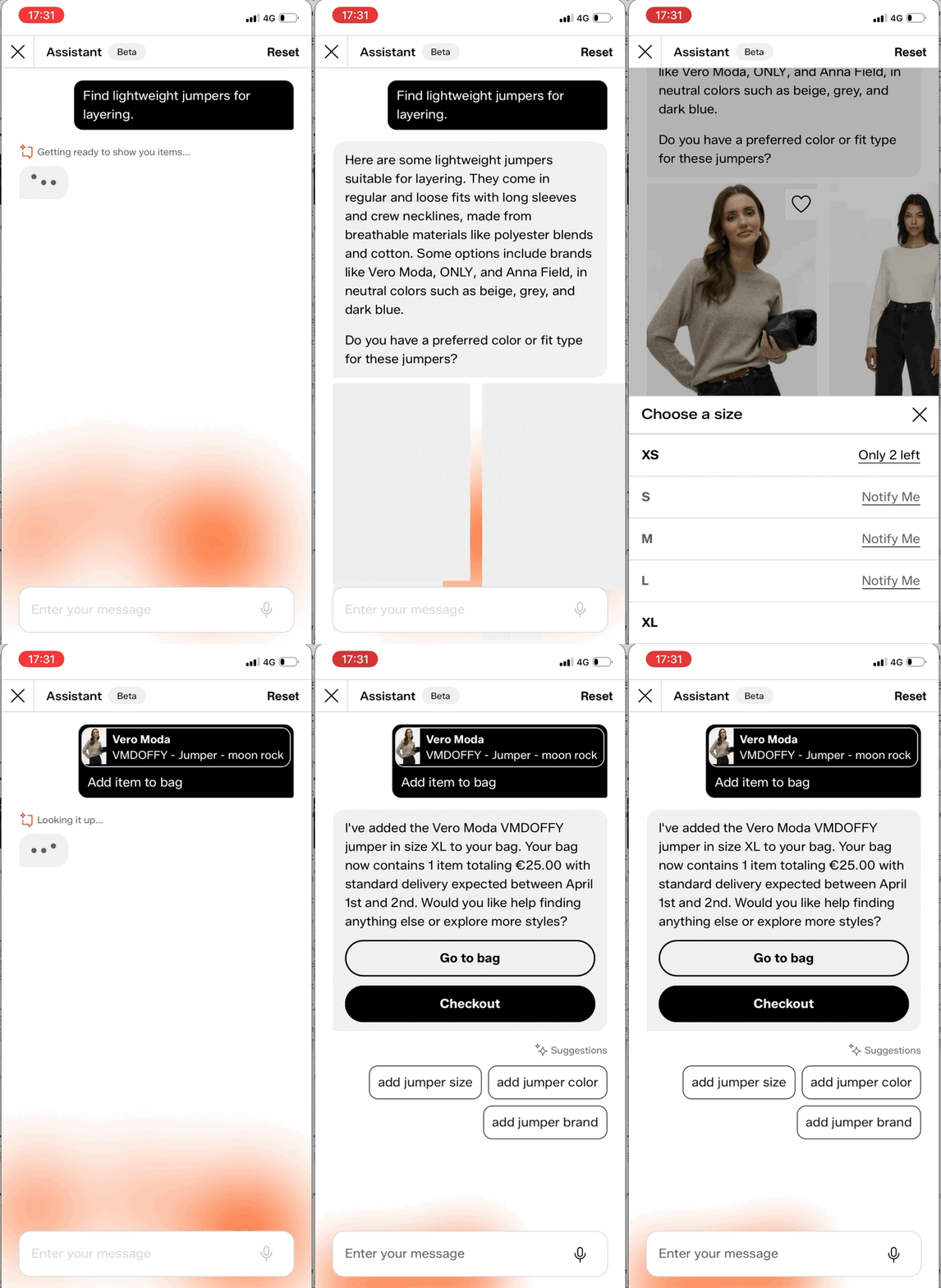
To effectively design, develop and iterate agentic experiences, you need a framework and workflows that allow you to understand and modify the CX variables in a systematic, observable and controlled way based on your customer and business goals. Similarly, the workflows should allow you to create shared language across job disciplines and stakeholders, empowering everyone in the team — humans and agents alike — to build towards the same goals.
Such a framework and related workflows aren’t born automatically when you explore and experiment with different AI tools and tech stacks to build agentic experiences. Rather, you need to intentionally build towards them. So how might you get started?
Clarify your purpose and key use cases
What are you building towards and which use cases are critical for your customers and business? How does your solution and process create customer and business value? What kind of a setup enables the team and your organization to achieve its goals? Answering these questions forms a critical foundation that enables you to navigate the ambiguity in the fast-moving agentic CX and tech landscape.
At Zalando, we believe that agentic AI will transform the ecommerce business: the shopping experiences and the way they are designed and built. The agentic change spans from customer-facing experiences to internal tooling and logistics.
Purpose becomes even more critical in the age of agents because the system is no longer only presenting options but can increasingly make decisions, initiate actions and shape journeys on behalf of the customer. You need to be clear what kind of autonomy is desirable, where it creates value and where it creates unnecessary risk, friction or cost. In many cases, the best solution is not full autonomy, but carefully calibrated autonomy: the right balance between user control and proactive system initiative.
Define the core CX variables
Do you and your teams have a shared understanding of how different elements and underlying capabilities contribute to creating the experience? CX variables can be split into two main buckets: visible elements (UI/UX, content) and under-the-hood capabilities (data, models, agentic features of state, memory, tools, goals and policies).
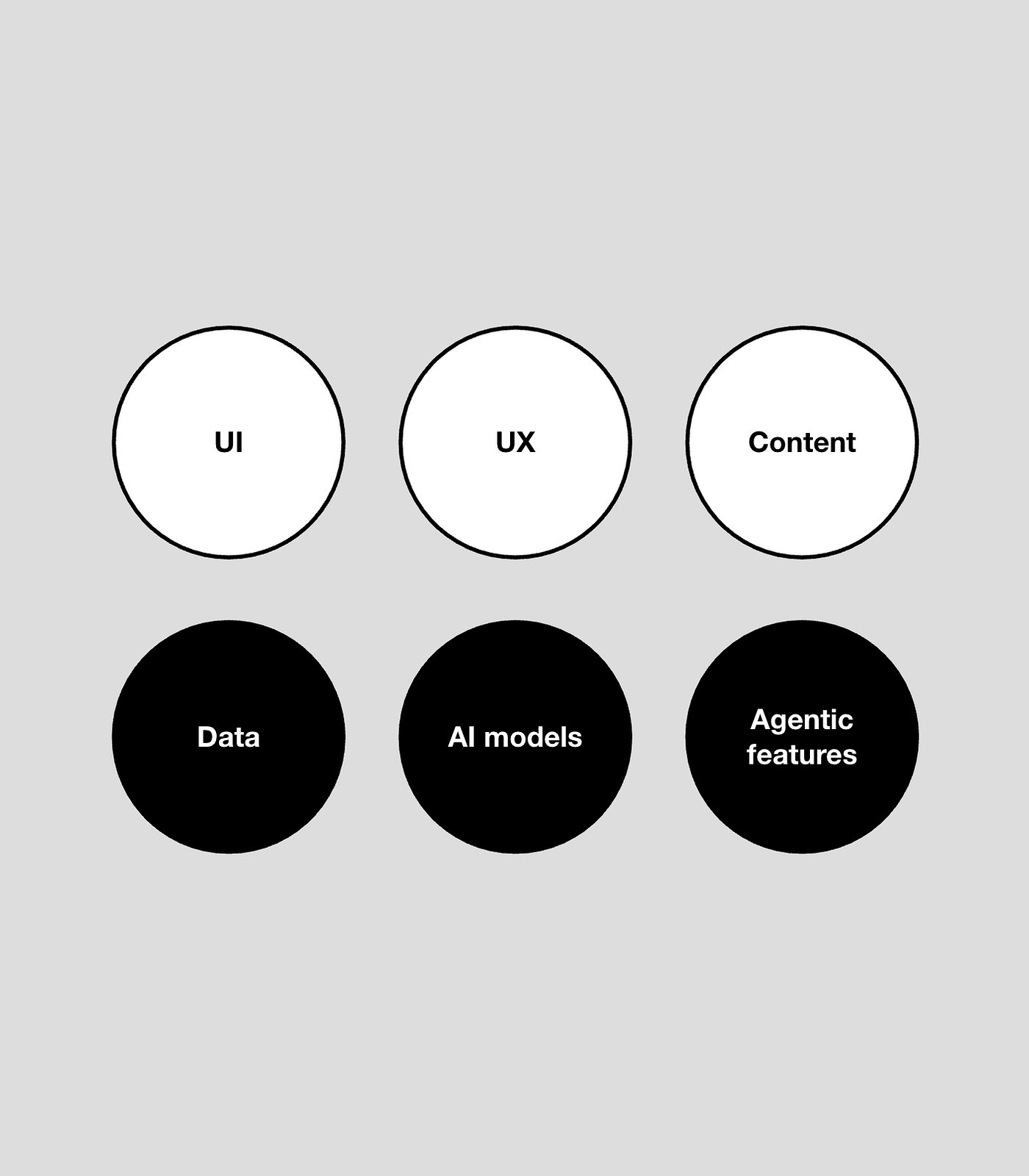
The core CX variables
Start by creating a shared understanding of how the visible and unseen variables come together in the current experience: this is UI/UX, these are the content, data and memory being used, these are the model(s) and tools that orchestrate the experience, this is the policy logic and these are the goals being optimised for. Creating such a shared understanding gives you a critical baseline to start assessing how the variables contribute to the experience and how modifying them might change it or build towards a future target state.
Importantly, these variables are not independent ‘knobs’. They form an interdependent system whose behaviour needs to be observed empirically. A change in memory logic, ranking model or approval threshold can have as much impact on the customer experience as a change in interface or content.
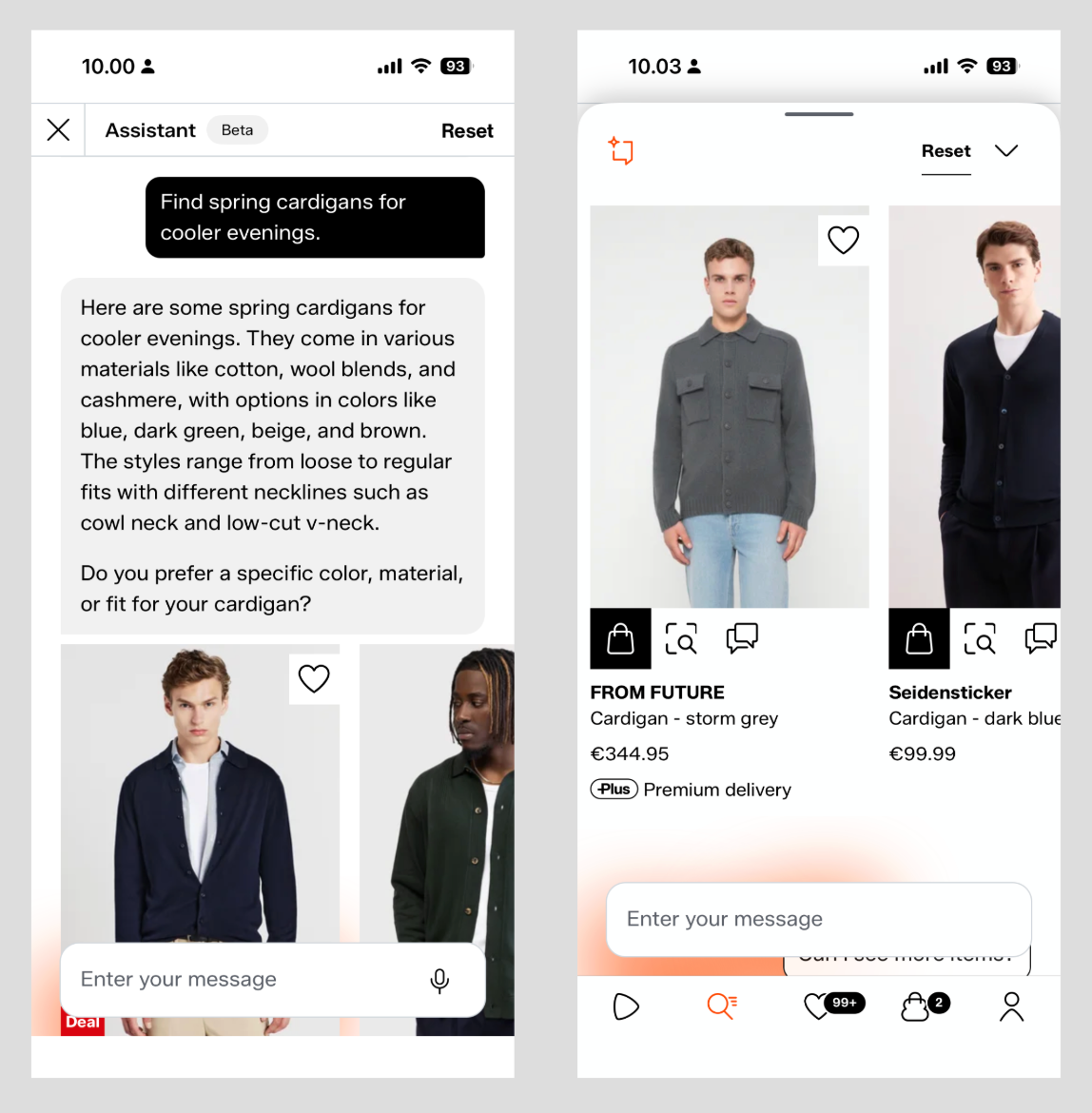
In Zalando Assistant, we perform continuous experimentation and A/B testing to understand how different CX variables and their changes affect the experience.
In agentic experiences, visibility itself becomes a design variable: what should remain visible and controllable for humans, what can be abstracted away and what must always remain visible and controllable.
Develop a workflow for modifying and iterating CX variables
The agentic era, with its transforming job descriptions and roles, requires us to rethink design and development workflows. To build functioning multidisciplinary agentic workflows with the right tools, product design needs to partner with other job disciplines, especially engineering and product, to build a concretely shared working flow and environment. This type of environment should allow product designers, engineers, data scientists, product and business people to collaboratively contribute to the evolution (and revolution) of the experience. Similarly, it should allow the team to fluidly and seamlessly bring and orchestrate agents in the workflows.
Imagine a tooling view of your experience that allows you to see how the different CX variables come together, enabling you to modify and compare the resulting CX in one view. The tooling should allow you to control and connect agents and tools (e.g. MCPs) that can then modify UI, UX, content, data, models and agentic features, informed by simulations and evals. It should also enable teams to inspect state, memory, goals, actions, approvals and outcomes so that the system behaviour becomes more accessible and observable across disciplines.
Any existing AI design or vibe coding tool doesn’t offer this kind of workflow off the shelf. The more dynamic the experience, the more it requires simulation and online/offline evaluation capabilities, since the variations and permutations of the variables can’t be captured by humans alone. You need to figure out through exploration, testing and iteration what works best for your team and organisation.
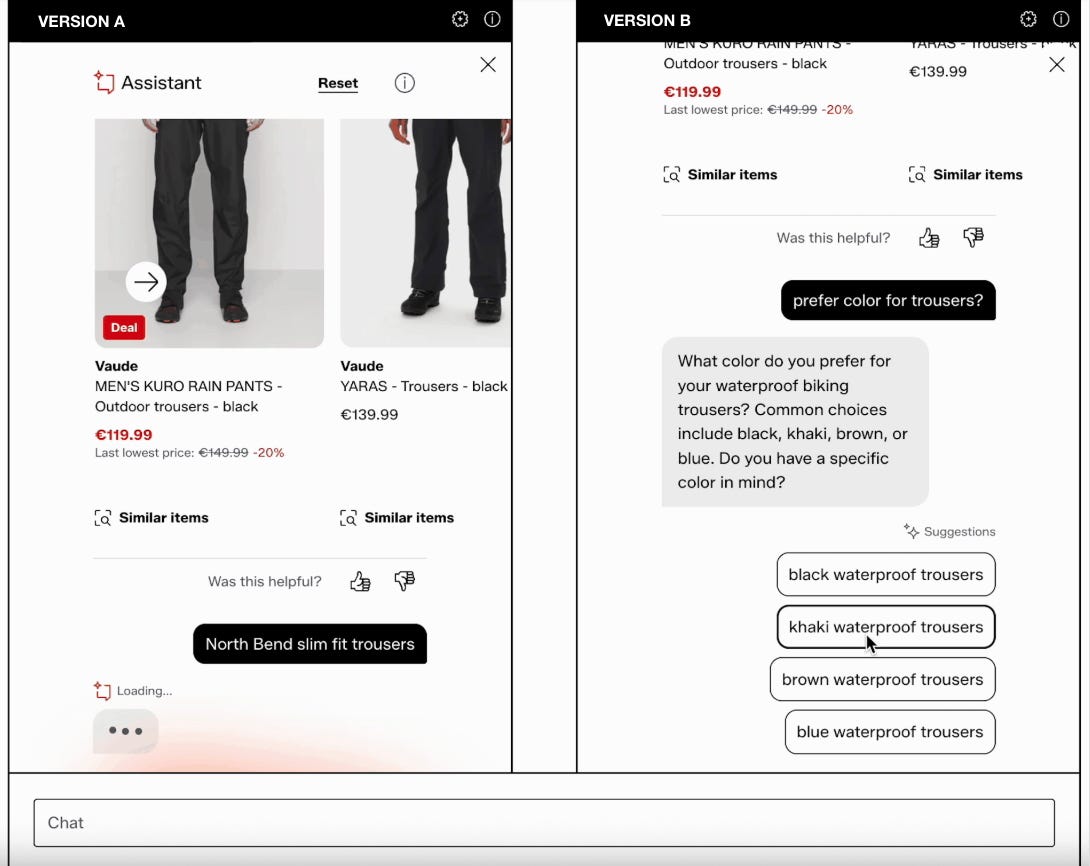
In Zalando Assistant, we’ve created a tooling view for the team that allows us to compare the CX created by different prompt versions, customer data points, AI models and agentic features such as memory.
For agentic systems, such workflows also need to support decisions around autonomy and accountability. What can the system do without asking? Which actions require explicit approval? Which actions are reversible, and which are not? How should the system communicate confidence, uncertainty and next steps? From a workflow perspective: who owns the policies, prompts, models, memory and evaluation logic? The more capable the system becomes, the more important it is to make these decisions explicit instead of leaving them implicit between job functions.
Create a baseline and tooling for CX quality evaluation
The more dynamic and agentic the experience becomes, the less sufficient traditional design reviews, user tests and quality assurance methods become. You need evaluation capabilities that allow you to assess not only whether the experience looks and feels right, but whether it performs, behaves and creates the impact you’re after.
This means evaluating agentic experiences across multiple layers. At the most basic level, can the agent complete the task successfully? Beyond that, how helpful, proactive, coherent and trustworthy does the experience feel? How often do users need to intervene, correct or override? What kind of business impact does the experience create? What kinds of risks, failures or unintended outcomes emerge over time?
In practice, this requires a combination of qualitative research, high-fidelity prototyping, offline evals, simulations, online experiments and continuous monitoring in production. It also requires teams to agree on what “good” actually means across customer value, business value and system reliability.
Design for trust, failure and recovery
Agentic experiences are not only defined by how well they perform when everything works. They’re equally defined by how they behave when they are uncertain, wrong, interrupted or operating without necessary contextual knowledge. This requires teams to intentionally design beyond the ideal, ‘happy’ path.
How should an agent make its actions visible, or, for example, communicate uncertainty? When should it ask for clarification, and when should it proceed based on best judgement? How can a customer inspect, correct or reverse an action? What happens when memory is wrong, context is incomplete, the agent fails to use a tool or the model chooses the wrong next step? As systems become more proactive and semi-autonomous, managing failures gracefully through auditability, rollback and recovery become essential design topics, not just technical ones.
In evolving Zalando’s agentic tooling landscape, we’ve worked on foundational features related to agent observability, authentication, access management and related guardrails. Addressing such topics is pivotal in creating compliant and trustworthy agentic tooling at scale.
This is where human-centric design becomes even more important. Trust in agentic experiences is built not only through intelligence, but through usability, explainability and control. Customers and internal users alike need to understand what’s happening, why it’s happening and what they can do when they disagree with the system.
Be tool and tech agnostic to find the right tools and processes
Don’t chase the latest AI tool; focus instead on figuring out what tools you need to create value for your customer and business. There is no one AI tool or platform currently available that provides a way to take your idea from concept straight to market-ready and compliant digital product, and then iterate it forward by effectively combining and modifying the core CX variables.
Different AI tools come with different features and limitations. You need to figure out the tool stack, model environment, baseline agentic setup and data landscape that works for you. The requirements for choosing the right tools for the task depend on your organisation’s mission, working culture, existing systems and the company’s specific requirements, especially in relation to data, privacy, security and legal topics.
In Zalando Product Design, we’re working closely with our Engineering, Applied Science and Product partners in defining the requirements and finding the scalable tools for multidisciplinary workflows, bridging the gap between design and code.
At the same time, it’s important to recognise that not every use case benefits from agentic behaviour. In some cases, a simpler deterministic flow, transparent interface or classic recommendation system may create a better and more efficient experience. The goal is not to make every experience autonomous, but to identify where proactive and delegated behaviour creates disproportionate value compared to the complexity, risk and operational cost it introduces.
Success in agentic CX is mission driven
To drive product design in today’s agentic world requires us to rethink the foundational design inputs, outputs and workflows, and to embrace a cross-functional approach.
Not every AI-powered experience is truly agentic. Until it can interpret goals, select or plan actions, use tools, operate with some persistence across steps, and adapt its behaviour based on feedback or state (within bounded autonomy), a conversational interface or recommendation system alone does not yet make an agentic experience.
The agentic ways of working have the potential to super charge your organisation when they’re built around the mission, purpose and values of your team, not around the tools or technologies. And agentic experiences that succeed are not defined only by intelligence or automation, but by how well they solve concrete customer problems, balancing initiative with control, adaptability with explainability, and autonomy with accountability.
메타데이터
- post_id
- b1eb3095c979
- slug
- how-to-build-agentic-cx-frameworks-transitioning-from-static-to-agentic-workflows-b1eb3095c979
- url
- https://medium.com/zalando-design/how-to-build-agentic-cx-frameworks-transitioning-from-static-to-agentic-workflows-b1eb3095c979
- canonical_url
- https://medium.com/zalando-design/how-to-build-agentic-cx-frameworks-transitioning-from-static-to-agentic-workflows-b1eb3095c979
- author_url
- https://medium.com/@ilparone
- status
- ok
- fetched_at
- 2026-06-12 18:20:59