We Could Have Won This Case — Here’s the Constitutional Argument That Mattered
Why Administrative “Election Integrity” Has a Dangerous History
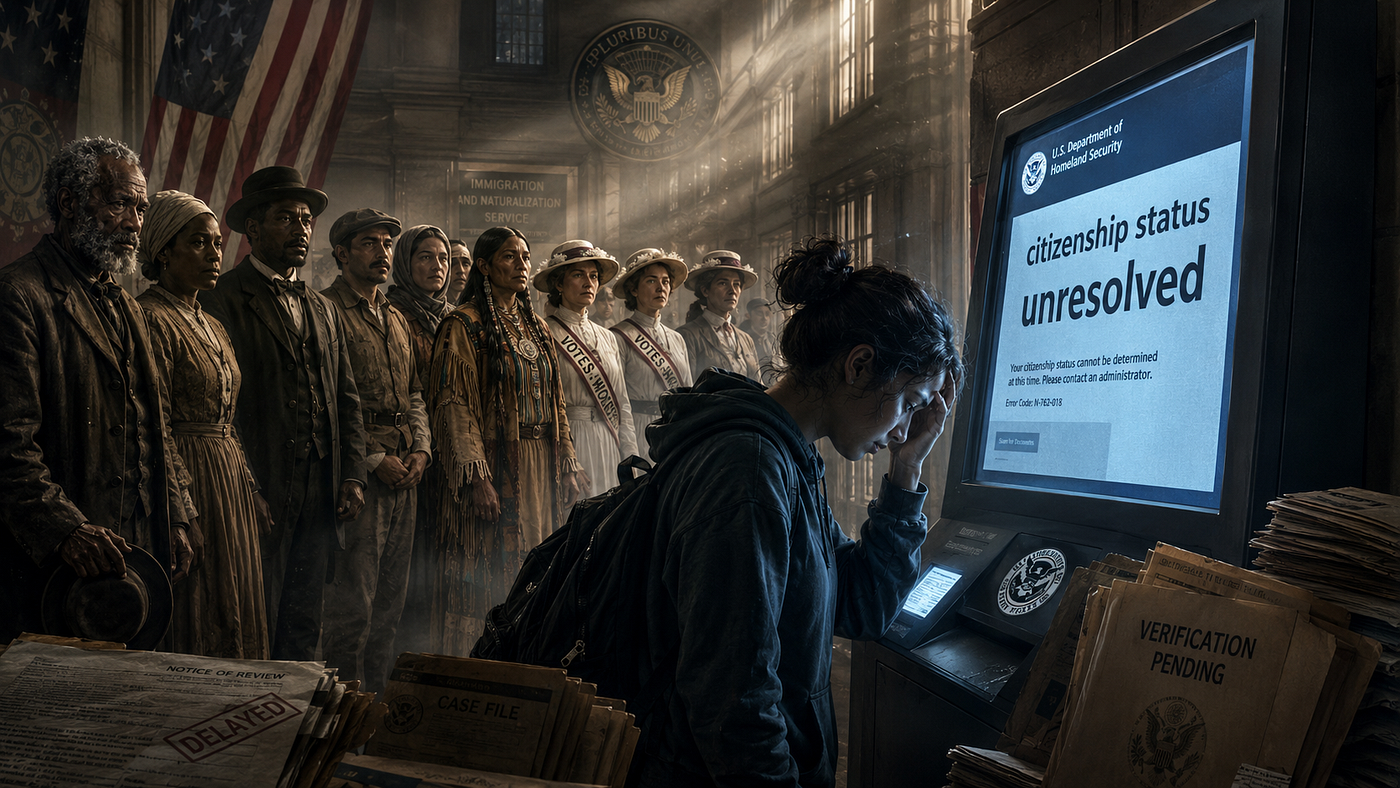
(AI-generated image | created by author using Image Generator PRO)
THE BUREAUCRATIC PATH TO DISENFRANCHISEMENT: THE CONSTITUTIONAL ARGUMENTS THE COURT REFUSED TO CONFRONT
We Could Have Won This Case — Here’s the Constitutional Argument That Mattered
Why Administrative “Election Integrity” Has a Dangerous History
Historical Patterns of Voter Suppression and the Legal Dangers of Federally Curated Citizenship Lists for Mail Balloting
Introduction
US District Judge Carl Nichols’ recent refusal to bar a federal executive directive conditioning mail-ballot access upon federally compiled citizenship lists represents a profound constitutional and historical rupture within the American electoral tradition (Nebria, 2026).
Although framed rhetorically as an anti-fraud initiative under Article II authority, such a scheme will likely reproduce some of the most infamous patterns of voter suppression and disenfranchisement in United States history; particularly where bureaucratic gatekeeping mechanisms were historically weaponized against marginalized populations (Davis, 2023).
The judge’s assertion that “no harm has yet occurred” ignores a long and well-documented jurisprudential and sociopolitical reality: disenfranchisement often begins not with visible violence, but with administrative architecture. Historically, American voter suppression has rarely announced itself openly as exclusion (Wang, 2012).
Rather, it has repeatedly emerged through ostensibly neutral procedural mechanisms: poll taxes, literacy tests, grandfather clauses, voter purges, documentary requirements, and racially skewed registration systems that disproportionately burdened targeted populations while maintaining superficial constitutional legitimacy (Keyssar, 2009; Alexander, 2010).
Here, I establish the proposed federal compilation of citizenship lists for ballot eligibility will therefore not arise in a constitutional vacuum. It will emerge within a deeply established historical continuum in which administrative “verification” systems have repeatedly functioned as instruments of selective democratic exclusion.
I. Historical Foundations of Administrative Disenfranchisement
A. Reconstruction, Redemption, and the Bureaucratization of Exclusion
Following Reconstruction, Southern states developed increasingly sophisticated mechanisms to suppress Black political participation while nominally complying with constitutional amendments (Bass, 1995; Foner, 1988).
Poll taxes, literacy tests, property requirements, and understanding clauses were frequently justified under the language of “electoral integrity” and “qualified citizenship” (150 Years and Counting, 2020; Foner, 1988).
The Supreme Court’s failure for decades to meaningfully intervene enabled these systems to calcify into institutional norms (Massey, 2011; Clawson et al., 2008).
Importantly, many of these barriers were administered through local bureaucratic discretion, allowing officials enormous latitude in determining eligibility and documentation standards (Weinstein-Tull, 2018; Kousser, 1971).
This historical parallel is critical. The federal directive similarly centralizes eligibility determination through governmental list-making processes that could inevitably inherit inaccuracies, omissions, and unequal implementation. Historically, bureaucratic discretion has rarely operated neutrally in politically charged environments (Koven, 2019).
As political scientists Joe Soss and Vesla Weaver (2017) note, administrative systems frequently become “sites of democratic inequality,” where procedural mechanisms disproportionately burden vulnerable populations under the guise of neutrality.
B. Jim Crow Documentation Systems as Precursors
The proposed citizenship-list framework strongly resembles prior systems requiring documentary proof before civic participation could occur. Such mechanisms historically harmed:
- African Americans in the Jim Crow South,
- Native Americans lacking standardized birth records,
- poor rural whites,
- immigrant communities,
- elderly citizens,
- and transient labor populations (Bier, 2023; Piven & Cloward, 2000).
Even minor discrepancies in documentation historically resulted in exclusion. Modern scholarship has repeatedly demonstrated that voter-identification and documentary-proof systems disproportionately impact minority voters due to disparities in access to records, transportation, economic resources, and bureaucratic navigation capacity (Hajnal et al., 2017).
The danger is not theoretical abstraction. Federal citizenship databases themselves are notoriously imperfect (Maxwell & Tomlinson, 2022; Brown et al., 2018).
Government audits have repeatedly found inaccuracies in immigration and citizenship databases, including false positives and mismatched records (State of Surveillance, 2025; Incomplete and Garbled EOIR…, 2019).
Accordingly, I affirm requiring federally curated citizenship lists before ballot distribution risks structurally disenfranchising legally eligible voters through inevitable bureaucratic error.
II. Constitutional Concerns
A. Elections Clause and Federalism
Plaintiffs’ case correctly identifies a fundamental constitutional concern: the Elections Clause grants primary authority over the “Times, Places and Manner” of federal elections to state legislatures, subject to congressional regulation, not unilateral executive restructuring (U.S. Const. art. I, § 4, 2024).
While Article II grants the executive branch certain enforcement powers, it does not authorize unilateral redesign of national electoral access mechanisms absent explicit congressional authorization (Lewis, 2025).
Historically, courts have viewed executive encroachment into election administration with considerable skepticism when it risks upsetting federal-state balances (Bulman-Pozen & Seifter, 2022; Schleicher, 2016).
Moreover, the Supreme Court has repeatedly emphasized voting as a fundamental constitutional right preservative of all other rights (Douglas, 2016; Levinson, 2011; Yick Wo v. Hopkins 1886 | Encyclopedia.com, 2026). Policies burdening access therefore trigger heightened scrutiny when they risk unequal or arbitrary exclusion.
B. Equal Protection and Disparate Impact
Even facially neutral voting policies may violate constitutional principles if they produce disproportionate discriminatory effects. In Harper v. Virginia Board of Elections (1966), the Supreme Court recognized that wealth or payment of a fee has no relation to a person’s qualifications to vote; this violated the Equal Protection Clause of the Fourteenth Amendment and was therefore unconstitutional.
Likewise, Anderson v. Celebrezze (1983) established that courts must weigh burdens placed upon voters against governmental interests asserted in justification.
Here, the purported governmental interest, fraud prevention, appears constitutionally weak given overwhelming empirical evidence that widespread voter fraud in mail balloting is exceedingly rare (Katz & Angel, 2025; Auerbach & Pierson, 2021).
As precedent, comprehensive studies repeatedly demonstrate that voter impersonation and mail-ballot fraud occur at statistically negligible rates (Katz & Angel, 2025; Minnite, 2010). The Brennan Center for Justice similarly concluded that fraud rates range between 0.0003% and 0.0025% (Brennan Center for Justice, 2017).
Thus, courts could reasonably conclude that severe burdens imposed upon lawful voters will be grossly disproportionate to the speculative harm allegedly prevented.
III. Administrative Harm Occurs Before Final Exclusion
The judge’s reasoning: intervention is premature because implementation has not yet occurred, ignores extensive historical precedent showing that the chilling effect of restrictive election systems often begins immediately upon announcement (Weingast & Wittman, 2008; Calingaert, 2006).
Historically:
- Black voter turnout plummeted following literacy-test announcements before full implementation,
- Native American participation declined amid documentary uncertainty,
- and modern voter-purge announcements frequently deter lawful participation due to confusion and fear of rejection (Bentele & O’Brien, 2013).
Political scientists have long observed that uncertainty itself functions as a suppressive mechanism. Citizens uncertain of eligibility frequently self-select out of participation rather than risk humiliation, prosecution fears, or bureaucratic rejection (Sugie et al., 2024; Hasen, 2012).
Thus, the injury is not merely speculative future harm; the administrative threat itself alters democratic participation behavior (Macedo, 2006)
IV. USPS Weaponization Concerns
The involvement of USPS introduces additional constitutional and ethical complications. Historically, American postal infrastructure has often been treated as a quasi-public democratic utility essential for civic participation and communication (John, 1995).
I contend transforming USPS into an enforcement arm of citizenship verification risks politicizing an institution historically designed to facilitate — not condition — public participation.
This concern is amplified given modern controversies surrounding mail ballot delays, postal operational changes, and partisan disputes over absentee voting access (Herrnson & Stewart, 2023; Herron & Smith, 2021).
In practical effect, such a directive could convert ballot delivery from a presumptive civic right into a conditional administrative privilege.
V. The Broader Democratic Danger
From an anthropological perspective, democratic erosion rarely begins through overt abolition of elections. More commonly, democratic backsliding emerges incrementally through procedural narrowing of participation under bureaucratic justification (Levitsky & Ziblatt, 2018).
Historically, regimes drifting toward democratic instability often:
- invoke fraud narratives unsupported by empirical evidence,
- centralize administrative control,
- redefine eligibility standards,
- and burden participation asymmetrically.
The danger therefore lies not solely in the order itself, but in the institutional precedent it establishes: namely, that executive authorities may unilaterally redefine electoral access mechanisms under broad claims of national integrity (Executive Order on Elections…, 2025).
Once normalized, such frameworks historically expand rather than contract.
Verdict
Judge Nichols’ refusal to proscribe this executive directive reflects a dangerously narrow conception of constitutional injury detached from America’s long history of administrative disenfranchisement.
The United States possesses a deeply documented historical pattern in which bureaucratic “integrity” measures repeatedly functioned as instruments of voter suppression, particularly against marginalized communities (Norris, Cameron & Wynter, 2019).
Poll taxes, literacy tests, documentary requirements, voter purges, and registration barriers were similarly defended as neutral procedural safeguards (DeRienzo, 2020). History demonstrates otherwise.
The constitutional right to vote cannot depend upon flawless bureaucratic compilation systems, especially where the alleged governmental threat, mass voter fraud, remains empirically inconsequential. To permit centralized, federal, citizenship-list-conditioning of mail-ballot access risks recreating historical systems of exclusion under modern administrative language (VOTING RIGHTS AND ELECTION…, 2019).
Courts need not countdown until disenfranchisement becomes fully operationalized to recognize constitutional danger: American judiciary history has already shown where such pathways lead (Siegel, 2019).
I also warmly invite you to dive into the incredible work of the writers listed below — among many other brilliant voices worth exploring!
❤️ ❤️ Never Give Up Ninja ❤️ ❤️; Angelo 🕯️🇨🇴; Annie Trevaskis; Arashhadad; Ari Love; Ashley Heacock; Asuquo kevin; Author Peter | Lawyer| MBA…; Bee Rose; Bella George; Beverly Green; Brittney Leigh; Chasing A Dying Empire; Chrystal Comments; cindee D Renee; Debbra Lupien, Voice of the…; Dr. Tarannum Shaikh; Edger Ai Bington; Edward Richardson; Elwood Watson, Ph.D.; Emma Rose 🌹 Purposeful Poetry; Emma. T; Ernesto DR Santibanez Gonzalez; Ethan Siegel; F. Perry Wilson, MD MSCE; Gloria Geiser; HodHoda; Jeannie.Chambers; Jerry Glazer; Julia Kalman; Julie Leah Blooms; Kenta Tsushima; Laurel Sibanda; Linh Huynh; London II; Malicyoung; Mallick Speaks; Manas_ Das; Marziya🤩😍🥳❤️🎉😇; Maya D’Souza;modester-aish; MSoul; Naima Khachab; Nate McCallister 💡; New Earth Institute; Nimkeek; Paulina Rau; Pragya Jain; Rana Asad; Ravinimbus; RICH CHOI; Robert G. Longpré [he / him]; Shahid Mahmood; Shaant; Sneha Lodha; Soulful Journey; Steamy Storyteller | Passion Through Words; Stephen Dalton; Stuart Aken; Tehniat Zakir S.; …Douglas Wayne Goff; Tim Andersen, Ph.D.; Trish Church; Uss varma; Vera Byron; Vishnu Kumawat
Disclaimer: If you prefer not to be included in the above writer’s link, please let me know, and I’ll respectfully remove your name. 🤗
메타데이터
- post_id
- b1ef00a645d0
- slug
- we-could-have-won-this-case-heres-the-constitutional-argument-that-mattered-b1ef00a645d0
- url
- https://medium.com/the-polis/we-could-have-won-this-case-heres-the-constitutional-argument-that-mattered-b1ef00a645d0
- canonical_url
- https://medium.com/the-polis/we-could-have-won-this-case-heres-the-constitutional-argument-that-mattered-b1ef00a645d0
- author_url
- https://medium.com/@jedts
- status
- ok
- fetched_at
- 2026-07-10 19:34:48