Why SOLID Matters for Pythonistas
The moment when your “quick script” becomes a “core system.”
Why SOLID Matters for Pythonistas
The moment when your “quick script” becomes a “core system.”
The Problem: The “Swiss Army Knife” Function
Imagine you have a class that calculates the area of shapes. Without OCP, every time you add a new shape (like a Triangle), you have to modify the existing class.
# BAD: Non-OCP approach
class AreaCalculator:
    def calculate(self, shape):
        if shape.type == "square":
            return shape.side ** 2
        elif shape.type == "circle":
            return 3.14 * (shape.radius ** 2)
        # Every time you add a shape, you MUST modify this file.
It started small.
One file.
One function.
A couple of if statements.
Six months later? You’re afraid to change anything because touching one line breaks three unrelated things.
That’s when you realize:
Python’s flexibility is a gift. But without discipline… it becomes curse.
Enter: SOLID principles.
🧠 My Learning Strategy: Stay Curious, Stay Sharp
- What Are SOLID Principles in Python?
- When Should You Apply Them?
- Why Are They More Important in Python?
- Where Do They Matter Most?
- Who Actually Benefits?
- How Do You Apply OCP the Right Way?
What Are SOLID Principles in Python?
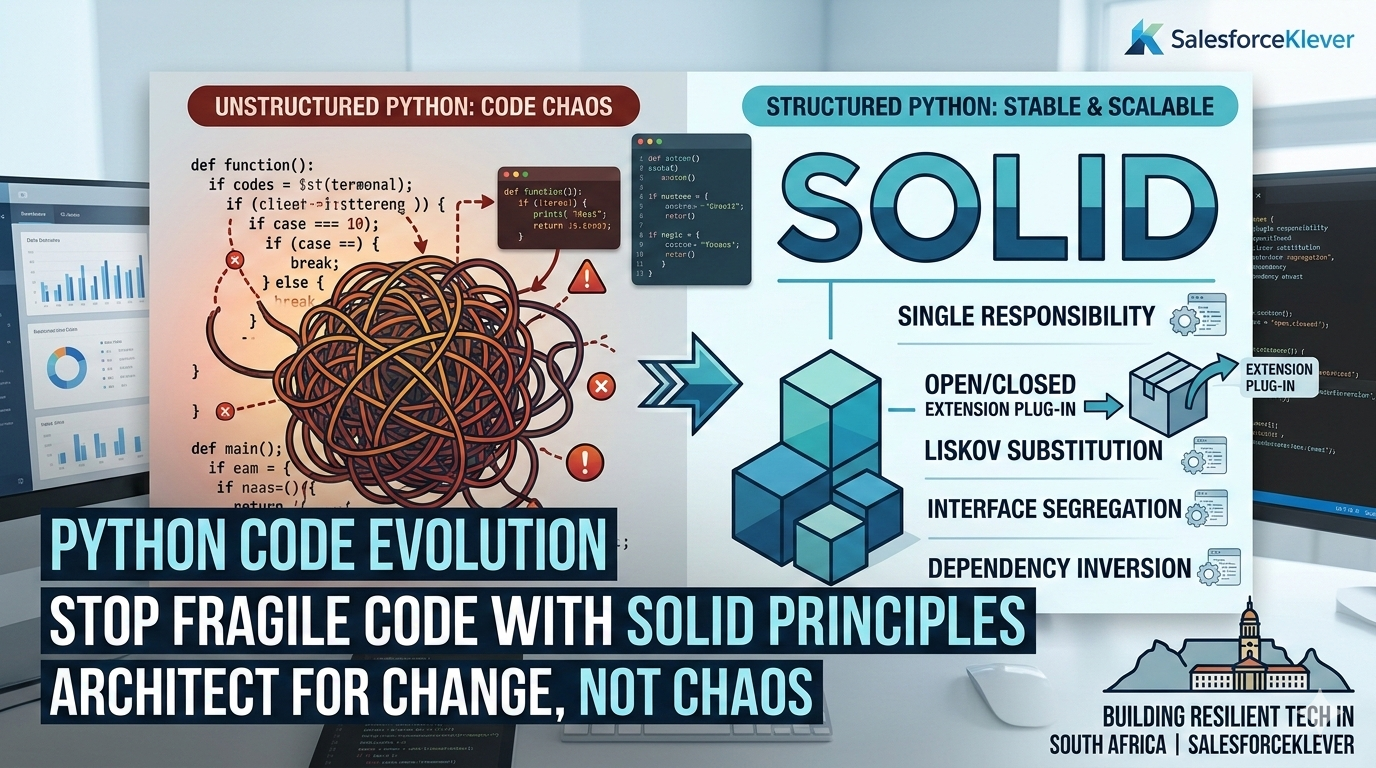
SOLID stands for:
- Single Responsibility
- Open/Closed
- Liskov Substitution
- Interface Segregation
- Dependency Inversion
They are not “Java rules.”
They are architecture survival rules.
In strict languages like Java or C++, the compiler forces structure.
Python doesn’t.
Which means structure is your responsibility.
When Should You Apply SOLID?
- When your project moves beyond “just a script.”
- When multiple developers touch the same codebase.
- When business rules evolve.
- When refactoring feels risky.
If you’re building something meant to live longer than a weekend, SOLID matters.
Why Is SOLID More Important in Python?
Because Python lets you:
- Add attributes dynamically.
- Monkey patch functions.
- Modify objects at runtime.
- Drop logic into giant functions without resistance.
It feels productive.
Until it isn’t.
Without structure, Python projects quietly become spaghetti.
Not because Python is bad.
But because Python trusts you.
Let’s Focus on One: The Open/Closed Principle (OCP)
Software entities should be open for extension but closed for modification.
Translation?
Add new behavior without changing stable code.
The Problem: The “Swiss Army Knife” Function
Here’s what happens without OCP:
class AreaCalculator:

    def calculate(self, shape):
        if shape.type == "square":
            return shape.side ** 2
        elif shape.type == "circle":
            return 3.14 * (shape.radius ** 2)
        # Every new shape forces modification here.
Every time you add:
- Triangle
- Pentagon
- Hexagon
You must reopen this file.
Modify working logic.
Risk breaking existing shapes.
One indentation mistake? Production issue.
That’s fragility.
Why This Becomes Dangerous at Scale
1️⃣ Regression Risk
You edit old code → old logic can break.
2️⃣ Merge Conflicts
Two developers add two shapes → both modify the same file.
3️⃣ Test Explosion
Each new condition interacts with all previous ones.
Complexity grows exponentially.
The Solution: Extension via Polymorphism
Now we introduce discipline.
from abc import ABC, abstractmethod

# The "Closed" contract
class Shape(ABC):
    @abstractmethod
    def get_area(self):
        pass

# Extensions
class Square(Shape):
    def __init__(self, side):
        self.side = side

    def get_area(self):
        return self.side ** 2

class Circle(Shape):
    def __init__(self, radius):
        self.radius = radius

    def get_area(self):
        return 3.14 * (self.radius ** 2)

# Stable function
def print_area(shape: Shape):
    print(f"Area: {shape.get_area()}")
Now what happens when we add Triangle?
We create:
class Triangle(Shape):
    def __init__(self, base, height):
        self.base = base
        self.height = height

    def get_area(self):
        return 0.5 * self.base * self.height
We don’t touch print_area.
We don’t touch Square.
We don’t touch Circle.
We extend.
That’s OCP.
Where Does This Matter Most?
- Plugin systems
- Web frameworks
- Payment gateways
- File processors
- Rule engines
- API integrations
Anywhere behavior evolves.
OCP is the foundation of clean plugin architecture.
Who Benefits?
👨💻 Developers
Less fear when adding features.
🧪 Testers
Only test new logic — not retest everything.
👥 Teams
Fewer merge conflicts.
🏢 Businesses
Faster iteration without destabilizing systems.
The “Pythonic” Trade-Off
Let’s be honest.
Python culture values simplicity.
The Zen of Python says:
“Simple is better than complex.”
SOLID does not mean:
- 15 interfaces for a Hello World app.
- Over-engineered abstractions.
- Academic architecture.
There’s a difference between:
Over-Engineered vs Structured
You don’t build architecture for ego.
You build it when volatility demands it.
Pro Tip: Advanced Python OCP
Beyond inheritance, Python allows:
- Decorators to extend behavior
- Composition over inheritance
- Dependency injection for testability
- Strategy patterns via callable objects
But remember:
Just because Python allows monkey patching doesn’t mean production should.
Discipline > cleverness.
Gotchas ⚠️
“Isn’t this more code?”
Yes.
But controlled complexity is better than hidden complexity.
“Do I need SOLID for small scripts?”
No.
Architecture should follow pain.
If the code changes often → structure it.
If it doesn’t → keep it simple.
💭 Final Thought
You don’t follow SOLID to impress textbooks.
You follow it so that: Six months from now…
You don’t open your own code and feel betrayed by your past self.
Python gives you freedom. SOLID gives you control and great engineers balance both.
That’s the PythonKlever way.
메타데이터
- post_id
- b1f22f05d26c
- slug
- why-solid-matters-for-pythonistas-b1f22f05d26c
- url
- https://medium.com/@kmniroi/why-solid-matters-for-pythonistas-b1f22f05d26c
- canonical_url
- https://medium.com/@kmniroi/why-solid-matters-for-pythonistas-b1f22f05d26c
- author_url
- https://medium.com/@kmniroi
- status
- ok
- fetched_at
- 2026-06-15 20:49:13