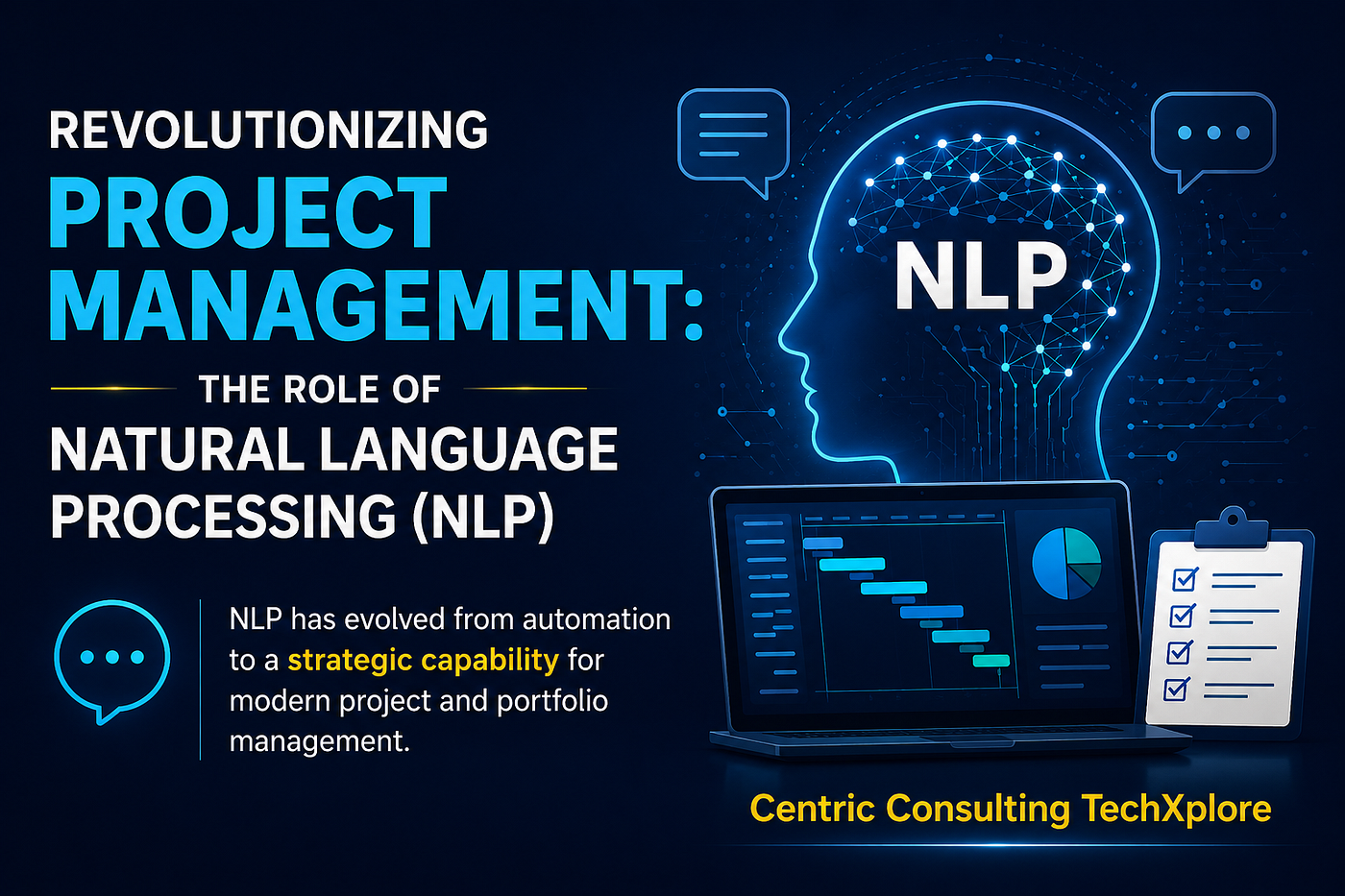
Revolutionizing Project Management: The Role of Natural Language Processing (NLP)
Introduction
Revolutionizing Project Management: The Role of Natural Language Processing (NLP)
Introduction
Artificial Intelligence is transforming project management by improving efficiency, visibility, and decision-making. Among its most impactful capabilities is Natural Language Processing (NLP), a branch of AI that enables systems to understand, analyze, and generate human language.
As project environments become increasingly complex, leaders must process large volumes of information spread across emails, meeting notes, chat conversations, requirements documents, and status reports. NLP helps convert this unstructured information into actionable insights, enabling faster decisions and more effective project delivery.
With the advancement of large language models (LLMs) such as GPT-4, BERT, and T5, NLP has evolved beyond simple automation to become a strategic capability for modern project and portfolio management.
Why NLP Is Becoming Essential in Project Management
Project and portfolio leaders are under increasing pressure to make timely decisions with fragmented and constantly changing information. Traditional reporting approaches often rely on manual effort, delayed updates, and disconnected tools that struggle to keep pace with modern delivery environments.
Natural Language Processing addresses this challenge by transforming everyday project communications and documentation into real-time, decision-ready intelligence.
NLP enables organizations to:
- Analyze large volumes of unstructured project data.
- Automate documentation and reporting activities.
- Improve communication clarity and alignment.
- Detect emerging risks and delivery concerns earlier.
- Provide conversational access to project intelligence.
By reducing the time spent collecting and interpreting information, project leaders can focus more on decision-making, stakeholder engagement, and strategic execution.
Understanding Natural Language Processing (NLP)
Natural Language Processing (NLP) is a branch of artificial intelligence that enables systems to understand, analyze, and respond to human language. It powers capabilities such as text analysis, summarization, sentiment detection, and conversational automation.
Within project management, NLP is applied to large volumes of unstructured information including emails, meeting notes, requirements documents, chat conversations, and status updates. By extracting meaning, trends, and signals from this data, NLP helps streamline workflows, reduce interpretation gaps, and surface insights that would otherwise remain hidden in manual reporting.
In project environments, this means leaders spend less time interpreting data and more time acting on insight.
Press enter or click to view image in full size

Where NLP Delivers Tangible Value in Project Management
These capabilities shift project management from administrative tracking to continuous decision support. One of the most immediate benefits of NLP is automated documentation and reporting. Status updates, meeting summaries, and executive reports can be generated automatically, improving speed and consistency while reducing manual effort. Natural language commands further simplify routine actions such as scheduling reviews, updating tasks, or generating dashboards.
NLP also enhances communication quality and alignment. Writing assistance and automated summarization reduce ambiguity and information overload, enabling teams to focus on execution rather than administration.
A growing area of value is sentiment analysis and delivery health monitoring. By analyzing tone and language patterns in project communications, NLP can surface early indicators of delivery pressure, stakeholder dissatisfaction, or team fatigue. This enables proactive leadership intervention rather than reactive escalation.
NLP strengthens requirement clarity and traceability by extracting action items, risks, and dependencies directly from documents and discussions, improving reliability, and reducing missed commitments.
Finally, NLP-powered virtual assistants provide intuitive access to project intelligence. Stakeholders can query project status, risks, and capacity conversationally, accelerating insight consumption and decision-making.
Strengthening Enterprise Portfolio and Program Management (EPPM)
At scale, the value of NLP extends beyond individual projects into Enterprise Portfolio and Program Management (EPPM), where organizations focus on executing strategy, optimizing investment decisions, and strengthening governance. NLP enables portfolio-level visibility by aggregating insights across programs and initiatives. Instead of manually consolidating dozens of reports, leaders gain near real-time understanding of delivery confidence, emerging risks, and performance trends, enabling executives to course-correct earlier, reallocate investment faster, and protect strategic outcomes before delivery risk escalates.
From a governance perspective, NLP continuously scans communications, risks, and change activity to identify early warning signals and systemic issues. This supports faster escalation, improved compliance, and more informed executive decision-making.
NLP also improves cross-program collaboration and knowledge reuse, reducing operational silos and accelerating learning across the enterprise.
Equally important, NLP supports people and change enablement. Automation reduces administrative friction, virtual assistants simplify access to information, and intelligent reporting increases transparency — strengthening adoption of modern delivery practices.
This alignment between strategy, operations, people, and technology reflects the core objectives of effective EPPM.

Transition from Strategy to Execution
Strategic value is realized only when NLP capabilities are embedded into daily delivery workflows. Without operational integration, portfolio intelligence remains theoretical. When applied within execution tools and governance rhythms, NLP transforms strategy from static plans into continuously informed action.
The following example illustrates how NLP-enabled automation and analytics move from concept into execution — delivering faster reporting, stronger visibility, and improved decision quality.
Industry Momentum
NLP capabilities are no longer experimental. Leading enterprise platforms have embedded intelligent language features directly into everyday project and collaboration tools, accelerating adoption at scale.
Azure DevOps applies AI-driven analytics to delivery data, helping teams identify emerging bottlenecks, forecast risks, and optimize resource utilization. By interpreting historical trends and operational signals, teams gain earlier visibility into delivery constraints and improvement opportunities.
Microsoft Project leverages conversational AI to simplify access to schedule, dependency, and resource intelligence. Instead of navigating complex reports, leaders can ask natural language questions about delivery status, upcoming risks, or capacity availability — enabling faster decision-making with reduced friction.
Jira uses NLP to automate issue creation, triage, updates, and workflow orchestration through natural language interactions. This reduces manual administration while improving traceability and delivery consistency across agile teams.
Microsoft Teams embeds NLP across collaboration workflows, enabling real-time transcription, intelligent meeting summaries, action extraction, and smart scheduling. This improves knowledge retention, accountability, and cross-team alignment — particularly in distributed environments.
Together, these platforms demonstrate how NLP is becoming embedded into the operational fabric of project delivery. What was once considered advanced innovation is rapidly becoming a baseline expectation for modern project environments.
As these capabilities mature and scale, the opportunity shifts from tool-level efficiency to enterprise-level impact — strengthening portfolio visibility, governance, collaboration, and strategic execution within an EPPM framework.
Key Adoption Considerations
Realizing value from NLP requires more than technology deployment.
Organizations must address data privacy, security, governance, and responsible AI usage. Integration with existing delivery platforms must be seamless to avoid fragmentation.
Equally critical are change management and workforce enablement. Teams must build confidence in AI-generated insights, adapt workflows, and develop the skills required to use these tools effectively. Sustainable value comes from aligning technology adoption with operating model maturity.
Figure 2 highlights the operational and governance considerations organizations should address when scaling NLP adoption.
(Figure 2: Foundation of NLP Adoption)

Recent Advancements Accelerating NLP Adoption
Recent advances in language models continue to expand what NLP can deliver in enterprise environments. Transformer-based models such as GPT-4, BERT, and T5 have significantly improved accuracy in language understanding, summarization, and generation.
Few-shot and zero-shot learning techniques now allow organizations to build customized NLP use cases with minimal training data, accelerating experimentation and deployment. Improvements in AI-powered speech recognition enable voice-driven interactions for meeting capture, task updates, and real-time transcription. Multilingual NLP capabilities further support global teams by breaking language barriers and improving collaboration across regions.
Together, these advancements are accelerating enterprise adoption by making NLP more scalable, adaptable, and accessible across business functions.
Future Trends in NLP for Project Management
NLP will continue evolving from task automation toward predictive and proactive intelligence. Future capabilities will increasingly support early risk detection, delivery forecasting, multilingual collaboration, and personalized virtual assistants for project leaders.
As models mature and enterprise adoption scales, NLP will play a larger role in decision support, portfolio intelligence, and real-time operational visibility. Organizations that invest early in governance, skills, and integration will be best positioned to capture long-term value.
Practical Use Case: AI + Jira + Power BI for Sprint Performance & Automated Reporting
Previously, sprint reporting required hours of manual consolidation, subjective interpretation, and delayed distribution. Today, the same insights are produced automatically, consistently, and with contextual intelligence — at sprint close.
Tool Used: Jira with AI integration, and Power BI for automated project dashboards.
In our project, reporting has become almost hands-free with the way Jira and Power BI work together. At the end of each sprint, the only manual step required is for the Scrum Master or Project Manager to update the capacity for the next sprint in Jira. From that point on, automation takes over.
- Data Flow: Jira automatically pushes sprint data (stories completed, spillovers, blockers, and capacity utilization) into Power BI.
- Dashboards: Power BI then generates real-time, interactive dashboards, showing velocity trends, team performance against committed capacity, and overall sprint health.
- Automated Insights: Instead of just numbers, AI-driven analysis interprets patterns — for example, whether velocity is improving, if blockers are recurring, or if capacity planning is mismatched.
- Sentiment & Health Checks: Jira comments and updates are run through sentiment analysis to produce a quick “project morale/health indicator,” giving stakeholders early warnings if communication tone trends negative.
- Executive Reports: At sprint closure, Jira auto-publishes a summary note along with a PPT deck that goes directly to stakeholders. This report includes not just raw data but also AI-generated insights like:
- “Team velocity has improved 12% compared to the previous sprint.”
- “Two user stories were blocked for more than 3 days, highlighting a dependency risk.”
- “Overall project sentiment is neutral-to-positive, indicating stable team morale.”
Impact: What used to take hours of manual consolidation is now produced automatically at sprint end. Leadership no longer just sees static numbers but receives contextual insights into project health and team performance — making the reporting both faster and smarter.
Press enter or click to view image in full size

Conclusion:
Natural Language Processing has evolved from a supporting automation capability into a strategic enabler for modern project and portfolio delivery. Increasingly, NLP is becoming a leadership capability rather than a technology feature. By improving documentation efficiency, communication quality, sentiment awareness, intelligent automation, and portfolio visibility, NLP enables organizations to operate with greater speed, transparency, and decision confidence.
However, sustainable value does not come from technology alone. Successful adoption requires strong governance, seamless integration, workforce enablement, and effective change management to ensure NLP becomes embedded within everyday delivery practices.
As NLP capabilities continue to mature, organizations that invest early in scalable foundations will be best positioned to accelerate execution, strengthen portfolio performance, and deliver measurable business outcomes.
How is your organization leveraging NLP to enhance project execution and strategic visibility? We invite you to share your perspectives and experiences.
Centric Consulting is an international management consulting firm with unmatched in-house expertise in business transformation, hybrid workplace strategy, technology implementation and adoption. Founded in 1999 with a remote workforce, Centric has established a reputation for solving its clients’ toughest problems, delivering tailored solutions, and bringing deeply experienced consultants centered on what’s best for your business.
Backed by over a decade of offshore IT services experience, Centric India enables seamless collaboration and trusted delivery across global teams.
메타데이터
- post_id
- b1f71ec2b9ed
- slug
- revolutionizing-project-management-the-role-of-natural-language-processing-nlp-b1f71ec2b9ed
- url
- https://medium.com/centric-consulting-techxplore/revolutionizing-project-management-the-role-of-natural-language-processing-nlp-b1f71ec2b9ed
- canonical_url
- https://medium.com/centric-consulting-techxplore/revolutionizing-project-management-the-role-of-natural-language-processing-nlp-b1f71ec2b9ed
- author_url
- https://medium.com/@rita2726
- status
- ok
- fetched_at
- 2026-07-06 18:57:36