Josef Müller-Brockmann: Effective Communication is Key to Successful Design Beyond Aesthetics Alone
Josef Müller-Brockmann was an influential Swiss graphic designer whose philosophy revolutionised the field during the Swiss Design Movement…
Josef Müller-Brockmann: Effective Communication is Key to Successful Design Beyond Aesthetics Alone
Josef Müller-Brockmann was an influential Swiss graphic designer whose philosophy revolutionised the field during the Swiss Design Movement era. This essay explores his visual approaches within historical and philosophical contexts with regards to social-cultural events response, as well as contemporary relevance.
Josef Müller-Brockmann was born in Rapperswil, Switzerland, on May 9, 1914. According to Ralph (2022), Müller-Brockmann enrolled at Zurich School of Arts and Crafts (Zurich University of the Arts today) between 1933–1936 due to his passion for art & design where he received training in traditional graphic practices but soon realised their limitations hence developed an innovative approach. Josef Müller-Brockmann was entranced by the works of modernist giants like Wassily Kandinsky, Moholy-Nagy and Jan Tschichold and their emphasis on strict composition via grids, geometric forms and clean lines (Grapheine, 2013). These influences motivated him to develop a unique design philosophy that made significant contributions to the Swiss Design Movement and International Typographic Style.
The Swiss Design Movement and His Contribution
The emergence of Swiss style or International Typographic Style originated from Switzerland during the mid-1900s following fine arts being distinguished as a distinct field aside from applied arts explained by Aproposter (2018). Particularly notable in German-speaking regions such as Switzerland around World War II amidst worldwide conflict where it became an avenue for intellectual exchange that jump-started this movement combining ideas inspired by past artistic groups namely Suprematism, Constructivism, De Stijl and Bauhaus with technical practices utilising geometric shapes, sans-serif typography and mathematical grids forming compositions. The emergence of this style can be traced back to two renowned educational institutions located in Switzerland: Kunstgewerbeschule in Zurich led by Josef Müller-Brockmann; Allgemeine Gewerbeschule in Basel under Armin Hofmann’s leadership.
Both schools emphasised placing content before style whilst adhering to form following function modernist principles. In contrast with popular ornate Arts & Crafts or Jugendstil styles predominant during those times across England & Germany, Swiss Style instead promoted simplicity via machine-based designs. Amongst a group of renowned professional Swiss graphic designers like Müller-Brockmann, Ernst Keller, Armin Hofmann, Emil Ruder & Max Bill had developed the principles of Swiss Style (Budrick, 2020). However, based on various researches conducted by Bigman (2016) and Garg (2018), Josef Muller-Brockmann played a pivotal role in establishing and shaping this movement.
The innovative Swiss Style gained significant momentum due to Muller-Brockmann’s efforts, who emphasised grids, sans-serif typography and a clear hierarchy for content and layout. The International Typographic Style (ITS) movement stressed upon mathematical grids which are regarded as the most readable and balanced method for organising information (Meggs & Purvis, 2011). Other key elements of this design style included sans-serif typography to enhance legibility, minimalist layouts that prioritised simplicity and precision, usage of images as informative elements rather than mere decoration allowing designers to be more flexible in designing layouts; thus facilitating clear visual hierarchies that aid readability.
Design Philosophy and Visual Approaches
Müller-Brockmann’s design approach was firmly rooted in modernist principles such as clarity, simplicity and functionality; a reaction to post-war Switzerland’s unsatisfactory climate where pre-war excesses were no longer viable (Flask,n.d.). The designer believed good design should have universal appeal with its visual language easily accessible worldwide (Schneider, 2023). To achieve his goal of conveying messages practicably as well as aesthetically while minimising subjectivity he used an objective perspective in his designs (Session College, 2022). His preference for sans-serif typefaces, restrained colour palettes and rigid grids ensured legibility and functional consistency. By following these grids strictly, he achieved rhythmic consistency across all elements on a page resulting in an impactful impression when combined with proportional amounts of white space. The purpose of this method was to simplify visual communication while adhering to reading psychology principles. Ralph (2022) explains that this approach became an essential component of Swiss Style movement’s overall design language. Using a grid as a system for organising designs displays a constructive attitude towards progress according to Müller-Brockmann (as cited in Armstrong, 2009).
Designers should aim for objectivity, functionality, comprehensibility while maintaining aesthetics with mathematical characteristics. Constructivist design aims at shaping society’s taste through creating refined compositions committed to public welfare for democratic behaviour promotion. To create systematic output combining colour, form material and space cohesively requires adopting the necessary grid system. The ability to create high-quality designs depends on factors such as education attainment, expertise levels, aptitude as well as mindset attributed to the designer.
One exceptional figure who transcends graphic artistry by advancing objectivity principles in designing is Müller-Brockmann. For him, responsibility towards society goes beyond mere beauty; instead entails ensuring fairness and preciseness in disseminating information-which ought to be considered everyone’s birthright. One notable example of Brockmann’s principled stance can be seen in his decision to cease working for industries involved in alcoholic beverages, tobacco, war exercises, the military, and politicians in the 1950s. This was documented by Lars Müller’s monograph which delves into Brockmann’s sudden departure from Turmac cigarettes after learning about the link between nicotine and cancer (Grapheine, 2013). In essence then social issue analysis plays a pivotal role in achieving both aesthetic beauty functionality harmoniously according to this great designer.
Design Response to Social and Cultural Contexts
Switzerland’s experience of rebuilding after World War II is what influenced Muller Brockman’s response to graphic designing (Eye Magazine, 1995). Modernism with its emphasis on clarity & efficiency became hallmark features for building up Switzerland again following its conflict-ridden years; thus developing Swiss Graphic Design movement with practical typography, grid systems, and colour usage as central themes while avoiding any ornamentation or decoration (Budrick, 2021). Subsequently, this unique design approach became widely acclaimed in America during the 1960s and significantly contributed to shaping modern graphic design (Budrick, 2021).
Müller-Brockmann remarkably impacted this period by contributing to the Swiss design movement that valued practicality over decoration using typography, grids and colours resourcefully. As expected, this unique approach garnered great interest stateside during mid-century times when it left lasting changes on designing practices worldwide. Moreover, Müller-Brockmann alliance with Rand established avenues for designers’ methods to complement business acumen leading towards a more strategic outlook on designs today. As per Müller-Brockmann’s insight that “The designer is a visual communicator who acts harmoniously with the objectives of his client” (Armstrong, 2009). Acknowledgement of this practical outlook towards design practices by companies today have evolved exceptionally. They can now leverage these techniques to amplify brand recognition and improve product/service offerings thereby resulting in greater market competitiveness overall. This shift also highlights how crucial good design is towards business success — leading many firms to increase investment within this field significantly.
Two Examples of His Work with Analysis

“Concert poster for the Zurich Town Hall” (1955)
Joseph Müller-Brockman’s approach towards graphic designing can be observed through his 1955 “Concert Poster for Zurich Town Hall”. The minimalistic design is exceptionally exemplary of Swiss Style’s hallmark functionality and clarity in graphics designing. With a blue-white colour scheme combined with a tightly structured grid system adds up to its minimalist feel. Through this minimalist approach, Muller-Brockman relied entirely upon his audience’s intelligence in comprehending the message conveyed by displaying only the name of conductor, soloist composer with minimum elements involved in it. He has shown his typography mastery by placing all text evenly within columns having approximately equal widths which have provided an orderly well-balanced composition through clean lines and geometric shapes — making it evident that he is nothing but a skilled artist who knows how to pair form & function effectively.
Müller-Brockmann’s “Concert poster for the Zurich Town Hall” from 1955 serves as both a masterful example of Swiss Style graphic design principles as well as a timeless piece that continues to engage audiences today. The minimalist approach utilised in this poster resonates with viewers due to its striking appearance which expertly draws attention to crucial event details through an optimal balance between colour, typography and space usage. The result is an aesthetically pleasing yet functional work that exemplifies expert-level graphic designing all around.

“Grid Systems in Graphic Design’’ book cover
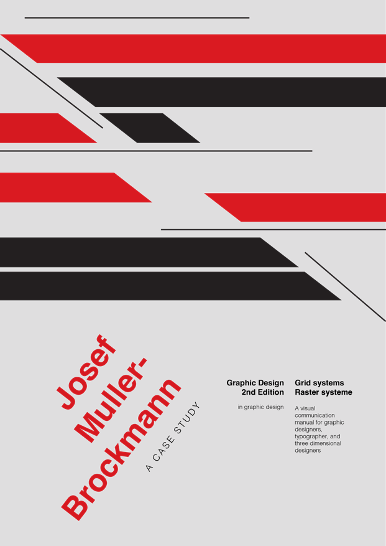
The “Grid System in Graphic Design” book cover (Muller-Brockmann, 1996) clearly shows his minimalist design style. This design aligns with his artistic ethos as demonstrated in previous work such as posters. A significant aspect of Müller-Brockmann’s artistry lies within a grid system; this theme dominates the focus of this book.
The cover radiates equilibrium and structure due to precise geometric shapes that are iconic of Müller-Brockmann’s workmanship.The bold contrast produced by black & white colour schemes coupled with well-patterned typography generates a visually appealing set up recognizable from afar. Moreover, composition matches this technique governing typographic hierarchy concurrently.The impeccable layout highlights the book content concisely while portraying how functional designs can be created using grids; hence displaying excellence on how designers improve content using principle designs.
Conclusion
To conclude, Müller-Brockmann was a revolutionary designer whose vision continues to shape contemporary practices. His advocacy for functional design and role in establishing the Swiss style were pivotal achievements. By prioritising simplicity, readability, and organisation in his visual language he captured the cultural context of his era. Müller Brockmann’s designs have proven timeless leaving an indelible mark on modern day digital and interactive design landscapes. His lasting legacy leaves a profound footprint on the history of design shaping its visual language in ways that continue to resonate with creatives everywhere. It is certain that his contributions will be celebrated well into the future.
References
Armstrong, H. (2009). Graphic design theory: Readings from the field. Princeton Architectural Press. http://ebookcentral.proquest.com/lib/uwsau/detail.action?docID=3387353
Aproposter. (2018, May 2). What you should know about Swiss style graphic design. Aproposter. Retrieved May 10, 2023, from https://www.aproposter.com/swiss-style-graphic-design/
Bigman, A. (2016). What exactly is Swiss design, anyway?. 99designs. Retrieved May 10, 2023, from https://99designs.com/blog/design-history-movements/swiss-design/
Budrick, C. (2020, January 31). Swiss style: The principles, the typefaces and the designers. PRINT Magazine. Retrieved April 25, 2023, from https://www.printmag.com/featured/swiss-style-principles-typefaces-designers/
Eye Magazine. (1995). Reputations: Josef Müller-Brockmann. Eye Magazine. Retrieved May 10, 2023, from https://www.eyemagazine.com/feature/article/reputations-josef-muller-brockmann
Garg, C. (2018, May 28). International Typographic Style. Medium. Retrieved May 10, 2023, from https://charchitgarg27.medium.com/international-typographic-style-cd99a24721ad
Grapheine. (2013, March 12). Josef Müller-Brockmann “swiss style”. Grapheine. Retrieved May 10, 2023, from https://www.grapheine.com/en/graphic-design-en/graphic-designer-muller-brockmann-swiss-style
Keung, L. (2021, October 13). What is Swiss design, and why you should know its history?. Design and Illustration Envato Tuts+. https://design.tutsplus.com/articles/what-is-swiss-design-and-why-you-should-know-its-history--cms-38463
Schneider, S. (2023, April 14). Josef Müller-Brockmann: principal of the Swiss school. The Jotform Blog. https://www.jotform.com/blog/josef-muller-brockmann-principal-of-the-swiss-school/
Sessions College. (2022, February 11). Graphic giants: Josef Müller-Brockman. Sessions College. Retrieved May 10, 2023, from https://www.sessions.edu/notes-on-design/graphic-giants-josef-muller-brockman/
Shillington. (2016, June 9). Josef Müller-Brockmann — famous Swiss graphic designer. Shillington Design Blog. Retrieved May 10, 2023, from https://blog.shillingtoneducation.com/josef-muller-brockmann-tbt/
Muller-Brockmann, J. (n.d.). Josef Müller-Brockmann, poster strawinsky / fortner / berg, 1955. internationalposter.com. https://www.internationalposter.com/product/strawinsky-berg-fortner--tonhalle/
Index:
Figure 1:
Muller-Brockmann, J. (n.d.). Josef Müller-Brockmann, poster strawinsky / fortner / berg, 1955. internationalposter.com. https://www.internationalposter.com/product/strawinsky-berg-fortner--tonhalle/
Figure 2:
Muller-Brockmann, J. (1996, October 1). Grid systems. Amazon. https://www.amazon.com/Grid-Systems-Graphic-Design-Communication/dp/3721201450?_ga=2.138400885.433451898.1684564467-976401464.1682157614
메타데이터
- post_id
- b1fa6e784694
- slug
- josef-müller-brockmann-effective-communication-is-key-to-successful-design-beyond-aesthetics-alone-b1fa6e784694
- url
- https://medium.com/@zein44/josef-m%C3%BCller-brockmann-effective-communication-is-key-to-successful-design-beyond-aesthetics-alone-b1fa6e784694
- canonical_url
- https://medium.com/@zein44/josef-m%C3%BCller-brockmann-effective-communication-is-key-to-successful-design-beyond-aesthetics-alone-b1fa6e784694
- author_url
- https://medium.com/@zein44
- status
- ok
- fetched_at
- 2026-07-23 14:50:44