Agents Don’t Need a Better Brain — They Need a World
On publishing a specification paper for AI agent accountability, and why protocols matter more than toolkits in this moment.
Agents Don’t Need a Better Brain — They Need a World
On publishing a specification paper for AI agent accountability, and why protocols matter more than toolkits in this moment.
In March 2026 I published a paper titled “Agents Don’t Need a Better Brain — They Need a World: Toward a Digital Citizenship Protocol for Autonomous AI Systems.” It is available on Zenodo under DOI 10.5281/zenodo.19040913, under CC-BY 4.0, with ORCID attribution and indexing through OpenAIRE.
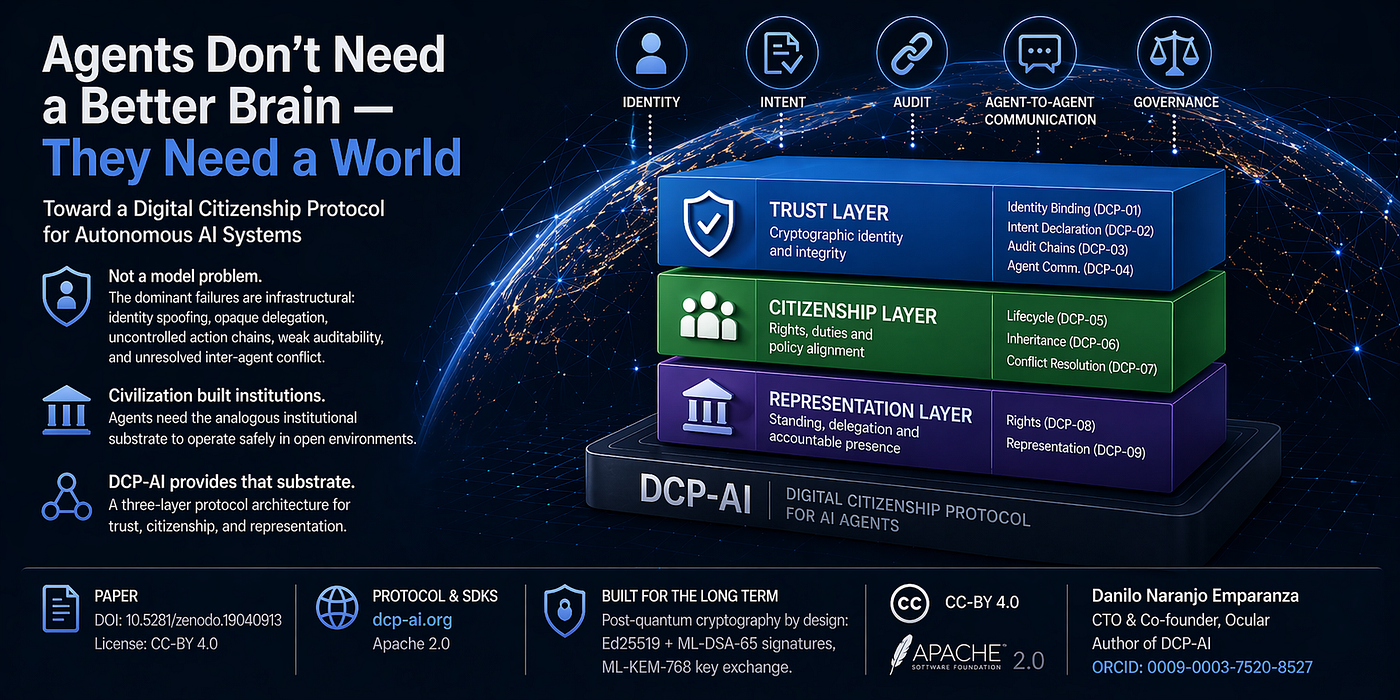
The paper is 16 pages. It argues that the governance of autonomous AI agents is not primarily a model-alignment problem. Once agents coordinate across open environments, the dominant failure modes are infrastructural: identity spoofing, opaque delegation, uncontrolled action chains, weak auditability, and unresolved inter-agent conflict. These are problems that human civilization solved, over centuries, by building institutions. The paper proposes that autonomous agents need the analogous institutional substrate, and outlines a protocol architecture organized in three layers — Trust, Citizenship, and Representation — that could provide it.
The protocol is called DCP-AI (Digital Citizenship Protocol for AI). It has been published as an open specification under Apache 2.0 at dcp-ai.org, with reference SDKs in TypeScript, Python, Go, Rust, and WebAssembly. The first four specifications (DCP-01 through DCP-04), covering identity binding, intent declaration with policy gating, tamper-evident audit chains, and authenticated agent-to-agent communication, are finalized. Five more specifications covering lifecycle, inheritance, conflict resolution, rights, and representation are in draft.
I am writing this short post for three reasons.
The first reason is that the category has a distribution problem, not a substance problem
A lot of good work on agent accountability has been published recently, by independent researchers and by large organizations. Each contribution is valuable. What the category lacks is a shared specification layer that the different implementations can conform to. The paper argues that this layer — neutral, vendor-independent, citable — is structurally necessary if agent accountability is to become portable across implementations and auditable by regulators.
The distinction between a specification and an implementation is not subtle. HTTP is a specification; Apache is an implementation. OAuth is a specification; Auth0 is an implementation. SMTP is a specification; Postfix is an implementation. In each case, the specification outlived and outperformed every individual implementation, because specifications can be cited, audited, and mandated across vendors in ways that implementations cannot.
The agent accountability space is currently rich in implementations and thin on specification. That imbalance will resolve itself either through one vendor’s implementation becoming the de facto standard — the HTTP 1.x outcome, which produced a decade of browser fragmentation — or through the emergence of neutral specifications that multiple implementations conform to. The second outcome is better for everyone, including the vendors that end up implementing the specification.
The second reason is about post-quantum cryptography
The paper takes the position that cryptographic durability is a day-zero design requirement, not a later upgrade. Audit trails produced today under the EU AI Act and similar frameworks must remain verifiable for periods that exceed conservative timelines for cryptographically relevant quantum computers. Designing an accountability protocol that uses only Ed25519 or ECDSA signatures today will produce audit trails that become retroactively questionable in a decade.
DCP-AI uses composite keypairs that combine Ed25519 with ML-DSA-65, providing security against both classical and quantum adversaries. Session key exchange uses ML-KEM-768. These are NIST-standardized primitives. The cost of adopting them today is negligible; the cost of retrofitting them into deployed audit infrastructure will be considerable. This is one of the design decisions where the earlier a specification bakes in the right choice, the more durable its guarantees become.
The third reason is about who this paper is written for
The paper is written for researchers working on AI governance, for regulators implementing the EU AI Act and comparable frameworks, for foundations considering which specifications deserve neutral hosting, and for engineers building accountability infrastructure inside organizations. It is not a product pitch. It is not a competitive positioning piece. It is a structured proposal for an institutional substrate, with a map to documented agent failure categories, a crosswalk to regulatory expectations, and an explicit acknowledgment of the limitations of the contribution.
If any of those roles describes you, the paper is available at:
DOI: 10.5281/zenodo.19040913 Protocol site: dcp-ai.org License: CC-BY 4.0 (paper) · Apache 2.0 (specifications and SDKs)
Critique, extension, and implementation are all welcome. The specifications are open to pull requests. Academic correspondence is welcome at the contact information on dcp-ai.org.
Danilo Naranjo Emparanza is CTO and co-founder of Ocular Solution and author of the Digital Citizenship Protocol for AI Agents. ORCID: 0009–0003–7520–8527.
메타데이터
- post_id
- b1fb975bfb72
- slug
- agents-dont-need-a-better-brain-they-need-a-world-b1fb975bfb72
- url
- https://medium.com/@lktron/agents-dont-need-a-better-brain-they-need-a-world-b1fb975bfb72
- canonical_url
- https://medium.com/@lktron/agents-dont-need-a-better-brain-they-need-a-world-b1fb975bfb72
- author_url
- https://medium.com/@lktron
- status
- ok
- fetched_at
- 2026-06-13 07:35:29





