Detailed Project Report for Bank Loan
A Detailed Project Report (DPR) is a comprehensive document that serves as the “blueprint” of your business. For a bank loan, it is the…
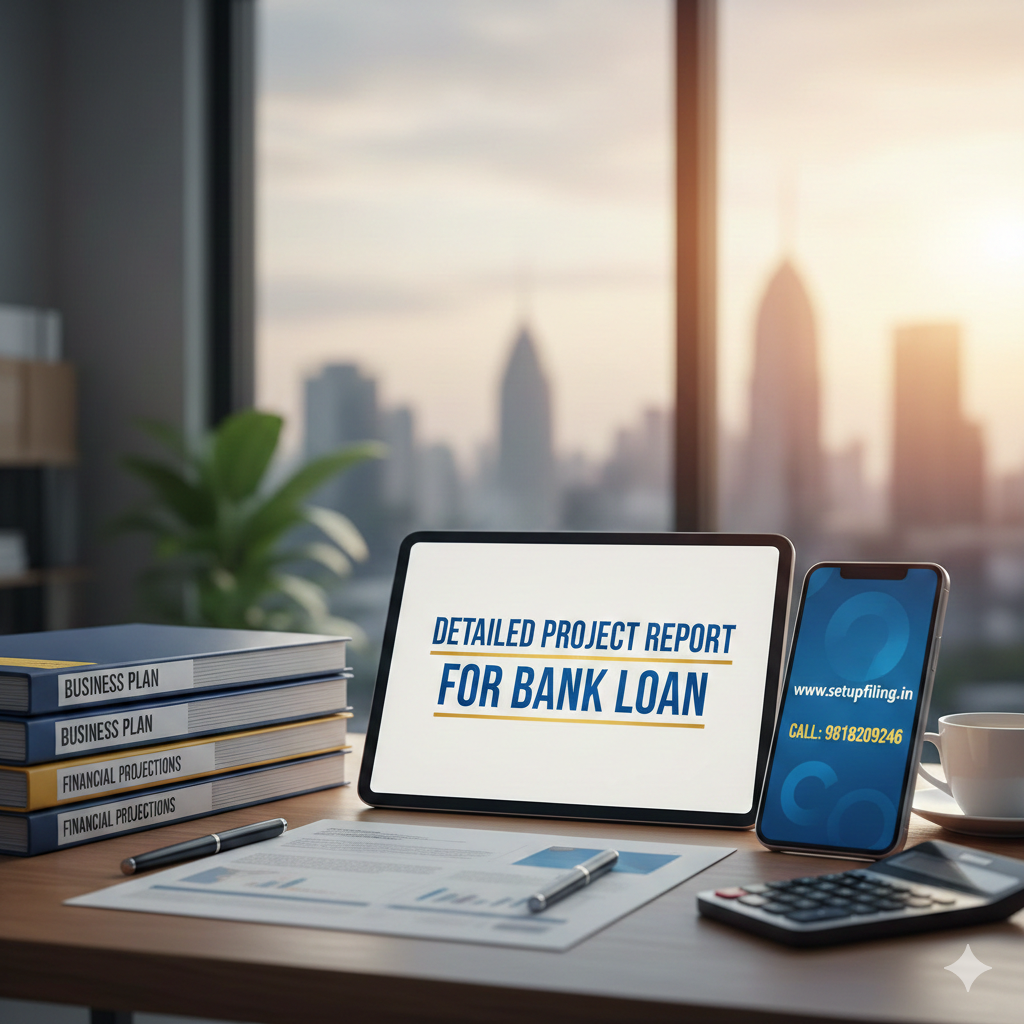
Detailed Project Report for Bank Loan
A Detailed Project Report (DPR) is a comprehensive document that serves as the “blueprint” of your business. For a bank loan, it is the most critical document because it tells the lender exactly how you plan to use their money and, more importantly, how you will pay it back.
🏗️ Core Components of a Bank-Ready DPR
A professional DPR is typically divided into four main pillars: **Market, Technical, Financial, and Management.**
1. Executive Summary
The “elevator pitch” of your document.
- Business Name & Constitution: (Proprietorship, LLP, or Pvt Ltd).
- Loan Amount Required: Specify working capital vs. term loan.
- Promoter Profile: Brief background of the owners.
2. Market Analysis
Banks need to know there is a demand for what you are selling.
- Target Audience: Who are your customers?
- Competitor Analysis: Who else is in the space?
- Marketing Strategy: How will you reach $X$ amount in sales?
3. Technical Feasibility
- Location: Why this specific site? (Proximity to raw materials/customers).
- Manufacturing Process: A step-by-step flow of production.
- Utilities: Requirements for power, water, and waste management.
💰 The Financial Blueprint (The Most Important Part)
This is where the bank’s credit department spends 90% of their time. You must include:
Financial Statement
Purpose
Cost of Project
Total investment needed (Land, Building, Machinery, Working Capital).
Means of Finance
How much is “Promoter’s Contribution” vs. “Bank Loan.”
Projected Balance Sheet
A 5 to 7-year forecast of assets and liabilities.
Cash Flow Statement
Proof that you will have actual cash on hand to pay monthly EMIs.
Break-Even Analysis
The point where your business stops losing money and starts profiting.
📈 Key Ratios Banks Look For
Banks don’t just look at profit; they look at Safety Ratios:
- DSCR (Debt Service Coverage Ratio): This measures your ability to pay back the loan. A ratio of 1.5 to 2.0 is generally considered healthy.
- DER (Debt-to-Equity Ratio): Banks usually prefer a ratio of 2:1 or lower (meaning for every $2$ the bank gives, you put in $1$).
- Current Ratio: Measures your short-term liquidity. Ideally 1.33 or higher.
📑 Checklist of Documents to Attach
To make your DPR “Bank-Ready,” attach these supporting documents:
- Quotations: Formal price quotes for any machinery or equipment you plan to buy.
- KYC & GST: Registration copies of your business (including that IEC Code we discussed!).
- Rent Agreement/Land Deeds: Proof of business premises.
- **Past 3 Years ITR:** If it is an existing business.
💡 Pro-Tip for your Website (setupfiling.in)
Since you help with IEC Registration, you can pitch a DPR as a “Value-Add” service. Many exporters need a DPR to get Export Packing Credit (EPC) or Post-Shipment Finance from banks.
Would you like me to create a professional “Request for Quote” template or a checklist you can send to your clients who need a DPR.
메타데이터
- post_id
- b1fbaa7af4d1
- slug
- detailed-project-report-for-bank-loan-b1fbaa7af4d1
- url
- https://medium.com/@monikapathak.setupfiling/detailed-project-report-for-bank-loan-b1fbaa7af4d1
- canonical_url
- https://medium.com/@monikapathak.setupfiling/detailed-project-report-for-bank-loan-b1fbaa7af4d1
- author_url
- https://medium.com/@monikapathak.setupfiling
- status
- ok
- fetched_at
- 2026-06-18 07:02:39