From an Order-Flow Bot to a Live Automated Trading System
EP1 — The Origin: A Bot That Only Counted Buy and Sell Volume
From an Order-Flow Bot to a Live Automated Trading System
EP1 — The Origin: A Bot That Only Counted Buy and Sell Volume
▍ The Starting Point: A “System” That Didn’t Predict Anything
Back around 2023, my “quantitative system” didn’t predict anything.
▍ The Motivation: Manual Trading Watches Order Flow — So I Turned It Into Data
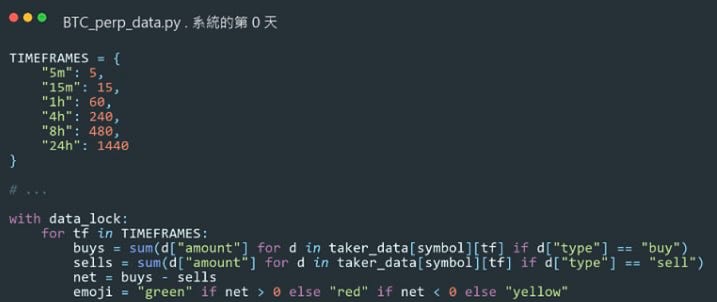
It did one thing: parse every OKX trade, classify it as a taker buy or taker sell, aggregate the volume, and push the result to Telegram. The goal was simple — to see how order flow moved across different timeframes. Why did I build it? In my manual trading I had always paid close attention to liquidity sweeps. If those are discrete, identifiable events, I figured: if I could see exactly how capital was moving during the sweep itself, I might be able to judge whether the move would break out or reverse. That was the bot’s original purpose.
▍ Reviving the Original: commit 69d1424
Fast-forward to March 15, 2026 — I revived the original version (commit 69d1424). No machine learning. No automated order submission. Not even a Binance integration yet. Just OKX.
▍ The Core Logic: An In-Memory Buffer Across Six Time Windows
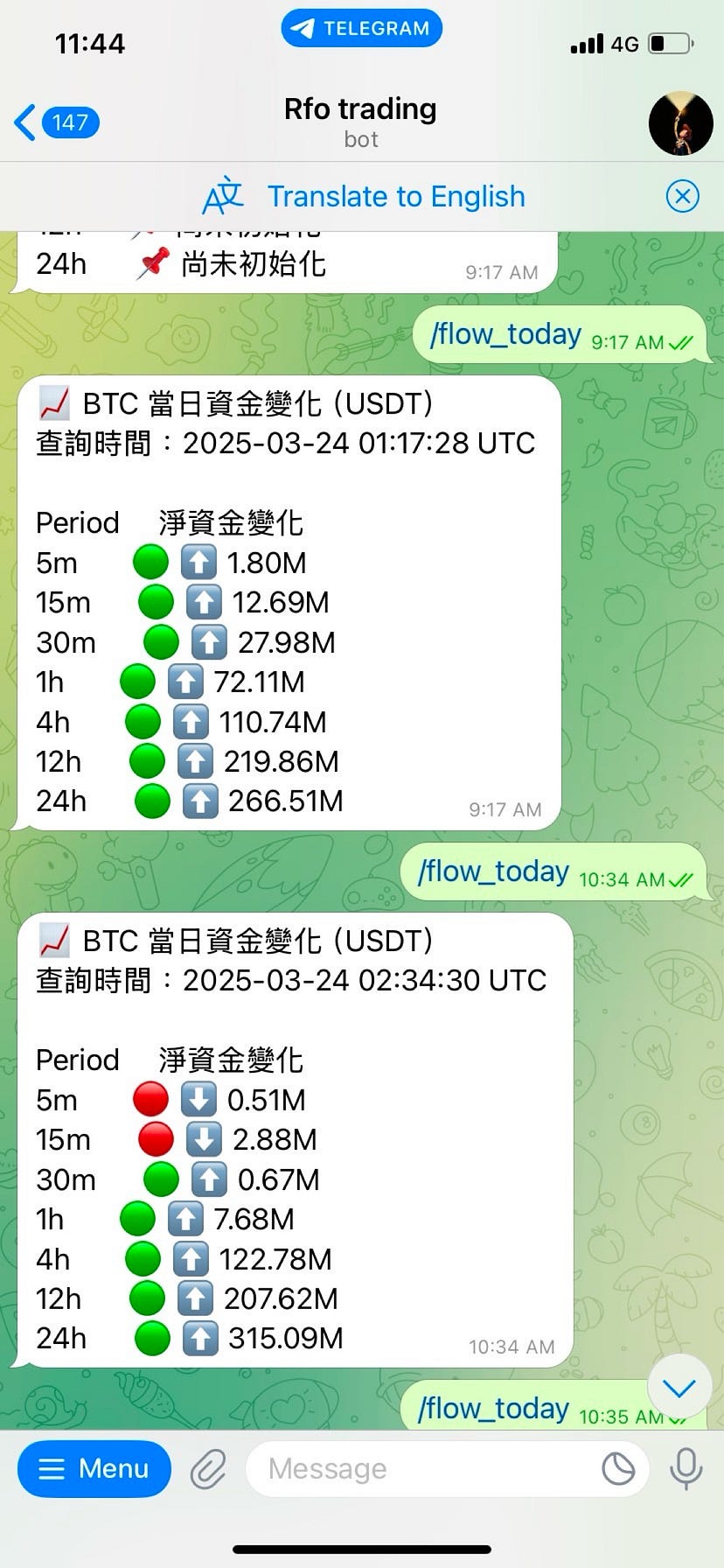
The logic was deliberately primitive: an in-memory buffer that, across six time windows (5m, 15m, 1h, 4h, 8h, 24h), summed taker buy volume and taker sell volume separately. I typed /flow_today and it returned a long/short comparison table. That was the whole thing.
▍ Why I’m Grateful for This Bot
Looking back, I’m genuinely grateful I built this bot. Without it, none of what came after would exist.
▍ No Blueprint — Just One Simple Question
I never started with a grand blueprint to build a “quantitative trading system.” In 2023 the only tool was GPT, and most of the code had to be stitched together — GPT’s output broke constantly, and I spent meaningful time auditing and integrating the pieces by hand.
All I wanted to know was: at any given price move, was it the buyers or the sellers pushing? That simple. Everything that came later — the feature engineering, the dual-model architecture, the risk controls, the automated execution — was built on top of this foundation, combined with my own intuitions from manual order-flow trading.
▍ Good Systems Are Rarely “Designed” Up Front — Especially Trading Ones
I believe good systems are rarely “designed” up front. That’s especially true in trading. Plenty of people online talk about “AI quant” and “AI trading,” but most are optimizing for engagement — backtest curves that look beautiful, with no OOS validation, no walk-forward, no Monte Carlo. Once you actually do the work yourself, you realize edge is hard to find and even harder to verify. You have to iterate, pressure-test, and refine, until you can see a sliver of real signal. Along the way I’ve fallen into many of the same pitfalls I had hit in manual trading. For me, that pressure is the point — every setback sharpens the next iteration, and there is a particular kind of satisfaction in seeing your own research validated by the market, regardless of which way the verdict lands.
▍ What’s Next
Going forward I’ll be sharing more of this journey — not only the quant trading parts, but also manual trading lessons and the broader Web3 space.
⚠️ Risk Disclaimer
- This post shares personal quantitative research and system
- . development experience only. It is not investment advice and not
- . a recommendation to buy or sell any security or cryptocurrency.
OrderFlow #QuantitativeTrading #AlgorithmicTrading #Web3 #Crypto #TradingSystems
메타데이터
- post_id
- b20c3f306bfd
- slug
- from-an-order-flow-bot-to-a-live-automated-trading-system-b20c3f306bfd
- url
- https://medium.com/@rfobelieve2/from-an-order-flow-bot-to-a-live-automated-trading-system-b20c3f306bfd
- canonical_url
- https://medium.com/@rfobelieve2/from-an-order-flow-bot-to-a-live-automated-trading-system-b20c3f306bfd
- author_url
- https://medium.com/@rfobelieve2
- status
- ok
- fetched_at
- 2026-06-20 20:29:01




