The Italian Maritime Republics and the Medieval Battle for the Mediterranean
The Italian maritime republics were medieval port cities whose power came from ships, trade, autonomy, and naval force. Venice, Genoa…
The Italian Maritime Republics and the Medieval Battle for the Mediterranean
The Italian maritime republics were medieval port cities whose power came from ships, trade, autonomy, and naval force. Venice, Genoa, Pisa, and Amalfi became the four best-known examples, but they were not the only ones. Their rise began when Mediterranean routes regained importance after centuries of instability, and sea connections became more decisive than land roads.
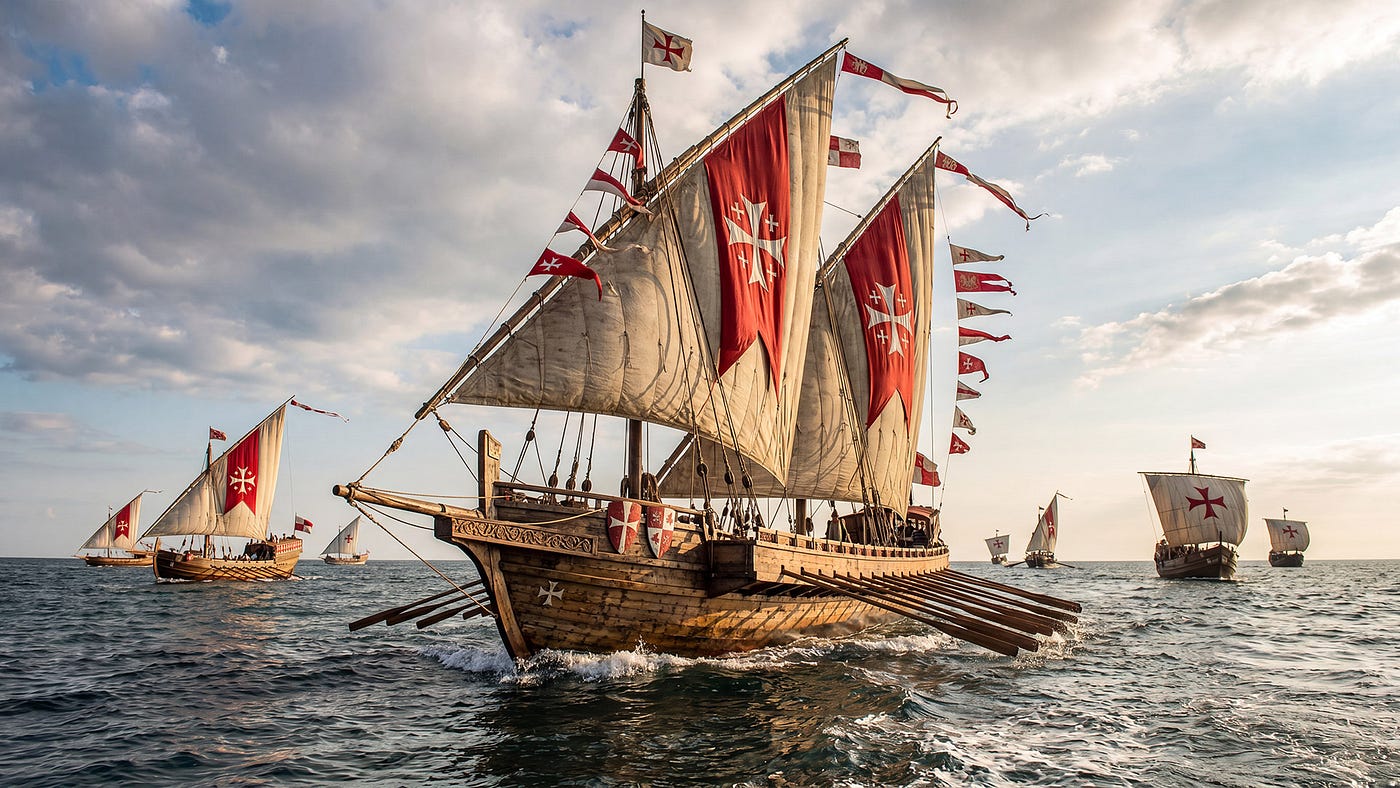
These cities were different in political structure. Some developed as communes, others as duchies or oligarchic republics. What united them was maritime independence, the ability to defend commercial interests, and the creation of trade networks across the Mediterranean, Adriatic, Black Sea, Aegean, and Levant. Their merchants moved spices, silk, grain, wool, metals, timber, oil, wine, coral, and luxury goods.
Their success depended strongly on geography. Venice grew in the protected lagoon of the northern Adriatic. Genoa controlled an excellent natural harbor on the Ligurian coast. Pisa rose near the mouth of the Arno, when the city was still closely connected to the sea. Amalfi occupied a strategic position between the Latin West, Byzantium, and the Islamic Mediterranean.
Venice became the longest-lived and most stable maritime republic. It emerged from lagoon communities formed between the 5th and 6th centuries, when inhabitants of the mainland sought shelter from invasions. In its early history, Venice was linked to the Byzantine world, but it gradually transformed dependence into autonomy and built a political system centered on the doge, councils, and merchant families.
Venetian power first grew in the Adriatic. Around the year 1000, Venice fought pirates along the Istrian and Dalmatian coasts, securing routes and presenting itself as the guardian of maritime order. Its decisive expansion came after the Fourth Crusade in 1204, when Constantinople was captured and Venice received important territories and privileges in the eastern Mediterranean.
Crete became one of Venice’s most valuable possessions, connecting the republic to the Aegean, Egypt, the Levant, and the Adriatic. Cyprus was later acquired in 1489, after Caterina Cornaro ceded the kingdom to Venice. These islands helped Venice control strategic routes, but Ottoman expansion gradually reduced its influence. Venice lost Cyprus in 1571 and Crete in 1669.
Genoa was Venice’s greatest rival. It rose from a Ligurian settlement with a natural harbor and revived strongly after the 10th century. The Genoese first cooperated with Pisa against Muslim raiders, especially in Sardinia, but the alliance soon turned into rivalry. Genoa became one of Europe’s major ports through trade, shipbuilding, banking, and Mediterranean commercial networks.
The Treaty of Nymphaeum in 1261 was crucial for Genoa. By supporting the Byzantine Empire of Nicaea, Genoa gained privileges after the recovery of Constantinople. This opened access to the Black Sea and weakened Venetian dominance in the East. Genoese bases such as Pera, near Constantinople, and Kaffa, in Crimea, became central to trade in grain, slaves, furs, wax, and eastern goods.
Genoa reached its medieval peak through naval victories. In 1284, it defeated Pisa at the Battle of Meloria, damaging Pisan sea power permanently. In 1298, Genoa defeated Venice at Curzola, though Venice remained strong. Genoa’s weakness was internal instability, as powerful families such as the Doria, Spinola, Fieschi, and Grimaldi often competed for control.
In 1528, Andrea Doria reorganized Genoa and gave the republic a new phase of importance. Its later strength was less naval and more financial. Genoese bankers became closely linked to the Spanish monarchy, and the 16th century was remembered as the “century of the Genoese.” The republic declined later and became the Ligurian Republic under Napoleonic pressure in 1797.
Pisa was one of the great naval powers of the western Mediterranean. In the Middle Ages, it was much closer to the coast than today, before centuries of sedimentation moved the shoreline away. Its maritime power depended on the Arno, Porto Pisano, Tuscan resources, and strong connections with Sardinia, Corsica, and Tyrrhenian routes.
Pisa’s rise was connected to campaigns against Muslim raiders. In 1016, Pisans and Genoese helped drive Saracens from Sardinia. In 1063, the Pisan fleet attacked Muslim Palermo, and wealth from these campaigns helped finance the monumental cathedral complex in Piazza dei Miracoli. Pisa developed as a commune in the second half of the 11th century.
Pisan influence spread to Elba, Sardinia, and Corsica. The city also gained imperial support, especially from Frederick Barbarossa, who granted privileges in 1162 and 1163. Pisa followed the Ghibelline, pro-imperial side in Italian politics, which gave advantages but also involved the city in larger conflicts. Its merchants were active in the Levant during the Crusades.
The decisive blow came on 6 August 1284, at the Battle of Meloria near Livorno. Genoa defeated Pisa and caused enormous losses. Afterward, Pisa could not recover its old maritime strength. It renounced claims to Corsica in 1299, lost Sardinia to Aragon in 1324–1325, and faced strong land pressure from Florence and Lucca.
Florence conquered Pisa in 1406. The city briefly recovered autonomy in 1494, during the Italian Wars, but Florence reconquered it in 1509. By then, the silting of the Arno and the rise of Livorno had ended Pisa’s role as a major port. Its maritime legacy survived more in history and architecture than in political power.
Amalfi was one of the earliest maritime republics, strongest between the 9th and 11th centuries. Unlike Venice, Genoa, and Pisa, it reached its peak earlier. Its merchants traded with Sicily, Apulia, Tripoli, Alexandria, Constantinople, and other Mediterranean ports. Amalfi connected Latin, Byzantine, and Arab commercial worlds through goods, coins, laws, and navigation.
Amalfi’s merchants traded timber, gold, spices, precious stones, silk, perfumes, and fine textiles. The city issued the tarì, a coin influenced by Islamic models, and developed the Tavole Amalfitane, an important medieval maritime law code. Amalfi is also associated with the spread and improvement of the compass in European navigation, although the legendary Flavio Gioia is not considered a historical inventor.
Its decline began in the 11th century. Amalfi came under Salerno, then Norman influence, and lost autonomy under Roger II of Sicily in 1131. In 1135, Pisans sacked the city, damaging its fleet and maritime infrastructure. A destructive storm or tsunami in 1343 and the Black Death in 1348 further weakened Amalfi’s population and economy.
Other maritime republics also mattered, including Ancona, Gaeta, Noli, and Ragusa. Ancona traded across the Adriatic and resisted Venetian dominance. Gaeta developed autonomy from Byzantium and traded with North Africa. Noli prospered during the Crusades under Genoese protection. Ragusa, today Dubrovnik, became a major Adriatic merchant city and preserved autonomy through careful diplomacy.
Modern Italy still commemorates Venice, Genoa, Pisa, and Amalfi through the Regatta of the Historical Marine Republics, created in 1955. The race rotates among the four cities and includes historical processions, symbolic boats, and crews of 8 rowers plus 1 helmsman. It preserves the memory of the medieval sea powers that once shaped Mediterranean history.
메타데이터
- post_id
- b21ef2262192
- slug
- the-italian-maritime-republics-and-the-medieval-battle-for-the-mediterranean-b21ef2262192
- url
- https://medium.com/@ovidiu.tutunaru/the-italian-maritime-republics-and-the-medieval-battle-for-the-mediterranean-b21ef2262192
- canonical_url
- https://medium.com/@ovidiu.tutunaru/the-italian-maritime-republics-and-the-medieval-battle-for-the-mediterranean-b21ef2262192
- author_url
- https://medium.com/@ovidiu.tutunaru
- status
- ok
- fetched_at
- 2026-07-23 10:24:43