The Digital Gold Paradox: Why Bitcoin Still Hasn’t Claimed the Market Crown
In December 2024, a historic milestone was reached in financial markets. Bitcoin ETFs’ total assets under management (AUM) surpassed…
The Digital Gold Paradox: Why Bitcoin Still Hasn’t Claimed the Market Crown
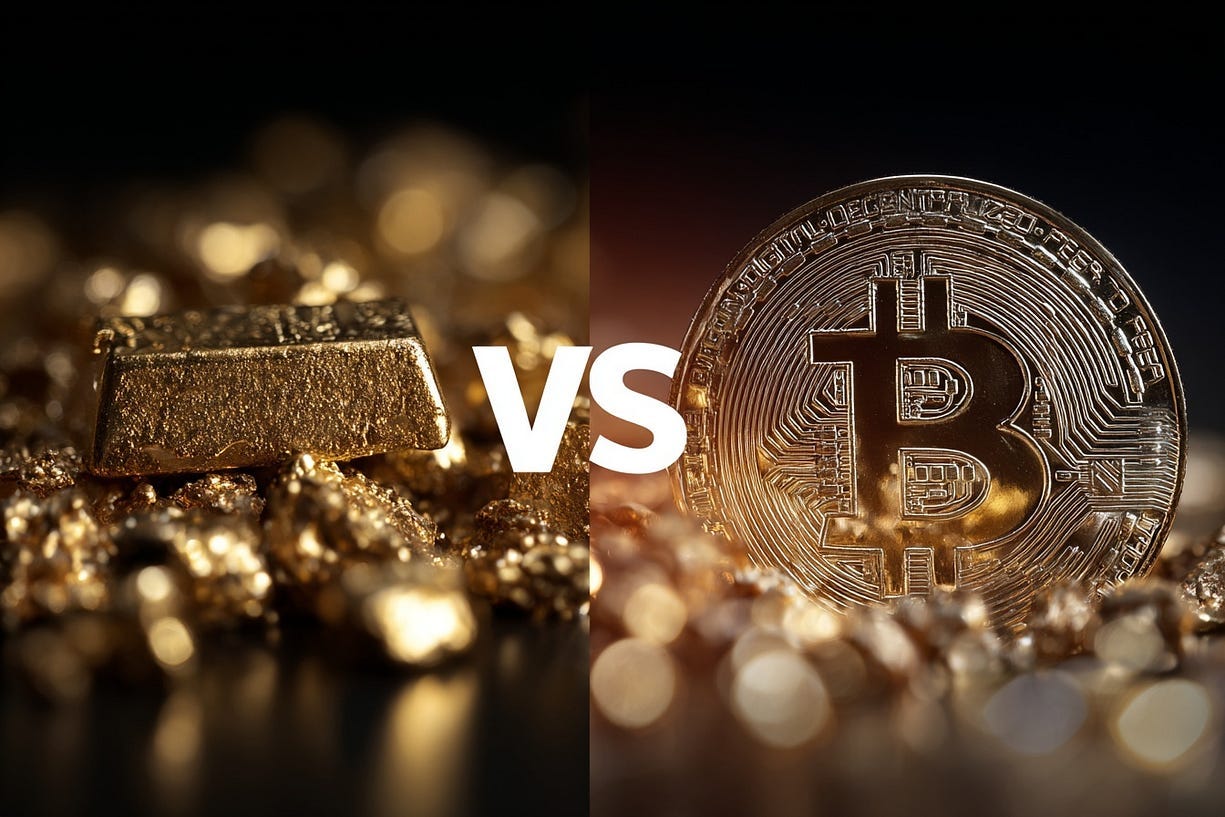
In December 2024, a historic milestone was reached in financial markets. Bitcoin ETFs’ total assets under management (AUM) surpassed traditional gold ETFs for the first time. This achievement, accomplished in just 11 months, demonstrates remarkable growth velocity. As of November 2025, Bitcoin ETF AUM maintains around $110 billion, with the competition against gold ETFs continuing.
Yet market perception remains cold. Despite overwhelming quantitative growth, Bitcoin still doesn’t receive the ‘safe and solid’ treatment that gold enjoys. It gyrates whenever the Nasdaq trembles, still classified as a ‘risk-on’ asset. What drives this ‘digital gold paradox,’ and when will Bitcoin finally wear the true crown?
1. The Fundamental Disconnect: Scale Has Grown, but Trust and Character Remain Immature
1.1 The Power of Time: 5,000 Years vs 16 Years
Gold has accumulated trust as a store of value through 5,000 years of human history. It has weathered the fall of the Roman Empire, the Great Depression, two World Wars, the collapse of Bretton Woods, and the 2008 financial crisis.

In contrast, Bitcoin’s 16 years are but a moment in financial history. Market trust follows the ‘Lindy Effect’ — the longer something has survived, the more likely it is to continue surviving. Bitcoin has yet to experience a true global financial crisis or major geopolitical shock. Its brief plunge and recovery during the 2020 COVID pandemic was its only real test.
1.2 The Nature of Capital: Patient Capital vs Speculative Capital
A significant portion of the $120 billion flowing into Bitcoin ETFs comes from hedge funds and aggressive institutional investors seeking ‘yield maximization’ and ‘volatility betting.’ To them, Bitcoin isn’t ‘digital gold’ but rather an extreme version of ‘high-risk, high-reward tech stocks.’

The difference becomes stark when examining gold ETF capital composition. Central banks comprise 22%, pension funds 18%, insurance companies 15%, individual long-term investors 25%, and others 20%. In contrast, Bitcoin ETFs consist of hedge funds at 35%, trading desks at 25% — meaning 60% is short-term speculative capital — with venture capital at 15%, individual short-term investors at 20%, and others at 5%.
This difference in capital composition manifests clearly in responses to market volatility. When markets become unstable, Bitcoin isn’t held like gold but becomes the first asset liquidated alongside the Nasdaq. While ‘quantitative growth’ has been achieved, the ‘qualitative constitution’ remains risk-seeking.
1.3 Market Behavior Patterns: The Correlation Trap
Since 2024, the 60-day correlation coefficient between Bitcoin and the Nasdaq 100 index has averaged 0.65. This means Bitcoin is still perceived as an ‘extreme version of tech stocks.’ Meanwhile, gold’s correlation with the Nasdaq oscillates between -0.15 and +0.1, showing independence or inverse correlation.
The problem is even more evident in crisis behavior patterns. During the Fed’s 2022 rate hike cycle, when the Nasdaq fell 33%, Bitcoin crashed 64% — nearly double the decline. During the same period, gold fell merely 3%. This clearly demonstrates that Bitcoin is still treated as the ‘king of risk assets.’
2. The Uncomfortable Truth of 2025: Gold Still Reigns
2.1 The Market Size Reversal
While Bitcoin ETFs surpassed gold ETFs in late 2024, the situation dramatically reversed in 2025. As of August 2025, gold ETFs soared to $325 billion while Bitcoin ETFs remained at $162 billion. Even more shocking was the performance gap. Gold prices surged 60% year-to-date, reaching a historic high of $4,000 per ounce, while Bitcoin gained only 20% during the same period.
This performance gap raised serious questions among Bitcoin investors. Anxiety about whether Bitcoin can truly become digital gold is spreading within the community, with even some long-term investors reconsidering portfolio rebalancing.
2.2 Structural Causes of Gold’s Resurgence
Gold’s resurgence isn’t merely a temporary phenomenon but based on structural factors. Above all, massive central bank purchases were the key driver. Central bank gold purchases in the first half of 2025 reached record levels, with China, India, and Russia dramatically increasing gold holdings to reduce dollar dependence. Emerging countries like Turkey and Poland also joined this trend by expanding gold’s share of their foreign reserves.
Deepening geopolitical uncertainty also fueled gold demand. As U.S.-China tensions persist forming a new Cold War structure and Middle East instability increases, investors sought proven safe haven assets. Global supply chain reorganization adding trade tensions further highlighted gold’s appeal.
Concerns about inflation and currency depreciation also strengthened gold preference. As major countries’ fiscal deficits expanded, trust in fiat currencies declined, and gold demand exploded in countries where real interest rates remain negative. Crucially, the psychology favoring physical over digital assets strengthened again.
2.3 The Bitcoin Community’s Dilemma
This situation presents deep concerns for Bitcoin supporters. The biggest shock was psychological. As the ‘digital gold’ narrative weakened, the Bitcoin community experienced a kind of identity crisis. The reality that institutional investors still choose gold during crises was a painful lesson, and criticism that Bitcoin’s high volatility impedes its safe haven status resurfaced.
Investment strategies are also undergoing fundamental review. Surprisingly, even some Bitcoin maximalists have begun increasing gold allocations, with hybrid strategies like “60% Bitcoin + 40% gold” gaining new attention. There’s also movement toward reassessing the importance of long-term value preservation over short-term gains. This reality shows Bitcoin still has far to go. While quantitative growth has been achieved, qualitative transformation remains incomplete.
3. Four Key Triggers for Qualitative Leap
3.1 Strategic Allocation by Sovereign Wealth Funds and Pension Funds
The first gateway for Bitcoin to be recognized as true digital gold is strategic adoption by long-term investment institutions. What’s needed now isn’t simple investment but official declarations. The world’s top 10 sovereign wealth funds must officially announce 2–5% portfolio allocation to Bitcoin, and major U.S. pension funds must grant Bitcoin ‘strategic asset’ status. Particularly important is codifying long-term investment policies like “10+ year holding periods,” officially recognizing it as a ‘core asset class’ beyond simple investment.

Recent Developments: Several institutional investors have expanded Bitcoin investments in 2025. BlackRock’s IBIT has grown to $97 billion, leading institutional demand, with some U.S. state pension funds considering Bitcoin ETF investments. Abu Dhabi Investment Council (ADIC) has also begun investing in Bitcoin ETFs, though still at an early stage with relatively small portfolio allocation.
3.2 Official State-Level Adoption: Foreign Reserve Inclusion
State-level official adoption is the most powerful catalyst that could fundamentally change Bitcoin’s status. If a G7 central bank includes 1% or more of foreign reserves in Bitcoin, or if the IMF includes Bitcoin in its Special Drawing Rights (SDR) basket, the rules of the game would completely change. Additionally, if Basel III regulations are revised to recognize Bitcoin as Tier 1 capital, banks worldwide could hold Bitcoin without capital burden. Legal tender adoption by El Salvador and the Central African Republic remains symbolic. True change will begin when major economic powers move.

Recent Developments: In November 2025, a proposal to add Bitcoin as a national strategic asset was submitted to the U.S. House of Representatives. This suggests the U.S. is beginning to seriously consider official Bitcoin adoption.
3.3 Proving Safe Haven Role During Crises
Practice matters more than theory. For Bitcoin to be recognized as a true safe haven asset, it must demonstrate gold-like behavior in actual crises. Bitcoin must surge during banking crises or rise alongside gold during geopolitical shocks in the Taiwan Strait or Middle East. It must also prove it can function as an alternative currency when major currencies collapse.
Recent Developments: Bitcoin surged over 20% during the March 2023 Silicon Valley Bank (SVB) collapse. However, this remained an isolated event and hasn’t established a consistent pattern. For Bitcoin to be recognized as a true safe haven asset, such cases must be repeatedly observed.
3.4 Technical Maturation and Infrastructure Advancement
Bitcoin network evolution and infrastructure improvement are also essential. Layer 2 solutions like Lightning Network must become mainstream for daily payments, and direct custody services by major banks must become commonplace. Additionally, renewable energy usage in Bitcoin mining must rise above 90% to completely address ESG concerns, and quantum resistance must be secured to ensure long-term security.

Recent Developments: As of 2025, Lightning Network channels have exceeded 150,000, and major banks are launching Bitcoin custody services in earnest. Notably, renewable energy usage in Bitcoin mining has surpassed 50%, alleviating ESG concerns.
4. Forecast Timeline: 2026–2030, The Era of Paradigm Shift
4.1 Phase 1 (2026–2027): Volatility Reduction and Early Institutionalization
In the first phase, daily volatility will settle below 5% as ETF fund inflows stabilize. Institutional investor proportion will exceed 60%, increasing market maturity, and the first G20 country will begin officially reviewing Bitcoin as a reserve asset. Additionally, the groundbreaking moment will arrive when 1–2 major pension funds declare Bitcoin a ‘strategic asset.’
4.2 Phase 2 (2028–2029): Full-Scale Institutional Integration
The second phase will see institutional integration accelerate. 2–3 major sovereign wealth funds will officially expand Bitcoin investments, and Basel regulatory improvements will pass, facilitating bank Bitcoin holdings. Bitcoin’s correlation with Nasdaq will drop below 0.3, strengthening its character as an independent asset, and it will partially prove its safe haven role during the first financial crisis.
4.3 Phase 3 (2030): Digital Gold Status Establishment
In the final phase of 2030, Bitcoin will finally establish its status as ‘digital gold.’ The first G7 central bank will include Bitcoin in foreign reserves, and it will fully prove its safe haven role in multiple crisis situations. Volatility will drop to 20–25%, reaching levels similar to gold, and Bitcoin will completely establish itself as an essential element of global asset allocation.
5. Conclusion: Crossing the Threshold of Time
Bitcoin has already completed ‘quantitative growth.’ Its December 2024 surpassing of gold ETFs proves this. However, as gold’s 2025 resurgence shows, becoming true ‘digital gold’ requires time’s verification, qualitative transformation of capital, and real-world proof.
Substantive change will begin in 2026. As the first G20 country’s official review, major pension funds’ strategic asset declarations, and partial verification in actual crisis situations converge, Bitcoin will gradually shed its ‘risk asset’ label and wear the ‘digital gold’ crown around 2030.
We now stand at the threshold of a massive paradigm shift. Bitcoin’s 16-year journey challenging gold’s 5,000-year history has only just begun.
메타데이터
- post_id
- b2291f4d9e60
- slug
- bitcoin-vs-gold-b2291f4d9e60
- url
- https://medium.com/hashed-official/bitcoin-vs-gold-b2291f4d9e60
- canonical_url
- https://medium.com/hashed-official/bitcoin-vs-gold-b2291f4d9e60
- author_url
- https://medium.com/@seojoonkim
- status
- ok
- fetched_at
- 2026-07-15 05:07:54