The Dark Knight Rises Is a Flawed but Majestic Finale to the Greatest Superhero Trilogy Ever Made
Writen by James Henning
The Dark Knight Rises Is a Flawed but Majestic Finale to the Greatest Superhero Trilogy Ever Made
Writen by James Henning
When Christopher Nolan set out to complete his groundbreaking Batman trilogy with the release of The Dark Knight Rises in 2012, he faced an almost impossible cinematic hurdle. Its predecessor, The Dark Knight, had not only revolutionized the superhero genre but had also become a cultural phenomenon, largely driven by Heath Ledger’s legendary, Oscar-winning performance as the Joker. Expecting any sequel to match that lightning-in-a-bottle moment was unrealistic, yet Nolan managed to deliver a grand, operatic, and deeply satisfying conclusion that feels entirely distinct from what came before. Instead of trying to replicate the chaotic, psychological crime thriller aesthetic of the second film, Nolan opted for a massive, historical-scale epic inspired by Charles Dickens’s A Tale of Two Cities. The result is a film that is undeniably messy in its plotting and pacing, yet remains a towering achievement in blockbuster filmmaking, offering a profound exploration of pain, legacy, and the ultimate cost of heroism.
The narrative begins eight years after the events of the previous film, presenting a Gotham City that has achieved peace but is built entirely on a foundation of lies. The city is clean, organized, and largely free of organized crime thanks to the Dent Act, a harsh piece of legislation inspired by the supposedly heroic sacrifice of Harvey Dent. However, this peace has come at a terrible psychological cost for Bruce Wayne. Christian Bale delivers his most vulnerable performance as a broken, reclusive Bruce, who has locked himself away in Wayne Manor, walking with a cane and mourning the loss of Rachel Dawes. He is a ghost of his former self, having completely abandoned the Batman persona because he believes his mission is over. This setup is brilliant because it forces the audience to confront the reality of what being Batman would actually do to a human body and mind. Bruce did not just retire; he withered away, leaving Gotham vulnerable to a new kind of terror that thrives in the shadows of the city’s underground.
That terror arrives in the form of Bane, played with terrifying physical presence and unexpected theatricality by Tom Hardy. While the Joker was an agent of chaos who wanted to tear down society’s moral fabric, Bane is a military tactician, a revolutionary leader who represents total, systemic destruction. Despite the limitation of having his face obscured by a massive gas mask, Hardy conveys immense menace through his posture, his shifting eyes, and a bizarre, sing-song voice that sounds both regal and deeply unsettling. Bane does not just want to break Batman’s body; he wants to dismantle Gotham’s entire social hierarchy. He exploits the economic inequality within the city, turning the poor against the wealthy, raiding the stock market, and locking the entire police force underground. This socioeconomic commentary gives the film a massive, historical weight, transforming a simple superhero story into a sprawling war for the very soul of an American metropolis.
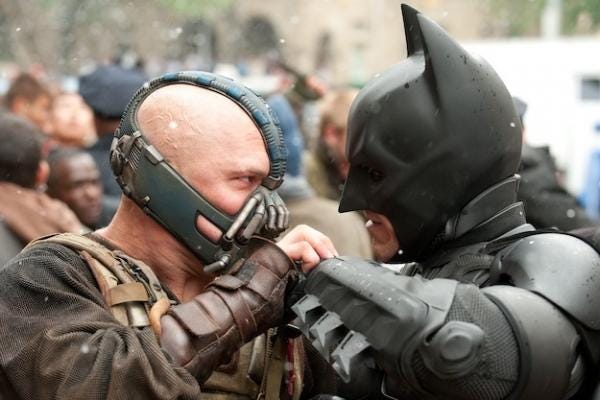
The physical and ideological clash between Batman and Bane reaches its absolute peak during their first subterranean brawl, which stands as one of the greatest sequences in modern action cinema. Nolan purposefully strips away the bombastic musical score for this scene, leaving only the echoing sounds of dripping water, heavy footsteps, and the brutal thud of fists hitting flesh. Bruce, relying on old tricks and a broken body, is completely outmatched by Bane’s raw power and youthful ferocity. The scene is agonizing to watch because it marks the complete defeat of our hero, culminating in the iconic comic book moment where Bane snaps Batman’s back over his knee. Bruce is then exiled to “The Pit,” an ancient, brutal underground prison located halfway across the world, where the only escape is a seemingly impossible vertical climb without a safety rope.
This prison sequence serves as the emotional and thematic heart of the entire film. It forces Bruce to strip away his reliance on high-tech gadgets and wealth, reducing him to nothing but his raw willpower. The script brilliantly flips the concept of fear on its head; Bruce fails to make the final leap to freedom because he does not fear death, believing he has nothing left to live for. It is only when he discards the safety rope, embracing the primal, terrifying fear of falling, that he finds the strength to conquer the climb. This moment redefines the core thesis of Nolan’s entire trilogy, proving that Batman was never about the armor or the vehicles, but about the unyielding human spirit that refuses to stay down. Bruce’s literal and metaphorical rise from the depths of the earth is a breathtaking cinematic moment, perfectly elevated by Hans Zimmer’s chanting, propulsive musical score.
While Bruce is exiled, the film tracks the desperate resistance inside Gotham, introducing key new characters who carry the narrative weight. Anne Hathaway’s portrayal of Selina Kyle, or Catwoman, is a massive highlight, perfectly balancing a cynical, self-serving survival instinct with a hidden moral compass. She slides effortlessly into Nolan’s grounded universe, acting as a perfect foil to Bruce’s rigid morality. Meanwhile, Joseph Gordon-Levitt’s John Blake represents the pure, uncorrupted idealism that Bruce used to possess. Blake is a street-level detective who still believes in systemic justice, serving as a reminder of why Gotham is worth saving in the first place. The collaboration between Blake, a dying Commissioner Gordon, and a returning Batman creates a thrilling, ticking-clock finale as they race to stop a decaying nuclear bomb from destroying the city.
The film does suffer from noticeable flaws, particularly in its third-act pacing and logistical logic. The timeline of Bruce traveling across the world back into a blockaded Gotham with zero resources is glossed over entirely. The final twist involving Marion Cotillard’s Miranda Tate being revealed as Talia al Ghul feels rushed, undermining Bane’s status as the ultimate mastermind and giving him a surprisingly abrupt, unceremonious death. Furthermore, the massive street battle between hundreds of police officers and Bane’s mercenaries, while visually stunning, stretches the boundaries of realism that the previous films fought so hard to establish. These narrative shortcuts prevent the film from achieving the tight, pristine perfection of The Dark Knight, showing the strain of Nolan trying to cram a massive comic book war into a traditional cinematic framework.
Despite these narrative stumbles, the emotional resolution of the film is absolutely flawless and incredibly cathartic. Batman’s final act of self-sacrifice, flying the nuclear bomb out over the ocean to save the city, provides the ultimate fulfillment of the promise made in Batman Begins: that Bruce Wayne could become an everlasting symbol of hope. The closing montage is an exquisite piece of editing, wrapping up the character arcs with poetic precision. We see Alfred finally achieving his quiet dream of seeing Bruce happy and alive in Florence, John Blake discovering the Batcave to carry on the legacy, and a new statue of the Dark Knight overlooking a rebuilt Gotham. By ending the story with a definitive conclusion rather than an open-ended setup for endless sequels, Nolan honored the artistic integrity of his vision, cementing this trilogy as a timeless masterpiece that proved superhero films could be serious, high-stakes art.
메타데이터
- post_id
- b232f445181a
- slug
- the-dark-knight-rises-is-a-flawed-but-majestic-finale-to-the-greatest-superhero-trilogy-ever-made-b232f445181a
- url
- https://medium.com/@jamesdonovanbricks13/the-dark-knight-rises-is-a-flawed-but-majestic-finale-to-the-greatest-superhero-trilogy-ever-made-b232f445181a
- canonical_url
- https://medium.com/@jamesdonovanbricks13/the-dark-knight-rises-is-a-flawed-but-majestic-finale-to-the-greatest-superhero-trilogy-ever-made-b232f445181a
- author_url
- https://medium.com/@jamesdonovanbricks13
- status
- ok
- fetched_at
- 2026-07-15 08:43:05





