Building My First Serverless REST API Completely Changed How I Think About Backend Development
After years of deploying traditional backend servers, I finally built a production-ready REST API using AWS Lambda and API Gateway. What…
Building My First Serverless REST API Completely Changed How I Think About Backend Development
After years of deploying traditional backend servers, I finally built a production-ready REST API using AWS Lambda and API Gateway. What surprised me wasn’t how easy deployment became — it was how much infrastructure simply disappeared.
For a long time, every backend project I built followed the same pattern.
Create a server.
Configure Nginx.
Install dependencies.
Set up Docker.
Manage scaling.
Configure monitoring.
Handle deployments.
Maintain operating systems.
It worked.
But after deploying several production applications, I realized something.
I was spending almost as much time managing infrastructure as I was writing actual business logic.
That’s when I decided to build my first fully serverless REST API.
Within a weekend, my perspective on cloud architecture completely changed.
Here’s what I learned.
1. A Serverless API Doesn’t Mean There’s No Server
This was probably the biggest misconception I had.
Serverless doesn’t mean servers magically disappear.
Servers still exist.
You just don’t manage them.
Instead of provisioning virtual machines, patching operating systems, or configuring load balancers, AWS automatically handles the infrastructure behind the scenes.
From a developer’s perspective, the workflow becomes surprisingly simple.
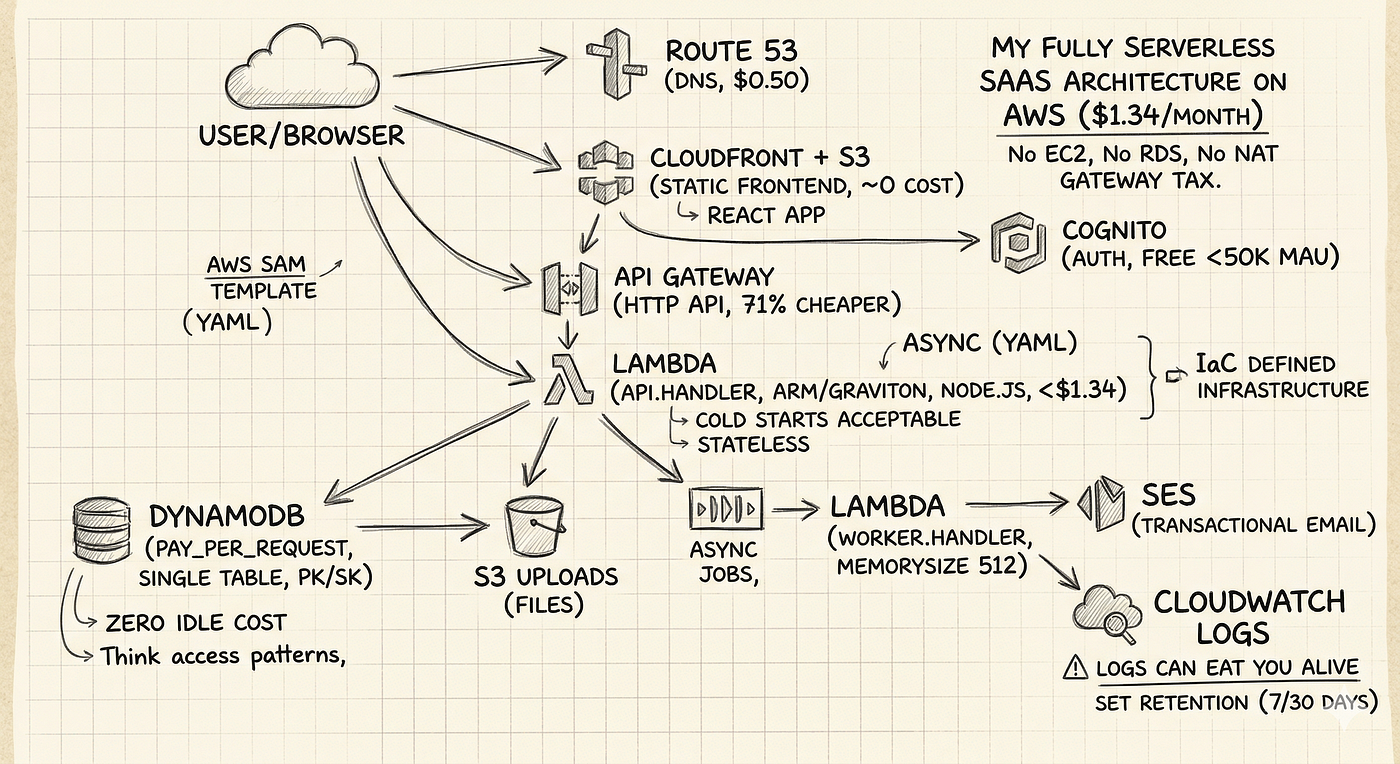
Client
   │
   ▼
API Gateway
   │
   ▼
AWS Lambda
   │
   ▼
Business Logic
   │
   ▼
Database
Instead of deploying an entire backend server, you’re deploying individual functions.
That shift dramatically reduces operational overhead.
2. API Gateway Handles Much More Than Routing
Initially, I assumed API Gateway was just another HTTP router.
It’s considerably more powerful than that.
Besides routing requests, it can also handle:
- Authentication
- Authorization
- Rate limiting
- Request validation
- Response transformation
- Logging
- API versioning
- Custom domains
- CORS configuration
In traditional applications, many of these responsibilities require additional middleware.
With API Gateway, they’re built directly into the platform.
That allows your Lambda function to focus almost entirely on business logic.
3. Writing a Lambda Function Feels Surprisingly Familiar
One thing that surprised me was how little my Python code changed.
Instead of starting a web server, I simply export a handler function.
import json
from datetime import datetime
def lambda_handler(event, context):
    method = event.get("httpMethod")
    path = event.get("path")
    if method == "GET" and path == "/health":
        return {
            "statusCode": 200,
            "headers": {
                "Content-Type": "application/json"
            },
            "body": json.dumps({
                "status": "healthy",
                "timestamp": datetime.utcnow().isoformat()
            })
        }
    return {
        "statusCode": 404,
        "body": json.dumps({
            "message": "Resource not found"
        })
    }
There’s no application server running continuously.
AWS invokes the function only when a request arrives.
After the response is returned, the execution environment can be reused — or shut down entirely.
That execution model felt strange at first.
Now it feels completely natural.
4. Organizing Lambda Functions Is Just as Important as Writing Them
One mistake I made early on was placing every endpoint inside a single Lambda function.
That became difficult to maintain surprisingly quickly.
A better structure is organizing functions by business capability.
serverless-api/
│
├── users/
│     ├── create.py
│     ├── update.py
│     ├── delete.py
│     └── get.py
│
├── orders/
│     ├── create.py
│     ├── list.py
│     ├── cancel.py
│     └── update.py
│
├── products/
│     ├── search.py
│     ├── inventory.py
│     └── pricing.py
│
└── shared/
      ├── database.py
      ├── auth.py
      └── utils.py
Each Lambda remains focused on a single responsibility.
As projects grow, that organization becomes incredibly valuable.
5. Connecting Lambda to DynamoDB Is Surprisingly Straightforward
Most REST APIs eventually need persistent storage.
For serverless applications, DynamoDB is often a natural fit.
Here’s a simple example for creating a new item.
import uuid
import boto3
table = boto3.resource("dynamodb").Table("Orders")
def create_order(customer, total):
    order = {
        "id": str(uuid.uuid4()),
        "customer": customer,
        "total": total,
        "status": "pending"
    }
    table.put_item(Item=order)
    return order

if __name__ == "__main__":
    result = create_order(
        customer="Alice",
        total=249.99
    )
    print(result)
The code remains remarkably small.
Most of the complexity shifts from infrastructure to application design — which is exactly where I want to spend my time.
6. Infrastructure as Code Makes Deployment Repeatable
One lesson I learned quickly is that manually configuring cloud resources doesn’t scale.
Instead, I describe the entire infrastructure as code.
Whether I deploy today or six months from now, the environment remains consistent.
Here’s a simplified AWS SAM template.
AWSTemplateFormatVersion: '2010-09-09'
Transform: AWS::Serverless-2016-10-31
Resources:
  GetUsersFunction:
    Type: AWS::Serverless::Function
    Properties:
      Runtime: python3.12
      Handler: app.lambda_handler
      CodeUri: src/
      MemorySize: 256
      Timeout: 15
      Events:
        Api:
          Type: Api
          Properties:
            Path: /users
            Method: GET
Instead of clicking through dozens of configuration screens, the infrastructure becomes version-controlled alongside the application.
That dramatically improves reproducibility.
7. Monitoring Is Just as Important as Deployment
One misconception I had was thinking serverless meant maintenance-free.
That’s not true.
Applications still need monitoring.
I now pay close attention to:
- Invocation count
- Execution duration
- Error rate
- Cold starts
- Throttling
- Memory utilization
- Timeout frequency
These metrics reveal bottlenecks long before users notice them.
Pro Tip: A serverless application without monitoring is just as risky as a traditional server without logs.
8. The Biggest Advantage Wasn’t Scaling — It Was Simplicity
When people discuss serverless architecture, they usually focus on automatic scaling.
That’s certainly valuable.
But it wasn’t the biggest benefit for me.
The real improvement was eliminating operational complexity.
Instead of asking:
- Which EC2 instance should I choose?
- How many application servers do I need?
- How should I configure auto scaling?
- When should I patch the operating system?
- How do I replace unhealthy servers?
I started asking much better questions.
- Is my API well designed?
- Is my business logic clean?
- Are my endpoints intuitive?
- Are my users getting fast responses?
That’s where engineering effort creates the most value.

Final Thoughts
Building my first serverless REST API taught me something I didn’t expect.
The hardest part of backend development isn’t always writing the API.
It’s managing everything around it.
AWS Lambda and API Gateway remove a significant portion of that operational burden.
They’re not the right solution for every workload.
Long-running processes, specialized networking requirements, and certain high-performance applications may still benefit from traditional servers.
But for event-driven applications, internal tools, microservices, REST APIs, and many business applications, serverless architecture offers a remarkably compelling development experience.
Looking back, I don’t think the biggest innovation was running code without servers.
It was allowing developers to spend far less time thinking about infrastructure — and much more time building software that actually solves problems.
Thousands of developers share what they’re building, learning, and discovering across our publications every month. One account connects you to our entire network of publications and communities. Explore more at plainenglish.io.
메타데이터
- post_id
- b247b31ca8bc
- slug
- building-my-first-serverless-rest-api-completely-changed-how-i-think-about-backend-development-b247b31ca8bc
- url
- https://aws.plainenglish.io/building-my-first-serverless-rest-api-completely-changed-how-i-think-about-backend-development-b247b31ca8bc
- canonical_url
- https://aws.plainenglish.io/building-my-first-serverless-rest-api-completely-changed-how-i-think-about-backend-development-b247b31ca8bc
- author_url
- https://medium.com/@maximilianoliver25
- status
- ok
- fetched_at
- 2026-07-08 21:34:33