Robotic Surgery for Women’s Cancer — What It Is, Who It Helps, and Why Training Matters
Robotic Surgery for Women’s Cancer — Precision, Recovery, and What the Technology Actually Delivers
Robotic Surgery for Women’s Cancer — What It Is, Who It Helps, and Why Training Matters
Robotic Surgery for Women’s Cancer — Precision, Recovery, and What the Technology Actually Delivers
The word robotic tends to do a particular kind of work in healthcare conversations. It suggests something futuristic, something reassuringly precise, something that sits at the cutting edge of what medicine can offer. For patients facing a gynecologic cancer diagnosis and a conversation about surgery, it often carries an almost instinctive appeal — the sense that if a robot is involved, the procedure will somehow be safer, cleaner, more controlled.
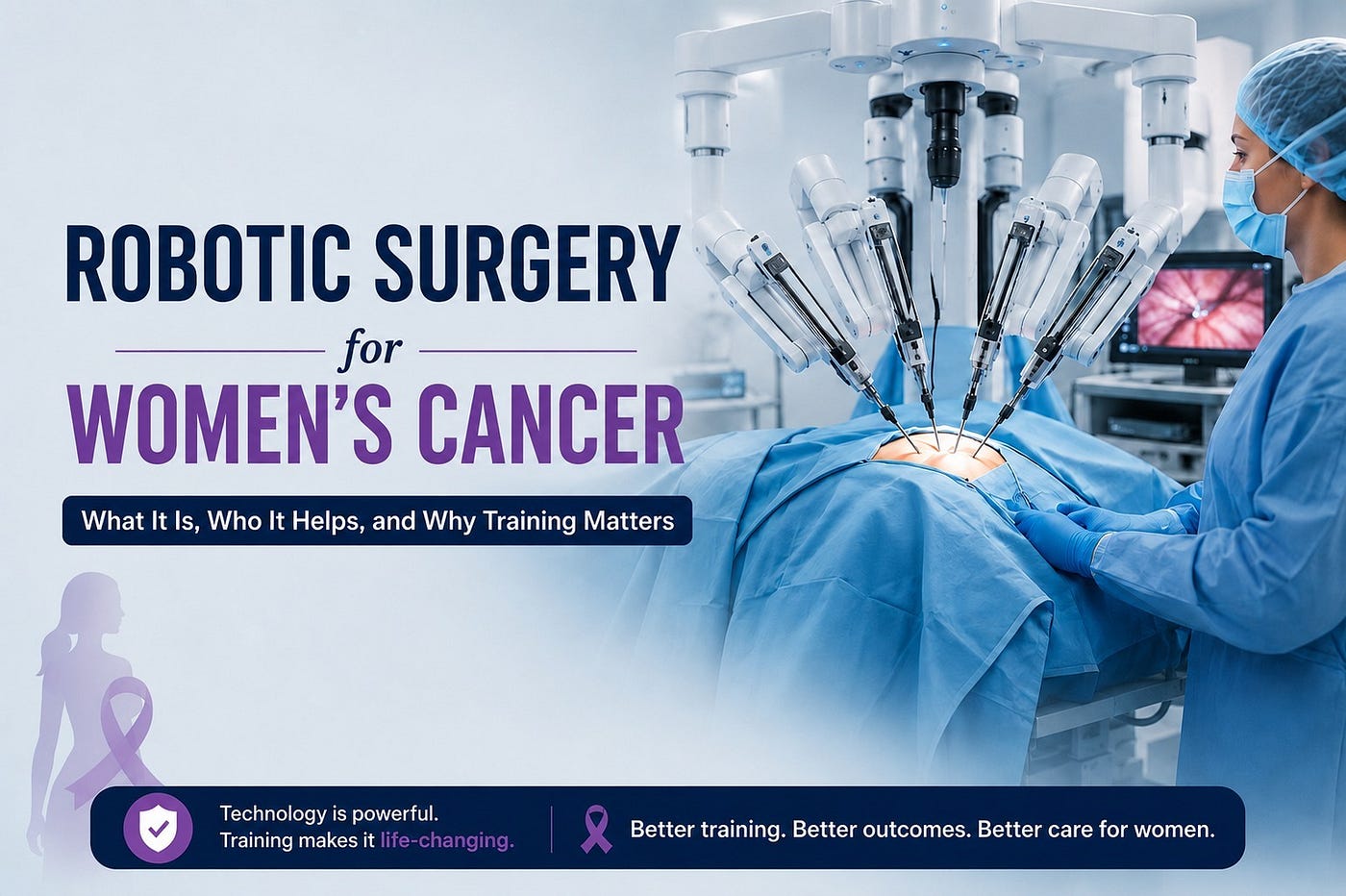
That instinct is not entirely wrong. But it is incomplete in ways that matter enormously for making genuinely informed surgical decisions. Robotic surgery in gynecologic oncology is a powerful tool with real clinical advantages in the right circumstances. It is also a tool that depends entirely on the surgeon operating it — and that distinction is the most important thing any patient considering robotic cancer surgery should understand.
What Robotic Surgery Actually Is
The term robotic surgery is, in a technical sense, a slight misnomer. The robot does not operate independently. There is no autonomous surgical decision-making, no machine replacing human judgment. What exists instead is a sophisticated surgical platform — most commonly the da Vinci Surgical System — that translates the surgeon’s hand movements, filtered through a computer interface, into precise instrument movements inside the patient’s body.
The surgeon sits at a console a short distance from the operating table, viewing a high-definition, three-dimensional magnified image of the surgical field. The instruments, inserted through small incisions in the patient’s abdomen, respond to the surgeon’s movements with a degree of dexterity that exceeds what conventional laparoscopic tools can provide. The platform filters out natural hand tremor. The instruments can rotate and articulate in ways that mimic the natural range of motion of the human wrist, reaching angles in confined anatomical spaces that straight laparoscopic instruments cannot.
What this means in practice is that the surgeon retains complete control of every movement, every decision, every cut and suture — while operating with a level of visual magnification and instrument precision that open surgery and standard laparoscopy cannot match in certain contexts.
Why Gynecologic Oncology Is Particularly Well Suited to Robotic Surgery
The anatomy of the female pelvis creates specific surgical challenges. The uterus, cervix, ovaries, and surrounding structures sit within a bony pelvis that limits access and visibility. Major blood vessels — the iliac arteries and veins — run immediately alongside the tissue planes where cancer surgery takes place. The ureter, the thin tube connecting the kidney to the bladder, passes within millimeters of the uterine artery and is one of the most common structures at risk during radical pelvic surgery. The nerves governing bladder function course through the same narrow spaces where radical hysterectomy dissection occurs.
In this environment, the enhanced three-dimensional visualization and wristed instrument articulation that robotic platforms provide translate into genuinely meaningful clinical advantages. Surgeons can dissect more precisely in tight spaces. They can identify and protect the ureter and adjacent nerves with greater confidence. They can control bleeding from small vessels with finer instrument movements. And they can maintain that precision across procedures that may last several hours, without the physical fatigue that affects laparoscopic instrument handling over time.
For gynecologic oncology specifically — where the completeness of the surgical procedure directly affects cancer outcomes — that precision is not merely a comfort. It is a clinical requirement.
The Cancers Where Robotic Surgery Has Proven Particularly Valuable
Endometrial cancer is the gynecologic malignancy where robotic surgery has the most established evidence base. Most endometrial cancers are diagnosed at early stages, when surgery alone or surgery followed by a short course of targeted radiation provides excellent cure rates. The standard operation — hysterectomy with removal of both ovaries and fallopian tubes, plus lymph node assessment — is well suited to robotic approaches.
Multiple large studies have confirmed that robotic hysterectomy and staging for endometrial cancer achieves oncologic outcomes equivalent to open surgery, while delivering substantially reduced blood loss, shorter hospital stays, lower wound complication rates, and faster return to normal activity. For the many women with endometrial cancer who are older, overweight, or have diabetes — risk factors that make open abdominal surgery more hazardous — robotic approaches make definitive cancer surgery significantly safer.
Sentinel lymph node mapping, which identifies the specific lymph nodes that drain the uterus and are most likely to contain cancer, is particularly well executed through the robotic platform. The fluorescence imaging capability built into modern robotic systems — where a dye injected into the cervix lights up under near-infrared light, revealing the sentinel nodes with striking visual clarity — has made this technique more reliable and reproducible. The result is accurate staging with dramatically reduced risk of lymphedema compared to complete lymph node dissection.
For cervical cancer, robotic surgery supports radical hysterectomy and trachelectomy procedures with the fine dissection that these operations demand. The nerve-sparing modifications of radical hysterectomy — surgical techniques designed to protect the autonomic nerves controlling bladder and bowel function — are facilitated by the robotic platform’s visualization and precision. Women who undergo nerve-sparing radical hysterectomy have meaningfully better bladder function outcomes than those whose surgeries cannot incorporate these techniques, and the robotic platform makes nerve preservation more consistently achievable.
For ovarian cancer, the robotic platform is used primarily for staging procedures in apparent early-stage disease — systematic inspection of the peritoneal cavity, omentectomy, lymph node assessment, and peritoneal biopsies. Comprehensive staging performed minimally invasively allows accurate determination of disease extent without the recovery burden of open laparotomy, facilitating earlier initiation of chemotherapy when indicated.
The Difference Between Laparoscopic and Robotic Surgery — and When Each Is Right
Patients frequently ask whether robotic surgery is simply better than laparoscopic surgery across the board. The honest answer is more nuanced than either a yes or a no.
Standard laparoscopic surgery uses straight, non-articulating instruments inserted through small incisions, with the surgeon operating while standing at the table viewing a two-dimensional monitor. In experienced hands, laparoscopic surgery achieves excellent outcomes for a wide range of gynecologic procedures including hysterectomy, ovarian cyst removal, and staging operations. The technique is well established, widely available, and supported by decades of outcome data.
Robotic surgery adds three-dimensional vision, instrument articulation, tremor filtration, and ergonomic advantages for the surgeon. These additions are most clinically meaningful in anatomically complex situations — deep pelvic dissection, radical hysterectomy with nerve preservation, lymph node dissection around major vessels, and procedures requiring precise suturing in confined spaces. For straightforward cases, the advantages of robotic over laparoscopic approaches are less pronounced. For complex oncologic procedures, they can be substantial.
The appropriate surgical approach — open, laparoscopic, or robotic — is never determined by technology preference or institutional prestige. It is determined by the specific requirements of each patient’s cancer, the anatomy of the surgical field, the patient’s overall health, and the evidence base for each approach in that clinical context. A gynecologic oncologist who has genuine competency across all three approaches, and who applies evidence-based judgment in selecting among them, is serving patients better than one who defaults to any single technique regardless of circumstance.
Certification, Training, and Why They Are Not Interchangeable
Access to a robotic surgical platform does not make a surgeon a robotic surgeon. This distinction matters more than most patients realize.
Robotic surgery involves a specific learning curve. The three-dimensional console view, the lack of tactile feedback from instruments inside the body, the coordination between console and bedside teams, and the technical demands of advanced procedures within the robotic platform all require dedicated training and supervised experience before independent practice is appropriate.
Formal certification programs exist specifically to address this. Dr. Aiswarya Sekar completed the Basic Skills Driving Licence Course at The Griffin Institute, Royal College of Surgeons of England in London — an internationally recognized credentialing pathway that establishes structured competency benchmarks for robotic surgical practice. This is not a manufacturer’s promotional course or a brief hands-on workshop. It is a rigorous training program associated with one of the world’s most respected surgical institutions.
For patients evaluating a surgeon’s robotic surgery credentials, this distinction is meaningful. The combination of formal robotic certification and subspecialty gynecologic oncology training — meaning the surgeon is not only technically proficient with the platform but clinically expert in the cancer procedures being performed through it — represents the standard patients should be looking for.
What Subspecialty Training Adds to Robotic Proficiency
Robotic technical skill and gynecologic oncology expertise are not the same thing, and one does not substitute for the other. A surgeon can be technically proficient with a robotic platform and still lack the oncologic judgment to perform cancer surgery safely and completely. Equally, a gynecologic oncologist performing complex cancer procedures through a robotic platform needs genuine platform competency to realize the technique’s clinical benefits.
The value of a surgeon who holds both — subspecialty oncology training and formal robotic certification — lies in the integration. Understanding which tissue planes to enter, how to identify structures at risk, how to achieve complete lymph node dissection, how to recognize when minimally invasive surgery should convert to open, and how to manage intraoperative complications: these are oncologic skills. Executing them with the precision and visualization that robotic surgery provides adds a technical dimension that enhances their clinical impact.
This is the framework within which Dr. Aiswarya practices robotic gynecologic oncology — not as a technological novelty, but as a surgical approach applied with oncologic discipline to patients who are most likely to benefit from it.
Recovery — What Robotic Surgery Means for the Patient Experience
For a woman facing gynecologic cancer surgery, the experience of the procedure itself represents only a fraction of what she is navigating. The weeks surrounding surgery — the anxiety beforehand, the physical recovery afterward, the emotional adjustment throughout — are equally real and consequential.
Minimally invasive surgery, including robotic approaches, changes the post-surgical experience in ways that patients consistently describe as more significant than they expected. The absence of a long abdominal incision means less postoperative pain, earlier mobility, and faster return to the activities and relationships that make life feel normal. For women undergoing cancer treatment who will subsequently need chemotherapy or radiation, recovering quickly from surgery is not merely a comfort — it determines how soon adjuvant treatment can begin and how physically resilient the patient is when it does.
Specific outcomes from robotic gynecologic cancer surgery include hospital stays of one to two nights compared to four to seven for open procedures, return to normal activities in two to three weeks rather than six to eight, significantly lower blood loss and reduced transfusion requirements, lower rates of wound infection and incisional hernia, and substantially reduced postoperative pain with lower opioid requirements.
These are meaningful quality-of-life differences for women whose cancer experience is already demanding in ways that extend far beyond what happens in the operating room.
The Role of Enhanced Recovery Protocols
Modern robotic gynecologic oncology does not end when the instruments are withdrawn. The surgical procedure sits within a broader perioperative framework — the Enhanced Recovery After Surgery protocol — that governs how patients are prepared before surgery and supported through recovery afterward.
ERAS principles include avoiding unnecessary preoperative fasting, using multimodal pain management strategies that reduce reliance on opioids, encouraging early mobilization from the first postoperative day, providing targeted nutritional support, and maintaining careful fluid balance during and after surgery. Together, these practices accelerate recovery and reduce the complications that can interrupt or delay the overall cancer treatment plan.
When minimally invasive robotic surgery is combined with evidence-based ERAS care, the cumulative effect on the patient experience and on clinical outcomes is considerably greater than either approach delivers in isolation.
Having the Right Conversation Before Surgery
One of the most important things any woman facing gynecologic cancer surgery can do is understand the full range of surgical options available to her before making a decision. That understanding requires a conversation with a specialist who has genuine competency in all the relevant approaches — open, laparoscopic, and robotic — and who applies clinical judgment rather than institutional default in selecting among them.
The right surgical approach is not always minimally invasive. For some patients with extensive disease, open surgery provides the access needed to achieve complete tumor removal in ways that laparoscopic or robotic approaches cannot replicate. For others, robotic surgery offers the precision and recovery advantages that make it the clearly preferred option. And for many, the appropriate approach lies somewhere in the nuanced middle — where the surgeon’s judgment about what a particular patient’s anatomy and disease extent actually require determines the plan.
What matters is that the conversation happens, that it is honest, and that the surgeon offering it has the training to back up whatever recommendation follows.
Women’s Cancer Surgery in Chennai — What Subspecialty Access Means Locally
For women in Chennai and across Tamil Nadu, access to a gynecologic oncologist who combines formal robotic surgery certification with subspecialty cancer training represents a meaningful advancement in what is available locally without traveling to Mumbai or Delhi.
The presence of that expertise at Dr. Rela Institute — a hospital with the surgical infrastructure, intensive care support, and multidisciplinary oncology services that complex cancer procedures require — means that women who need robotic gynecologic cancer surgery do not have to choose between proximity and quality.
That access is most valuable early in the diagnostic and treatment process, when surgical decisions are still fully open and when all options — including minimally invasive approaches — can be properly evaluated before any irreversible choices are made.
For women who are already past that point — who have had surgery elsewhere and are seeking evaluation of whether additional procedures are needed, or who have received a recurrence diagnosis and need reassessment of their options — subspecialty consultation provides clarity and a factual basis for the next decision.
The Technology Serves the Patient — Not the Other Way Around
There is a tendency, in healthcare marketing and in patient conversations alike, to treat advanced surgical technology as an outcome in itself. The presence of a robotic system becomes a selling point. The fact of certification becomes a credential to display. The sophistication of the equipment becomes a proxy for the quality of care.
None of that is wrong, exactly. Robotic surgery does offer genuine clinical advantages in the right circumstances. Certification does reflect real training and commitment. Sophisticated equipment does matter for complex procedures.
But the patient sitting in the consultation room is not interested in the technology for its own sake. She is interested in whether she will recover well, whether her cancer will be fully treated, whether her fertility will be preserved if that is her goal, whether she will maintain bladder function and bowel function and the physical dimensions of the life she is trying to protect. Those outcomes are produced not by a machine but by a surgeon — one who has trained long enough and broadly enough to bring genuine judgment to each individual case.
Robotic gynecologic oncology surgery, practiced with that understanding, is not a feature. It is a clinical approach in service of something that matters considerably more.
FAQ SECTION
Q: What is robotic surgery for gynecologic cancer?
Robotic surgery for gynecologic cancer uses a computer-assisted surgical platform to perform minimally invasive cancer procedures through small abdominal incisions. The surgeon operates from a console, controlling articulated instruments while viewing a magnified three-dimensional image of the surgical field. It is used for hysterectomy, lymph node dissection, staging, and other gynecologic oncology procedures, offering advantages in precision and recovery compared to open surgery in appropriate patients.
Q: Is robotic surgery better than laparoscopic surgery for gynecologic cancer?
Both approaches are forms of minimally invasive surgery with similar recovery advantages over open procedures. Robotic surgery adds three-dimensional visualization, wristed instrument articulation, and tremor filtration, which provide meaningful advantages in complex pelvic dissections, nerve-sparing procedures, and lymph node surgery. For straightforward procedures, the differences are less pronounced. The appropriate approach depends on the specific cancer, disease extent, patient anatomy, and surgeon expertise — not on technology preference alone.
Q: Which gynecologic cancers can be treated with robotic surgery?
Robotic surgery is most established for endometrial cancer staging and hysterectomy, where evidence strongly supports equivalent oncologic outcomes with significantly better recovery compared to open surgery. It is also used for cervical cancer surgery including radical hysterectomy and trachelectomy, ovarian cancer staging in early-stage disease, and lymph node dissection across all gynecologic cancer types. A gynecologic oncologist evaluates each patient individually to determine whether a robotic approach is appropriate.
Q: What is the recovery time after robotic gynecologic cancer surgery?
Most women undergoing robotic gynecologic cancer surgery stay in hospital for one to two nights and return to normal activities within two to three weeks. Open surgery typically requires four to seven days in hospital and six to eight weeks recovery. Individual recovery depends on the specific procedure performed, any complications, and overall health. Women needing adjuvant chemotherapy or radiation can typically begin those treatments sooner after robotic surgery due to faster recovery.
Q: What qualifications should a robotic gynecologic cancer surgeon have?
Patients should look for a surgeon who holds both subspecialty gynecologic oncology training — such as an MCh from a recognized cancer institution — and formal robotic surgery certification from an accredited training program. The combination of oncologic expertise and platform-specific technical training is essential for safe and effective robotic cancer surgery. Volume and experience with the specific procedures being performed are also important considerations.
Q: Is robotic surgery available for ovarian cancer treatment?
Robotic surgery is used for staging procedures in early-stage ovarian cancer, where minimally invasive assessment of the peritoneal cavity, lymph nodes, and omentum allows accurate staging without open laparotomy. For advanced ovarian cancer requiring cytoreductive surgery and HIPEC, open surgery remains the standard approach as the scope of disease removal requires full abdominal access. A gynecologic oncologist will determine the appropriate surgical approach based on disease characteristics and imaging.
Q: What is sentinel lymph node mapping and how does robotic surgery help with it?
Sentinel lymph node mapping identifies the specific lymph nodes most likely to contain cancer spread, allowing their targeted removal rather than complete lymph node dissection. Robotic platforms incorporate fluorescence imaging that illuminates sentinel nodes with high clarity after injection of a tracer dye, making their identification more reliable. This technique, performed through the robotic platform, achieves accurate staging while dramatically reducing the risk of lymphedema compared to complete node removal.
Q: Can I have robotic surgery if I have had previous abdominal operations?
Prior abdominal surgery creates scar tissue that can complicate minimally invasive approaches, but it does not automatically exclude robotic surgery. The surgeon evaluates prior surgical history, imaging findings, and likely adhesion burden when determining the appropriate approach. In some cases, robotic surgery proceeds without difficulty despite prior operations. In others, open surgery is safer. This assessment is part of the individualized surgical planning that should occur before any gynecologic cancer procedure.
메타데이터
- post_id
- b251dd85994d
- slug
- robotic-surgery-for-womens-cancer-what-it-is-who-it-helps-and-why-training-matters-b251dd85994d
- url
- https://medium.com/@dm.dr.aiswaryasekar/robotic-surgery-for-womens-cancer-what-it-is-who-it-helps-and-why-training-matters-b251dd85994d
- canonical_url
- https://medium.com/@dm.dr.aiswaryasekar/robotic-surgery-for-womens-cancer-what-it-is-who-it-helps-and-why-training-matters-b251dd85994d
- author_url
- https://medium.com/@dm.dr.aiswaryasekar
- status
- ok
- fetched_at
- 2026-06-20 20:29:01