Spark Dynamic Resource Allocation
Spark Scheduling: Allocation Strategies
Spark Dynamic Resource Allocation
Spark Scheduling: Allocation Strategies
Scenarios:
- Multiple Spark applications running on a shared cluster.
Challenges:
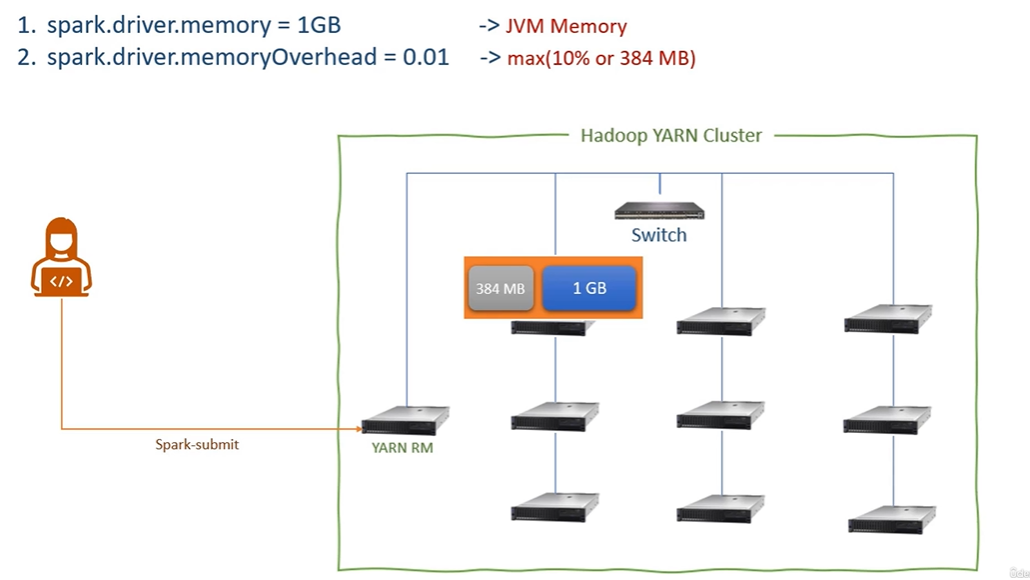
- Efficient resource utilization: Static allocation might lead to underutilized resources while an application holds them for its entire duration.
Spark Allocation Strategies:
- Static Allocation (default): (ex: — number of executors: 10, executor-memory: 8GB etc.)
- Application requests all resources at startup from the cluster resource manager.
- Holds onto all resources throughout its execution, regardless of actual usage.
- Less efficient for applications with varying resource needs across stages.
- Dynamic Allocation:
- Application requests resources dynamically as needed.
- Releases unused executors back to the cluster manager.
- Acquires new executors when more resources are required.
- Requires enabling configurations (
spark.dynamicAllocation.enabledandspark.dynamicAllocation.testingMode).
Dynamic Allocation Configuration:
spark.dynamicAllocation.enabled: Set totrueto enable dynamic allocation.spark.dynamicAllocation.idleTimeout: Time (default: 60 seconds) an executor can be idle before being released.spark.dynamicAllocation.backlogTimeout: Time (default: 1 second) pending tasks wait for an executor before requesting more resources.
Benefits of Dynamic Allocation (for shared clusters):
- Improved resource utilization by adapting to application needs.
- Allows multiple applications to share resources more efficiently.
Key Points:
- Dynamic allocation is a Spark-level configuration, not a cluster resource manager decision.
- Consider enabling dynamic allocation for shared clusters to optimize resource usage.
Serial vs. Parallel Execution within application
- Default (Serial): Spark jobs/tasks run sequentially, one after another.
- Parallel: You can submit jobs from multiple threads, allowing them to run concurrently.
Benefits of Parallel Execution:
- Improved performance by utilizing cluster resources more efficiently.
Challenges of Parallel Execution:
- Resource competition: Parallel jobs require resources to run tasks concurrently.
- Scheduling: Spark needs to manage resource allocation between parallel jobs.
Spark Schedulers:
- FIFO (default): Jobs are processed in the order they are submitted. Earlier jobs get priority on all available resources, potentially delaying later jobs.
- FAIR: Jobs are assigned tasks in a round-robin fashion, ensuring all parallel jobs get a fair share of resources and avoid waiting for each other.
Configuration:
- Enable FAIR scheduler using
spark.scheduler.mode=FAIR.
if __name__ == "__main__":
    spark = SparkSession \
        .builder \
        .appName("Demo") \
        .master("local[3]") \
        .config("spark.sql.autoBroadcastJoinThreshold", "508")
 \
        .config("spark.scheduler.mode", "FAIR") \
        .getOrCreate()

    file_prefix = "data/d"
    jobs = []
    outputs = []

    for i in range(0, 2):
        file1 = file_prefix + str(i + 1)
        file2 = file_prefix + str(i + 2)
        thread = threading.Thread(target=do_job, args=(file1, file2))
        jobs.append(thread)

    for j in jobs:
        j.start()

    for j in jobs:
        j.join()

    print(outputs)
Key Points:
- Consider parallel execution and FAIR scheduler for multithreaded Spark applications to optimize resource usage and job completion times.
- Spark UI provides insights into the active scheduler and resource allocation details.
메타데이터
- post_id
- b27a7199bf2d
- slug
- spark-dynamic-resource-allocation-b27a7199bf2d
- url
- https://blog.devgenius.io/spark-dynamic-resource-allocation-b27a7199bf2d
- canonical_url
- https://blog.devgenius.io/spark-dynamic-resource-allocation-b27a7199bf2d
- author_url
- https://medium.com/@nethaji.bhuma
- status
- ok
- fetched_at
- 2026-08-18 23:39:37