The Function and Structure of Oriki
Except from Egbe Iwa-Pele Ifa Training Course One by: Awo Falokun | Egbe Iwa-Pele
The Function and Structure of Oriki
Except from Egbe Iwa-Pele Ifa Training Course One by: Awo Falokun | Egbe Iwa-Pele
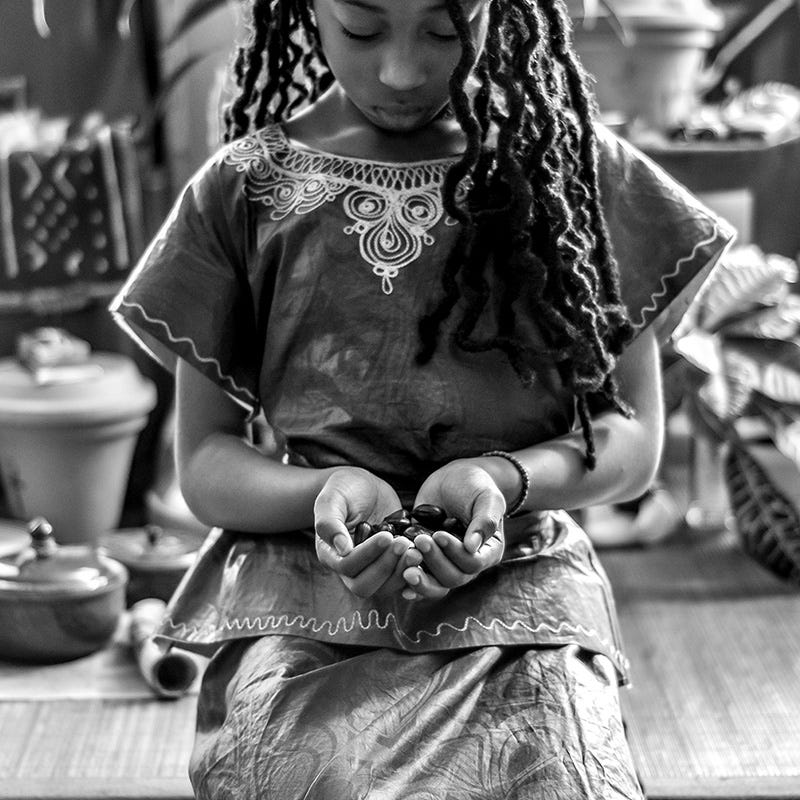
Photography by: Mark Anthony
There is a Ifa-Orisa proverb that says once we have been initiated we need to re-initiate our self everyday. The fundamental step in the ongoing re-initiation process is to maintain daily connection with Spirit. This is traditionally done through the recitation of morning Oriki. The word Oriki is from the elision Ori kiki meaning to praise consciousness. Ifa teaches that everything in the Universe from the smallest sub-atomic particle to the largest star has consciousness or Ori. The linguistic meaning of kiki in Yoruba is to praise as a way of calling forth consciousness. When word is repeated in the Yoruba as in ki ki it is a reference to the fundamental source or the spiritual inspiration for the single word. By saying kiki we are saying the word is a reference to the fundamental praise of the inner essense of a particular form of consciousness.
The word Oriki in English can be translated to mean invocation. The purpose of doing morning Oriki is to start our day in alignment with our iponri (higher self) and to make connection with those Orisa who guide our destiny. The Prophet Orunmila taught that all spiritual forms of consciousness that exit in the Universe exist in the Ori of an individual. This was an early expression of the scientific idea of living in a holographic universe. What this means in practical terms is that all forms of altered states of consciousness that are invoke in Ifa-Orisa are a part of every person’s Ori. We do, we cannot receive Orisa from another person. Orisa lives in our consciousness and is a gift from Olorun or the Source of Creation. When initiate someone we do not give them anything, we simply unlock that which is undiscovered.
After reciting daily Oriki it is traditional to do daily divination asking for guidance from the Immortals. It is also traditional after doing daily Oriki to pray for good fortune, for yourself, your family, your community and the global village. To make the process management daily oriki includes a prayer called Odaraji meaning forgiveness. The Odaraji prayer is asking the Immortals to excuse us from the daily obligation of making offerings so we can receive direct access to their guidance.
The function of the daily Oriki is to invoke each of the spiritual forces we have received during the course of our spiritual journey. We make those invocations so we can maintain a high level of sensitivity and connection with the spiritual forces we have chosen to guide our destiny. Once we have been initiated we re-initiate our self everyday. The daily recitation of oriki coupled with the daily consideration and critical self-evaluation involved in divination is the foundation of the re-initiation process. It is the heart and soul of Ifa-Orisa spiritual discipline.
It is traditional to sing Oriki. There is no right way to sing Oriki. The chanting of invocations is highly personal and different for everyone. We sing the Oriki because when Spirit comes to us and through us Spirit sings. Altered states of consciousness is the source of music in the world. Music is a part of the culture of every group of people on the planet. Sound brings creation into being and the Awo or mystery of Ifa-Orisa is that we can use sound, invocation and prayer to change our physical reality.
The function of Oriki is to invoke altered states of consciousness that serve as portals for ase or sacred power to come from Orun to Aye through the portal of human consciousness.
The daily Oriki has eights parts. The first two parts are generally the same for everyone in a particular lineage and there after the daily Oriki is modified to support the initiations received by the individual, the family and community. There are over two hundred dialects of the Yoruba language with a wide range of variation in pronunciation. The Yoruba language taught in Nigeria schools is based on the dialect spoken in Oyo State. The melodic quality of the language is indicated by tonal marks on the top of letters. There are three pitches used in the Yoruba language. In simple terms we can use the musical syllables do, re, me to explain the tonal marks. Re would be our normal speaking voice and would have no written indicator. Do would be one musical step under our our normal tone of voice and is indicated by a tonal mark slanting down from left to right. Me would be one step above our normal tone of voice and is indicated by a tonal mark slanting up from right to left. The range of variation in the Yoruba language frequently comes in the arena of tonal marks making this aspect of the language extremely challenging. I encourage students who are new to the language to concentrate their efforts on proper pronunciation. The tonal aspect of the language comes with practice and time spent listening to those who speak the language fluently.
Register for: Egbe Iwa-Pele Ifa Orisa Training Course One

Article Creative by: Mark Anthony Designs
**Posted by: Fasalewa Fagbemi Aworeni*
메타데이터
- post_id
- b2832e2143fd
- slug
- the-function-and-structure-of-oriki-b2832e2143fd
- url
- https://medium.com/@egbeiwapele/the-function-and-structure-of-oriki-b2832e2143fd
- canonical_url
- https://medium.com/@egbeiwapele/the-function-and-structure-of-oriki-b2832e2143fd
- author_url
- https://medium.com/@egbeiwapele
- status
- ok
- fetched_at
- 2026-08-03 22:09:20