The Limits of Nonviolent Communication (NVC) in Intentional Communities
After several years of living in a cohousing community “using” NVC, I’ve come to witness both its limitations and its misuses.
The Limits of Nonviolent Communication (NVC) in Intentional Communities
After several years of living in a cohousing community “using” NVC, I’ve come to witness both its limitations and its misuses. Here is my personal reflection based on this lived experience.
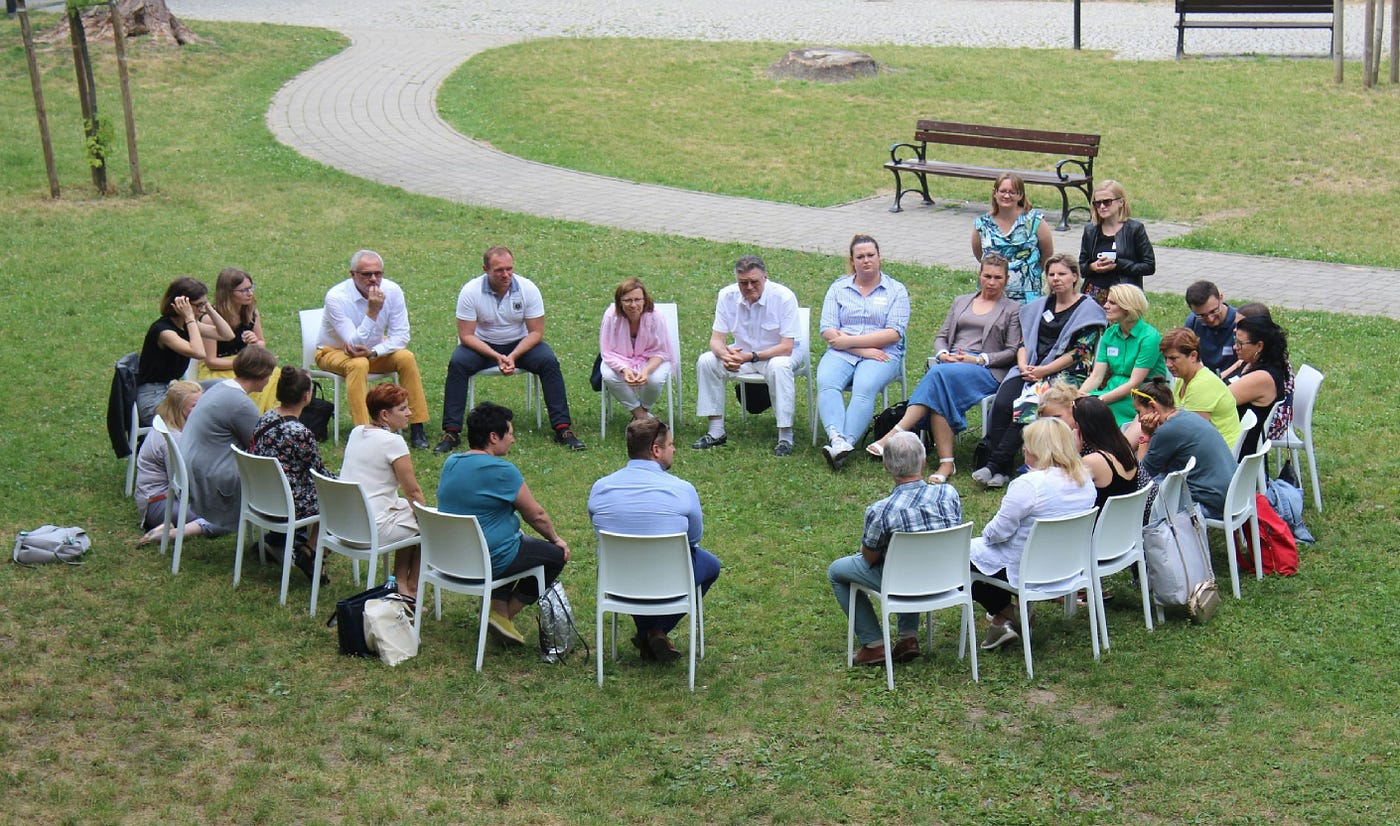
Photo by Ria Truter on Unsplash
Nonviolent Communication (NVC), popularized by Marshall Rosenberg, is often seen as a miracle tool to resolve conflicts, improve human relationships, and foster a culture of dialogue and empathy. Naturally, in intentional communities like cohousing projects — where collective life relies on cooperation and mutual respect — NVC is frequently adopted as a communication standard. Yet many experiences show that NVC, far from always soothing tensions, can sometimes exacerbate them — or even serve as a tool for oppression. How come? Here are a few lines of thought.
1. Misunderstanding NVC: A communication tool, really?
A common mistake in intentional communities is to treat NVC as a simple communication technique — a “correct” way of talking. This often leads to focusing on the form — naming needs, feelings, observations — without embracing the deeper path it invites.
But the real value of NVC lies not in the formula, but in the consciousness underneath it: a clear intention to connect, listen, and co-create mutually satisfying solutions. It invites us to listen sincerely to ourselves, to take responsibility for our emotions, and to be truly open to others.
When used mechanically — without this inner work and shift in consciousness — NVC becomes an empty shell. We “do NVC” to feel good about ourselves or to shield ourselves, without any real authenticity. In this approach, it doesn’t open up space for connection — it freezes it into rigid protocols.
2. A Demanding Posture That’s Unrealistic to Uphold Collectively
NVC calls for a deep change in posture: letting go of judgment, owning our feelings, identifying core needs, listening actively without trying to convince. This is demanding work. It requires emotional maturity, self-regulation, ongoing attentiveness, and above all, a serious personal commitment. In a diverse group, these preconditions can’t be assumed or required of everyone. Each person brings their own life history, wounds, defense mechanisms, and limitations. Expecting all members to commit to the inner work that NVC entails is unrealistic.
NVC can only bear fruit when freely chosen — not when enforced as a collective norm or rule. Imposing it may even backfire, generating frustration, guilt, or resistance. That’s why integrating NVC in a group must come through inspiration, role modeling, and respect for each other’s personal rhythm — never through obligation.
Also, living collectively naturally brings conflict: disagreements about shared decisions, recurring tensions, unequal contributions, unspoken resentments... In these moments, maintaining a nonviolent posture is especially difficult. The temptation to use NVC language while holding onto a defensive or passive-aggressive attitude is strong. This gap between “sanitized” words and actual intention can lead to deep relational confusion.
3. A Tragic Paradox: NVC as a Tool for Oppression
Even worse, some individuals — believing they understand and master NVC better than others — may (often unconsciously) use it as a weapon, a tool of disguised domination under the appearance of kindness.
They use it to impose their needs and get what they want: a “request” in NVC language becomes a subtle pressure that’s hard to refuse without feeling guilty or uncooperative.
They also use it to correct others — demanding a certain tone or form of expression. In the name of harmony and peaceful communication, they end up suppressing anger, pain, or outrage. The goal is no longer to connect or understand, but to control. Instead of creating space for true expression, NVC becomes a way to silence, to disqualify anything that doesn’t fit the “acceptable” mold of supposedly nonviolent form of communication. It’s a double punishment: you’re suffering, and on top of that, you’re called out for not expressing it “properly.” This is the perverse trap of misunderstood NVC: it imposes an emotional norm — calm, composed, “aware” — that excludes those who don’t fit or can’t conform to it in the moment. It’s violence disguised as peace.
When practiced without the consciousness and posture shift it requires, NVC — which is meant to liberate speech— becomes a form of symbolic oppression, a tool of normalization, or even exclusion.
Conclusion
NVC relies on demanding foundations: self-awareness, radical honesty, openness to others, emotional regulation. In theory, this is inspiring. In practice, it’s rarely — if ever — achieved collectively. In the real-world messiness of intentional communities — with their tensions, drama, and different levels of consciousness— it’s deceptive to expect a shared, stable, and authentic NVC posture.
Rather than upholding a collective obligation to use NVC — which often results in pressure, guilt, or power games — it seems more realistic and healthier to treat it as an individual practice: a tool for introspection, inner clarity, and personal responsibility. Not as a mandatory group code of conduct.
Accepting this is an act of lucidity. And it may open the door to more honest forms of dialogue — even if they’re rougher at times. Without endorsing verbal violence, it’s often better to have imperfect but true speech than a polished “nonviolent” language that masks deep-seated tensions.
메타데이터
- post_id
- b285280d5c1e
- slug
- the-limits-of-nonviolent-communication-nvc-in-intentional-communities-b285280d5c1e
- url
- https://medium.com/@ddoute/the-limits-of-nonviolent-communication-nvc-in-intentional-communities-b285280d5c1e
- canonical_url
- https://medium.com/@ddoute/the-limits-of-nonviolent-communication-nvc-in-intentional-communities-b285280d5c1e
- author_url
- https://medium.com/@ddoute
- status
- ok
- fetched_at
- 2026-06-11 10:13:20