Cellular Architecture and Neighborhood-Informed Virtual Spatial Tumor Profiling from Histopathology
Histopathology has long been the foundation of cancer diagnosis, providing essential information about tumor morphology and tissue…
Cellular Architecture and Neighborhood-Informed Virtual Spatial Tumor Profiling from Histopathology
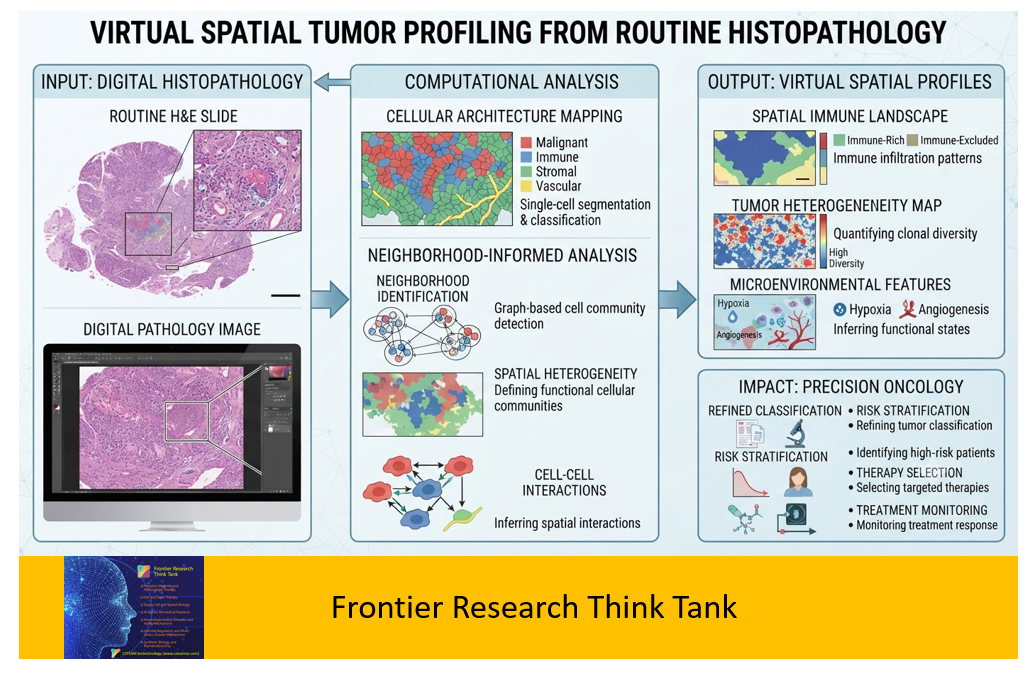
Histopathology has long been the foundation of cancer diagnosis, providing essential information about tumor morphology and tissue organization. Recent advances are expanding its value beyond visual interpretation by enabling the reconstruction of virtual spatial tumor profiles directly from routine hematoxylin and eosin (H&E) slides. This emerging approach combines cellular architecture with neighborhood analysis to reveal the biological organization of tumors at unprecedented resolution.
Every tumor contains a complex ecosystem in which malignant cells, immune cells, stromal cells, and vascular structures interact continuously. The spatial arrangement of these cellular populations influences tumor growth, immune surveillance, metastatic potential, and therapeutic response. Rather than examining individual cells in isolation, neighborhood-informed analysis captures how groups of cells organize into functional communities that shape disease behavior.
Virtual spatial profiling offers several practical advantages. Because it can be generated from widely available digital pathology images, it has the potential to extend spatial biology insights without requiring expensive spatial transcriptomics or multiplex imaging technologies. Computational models can infer cellular interactions, identify immune-rich and immune-excluded regions, estimate tumor heterogeneity, and predict clinically relevant microenvironmental features from standard pathology slides.
These capabilities may significantly influence precision oncology. Virtual spatial profiling could assist pathologists in refining tumor classification, identifying high-risk patients, selecting targeted therapies, and monitoring treatment response. It also provides researchers with an efficient platform for studying tumor ecosystems across large clinical cohorts.
As digital pathology continues to evolve, integrating histopathology with computational spatial analysis is transforming routine tissue slides into rich biological maps. This shift moves pathology from descriptive observation toward functional interpretation, offering new opportunities for understanding tumor architecture and supporting more personalized cancer care.
Keywords: Digital Pathology; Spatial Tumor Profiling; Histopathology; Tumor Microenvironment; Precision Oncology; Computational Pathology
If you would like to access a comprehensive analysis report on the topic, please visit my Pro Substack page (https://substack.com/@jackhuang2026).
메타데이터
- post_id
- b28d95c476a5
- slug
- cellular-architecture-and-neighborhood-informed-virtual-spatial-tumor-profiling-from-histopathology-b28d95c476a5
- url
- https://medium.com/@csteam7890/cellular-architecture-and-neighborhood-informed-virtual-spatial-tumor-profiling-from-histopathology-b28d95c476a5
- canonical_url
- https://medium.com/@csteam7890/cellular-architecture-and-neighborhood-informed-virtual-spatial-tumor-profiling-from-histopathology-b28d95c476a5
- author_url
- https://medium.com/@csteam7890
- status
- ok
- fetched_at
- 2026-07-22 13:10:46






