Sociological and Psychological Exploration of Punk, Grunge, Heavy Metal, and Political Orientation
Sociological and Psychological Exploration of Punk, Grunge, Heavy Metal, and Political Orientation
Music scenes are rarely just about music. Beneath the distortion, fashion, aggression, and spectacle lies something deeper: a social ecosystem that attracts particular personalities, values, emotional needs, and worldviews. Entire academic disciplines, from sociology to personality psychology, have long studied why certain individuals gravitate toward specific subcultures and how those subcultures develop recognizable cultural and even political tendencies over time. When examining famous punk, grunge, and heavy metal artists statistically, a striking pattern emerges in public political expression. Punk and grunge scenes appear overwhelmingly left-leaning or progressive, while heavy metal — especially once 1980s glam and arena metal are included — becomes far more ideologically mixed. The central question is not simply whether this difference exists, but why it exists, and what it reveals about the psychological architecture of rebellion itself.
A survey of highly influential frontmen from punk and grunge scenes shows a strong clustering around progressive or left-libertarian political identities. Figures such as Kurt Cobain of Nirvana, Joe Strummer of The Clash, Jello Biafra of Dead Kennedys, Eddie Vedder of Pearl Jam, and Billie Joe Armstrong of Green Day consistently expressed political views aligned with progressivism, socialism, feminism, anti-corporate activism, or broader social justice movements. In contrast, heavy metal presents a far more heterogeneous distribution. Within metal, one finds explicitly progressive activists such as Serj Tankian of System of a Down, libertarian or largely apolitical figures such as James Hetfield of Metallica, conservative-leaning artists such as Dave Mustaine of Megadeth, commercially oriented glam-era figures such as Bret Michaels of Poison and Gene Simmons of Kiss, and a wide range of artists whose political identity is either mixed or minimally emphasized. Even within the same broad genre, ideological cohesion is weak, and political identity is far less central to the artistic identity than it is in punk.
When these observations are converted into a rough cultural estimate, punk and grunge scenes appear to be overwhelmingly progressive, with approximately eighty to ninety-five percent of influential figures publicly aligning with left-leaning or progressive causes, a very small minority appearing politically neutral, and virtually no visible conservative representation among major figures. Heavy metal, by contrast, appears far more distributed, with a substantial portion of artists expressing progressive views, a nearly comparable portion expressing conservative, libertarian, or mixed views, and a large segment remaining apolitical or ideologically ambiguous. These are not formal polling statistics, since musicians are not systematically surveyed for political affiliation, but they are consistent with long-standing sociological observations of these subcultures.
To understand why this divergence exists, it is necessary to ask a deeper question: what, exactly, is being rebelled against? At first glance, punk and metal both appear to be expressions of anti-establishment energy. Both are loud, aggressive, emotionally intense, and deeply critical of mainstream norms. However, the nature of the rebellion differs significantly. Punk’s rebellion is largely collective and structural, whereas metal’s rebellion is more individual and existential. This difference in the target of rebellion has profound implications for political orientation.
Punk emerged in economically and socially unstable urban environments during the 1970s in places such as New York and London, where young people experienced unemployment, deteriorating infrastructure, class frustration, and a general sense of institutional decay. Within this environment, suffering was often interpreted as systemic rather than individual. The perceived enemy was not only personal frustration or emotional alienation but broader structures such as capitalism, hierarchy, racism, nationalism, authoritarian governance, corporate exploitation, and police power. Psychologically, punk attracted individuals high in openness to experience, sensitivity to inequality, anti-authoritarian disposition, collective identity formation, moral urgency, and social idealism. This is reflected in the strong DIY ethic of punk culture, which emphasized collective organizing, independent record labels, zines, community venues, and activist networks. Over time, punk became what sociologists would describe as a movement subculture, where artistic expression and political identity are deeply intertwined and mutually reinforcing. This is why punk scenes so frequently produced artists aligned with anarchism, socialism, anti-racism, feminism, environmentalism, labor activism, and queer rights movements. Political engagement was not an external layer added to the music; it was part of the cultural infrastructure itself.
Grunge, which emerged later in the Pacific Northwest, inherited much of punk’s anti-commercial skepticism but shifted the emotional center of gravity inward. Where punk often framed the problem as societal corruption, grunge more often framed it as personal exhaustion within that society. Artists such as Kurt Cobain embodied a form of emotionally raw, introspective rebellion that resisted not only corporate culture but also performative masculinity and excessive stylization. The Seattle grunge scene placed high value on authenticity, emotional honesty, and discomfort with hierarchy and superficial status competition. It also developed partly as a cultural backlash against the flamboyance and commercial excess of 1980s glam metal. This contrast between emotional austerity and theatrical excess helped shape grunge into a more socially progressive cultural space, particularly in its rejection of machismo, its openness to vulnerability, and its general skepticism of corporate influence.
Heavy metal, in contrast, developed as a far more ideologically diverse cultural system. Its core themes tend to revolve around power, transcendence, darkness, mythology, war, chaos, endurance, and emotional intensity. Psychologically, metal attracts individuals who often score higher in sensation-seeking, nonconformity, outsider identity, emotional intensity, and fascination with taboo or extreme subject matter. However, unlike punk, metal rarely channels these traits into a unified political ideology. Instead, its rebellion is often symbolic, aesthetic, or existential. The “enemy” in metal is more abstract and internalized, often taking the form of death, weakness, hypocrisy, religious control, emotional repression, or existential limitation itself. This allows metal to accommodate a wide range of political identities, including progressive activists, libertarians, apolitical individuals, and even occasional nationalist or conservative figures. The genre does not require ideological conformity, which leads to its broad political dispersion.
The inclusion of 1980s glam and hair metal further expands this ideological diversity. Hair metal, unlike punk, was not primarily anti-commercial. It was deeply embedded in mainstream consumer culture and often celebrated fame, luxury, sexuality, excess, and spectacle. Artists such as Bret Michaels of Poison, Vince Neil of Mötley Crüe, David Lee Roth of Van Halen, and members of Kiss and related bands were part of a culture that was far more comfortable with commercial success and status competition than punk ever was. Psychologically, this environment attracted individuals more oriented toward performance identity, aspirational success, and consumer engagement. As a result, glam metal artists often appear politically moderate, libertarian, patriotic, or simply indifferent to ideological activism. While there are exceptions, including politically outspoken figures such as Sebastian Bach or Jon Bon Jovi, the overall effect of including glam metal is to further broaden the political distribution of the metal category as a whole.
From a psychological perspective, one of the most important distinctions between punk and metal lies in the source of meaning. Punk tends to derive meaning through collective moral struggle and the desire to change society. Metal tends to derive meaning through personal endurance and the desire to survive or transcend society. Punk is therefore more outward-facing and socially reformist, while metal is more inward-facing and existential. This difference aligns with broader findings in political psychology, which often show that individuals with progressive tendencies score higher in openness, empathy toward marginalized groups, tolerance for ambiguity, and collective social concern, whereas individuals with conservative tendencies often show higher preferences for order, stability, tradition, personal responsibility, and sensitivity to perceived threats. Metal culture uniquely spans both psychological profiles because it combines aggression, emotional catharsis, anti-conformity, and strong subcultural identity without requiring a unified political framework.
Despite these differences, both punk and metal share a crucial sociological similarity: they attract outsiders. Many participants in both scenes have experienced alienation, rejection, bullying, or social marginalization. However, the key divergence lies in how that alienation is interpreted. Punk tends to externalize blame toward social systems, while metal tends to internalize struggle as a test of personal resilience. Punk asks how society should change, while metal asks how the individual should endure within it. Both are forms of rebellion, but they operate on different psychological and sociological axes.
Ultimately, the statistical differences in political orientation between punk, grunge, and heavy metal are not merely accidental artifacts of sampling but reflections of deeper structural differences in how each culture conceptualizes rebellion, identity, and meaning. Punk and grunge form ideologically clustered, socially engaged subcultures that tend to channel rebellion into collective political expression. Heavy metal, by contrast, forms a fragmented but psychologically rich ecosystem where rebellion is aestheticized, individualized, and ideologically plural. Both emerge from alienation, both reject conformity, and both demand authenticity, but they diverge in whether freedom is imagined as a transformation of society or a transformation of the self.
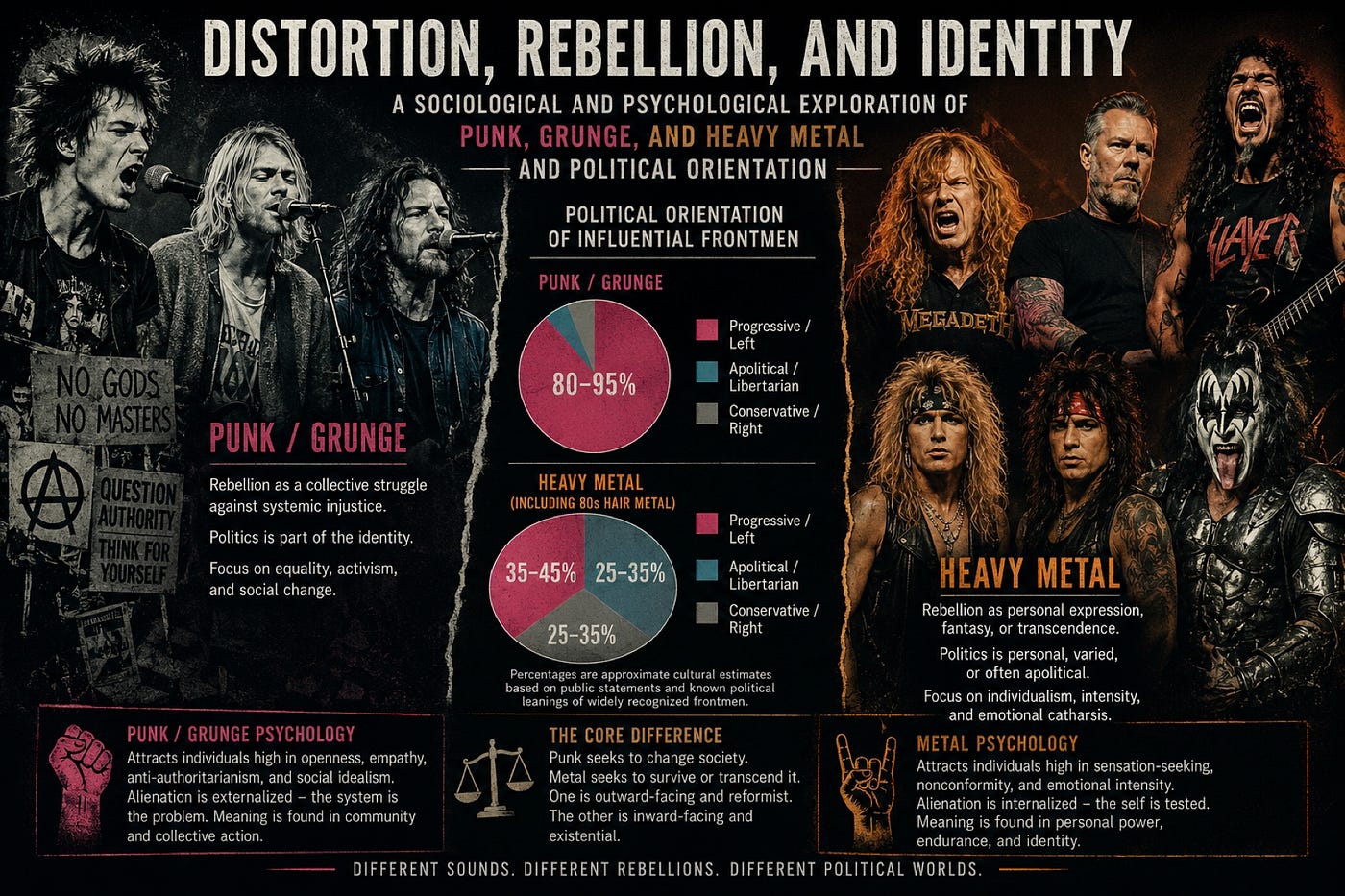
Image Generated by Author Using ChatGPT
메타데이터
- post_id
- b2a8b46c7339
- slug
- sociological-and-psychological-exploration-of-punk-grunge-heavy-metal-and-political-orientation-b2a8b46c7339
- url
- https://medium.com/@joshlevin10/sociological-and-psychological-exploration-of-punk-grunge-heavy-metal-and-political-orientation-b2a8b46c7339
- canonical_url
- https://medium.com/@joshlevin10/sociological-and-psychological-exploration-of-punk-grunge-heavy-metal-and-political-orientation-b2a8b46c7339
- author_url
- https://medium.com/@joshlevin10
- status
- ok
- fetched_at
- 2026-07-10 13:01:02



