GPTs vs Assistants API: Exploring the Differences and Use Cases
In the rapidly evolving landscape of artificial intelligence (AI), two prominent tools are revolutionizing how we interact with AI: Custom…
GPTs vs Assistants API: Exploring the Differences and Use Cases
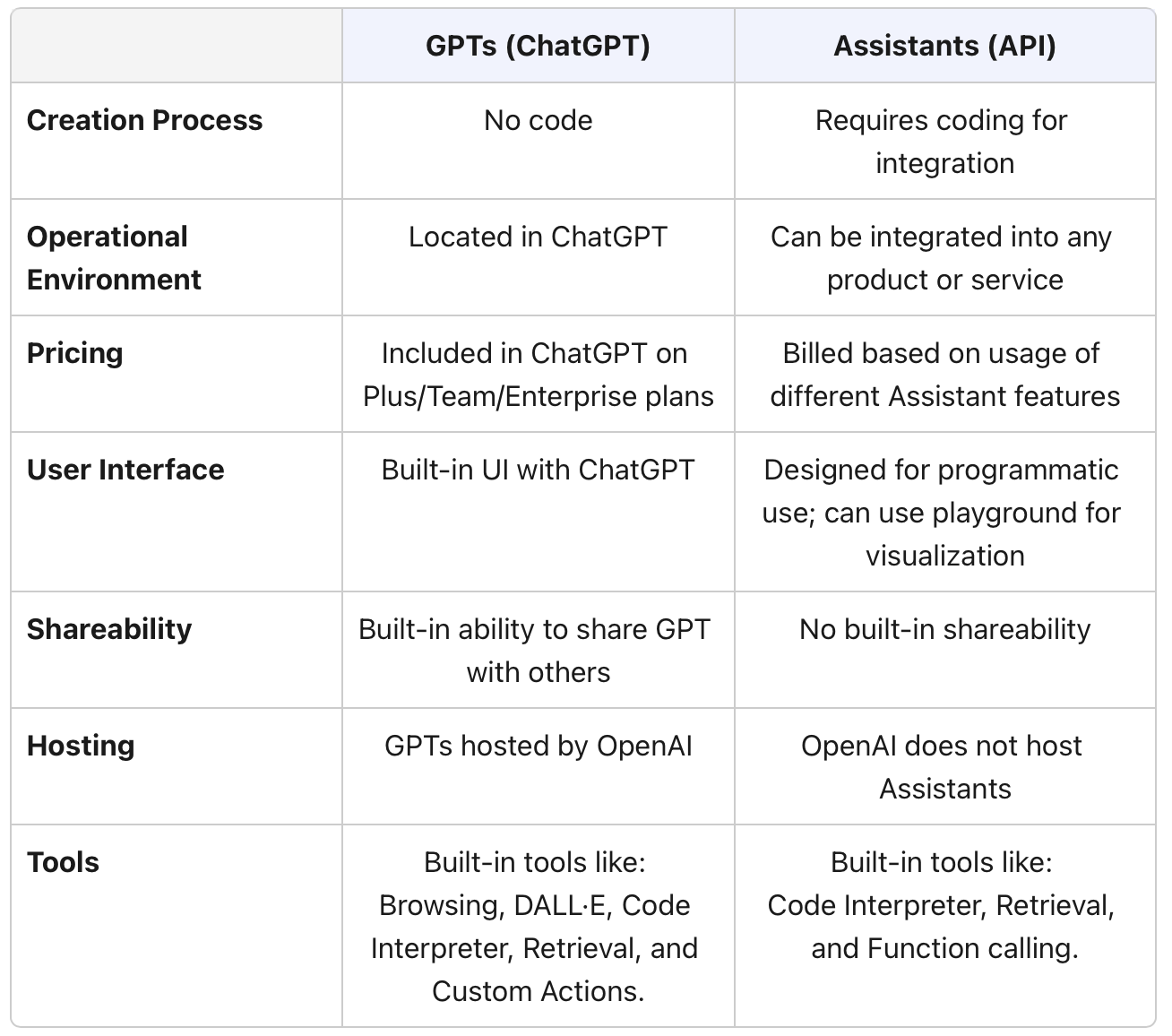
In the rapidly evolving landscape of artificial intelligence (AI), two prominent tools are revolutionizing how we interact with AI: Custom GPTs and Assistant APIs. Both offer unique capabilities for building AI-driven solutions, but they differ significantly in how they’re designed, their use cases, and how developers or non-developers can interact with them.
Let’s dive into a detailed comparison of GPTs vs. Assistant APIs, to understand which tool is the right fit for your needs.
What Are GPTs?
GPTs (Generative Pre-trained Transformers) are powerful language models that can generate human-like text. With OpenAI’s Custom GPTs, users can create personalized versions of ChatGPT to perform specific tasks or answer queries based on provided instructions and data. The main appeal of GPTs is that they can be built without technical knowledge or coding.
Some key features of GPTs:
- No coding required: Users can create GPTs without programming.
- Easy setup: By providing instructions and uploading custom knowledge (e.g., PDFs, documents), GPTs can be trained quickly.
- Custom behavior: Users can modify how GPTs respond to different scenarios or commands.
- Shareable: You can make your GPT public or keep it private for internal use.
What Are Assistant APIs?
Assistant APIs, on the other hand, are more developer-focused tools that allow you to integrate sophisticated conversational AI into your applications, products, or services. Unlike GPTs, Assistant APIs require technical expertise, making them a better fit for developers looking to implement AI-driven features within apps or websites.
Some key features of Assistant APIs:
- Developer-centric: Requires coding knowledge and API integration.
- Flexible integration: Designed to fit into custom applications, websites, and services.
- Control over context: Developers have full control over how the assistant interacts, responds, and accesses data.
- Scalable: Ideal for businesses looking to integrate AI at a large scale within their products or platforms.
Key Differences: GPTs vs Assistant APIs
1. Technical Expertise
- GPTs: Anyone with basic knowledge of AI or ChatGPT can create a custom GPT. No coding or deep technical knowledge is needed. The process is guided through an easy-to-use interface.
- Assistant APIs: These require a background in development, API integration, and backend systems to implement. Assistant APIs are intended for developers building custom AI solutions into applications.
2. Customization Level
- GPTs: Custom GPTs allow users to train the model by uploading knowledge and providing specific instructions, but the customization is limited to what the platform supports.
- Assistant APIs: With APIs, developers have complete control over customization — allowing them to design an assistant from scratch, defining everything from the user flow to external integrations.
3. Ease of Use
- GPTs: With GPTs, the process is streamlined, and even non-developers can use a point-and-click interface to create their own models.
- Assistant APIs: Working with APIs requires writing code, setting up environments, and managing more complex workflows.
4. Data Integration
- GPTs: You can upload documents, PDFs, and other data to train your GPT and keep it up-to-date beyond the model’s pre-trained data.
- Assistant APIs: APIs allow you to pull data from any source, making them more versatile in terms of real-time data handling, database connections, and external APIs.
5. Use Cases
- GPTs: Best suited for creating specialized conversational agents that can handle particular tasks (e.g., customer support, content generation) with minimal setup. Perfect for small businesses, educators, or individuals.
- Assistant APIs: Ideal for enterprise-level applications, e-commerce platforms, and highly customized AI assistants that require real-time data, external integrations, or deep customization.
When to Choose GPTs
- No technical background: If you’re a non-developer or want a quick solution without diving into code, GPTs are perfect.
- Specialized knowledge tasks: For tasks like answering FAQs, providing customer support, or handling repetitive queries, custom GPTs work efficiently.
- Rapid prototyping: GPTs can be created and deployed quickly for immediate use.
When to Choose Assistant APIs
- You need deep customization: For businesses or developers looking for full control over how the assistant behaves, integrates with services, and interacts with users, APIs are the way to go.
- Complex environments: If you’re building AI into applications with multiple data sources, dynamic content, or advanced functionality (e.g., booking systems, e-commerce support), APIs provide the flexibility needed.
- Large-scale deployment: If your goal is to integrate AI into a large enterprise system, the scalability and adaptability of Assistant APIs make them the right choice.
Conclusion: GPTs or Assistant APIs?
The choice between GPTs and Assistant APIs ultimately depends on your goals and technical expertise:
- If you’re looking for a low-code, easy-to-use AI assistant, GPTs provide a fast and flexible solution.
- If you’re a developer or business with advanced AI needs, the customization and power of Assistant APIs offer far more control over your assistant’s capabilities.
Both tools are revolutionary in their own right, giving users the power to leverage AI in more creative and impactful ways. Whether you’re building a personal chatbot or integrating an AI assistant into your business operations, you now have the tools to do it, tailored to your specific needs.
메타데이터
- post_id
- b2aba9fb357b
- slug
- gpts-vs-assistants-api-exploring-the-differences-and-use-cases-b2aba9fb357b
- url
- https://medium.com/@rvermaphe/gpts-vs-assistants-api-exploring-the-differences-and-use-cases-b2aba9fb357b
- canonical_url
- https://medium.com/@rvermaphe/gpts-vs-assistants-api-exploring-the-differences-and-use-cases-b2aba9fb357b
- author_url
- https://medium.com/@rvermaphe
- status
- ok
- fetched_at
- 2026-06-29 22:44:20