CDR Momentum and Myths — Where are we now? (May 2026)
As part of May’s focus on Australia’s Consumer Data Right (CDR) and expanding fintech data horizons, Ben Ford from Wych and MOGOPLUS hosted…
CDR Momentum and Myths — Where are we now? (May 2026)

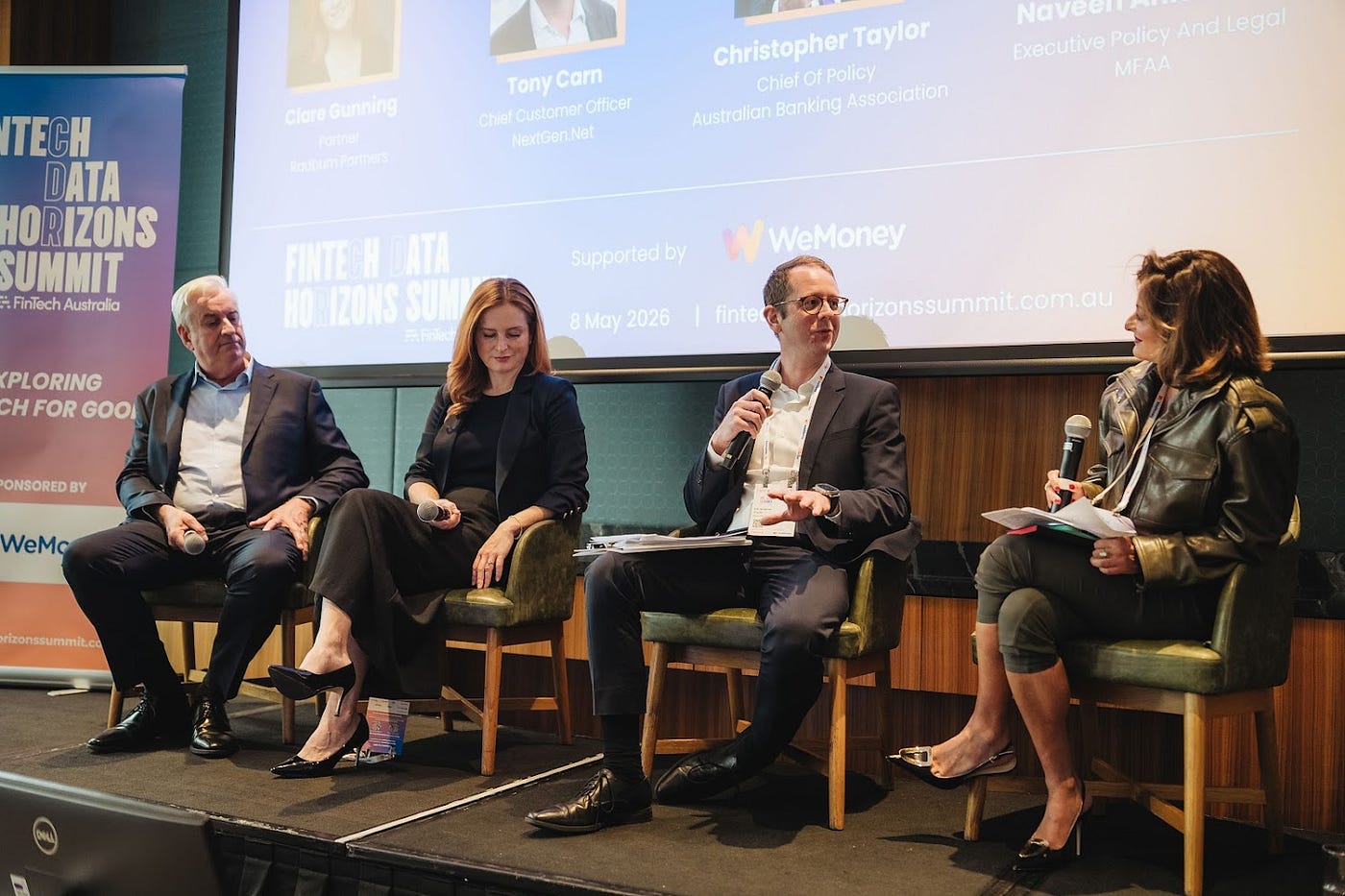
L-R: John Dunkerley, Ben Ford and Simeon Duncan in the studio.
As part of May’s focus on Australia’s Consumer Data Right (CDR) and expanding fintech data horizons, Ben Ford from Wych and MOGOPLUS hosted a special edition of the FinTech Australia podcast.
Ford’s guests were John Dunkerley from SISS Data Services and Simeon Duncan from Intuit.
After welcoming his guests and making introductions, Ford observed open banking has reached a tipping point.
Screen scraping is losing signal
SISS Data Services’ Dunkerley agreed, noting CDR has reached a level of maturity. Over the last 12 months, SISS Data Services has therefore started to support customers adopting open banking at scale.
“We’re seeing a huge increase in demand, primarily from platforms wanting to get away from screen scraping,” Dunkerley said.
“Not so much from direct feeds,” he clarified.
“We’re flat out at the moment because so many people want to jump off screen scraping and get to something that’s more stable for their customers,” Dunkerley noted, citing the introduction of multi-factor authentication by banks as a trigger.
“There’s a pretty high degree of urgency in needing to solve that issue,” Dunkerley said.
Intuit’s Duncan pointed to two key drivers of adoption.
- Consumer expectations that their apps will connect with each other in real-time and show the same balances.
- Increased public awareness of information security risks when uploading data to different platforms including LLMs.
CDR consent journey, “nom rep” problem, and completion rates
Ford noted the CDR consent journey has been a source of friction compared with other data sharing methods.
Duncan said the friction in the nominated representative process is real and expressed a desire to solve it, for example, the way the UK did.
Duncan added some context here. “In the UK, if you can operate an account, you can share the data,” he said, referring to a default opt-in, with optional opt-out.
Dunkerley commented: “All consent journeys have drawbacks. With screen scraping, you are disclosing your online banking credentials to a third party, and that’s not great.”
“The nominated representative issue comes up for us a lot. Personally I feel if you can access the data through an online channel, you should be able to share it through an online channel. That’s just my personal logic,” Dunkerley said.
Ford mentioned a personal lender that is seeing open banking conversion rates — being completion of the consent journey — comparable to screen scraping at 83% versus 85%.
“I think these things do have a habit of accelerating exponentionally. And we’re seeing that with our customers. They start with a pilot on a smaller number of customers, see it’s working well, then roll it out to everybody,” Dunkerley said.
Duncan referred back to his points on consumer expectations and enhanced security posture, saying “CDR is safe and secure to build on, and it’s reliable.”
“Consumers want to get jobs done using the CDR,” Duncan noted.
“What’s been interesting is the uptake in the lending space and the way the availability of the data is changing the way decisions are made, customers are monitored, and data can be enriched,” Dunkerley said.
Duncan noted the benefit for small businesses of being able to make decisions based on data.
“Once we start to rely on it, we then depend on it,” Duncan said.
Dispelling myths and negative messaging
Ford then turned the conversation to negative messaging that persists, starting with the myth that screen scraping is more complete or a richer source of data.
“We’re finding the range of what is covered is what our customers need,” Dunkerley said.
“Any slight blind spots are more than made up for by the reliability,” he added.
Duncan said: “Security settings aside, screen scraping gives you what a human would see on the screen. But CDR gives you the structured data that sits behind that, which as JD says, is a lot more reliable.”
“It’s not just about the completeness, it’s about how it fails,” he cautioned.
“Screen scraping fails silently. You hear it’s failed when the call centre complains their transaction data is incomplete. CDR fails loudly. You get an error code. So you are able to mitigate those a lot sooner. From a production point of view, how those two services fail, I think is quite important,” Duncan emphasised.
Ford pointed out there can be hesitation to change existing processes, and Dunkerley agreed there is cost and disruption of moving away from screen scraping over to open banking, but it’s becoming imperative.
“The writing on the wall has become very apparent in the last 12 months,” Dunkerley said.
The second myth addressed was that CDR compliance is too hard for small fintechs to become accredited.
The guests agreed that access pathways are now much better than back in 2020 when open banking commenced.
“I don’t think the barrier now is capability, it’s commitment,” Duncan said.
“Leadership must be committed. This is going to be a journey. But it’s better for our customers to have control and confidence in their data,” Duncan added.
Saying that participants must be held to a high standard, Dunkerley confirmed: “We can support ADRs as an OSP.”
However, as SISS Data Services’ business model is B2B, it is primarily offering the Business Consumer Disclosure Consent (BCDC) pathway as its access and compliance model. “The compliance is on us,” he confirmed.
“I think the compliance issue isn’t a big deal if you set yourself up correctly,” Dunkerley advised.
Ford noted the large number of CDR Representatives on the register.
“We can put the compliance myth to bed,” Ford said.
Poor customer experience for businesses was next, given the “nom rep” issue remains.
“The evidence is that once you get people past that step, completion rates on consent journeys is very high,” Dunkerley said.
“Data quality and consistency is very important to businesses who are using their data to do tax returns and apply for credit,” he noted, pointing to the requirement for raw banking data to be put into shape, which is still the case with open banking as with screen scraping.
Referring to the BCDC consent option being available to businesses but not individuals, Duncan asked: “How do we build the onramp to the CDR highway broad enough to get the new businesses, the side hustler, the sole trader, the person working in the gig economy, into CDR rather than having them locked out because they don’t have an ABN or ACN?”
Ford mentioned the visit to Australia by Dr Bill Roberts in 2024 when Dr Roberts remarked on a lack of collaboration by big banks with fintechs, in contrast to the open banking scene in the UK.
“We collaborate with the banks, they are partners to us, but the one thing that troubles me is the lack of understanding of open banking,” Dunkerley said.
“Often these things don’t percolate down to grass roots level,” he added, mentioning an experience with his own bank’s local business banking manager.
Duncan said he thinks there is actually a lot of cooperation and community and points of alignment, but it’s the points of disagreement that get the air time.
“To touch on Bill Roberts’ comments on the lack of cooperation in Australia, he’s put his finger on something that we’d all like to see more of,” Duncan said.
Ford added: “A lot of banks are using open banking in their lending flows. It’s in the consumer apps for the money management and PFM use cases.”
“The idea of being able to switch to a better interest-paying account is a source of existential dread for certain banks because it’s an easy way to lose customers. But on the flipside, it’s an easy way to win a lot of customers,” Ford noted, referring to action initiation.
“In many respects, the fostering of greater transparency may play to their benefit. The banks are very keen to use open banking to improve their models and improve their business, and I think that’s the way it becomes more understood and supported with banks,” Dunkerley said.
“The bankers I deal with are not anti open banking. It’s just not a particularly squeaky wheel. But as Simeon said, the numbers are now too great for it to be ignored. So I think that’s seen a distinct change in the way the banks are approaching it,” Dunkerley added.
Learning for non-bank lenders coming into CDR
The next talking point was data recipient solutions and the learnings from open banking for non-bank lending.
“I think for the non-bank lenders they should be buoyed by the fact that many in-scope organisations have already done this. You pay a price for being at the leading edge. You also pay a price when you have massive systems,” Dunkerley said.
Non-bank lenders are by and large smaller organisations and may have more modern tech stacks … so I think they are up for an easier journey than the pioneers in becoming data holders and I think they will find the the opportunities presented by being a data recipient will make the overall have a pretty favourable view of CDR.”
Ford posed the possibility for a non-bank lender to become a data recipient now, prior to being required to share data as a data holder.
“So get the nice stuff done first,” Ford said.
Duncan responded: “Those who get in early on that journey will reap the rewards. Far better to get in, and get the learnings, rather than wait and let your competitors fill that space.”
“Be unrelentingly and unapologetically customer-centric,” Duncan advised.
“For every design call, every technical call, what is the least amount of friction for our customers that we can apply while maintaining our compliance obligations. Is there another click, is there another paper form, another step that we can remove … because if they don’t take it out … their competitor will and those customers will move for whoever makes it easiest for them.”
“Build the lowest friction path to compliance that is reasonably possible,” Duncan advised.
Wishes to make open banking better
Ford closed by asking his guests for their open banking wishes.
Duncan’s wish: “The ABN, ACN issue. Build the door wide enough so those people who can really benefit can walk through it. The sole traders running their personal accounts, the gig workers, they are exactly the kind of people this regime should be serving. That’s a rules change not a tech change. So I think that’s quite possible.”
Dunkerley’s wish: “Mine would be nominated representative. If we could just make it that more people were opted in by default I think that would make the path a lot easier for businesses to start adopting at scale.”
Ford’s wish: “I’m going to go with screen scraping, which I think is kind of selecting itself out, so if I can’t have screen scraping, I’m going to go with open banking payments.”
This FinTech Australia podcast episode is available on Apple Podcasts, Spotify and Buzzsprout.
메타데이터
- post_id
- b2b05eda4e02
- slug
- cdr-momentum-and-myths-where-are-we-now-may-2026-b2b05eda4e02
- url
- https://medium.com/open-finance-australia/cdr-momentum-and-myths-where-are-we-now-may-2026-b2b05eda4e02
- canonical_url
- https://medium.com/open-finance-australia/cdr-momentum-and-myths-where-are-we-now-may-2026-b2b05eda4e02
- author_url
- https://medium.com/@jennifer_knows_pr
- status
- ok
- fetched_at
- 2026-06-09 14:34:10