ASK-A-GEOLOGIST by Jeff Wynn
Is this a meteorite? Citizen science is more important than you think.
ASK-A-GEOLOGIST by Jeff Wynn
Is this a meteorite? Citizen science is more important than you think.
Is this a meteorite?
As I implied earlier, at Ask-a-Geologist we see a disproportionate number of “What’s this rock” questions. Often, they are accompanied by a photo, and we find ourselves repeatedly trying to explain the complicated steps we must follow to identify a rock ourselves. The following query is a bit different — and not just because it had no photo attached. I hope the answer will help encourage readers to remake themselves into amateur scientists. The fact that the question was asked in the first place is encouraging to me — because no questions being asked means nothing is learned. There is no such thing as a “stupid question.”
As an aside, several fields of science have discovered that they can make huge progress by engaging interested amateurs in their research programs. Classifying galaxies, classifying folding proteins, and tracking bird species are just some of these. Some of the greatest science of the 19th and 20th Centuries was done by amateur scientists; Einstein (1879–1955) was a patent clerk when he published his Nobel-Prize-winning paper on Special Relativity in 1905. Michael Faraday (1791 –1867) discovered the principles underlying electromagnetic induction, diamagnetism and electrolysis. Although he received little formal education, he was one of the most influential scientists in history.
Q: I have a rock. I think it’s a meteorite. Where can I take it to have it tested? I am in San Bernardino, CA. Thank you,
- Nancy B.
A: Some background first, so you can better understand what you might have in your hand.
Meteorites are not commonly found lying on the ground, so there are relatively few experts who could be called upon to recognize one. Meteorites are found disproportionately in the Antarctic and in sand-dune-covered areas. As you might instinctively expect, they fall in equal numbers everywhere on the planet. However, in Antarctica they impact ice and snow, and do not get mixed in and confused with Earth rocks. Moreover, the ice and snow in Antarctica become glaciers, carrying their meteorite collections along like a conveyor belt. The glaciers tend to sublimate (evaporate) near their lead or terminal edges — where the meteorites then drop out and accumulate. Consequently, dark rocks falling out of white ice are concentrated, easy to see, and have not been mixed in with Earth rocks. For slightly different reasons (among other things, there is no conveyor belt concentrating mechanism), the Sahara of Africa and the Empty Quarter desert of Saudi Arabia are also sites where meteorites are more readily found — they stand out sharply in the white-to-beige sand dunes and lag-gravel plains.
Almost all meteorites break up in the upper to middle atmosphere of the Earth. Our atmosphere is an incredible protector, and along with our magnetic field (see later chapter, “The Earth’s magnetic field — and why it lengthens your life”) is why life exists on this planet. The space fragments that don’t burn up as meteors, but survive intact, generally fall to the ground at their terminal velocities in air and become meteorites. This terminal velocity is typically greater than 200 km/hour on average, and some have punched through cars and houses in the past. Some exceptions to the atmospheric breakup rule include the iron-nickel asteroid fragments, which can often make it all the way through the Earth’s powerfully protective atmospheric blanket.
With the Wabar object that I mapped in the Empty Quarter of Saudi Arabia (*Wynn and Shoemaker, Scientific American, November 1998*) we calculated the mass (from crater diameters) of the incoming asteroid to be about 3,500 tons at impact. That translates to an object about the size of a modest house. Compositionally, it was uniform: 94% iron, 4% nickel, and the rest cobalt, copper, and iridium (a so-called “sidereal” element not normally found on the Earth’s surface).
“Irons” like this represent only about 2% of the stuff floating around in the Asteroid Belt (most of which are stony or chondrite asteroids). However, iron meteorites represent about 5% of the meteorites found on Earth. Why the higher percentage? Because blackened/pitted metal is far more easily identified when picked up than an ablated (burned-looking) rock that falls among other similar-looking Earth-origin rocks. Also, large portions of the Earth’s landmass covered with vegetation tend to hide any kind of rocks.
Meteorites are notoriously difficult to identify — in large part because there are sooooo many rocks that could easily be mistaken for a meteorite (smelter slag is a common contender). As a very rough approximation, probably less than 1 object in 10,000 that people think could be a meteorite turns out to actually be a meteorite. Moreover, most professional geologists don’t know how to distinguish a meteorite from a look-alike… This is because a large majority of geologists have never seen a meteorite (these objects are so rare), except for a few under-representative examples in a museum somewhere. In other words, most geologists have never been able to handle and examine lots of meteorites, like the rocks they examine in the field areas where they are commonly working. To put things in a clearer perspective, there are far more gemologists than real meteorite specialists in the world.
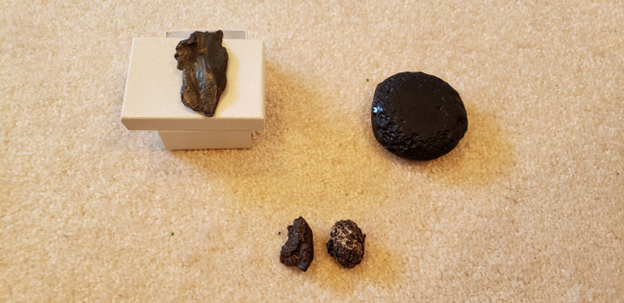
Left: a fragment of an iron-nickel meteorite from Henbury in Australia. Right: a Tectite from Thailand. Bottom: rusted fragments of a weathered iron-nickel asteroid from the Wabar impact site in Saudi Arabia. These are very difficult to distinguish from regular rocks and rusted iron from abandoned industrial facilities.
I wish I could help you myself, but I do not consider myself a meteorite specialist (though I’ve handled quite a few). Moreover, the U.S. Geological Survey is not funded by Congress to study meteorites — we have very specific tasks that we are assigned to do, such as monitor volcanoes or carry out mineral resource assessments (I do both of these, as well as conduct applied geophysics research to map ore deposits, deep groundwater in basins, oil on the seafloor, and briny water and volcanic magma beneath volcanoes). Consequently, any studies outside of these assigned tasks we must do on our own time — we do it because we find the subject interesting.
In my case, for instance, I was drawn into the meteorite field almost accidentally when I visited and mapped the Wabar meteorite impact site while living in Saudi Arabia. I was living in the country as a scientist-diplomat at the time, and chose to spend a Hajj vacation (when millions of Muslim faithful travel to Makkah for the Pilgrimage) on a desert-crossing expedition to test Hummer vehicles. Accompanying me on our third trip to Wabar was one of the foremost meteor impact specialists in the world at the time, Gene Shoemaker (the “Father of Astrogeology”), and he provided a massive data-dump of his experience for me.
One PhD geochemist friend transferred to NASA, because he couldn’t do what he most wanted to do (study meteorites) in the USGS. There are real meteorite specialists in the Smithsonian in Washington, DC, but both NASA headquarters and the Smithsonian are on the opposite sides of the continent from you. There are meteorite specialists at the Lunar and Planetary Lab at the University of Arizona in Tucson, and there are individuals who are competent to assess meteorites in the Astrogeology science center of the U.S. Geological Survey in Flagstaff, Arizona, among others.
All that said, how do you identify the sample you have? I will offer you two lines of approach, but both require that you expend significant personal effort to learn more. In essence, both require you to teach yourself to become an amateur meteorite scientist:
Easier Path (#1): Search the internet for books on, and photo examples of, meteorites. Look closely at any that show texture up close. For instance, Tectites have a distinctive “burst-bubble” texture, but are not technically meteorites. They are Earth-origin material that has “only” been blasted into suborbital altitudes by a large asteroid impact of some sort. Keep in mind also that there are quite a few different types of meteorites, from Stony to Chondrite to Nickel-Iron, to rare Pallasites and Nakhlites, as well as others. This list is in decreasing order of how common they are.
First you must become familiar with the possibilities, then when you see one that looks like your sample, search for other examples of that type. Especially search for detailed descriptions of that kind of sample. Buy or borrow a hand-lens or loupe (a reasonably good 10x Hastings Triplet will cost ~$35) and see if you can see any of these characteristics in your sample. I have seen a few reasonably good self-help guides for identifying rocks — choose one, and then spend some time in the first part of the book learning rock-identifying principles.
Harder Path (#2): This is more difficult, requiring you to make more than one cold call; it also requires you to do some significant homework up front. You could contact the geology department in a university close to you. Look for the largest university that you are willing to drive to, because you will have the best chance to find a true meteorite specialist there. Contact the geology department first to make sure you are not wasting your drive. Then see if you can arrange to meet the geologist there who indicates that she or he feels confident enough to identify a meteorite. Keep in mind that these people have paid work they must do (such as prepare and teach classes) and may not feel they have the time to help a stranger. Also, geology departments are often inundated with people showing up and asking “what is this rock?”… so, it will require patience on their part and persistence on your part to make a connection.
Warning: One thing I would not recommend is sending a photo of the sample. Case in point: you cannot really see the burst-bubble texture in the photo of the Tektite above. A competent geologist will rarely be willing to identify a rock from a photo alone (even if it was high-resolution, taken with a macro lens, and was crisply focused). The reason for this: to identify a rock, a geologist must be able to handle it, turn it over in sunlight looking at texture and constituent minerals, scratch mineral grains with a knife, crack the rock open to examine a fresh un-weathered surface, examine it minutely with a hand-lens, test its “streak” and carbonate content (using acid), magnetic susceptibility, etc. (see the earlier chapter, “I found this rock in my backyard…”).
In other words, a geologist needs much more information to identify a rock than can be seen in a photo. In most cases, a photo conveys less than 15% of the information needed to identify a rock. In many cases, even these more advanced manual techniques leave the identification unresolved, and petrologic thin-sections must be cut and examined under a polarizing microscope, or a chemical analysis must be done, or both, to get a definitive answer.
MOST IMPORTANT: DON’T GIVE UP. Like most things of value, this won’t be an easy thing for you. However, you will become a smarter and wiser (more analytical) person as you study this subject. Then you could go beyond that and become a serious amateur scientist (of meteorites, or birds, or anything else you choose). There is a long and rich tradition of this kind of amateur science — and some of the greatest scientists in history did not have advanced college degrees (Michael Faraday, one of my personal heroes, and Albert Einstein come to mind).
메타데이터
- post_id
- b2b609e8cbcc
- slug
- ask-a-geologist-by-jeff-wynn-b2b609e8cbcc
- url
- https://medium.com/@jeffwynnusgs/ask-a-geologist-by-jeff-wynn-b2b609e8cbcc
- canonical_url
- https://medium.com/@jeffwynnusgs/ask-a-geologist-by-jeff-wynn-b2b609e8cbcc
- author_url
- https://medium.com/@jeffwynnusgs
- status
- ok
- fetched_at
- 2026-08-17 15:22:10