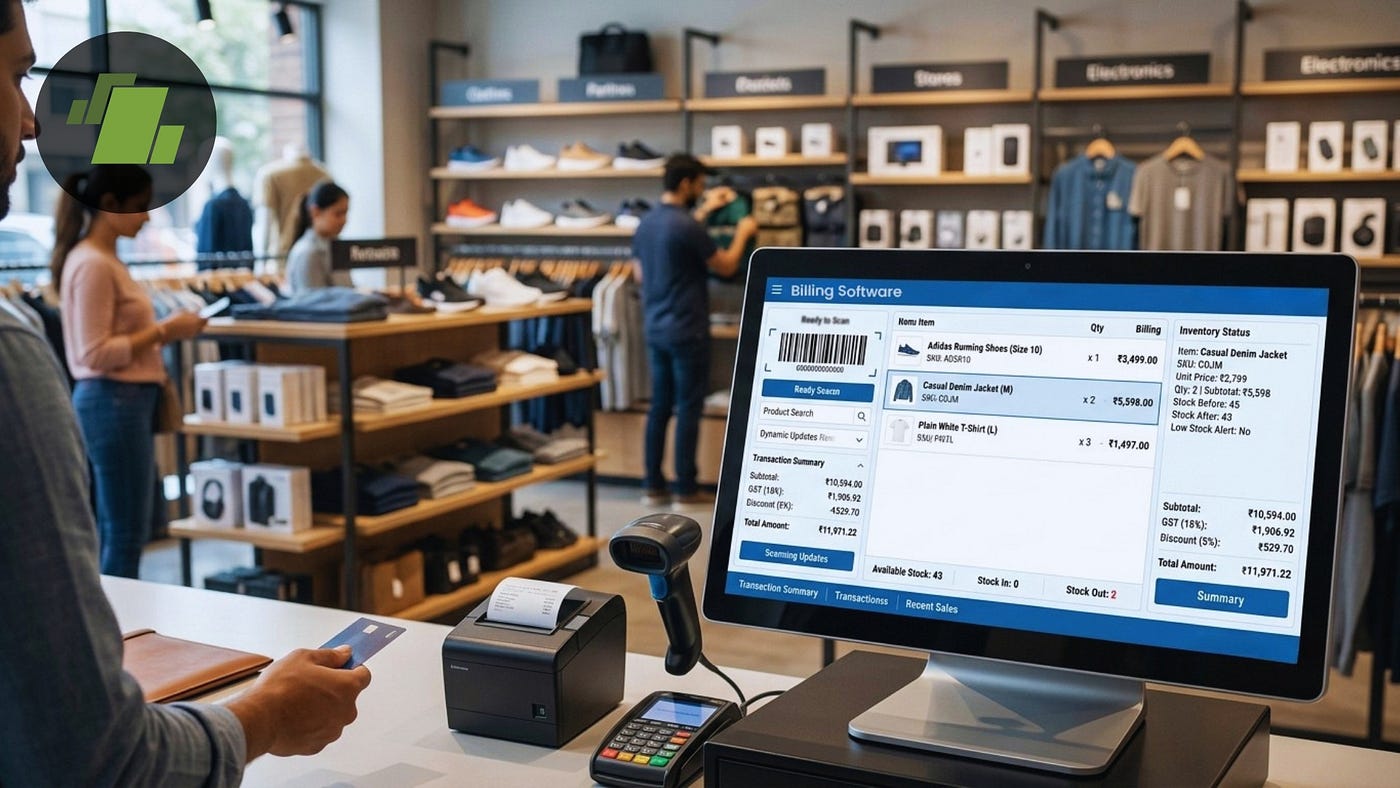
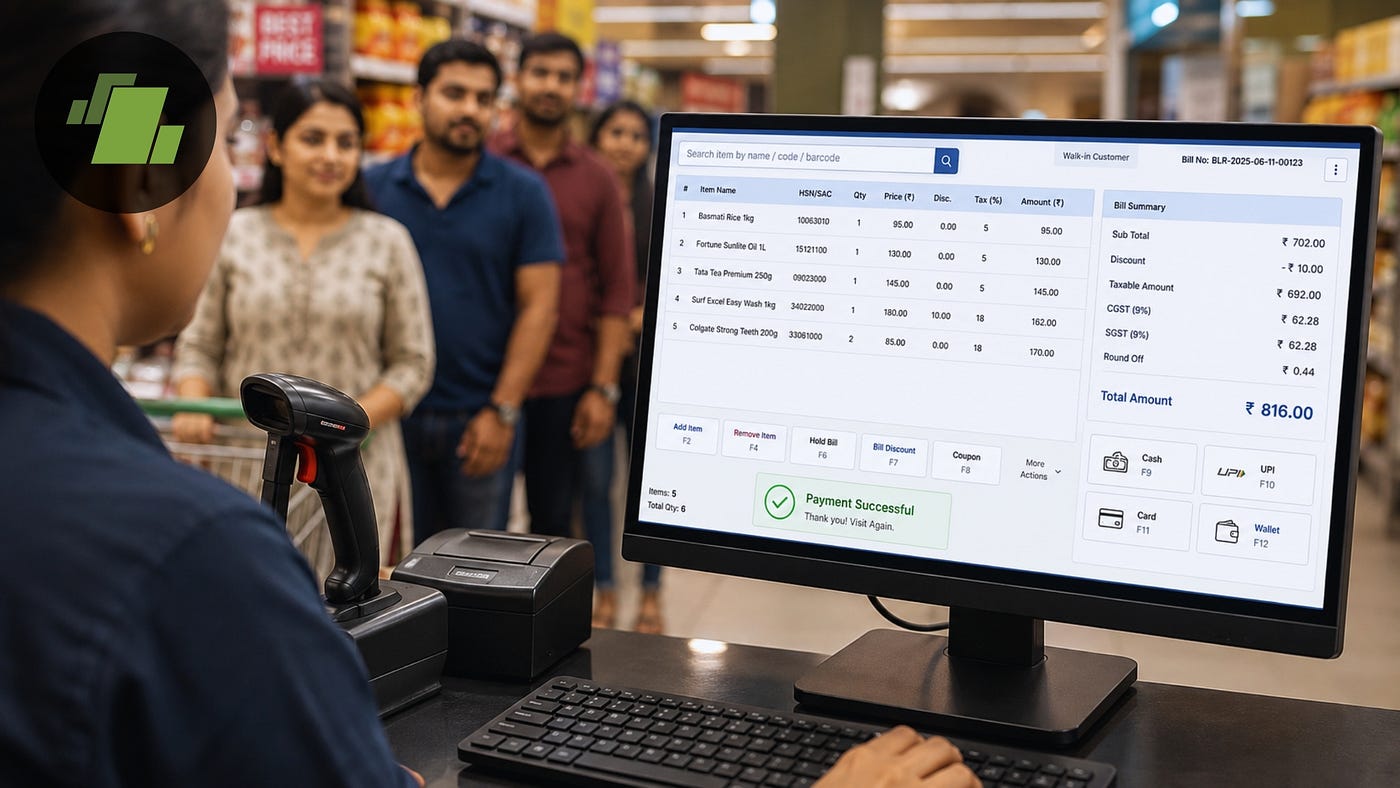
What Challenges Can LOGIC ERP Grocery Billing Software Solve for Grocery Retail Stores?
LOGIC ERP Grocery Billing Software helps grocery retailers solve billing, inventory, pricing, sales, and management challenges while…
What Challenges Can LOGIC ERP Grocery Billing Software Solve for Grocery Retail Stores?

Grocery Problems? LOGIC ERP Has the Solution.
LOGIC ERP Grocery Billing Software helps grocery retailers solve billing, inventory, pricing, sales, and management challenges while improving efficiency and control with a smart Grocery ERP Software solution.
Key Takeaways
- LOGIC ERP Grocery Billing Software helps retailers streamline billing, inventory, sales, purchasing, and everyday grocery store operations.
- With Grocery Billing Software, businesses can reduce billing errors, speed up checkout, and improve transaction accuracy.
- Grocery POS Software connects sales with inventory to provide better stock visibility and smoother store management.
- Using Grocery Management Software, retailers can manage customers, suppliers, purchases, reports, and multiple stores efficiently.
- As a scalable Grocery ERP Software, LOGIC ERP supports growing grocery shops, supermarkets, and multi-store retail businesses.
Introduction
Grocery retail stores manage hundreds or thousands of products, frequent transactions, changing prices, inventory, suppliers, customers, and payments every day. Without connected processes, retailers can face billing errors, checkout delays, stock discrepancies, wastage, and revenue leakage. A modern Grocery Billing Software connects billing with inventory, sales, purchasing, accounting, and reporting for better operational control.
LOGIC ERP Grocery Billing Software provides an integrated solution with barcode billing, automated calculations, inventory tracking, GST billing, sales reports, user permissions, and multi-store management. For businesses seeking Grocery Billing Software in India, it helps streamline daily transactions while giving owners better visibility into sales, stock, purchases, and overall business performance.
This article explains the common challenges faced by grocery retail stores and how LOGIC ERP Grocery Billing Software, Grocery POS Software, Grocery ERP Software, and Grocery Management Software can help address them.
[embed]
Watch this video to know more about LOGIC ERP Grocery, POS, Billing & Inventory Software for Retail Stores & Shops!
Common Challenges Faced by Grocery Retail Stores
Grocery stores deal with a wide variety of products and frequent customer transactions. As the business grows, maintaining accuracy and control becomes increasingly difficult.
Some Common Grocery Retail Challenges Include:
- Slow checkout processes
- Billing and calculation errors
- Incorrect product pricing
- Unauthorized discounts
- Inventory discrepancies
- Stock shortages
- Overstocking
- Product expiry and wastage
- Difficulty tracking stock movement
- Supplier management issues
- Purchase planning problems
- Poor sales visibility
- Limited business reporting
- Employee access concerns
- Difficulty managing multiple stores
- Disconnected accounting records
- Customer data management challenges
- Difficulty monitoring business performance
- Revenue leakage
- Repetitive data entry
These issues may appear small individually, but their combined impact can reduce profitability and affect customer satisfaction.
A comprehensive Grocery Retail Software solution can help retailers organize these activities within a connected business environment.
1. Challenge: Slow Billing and Long Checkout Queues
One of the most visible problems in grocery retail is slow checkout.
- Customers often purchase multiple products in a single transaction.
- If employees have to search for products, enter information repeatedly, calculate discounts, and calculate totals separately, the billing process can take longer.
- During busy periods, such delays can create long queues and affect the shopping experience.
How LOGIC ERP Grocery Billing Software Helps:
Slow billing can create long queues, delay checkout, and affect customer satisfaction.
LOGIC ERP Grocery Billing Software supports faster billing through features such as:
- Barcode scanning
- Quick product search
- Automated price calculation
- Quantity-based billing
- Configured discounts
- Automated tax calculations
- Multiple payment options
- Fast invoice generation
With barcode scanning, the cashier can identify products quickly instead of repeatedly entering product information.
A streamlined Grocery Store POS Software environment can help employees process transactions efficiently while reducing repetitive work at the checkout counter.
Business Benefits:
Faster billing can help grocery retailers:
- Reduce customer waiting time
- Process more transactions during peak periods
- Improve cashier productivity
- Reduce checkout-related errors
- Improve the overall shopping experience
For high-volume stores, even small improvements in billing speed can make a noticeable difference.
2. Challenge: Billing Errors and Incorrect Calculations
Incorrect quantities, prices, discounts, taxes, or totals can create billing discrepancies.
- Repeated data entry can increase the possibility of mistakes, particularly when a store processes a large number of transactions every day.
- Billing errors can also affect customer trust. If customers frequently notice incorrect prices or totals, they may question the accuracy of the store’s billing process.
How LOGIC ERP Grocery Billing Software Helps:
Grocery Billing Software can automate several calculations involved in a transaction.
LOGIC ERP can help manage:
- Product prices
- Quantities
- Discounts
- Taxes
- Subtotals
- Final invoice amounts
- Payment records
Product information can be stored centrally, allowing the billing counter to retrieve relevant details during a transaction.
This can reduce repeated data entry and provide a more consistent billing process.
Business Benefits:
Automated calculations can help:
- Reduce calculation errors
- Improve invoice accuracy
- Save cashier time
- Standardize billing
- Improve customer confidence
- Reduce reconciliation issues
For grocery retailers, accurate billing is directly connected with accurate sales records and revenue tracking.
3. Challenge: Incorrect Product Pricing
Grocery retailers manage products from multiple brands and suppliers.
- Prices may change because of supplier revisions, promotions, market conditions, seasonal offers, or business pricing decisions.
- Keeping product prices updated across billing counters can become difficult when information is maintained across disconnected records.
How LOGIC ERP Grocery Billing Software Helps:
LOGIC ERP Grocery Billing Software provides centralized product and pricing management.
Retailers can manage product information such as:
- Product name
- Product code
- Barcode
- Selling price
- Purchase price
- Tax information
- Category
- Brand
- Unit
- Discount
- Promotional price
When updated product information is available at the POS, cashiers can retrieve the appropriate details while generating a bill.
Business Benefits:
Better price management can help retailers:
- Reduce incorrect billing
- Maintain consistent prices
- Apply configured promotions
- Reduce price-related disputes
- Improve pricing control
- Keep product records organized
This becomes especially useful for supermarkets and grocery chains with large product catalogs.
4. Challenge: Unauthorized Discounts and Revenue Leakage
Discounts can help attract customers, clear slow-moving products, and support promotional campaigns.
- However, uncontrolled discounts can reduce margins and contribute to revenue leakage.
- Businesses may need to distinguish between authorized promotional discounts and discounts that should not be applied.
How LOGIC ERP Grocery Billing Software Helps:
Grocery Shop Billing Software with configurable discount management can help retailers establish greater control over promotional pricing.
LOGIC ERP can provide businesses with options to manage:
- Product-level discounts
- Promotional offers
- Customer-specific discounts
- Discount rules
- User permissions
- Transaction records
- Discount reports
User access controls can help restrict certain functions to authorized employees.
Managers can also review transaction reports to identify unusual discount activity.
Business Benefits:
Better discount control can help:
- Protect profit margins
- Reduce unauthorized price reductions
- Improve promotional management
- Increase transaction accountability
- Identify unusual billing patterns
This can make discount management more structured across grocery stores.
5. Challenge: Inventory Discrepancies
Inventory accuracy is one of the biggest concerns for grocery businesses.
- A store may show a certain quantity in its records while the physical shelf contains a different quantity.
- Such discrepancies can arise from sales, returns, damaged products, wastage, stock adjustments, misplaced items, or other causes.
- When stock information is inaccurate, purchasing decisions can also become less reliable.
How LOGIC ERP Grocery Billing Software Helps:
Grocery Management Software can connect sales transactions with inventory records.
When a product is sold through the POS, the corresponding inventory information can be updated within the connected system.
Retailers can monitor:
- Current stock
- Product movement
- Sales quantities
- Purchase quantities
- Low-stock products
- Fast-moving products
- Slow-moving products
- Stock adjustments
- Store-wise inventory
This creates greater visibility into inventory activity.
Business Benefits:
Integrated inventory management can help businesses:
- Reduce stock discrepancies
- Improve inventory visibility
- Monitor stock movement
- Identify unusual variations
- Improve purchase planning
- Reduce stock-related administrative work
6. Challenge: Stock Shortages and Out-of-Stock Products
Running out of popular products can result in missed sales and customer dissatisfaction.
For example, if a grocery store frequently sells a particular cooking oil, snack, beverage, or household product but does not replenish it on time, customers may purchase the product elsewhere.
How LOGIC ERP Grocery Billing Software Helps:
Grocery POS Software connected with inventory management can provide information about product availability and sales movement.
Retailers can identify:
- Low-stock products
- Fast-moving products
- Frequently purchased items
- Reorder requirements
- Store-wise stock levels
- Warehouse availability
Sales history can also provide useful information when deciding purchasing quantities.
Business Benefits:
Better stock monitoring can help retailers:
- Reduce stockouts
- Improve product availability
- Plan purchases more effectively
- Support customer satisfaction
- Maintain appropriate inventory levels
For high-volume grocery stores, timely replenishment can have a direct effect on sales performance.
7. Challenge: Overstocking and Slow-Moving Inventory
Stock shortages are not the only concern. Overstocking can also create financial and operational problems.
- Grocery businesses deal with products that may have limited shelf lives.
- Holding excessive quantities can increase the risk of expiry, wastage, markdowns, and storage pressure.
- Slow-moving inventory can also tie up money that could otherwise be used for faster-selling products.
How LOGIC ERP Grocery Billing Software Helps:
Grocery ERP Software can provide sales and inventory reports that help retailers identify product movement patterns.
Businesses can review:
- Fast-moving products
- Slow-moving products
- Product-wise sales
- Category-wise sales
- Stock levels
- Purchase quantities
- Inventory age
- Store-wise product movement
This information can support better purchasing and stock planning.
Business Benefits:
Retailers can use these insights to:
- Reduce excessive stock
- Improve shelf planning
- Identify slow-moving products
- Reduce expiry-related losses
- Improve purchasing decisions
- Allocate inventory more effectively
8. Challenge: Product Expiry and Wastage
Expiry management is particularly important for grocery retailers selling products such as dairy, packaged foods, beverages, snacks, sauces, frozen items, and other products with defined shelf lives.
Poor stock visibility can make it difficult to identify products approaching expiry.
How LOGIC ERP Grocery Billing Software Helps:
Inventory management capabilities can help businesses maintain product information and monitor stock movement.
Depending on the business configuration, retailers can track product batches, expiry-related information, stock quantities, and product movement.
Reports can help identify inventory that requires attention.
Business Benefits:
Better expiry monitoring can help:
- Reduce product wastage
- Improve stock rotation
- Identify ageing inventory
- Support timely promotions
- Improve purchasing decisions
- Protect inventory value
This is particularly valuable for grocery stores with large product ranges.
9. Challenge: Difficulty Tracking Stock Movement
Products may move between:
- Warehouses
- Stores
- Counters
- Storage areas
- Branches
When these movements are not properly recorded, inventory records can become difficult to reconcile.
How LOGIC ERP Grocery Billing Software Helps:
Grocery Retail Software can provide centralized inventory information that allows businesses to monitor stock movement across locations.
Retailers can review:
- Inter-store transfers
- Warehouse movement
- Incoming stock
- Outgoing stock
- Branch-wise inventory
- Product transfers
- Stock availability
- Inventory movement history
This becomes increasingly valuable for grocery chains and businesses with several locations.
10. Challenge: Purchase Management
Grocery retailers often work with multiple suppliers.
- Managing purchase orders, incoming goods, pricing, quantities, and supplier records can become complex as the business expands.
- Poor purchasing coordination can result in excess inventory, stock shortages, incorrect quantities, or difficulty comparing supplier performance.
How LOGIC ERP Grocery Billing Software Helps:
LOGIC ERP Grocery Billing Software connects purchasing with inventory and sales operations.
Retailers can manage:
- Supplier records
- Purchase transactions
- Purchase orders
- Product quantities
- Purchase prices
- Incoming stock
- Purchase returns
- Supplier-related records
By reviewing sales and inventory data alongside purchasing information, retailers can make better decisions about what to purchase and when.
11. Challenge: Poor Sales Visibility
A grocery store generates large amounts of sales data every day. If this information is not organized properly, owners may find it difficult to understand business performance.
Questions such as the following can become difficult to answer:
- Which products sell the most?
- Which categories generate the highest sales?
- Which store performs better?
- Which products are slowing down?
- Which discounts are being used most often?
- What are the daily and monthly sales?
- Which periods have the highest customer activity?
How LOGIC ERP Grocery Billing Software Helps:
Grocery Billing Software in India can provide sales reports that organize transaction information into useful business insights.
LOGIC ERP can support reports based on:
- Product
- Category
- Store
- Employee
- Date
- Customer
- Sales value
- Quantity
- Discounts
This allows business owners and managers to evaluate performance using actual transaction information.
12. Challenge: Limited Business Reporting
Without organized reports, grocery retailers may spend significant time collecting information from different sources.
A modern ERP system can centralize business data and provide structured reports.
How LOGIC ERP Grocery Billing Software Helps:
Grocery Management Software can provide reporting across multiple business functions.
Retailers can review:
- Sales reports
- Purchase reports
- Inventory reports
- Stock movement
- Customer transactions
- Supplier activity
- Discount activity
- Store performance
- Product performance
- Financial information
These reports can help managers identify trends and make informed decisions.
Business Benefits:
Better reporting can help retailers:
- Monitor performance
- Identify business trends
- Review product movement
- Improve purchasing
- Compare stores
- Monitor inventory
- Track operational activities
13. Challenge: Employee Access and Accountability
Grocery stores may have several employees working across billing counters, inventory areas, warehouses, and management functions.
Giving every employee unrestricted access to every system function can create operational risks.
How LOGIC ERP Grocery Billing Software Helps:
LOGIC ERP Grocery Billing Software can support user roles and access permissions. Businesses can determine which users can access specific functions, depending on their responsibilities.
This can help manage access to activities such as:
- Discounts
- Returns
- Price changes
- Stock adjustments
- Reports
- Billing functions
- Administrative settings
Transaction records can also help managers review activity by user.
Business Benefits:
User permissions can help:
- Improve accountability
- Restrict sensitive functions
- Reduce unauthorized changes
- Monitor employee activity
- Improve operational control
14. Challenge: Managing Returns and Refunds
Product returns can create complications when sales and inventory records are not properly connected.
A returned product may need to be reflected in inventory, while the financial transaction may also need to be updated.
How LOGIC ERP Grocery Billing Software Helps:
A connected Grocery Store POS Software environment can link return transactions with sales and inventory information. Retailers can manage return-related information and keep transaction records organized.
This can help businesses maintain more accurate records of:
- Returned products
- Return quantities
- Customer transactions
- Refund amounts
- Inventory adjustments
A structured return process can reduce confusion and improve transaction accuracy.
15. Challenge: GST Billing and Tax Records
Grocery retailers in India need to manage applicable GST-related billing requirements and maintain appropriate transaction records.
Incorrect tax calculations or incomplete invoice information can create accounting and compliance difficulties.
How LOGIC ERP Grocery Billing Software Helps:
Grocery Billing Software in India can support GST-related billing processes within an integrated ERP environment.
LOGIC ERP can help retailers manage information related to:
- GST invoices
- Product tax information
- HSN details
- Tax calculations
- Sales records
- Customer GST details where applicable
- Tax-related reports
Connecting billing and accounting information can also make reconciliation more organized.
16. Challenge: Disconnected Accounting and Retail Records
When billing, inventory, purchasing, and accounting are maintained separately, businesses may need to enter or reconcile the same information multiple times.
This can create data inconsistencies and make financial reporting slower.
How LOGIC ERP Grocery Billing Software Helps:
- Grocery ERP Software connects retail operations with accounting within a broader ERP environment.
- Sales, purchases, expenses, and other business transactions can contribute to financial records.
- This provides retailers with a more connected view of their operations.
Business Benefits:
An integrated approach can help:
- Reduce duplicate data entry
- Improve record consistency
- Simplify reconciliation
- Speed up reporting
- Connect operational and financial information
17. Challenge: Managing Customer Information
Customer relationships are increasingly important for grocery retailers, especially businesses competing with online marketplaces, supermarkets, and other nearby stores.
Retailers may want to maintain customer information and understand purchasing behavior.
How LOGIC ERP Grocery Billing Software Helps:
Grocery Management Software can help businesses maintain customer records and transaction information.
Depending on the business configuration, retailers can manage:
- Customer profiles
- Purchase history
- Credit information
- Transaction records
- Loyalty information
- Customer-specific pricing
- Promotional information
This can support stronger customer engagement and more organized customer service.
18. Challenge: Managing Multiple Grocery Stores
A single store may be relatively straightforward to monitor. However, managing five, ten, or more stores creates a different level of complexity.
Business owners may need to compare:
- Store-wise sales
- Inventory
- Purchases
- Employee activity
- Product movement
- Customer activity
- Store performance
How LOGIC ERP Grocery Billing Software Helps:
LOGIC ERP Grocery Billing Software provides multi-store management capabilities that can help businesses centralize their operations. Management can gain visibility into different branches and compare performance across locations.
This can support:
- Centralized product management
- Branch-wise inventory
- Store-wise sales reports
- Stock transfers
- Centralized purchasing
- Employee management
- Consolidated reporting
For expanding grocery brands, centralized visibility can make growth easier to coordinate.
19. Challenge: Difficulty Scaling Business Operations
As a grocery business grows, the number of products, employees, customers, transactions, and locations can increase significantly.
A basic billing application may not provide enough functionality for a growing retail business.
How LOGIC ERP Grocery Billing Software Helps:
Grocery ERP Software provides a broader operational framework that can support business expansion.
- Businesses can expand from:
- One Store → Multiple Counters → Warehouse → Multiple Stores → Grocery Chain
- while maintaining connected billing, inventory, purchasing, sales, and reporting processes.
- Scalability can help businesses avoid repeatedly changing systems as their operations become larger.
20. Challenge: Lack of Real-Time Business Information
Business owners may not always be present at every store. Without centralized information, they may have to depend on delayed reports from employees or individual branches.
This can make it harder to respond quickly to changes in sales or inventory.
How LOGIC ERP Grocery Billing Software Helps:
A connected Grocery POS Software and ERP environment can provide more current information about business activity.
Depending on system configuration and connectivity, authorized users can access information related to:
- Sales
- Inventory
- Purchases
- Customers
- Store performance
- Product movement
- Reports
Cloud-based capabilities can further support access across locations.
21. Challenge: Lack of Advanced Analytics
Sales and inventory data can contain valuable patterns, but simply collecting information is not enough. Retailers need ways to interpret that information.
Advanced analytics and AI-assisted capabilities can help grocery businesses understand patterns across large amounts of data.
How LOGIC ERP Grocery Billing Software Helps:
Limited analytics can make it difficult to identify sales trends, inventory patterns, and growth opportunities.
Modern ERP capabilities can support areas such as:
- Sales analysis
- Product performance
- Demand forecasting
- Inventory planning
- Customer analysis
- Store comparisons
- Business reporting
AI-assisted capabilities can help retailers identify patterns that may otherwise take more time to analyze.
For example, sales history can help identify products that experience higher demand during particular periods. Retailers can use such information to plan purchases and inventory more effectively.
22. Challenge: Repetitive Administrative Work
Grocery retail involves many repetitive activities, including billing, stock updates, calculations, reporting, purchase recording, and transaction reconciliation.
When these processes require repeated data entry, employees spend more time on administrative activities.
How LOGIC ERP Grocery Billing Software Helps:
Automation within Grocery Billing Software can simplify repetitive processes.
Examples include:
- Barcode-based product identification
- Automated calculations
- Inventory updates
- Invoice generation
- Sales reporting
- Purchase records
- Customer transaction records
- GST-related calculations
This allows employees to focus more on customer service and store operations.
23. Challenge: Poor Customer Experience
Customers expect grocery shopping to be convenient and quick. Long queues, incorrect bills, unavailable products, and slow service can negatively affect customer satisfaction.
How LOGIC ERP Grocery Billing Software Helps:
A connected grocery retail system can improve several customer-facing processes.
- Faster billing can reduce waiting time.
- Better inventory visibility can help stores maintain product availability.
- Accurate pricing can reduce billing disputes.
- Customer management can help retailers understand repeat buyers.
- Together, these capabilities can contribute to a smoother shopping experience.
24. Challenge: Difficulty Managing Fast-Moving Consumer Goods
Grocery retailers sell a large number of FMCG products, often with frequent sales and price changes.
Products can include:
- Packaged foods
- Beverages
- Snacks
- Personal care products
- Household products
- Dairy products
- Frozen products
- Staples
- Cleaning products
Each category may have different inventory characteristics.
How LOGIC ERP Grocery Billing Software Helps:
- Grocery Retail Software can help retailers organize product information by category, brand, barcode, price, stock level, and sales performance.
- This can help managers understand which products are moving quickly and which products require different purchasing or promotional strategies.
25. Challenge: Revenue Leakage
Revenue leakage from billing errors, unauthorized discounts, and stock discrepancies can reduce overall profitability.
Revenue leakage can occur through several sources:
- Incorrect prices
- Unauthorized discounts
- Billing errors
- Unrecorded transactions
- Stock discrepancies
- Incorrect returns
- Pricing inconsistencies
- Inventory loss
Even small discrepancies can add up over time.
How LOGIC ERP Grocery Billing Software Helps:
LOGIC ERP Grocery Billing Software provides several controls that can help businesses improve visibility and accountability.
These can include:
- User permissions
- Barcode billing
- Automated calculations
- Discount controls
- Transaction reports
- Inventory integration
- Sales monitoring
- Return records
The objective is to create a more traceable flow from product purchase and stock entry to billing and final sale.
26. Challenge: Lack of Centralized Management
When different functions operate separately, management may not have a single view of business performance.
For example, sales information may be stored in one application while inventory and accounting records are maintained elsewhere.
How LOGIC ERP Grocery Billing Software Helps:
LOGIC ERP Grocery Billing Software connects multiple retail functions within an integrated ERP environment.
This can provide a centralized view of:
- Sales
- Inventory
- Purchases
- Suppliers
- Customers
- Accounting
- Employees
- Stores
- Reports
Centralized management can help business owners make decisions based on connected information rather than isolated records.
Why Grocery Stores Need More Than Basic Billing Software?
A basic billing application may solve one problem: invoice generation. However, grocery retailers face a much broader set of operational requirements.
They need to manage:
- Billing + Inventory + Purchasing + Sales + Accounting + Customers + Suppliers + Employees + Reports + Stores
- This is why Grocery Management Software and Grocery ERP Software can provide greater value than a standalone billing application.
- An integrated system helps different functions communicate with one another.
For example:
- Purchase → Inventory → Billing → Sales → Accounting → Reporting
- When these processes are connected, retailers can obtain a more complete view of their business.
LOGIC ERP Grocery Billing Software for Small Grocery Shops
Small grocery shops may have fewer employees and fewer products than supermarkets, but they still need accurate billing and stock management.
Grocery Shop Billing Software Can Help Small Retailers Manage:
- Product billing
- Barcode scanning
- Inventory
- Purchases
- GST invoices
- Customer records
- Sales reports
- Supplier information
As the store grows, additional features can support more employees, products, counters, and locations.
This makes an integrated ERP approach useful for businesses that want to build a structured foundation for future growth.
LOGIC ERP Grocery Billing Software for Supermarkets and Grocery Chains
Supermarkets and grocery chains handle larger transaction volumes and more complex operations.
They May Require:
- Multiple billing counters
- Large product catalogs
- Multiple employees
- Multiple stores
- Warehouses
- Central purchasing
- Store-wise inventory
- Branch-level reporting
- Customer management
- Advanced analytics
Grocery Store Billing Software with ERP capabilities can bring these activities together.
LOGIC ERP can help supermarkets maintain a connected system for billing, inventory, purchasing, accounting, sales, and reporting.
LOGIC ERP Cloud-Based Grocery Management
Cloud-based technology can provide greater flexibility for businesses operating across locations.
A cloud-based Grocery Management Software environment can support authorized access to business information from different locations, subject to connectivity and system configuration.
This Can Help Owners and Managers Monitor:
- Store sales
- Inventory
- Reports
- Purchases
- Product movement
- Business performance
For multi-store grocery brands, cloud connectivity can support centralized management without requiring managers to be physically present at every branch.
LOGIC ERP AI-Powered Software Capabilities for Grocery Retail
The next generation of grocery management is increasingly data-driven.
AI-Powered Capabilities can Assist Retailers With:
- Demand analysis
- Sales forecasting
- Product performance analysis
- Inventory planning
- Customer insights
- Business reporting
- Reorder recommendations
For example, historical sales data can be analyzed to identify recurring demand patterns.
If a particular product consistently sells faster during certain periods, retailers can use this information to plan inventory ahead of time.
AI does not replace business judgment. Instead, it can provide additional information that helps owners and managers make more informed decisions.
What to Look for in Grocery Billing Software
Before selecting Grocery Billing Software, retailers should evaluate the system across several areas.
- Billing: Can the software process transactions quickly and accurately?
- Barcode Support: Can products be identified through barcode scanning?
- Inventory: Can retailers track stock levels and product movement?
- Purchasing: Can the business manage suppliers and purchase records?
- GST: Does the system support applicable GST billing requirements?
- Reporting: Can management access useful sales, inventory, and purchase reports?
- User Permissions: Can different employees receive different access levels?
- Customer Management: Can customer information and transaction history be maintained?
- Multi-Store Management: Can the system support several branches?
- Cloud Access: Can authorized users access information across locations where required?
- Scalability: Can the software support more products, users, counters, and stores as the business grows?
- AI and Analytics: Does the system provide advanced analytics and AI-assisted capabilities for future business needs?
These factors can help retailers select a solution based on both present requirements and future expansion.
How to Choose the Best Grocery Software for Your Business?
There is no single solution that fits every grocery retailer. The right choice depends on store size, product range, transaction volume, number of locations, employee count, inventory requirements, and growth plans.
1. Small Stores May Prioritize:
- Fast billing
- Barcode scanning
- Inventory
- GST billing
- Sales reports
- Ease of use
2. Supermarkets May Need:
- Multiple counters
- Large inventory
- Employee permissions
- Advanced reports
- Customer management
- Purchase management
3. Multi-Store Brands May Prioritize:
- Centralized management
- Multi-store inventory
- Store-wise reporting
- Stock transfers
- Cloud access
- Central purchasing
- Advanced analytics
Businesses searching for the Best Grocery Software should therefore evaluate the complete set of capabilities instead of looking only at the billing screen.
Key Benefits of LOGIC ERP Grocery Billing Software
By addressing multiple operational challenges, LOGIC ERP Grocery Billing Software can provide several benefits to grocery retailers.
- Faster Billing: Barcode scanning and streamlined workflows can help reduce checkout time.
- Better Billing Accuracy: Automated calculations and centralized product information can reduce common billing errors.
- Improved Inventory Visibility: Connected sales and stock records provide a more current view of inventory.
- Better Purchase Planning: Sales and stock information can support purchasing decisions.
- Controlled Discounts: Configured discount rules and user permissions can improve pricing control.
- Better Business Reporting: Sales, inventory, purchase, customer, and store reports provide greater visibility.
- Multi-Store Management: Centralized operations can help businesses manage multiple locations.
- Improved Employee Accountability: User permissions and transaction records can help managers monitor activities.
- Better Customer Experience: Faster checkout, accurate billing, and improved product availability can support customer satisfaction.
- Scalable Operations: An integrated ERP environment can support businesses as they add products, employees, counters, warehouses, and stores.
Read Case Study
**LOGIC ERP x Apna Bazaar: Building a Digitally-Enabled Grocery Store with Retail ERP Software**

LOGIC ERP x Apna Bazaar: Case Study!
Apna Bazaar, a grocery store based in Panchkula, Haryana partnered with LOGIC ERP to establish an advanced grocery retail management system right from the beginning of its grocery business journey. Their approach to introduce an integrated retail ERP solution helped them to streamline inventory management, billing, purchasing, sales, and accounting under a single platform.
Read the LOGIC ERP x Apna Bazaar case study to discover how implementing grocery retail software helped the business create a strong operational base, improve inventory accuracy, accelerate billing, and gain complete visibility into daily retail operations. With centralized business management and real-time reporting, Apna Bazaar is now equipped with a scalable ERP system that supports business growth and delivers a superior customer shopping experience.
Conclusion
Grocery retailers face challenges such as slow checkout, billing errors, stock shortages, inventory discrepancies, wastage, pricing issues, revenue leakage, and multi-store management. LOGIC ERP Grocery Billing Software connects billing, inventory, purchasing, sales, accounting, reporting, and store operations to improve efficiency and visibility.
For retailers choosing Grocery Billing Software in India, LOGIC ERP offers barcode billing, automated calculations, GST billing, stock monitoring, analytics, user permissions, cloud capabilities, and multi-store management. It provides a connected and scalable solution for grocery shops, supermarkets, and growing retail brands.
Call at +91–73411–41176/75 or send us an email at sales@logicerp.com to **book a free demo** today!
Frequently Asked Questions
Q1. What Challenges does LOGIC ERP Grocery Billing Software Solve?
LOGIC ERP Grocery Billing Software can help address slow checkout, billing errors, pricing discrepancies, inventory issues, discount control, GST billing, sales reporting, customer management, and other grocery retail challenges.
Q2. How does LOGIC ERP Grocery Billing Software Help Grocery Stores?
LOGIC ERP Grocery Billing Software connects billing, inventory, purchasing, sales, accounting, customer management, reporting, and store operations within an integrated ERP environment.
Q3. Can LOGIC ERP Grocery Billing Software Reduce Billing Errors?
Yes. Barcode scanning, centralized product information, automated calculations, configured pricing, and controlled discounts can help reduce several common billing errors.
Q4. Can LOGIC ERP Grocery Billing Software Help With Inventory Management?
Yes. LOGIC ERP Grocery Billing software can connect sales and inventory information to help retailers monitor stock levels, product movement, purchases, and availability.
Q5. Does LOGIC ERP Grocery Billing Software Support Barcode Billing?
Yes. Barcode-based product identification can help cashiers process grocery transactions faster and reduce repetitive product entry.
Q6. Can LOGIC ERP Grocery Billing Software Manage Grocery Store Purchases?
Yes. Retailers can manage suppliers and purchase information while connecting incoming inventory with broader store operations.
Q7. Does LOGIC ERP Grocery Billing Software Support GST billing?
LOGIC ERP Grocery Billing Software supports GST-related billing and reporting capabilities for retail businesses, helping retailers organize applicable tax and invoice information.
Q8. Can LOGIC ERP Grocery Billing Software Manage Multiple Grocery Stores?
Yes. Multi-store management capabilities can help grocery chains monitor branch-wise sales, inventory, purchasing, and other business activities.
Q9. Is LOGIC ERP Grocery Billing Software Suitable for Small Grocery Shops?
Yes. Small retailers can use grocery billing, inventory, purchasing, customer management, and reporting capabilities, while the broader ERP environment can support future expansion.
Q10. Is LOGIC ERP Grocery Billing Software Suitable for Supermarkets?
Yes. Supermarkets can benefit from barcode billing, multiple billing counters, inventory management, purchasing, reporting, employee permissions, customer management, and multi-store capabilities.
Q11. What is the Difference Between Grocery POS Software and Grocery ERP Software?
Grocery POS Software mainly focuses on point-of-sale activities such as billing, payments, and checkout. Grocery ERP Software covers a wider range of operations, including billing, inventory, purchasing, accounting, sales, reporting, suppliers, customers, employees, and store management.
Q12. How can LOGIC ERP Grocery Management Software reduce inventory loss?
By connecting sales, purchases, stock records, and inventory movement, LOGIC ERP Grocery Management Software can provide greater visibility into stock and help retailers identify discrepancies and unusual variations.
Q13. Can LOGIC ERP Grocery Billing Software Help Reduce Revenue Leakage?
Yes. Barcode billing, controlled discounts, user permissions, transaction reports, accurate pricing, and inventory integration can help retailers improve billing accountability and reduce several sources of revenue leakage.
Q14. Does LOGIC ERP Grocery Billing Software Support Cloud-Based Grocery Management?
LOGIC ERP Grocery Billing Software provides cloud-based capabilities that can support authorized access and centralized management across locations, depending on the business setup and connectivity.
Q15. Can LOGIC ERP Grocery AI Software Help Grocery Retailers Manage Inventory?
AI-assisted capabilities can analyze sales and inventory patterns to support demand forecasting, product analysis, inventory planning, and other business decisions.
Q16. Why Should a Grocery Retailer Choose an Integrated ERP system like LOGIC ERP Grocery Billing Software?
An integrated ERP system like LOGIC ERP Grocery Billing Software connects billing, inventory, purchasing, sales, accounting, customers, and reporting. This can reduce disconnected records, improve data consistency, and give management a broader view of business operations.
메타데이터
- post_id
- b2b653b552d4
- slug
- what-challenges-can-logic-erp-grocery-billing-software-solve-for-grocery-retail-stores-b2b653b552d4
- url
- https://medium.com/@logicerp/what-challenges-can-logic-erp-grocery-billing-software-solve-for-grocery-retail-stores-b2b653b552d4
- canonical_url
- https://medium.com/@logicerp/what-challenges-can-logic-erp-grocery-billing-software-solve-for-grocery-retail-stores-b2b653b552d4
- author_url
- https://medium.com/@logicerp
- status
- ok
- fetched_at
- 2026-08-24 12:27:04