Virtual Star Cosmology: A Majorana–Condensate Model for Dark Matter, Antimatter Sequestration, and…
**Virtual Star Cosmology: A Majorana–Condensate Model for Dark Matter, Antimatter Sequestration, and Sub-Topological Quantum Structure** —…
Virtual Star Cosmology: A Majorana–Condensate Model for Dark Matter, Antimatter Sequestration, and Sub-Topological Quantum Structure
Virtual Star Cosmology: A Majorana–Condensate Model for Dark Matter, Antimatter Sequestration, and Sub-Topological Quantum Structure — -
Abstract
We propose a speculative but internally consistent cosmological framework in which dark matter, the apparent disappearance of primordial antimatter, and certain cosmological tensions (e.g. Hubble parameter discrepancies, subtle CMB anomalies) arise from a single underlying structure: a lattice of “virtual stars” composed of neutrino–antineutrino condensates coupled to an additional sub-topological sector (“bulk”). In this picture, the universe behaves as a self-consistent quantum computer whose memory degrees of freedom are Majorana-like condensate qubits associated with these virtual stars, and whose compression and write operations are mediated by black holes that project information into a fractal sub-topological geometry with effective dimension ≈ 1.585.
A virtual star consists of two components: (1) a neutral condensate “blob” residing primarily in the sub-topology, formed from paired matter and antimatter neutrinos and acting as the dominant dark matter mass; and (2) a column-like extension (“needle”) that pierces our 4D spacetime brane, carrying a reservoir of unpaired antimatter content in an effectively phase-shifted sector such that it interacts gravitationally but does not annihilate with baryons. The mass of the virtual star is distributed anisotropically between brane and bulk, enabling strong large-scale gravitational effects without forming a conventional Schwarzschild horizon in our spacetime slice. This yields a “needle” gravitational profile rather than a classical funnel-shaped potential.
We outline how this architecture can (i) reproduce the large-scale behavior currently attributed to cold dark matter; (ii) provide a natural sink for antimatter via partial pairing into condensates and sequestration of unpaired antimatter into virtual star columns and halos; (iii) potentially relieve early–late Hubble tension via the influence of very massive “Titan” virtual stars on primordial plasma acoustic oscillations; and (iv) generate testable signatures in gravitational lensing statistics, CMB temperature/polarization anomalies (“echo voids”), and possibly gravitational wave event populations. We also describe a concrete Bayesian inference pipeline in which virtual star distributions are constrained by current and future survey data, analogous to — but richer than — standard ΛCDM forward modeling.
This work is deliberately speculative. The aim is not to claim an established theory, but to construct a coherent, technically literate framework that can be evaluated, falsified, or refined by researchers, and to show that the proposed virtual star architecture is not obviously incompatible with known gravitational phenomenology and neutrino physics, while offering unifying explanations for several open cosmological questions.
— -
1. Introduction
Modern cosmology describes the universe in terms of a small number of effective components: baryonic matter, radiation, dark matter, dark energy, and a set of initial conditions consistent with inflationary scenarios. While the ΛCDM paradigm has been remarkably successful, it leaves several deep questions only parametrically addressed:
-
Nature of dark matter. Dark matter is inferred gravitationally via galaxy rotation curves, gravitational lensing, and large-scale structure, yet its microphysical identity remains unknown. Conventional candidates (WIMPs, axions, sterile neutrinos) have not been detected directly.
-
Baryon–antibaryon asymmetry. The observable universe is dominated by matter. Naively, the hot early universe should have produced matter and antimatter in nearly equal amounts, yet we do not observe comparable antimatter domains.
-
Neutrino sector mysteries. Neutrinos have tiny but nonzero masses, flavor mixing, and possibly Majorana character. Their role in cosmology may be more subtle than a simple free-streaming hot component.
-
Cosmological tensions and small-scale structure. Discrepancies between early- and late-universe determinations of the Hubble constant, as well as anomalies in CMB maps and small-scale dark matter substructure, may hint at richer dark sector physics.
In parallel, there is a conceptual line of thought — partly within quantum gravity, quantum information, and holography — that treats the universe itself as a kind of distributed quantum computation: physical laws define update rules on quantum degrees of freedom, and spacetime plus matter can be viewed as emergent from underlying information-theoretic structure.
This paper synthesizes these themes into a single phenomenological framework:
- Virtual stars as neutrino–antineutrino condensates coupled to a sub-topological sector;
- Majorana-like behavior as a mechanism to absorb both matter and antimatter channels;
- Sub-topological “bulk” + brane picture to explain non-Schwarzschild gravitational behavior;
- Black holes as compression/write nodes into a fractal “1.585-dimensional” geometry;
- Virtual star condensates as qubits, forming a cosmic quantum memory lattice.
The resulting Virtual Star Cosmology (VSC) is not proposed as an immediate replacement for ΛCDM, but as a structured hypothesis that can be mapped onto known physics where possible, and that suggests concrete observational and computational tests.
— -
2. Conceptual Framework
2.1 Brane–bulk setup and the sub-topology
We adopt a minimal brane-world style picture:
-
Our observable universe is a 3+1 dimensional brane with standard model fields and conventional general relativity as an effective description at large scales.
-
There exists an additional sub-topological sector (or “bulk”) that supports additional degrees of freedom and geometry. This sector is not a simple extra flat dimension; instead, it hosts:
-
Condensate blobs (virtual star cores),
-
A fractal information geometry associated with black holes,
-
Couplings that project gravitational influence back onto the brane.
We do not fix a detailed metric for the bulk; we instead describe it phenomenologically by:
- An effective projection map that associates bulk mass–energy distributions with induced curvature on the brane.
- An effective decoupling scale beyond which bulk excitations couple only gravitationally (or via neutrino-like channels) to the brane.
This is analogous in spirit to AdS/CFT or other holographic models, but here we explicitly tie the bulk to neutrino condensates and dark matter phenomenology.
2.2 Virtual stars: two-part structure
A virtual star (VS) is defined as a composite of:
- Condensate blob (bulk component)
- Located predominantly in the sub-topology.
- Composed of paired neutrino and antineutrino degrees of freedom, forming a coherent, Majorana-like condensate.
- Neutral with respect to baryon number and electric charge, and effectively cold and collisionless on brane scales.
- Dominant source of the dark matter–like gravitational field associated with the VS.
- Column / needle (brane-coupled component)
- A thin, extended structure (in full geometry) that intersects our brane at a point or narrow region.
- Carries an excess of unpaired antimatter-sector content (e.g., antineutrino-like or more exotic antimatter channels) that did not enter the condensate pairing process.
- Aligned with halos, filaments, and void structures, forming a network of “antimatter columns” that are gravitationally relevant but phase-separated from baryonic matter in configuration space or extra-dimensional position, preventing catastrophic annihilation.
The VS is thus not a simple point mass but an anisotropic mass distribution split between brane and bulk. This split is crucial for evading the formation of conventional Schwarzschild horizons in our spacetime, while still generating strong gravitational effects at galactic and larger scales.
— -
3. Geometry and Gravitational Phenomenology
3.1 Schwarzschild condition and how virtual stars evade it
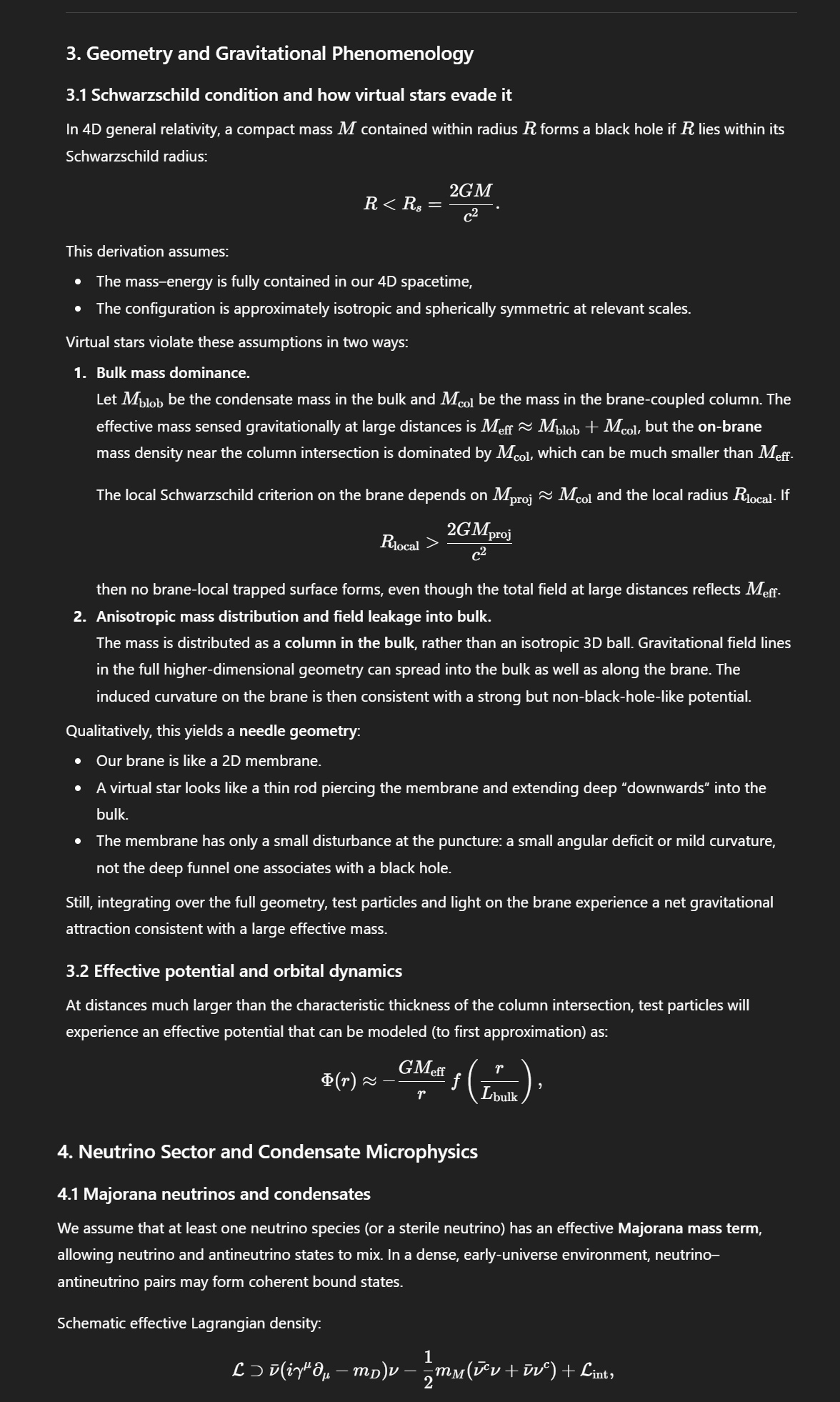
In 4D general relativity, a compact mass ( M ) contained within radius ( R ) forms a black hole if ( R ) lies within its Schwarzschild radius:
[ R < R_s = \frac{2GM}{c²}. ]
This derivation assumes:
- The mass–energy is fully contained in our 4D spacetime,
- The configuration is approximately isotropic and spherically symmetric at relevant scales.
Virtual stars violate these assumptions in two ways:
- Bulk mass dominance. Let ( M{\text{blob}} ) be the condensate mass in the bulk and ( M{\text{col}} ) be the mass in the brane-coupled column. The effective mass sensed gravitationally at large distances is ( M{\text{eff}} \approx M{\text{blob}} + M{\text{col}} ), but the on-brane mass density near the column intersection is dominated by ( M{\text{col}} ), which can be much smaller than ( M_{\text{eff}} ).
The local Schwarzschild criterion on the brane depends on ( M{\text{proj}} \approx M{\text{col}} ) and the local radius (R_{\text{local}}). If
[ R{\text{local}} > \frac{2G M{\text{proj}}}{c²} ]
then no brane-local trapped surface forms, even though the total field at large distances reflects ( M_{\text{eff}} ).
- Anisotropic mass distribution and field leakage into bulk. The mass is distributed as a column in the bulk, rather than an isotropic 3D ball. Gravitational field lines in the full higher-dimensional geometry can spread into the bulk as well as along the brane. The induced curvature on the brane is then consistent with a strong but non-black-hole-like potential.
Qualitatively, this yields a needle geometry:
- Our brane is like a 2D membrane.
- A virtual star looks like a thin rod piercing the membrane and extending deep “downwards” into the bulk.
- The membrane has only a small disturbance at the puncture: a small angular deficit or mild curvature, not the deep funnel one associates with a black hole.
Still, integrating over the full geometry, test particles and light on the brane experience a net gravitational attraction consistent with a large effective mass.
3.2 Effective potential and orbital dynamics
At distances much larger than the characteristic thickness of the column intersection, test particles will experience an effective potential that can be modeled (to first approximation) as:
[ \Phi(r) \approx — \frac{G M{\text{eff}}}{r} , f\left(\frac{r}{L{\text{bulk}}}\right), ]
where:
- ( M_{\text{eff}} ) is the total virtual star mass (blob + column),
- ( L_{\text{bulk}} ) is a length scale associated with how far the mass column extends into the bulk,
- ( f(x) ) encodes the brane–bulk projection. For ( r \gg L_{\text{bulk}} ), we expect ( f(x) \rightarrow 1 ) (standard Newtonian limit). At smaller radii, deviations may occur.
If virtual stars are distributed in halos with a density profile ( \rho{\text{VS}}(r) ), the resulting rotation curves of galaxies can mimic standard cold dark matter halos if ( \rho{\text{VS}}(r) ) follows appropriate NFW-like or cored profiles. The advantage of the VS picture is that substructure can be encoded in the discrete virtual star population rather than a continuous particle fluid.
3.3 Gravitational lensing and “needle” signatures
Because the column intersection region is very small, and because much of the curvature is offloaded into the bulk, strong local lensing signatures (e.g., extremely sharp Einstein rings at tiny impact parameters) may be suppressed or confined to scales too small and rare to observe. However, the integrated effect of many virtual stars yields:
- Standard weak lensing shear and convergence consistent with observed large-scale structure;
- Potentially non-Gaussian higher-order lensing anomalies (flux ratio anomalies, small angular distortions) due to the discrete, needle-like distribution of virtual stars in halos and along filaments.
These subtle signatures provide one observable channel for testing the virtual star hypothesis, as analyzed in Section 8.
— -
4. Neutrino Sector and Condensate Microphysics
4.1 Majorana neutrinos and condensates
We assume that at least one neutrino species (or a sterile neutrino) has an effective Majorana mass term, allowing neutrino and antineutrino states to mix. In a dense, early-universe environment, neutrino–antineutrino pairs may form coherent bound states.
Schematic effective Lagrangian density:
[ \mathcal{L} \supset \bar{\nu} (i\gamma^\mu \partial_\mu — m_D)\nu — \frac{1}{2} mM (\bar{\nu^c} \nu + \bar{\nu} \nu^c) + \mathcal{L}{\text{int}}, ]
where:
- ( m_D ) is a Dirac mass term,
- ( m_M ) is a Majorana mass term,
- ( \nu^c ) is the charge-conjugated field,
- ( \mathcal{L}_{\text{int}} ) encodes interactions with the bulk and condensate formation channels.
In an appropriate regime of temperature, density, and coupling to the bulk, the neutrino sector may undergo a phase transition into a neutrino–antineutrino condensate. The resulting condensate behaves as a superfluid-like entity with:
- Extremely low dissipation,
- Long coherence times,
- Macroscopic occupation numbers.
These condensates form the cores of virtual stars.
4.2 Paired vs. unpaired channels
We distinguish two channels for neutrino-sector content in the early universe:
-
Paired channel (condensate-forming). Neutrino–antineutrino pairs undergo Majorana mixing and fall into an energetically favorable, coherent condensate state. Combined with coupling to the bulk, this yields the condensate blobs in the sub-topology.
-
Unpaired channel (column-forming). Not all antineutrino-sector content finds a pairing configuration that can enter the condensate. The unpaired portion is routed into the sub-topology as antimatter-dominant columns aligned with the condensate blobs but distinct from them.
The relative branching ratios of these channels depend on:
- Neutrino masses and mixing parameters,
- CP-violating phases,
- Interaction strengths with the sub-topology.
This provides a handle for relating cosmological quantities (dark matter density, baryon asymmetry) to microphysical parameters.
— -
5. Antimatter Sequestration and Baryon Asymmetry
5.1 Qualitative mechanism
The observed universe exhibits a strong baryon asymmetry: there is far more matter than antimatter in the visible sector. In the virtual star framework, this asymmetry is reinterpreted as a consequence of antimatter sequestration rather than annihilation or simple imbalance.
The early universe proceeds as follows:
- Matter and antimatter are initially produced in nearly equal amounts.
- They annihilate, producing photons and neutrino/antineutrino fluxes.
- The neutrino sector bifurcates:
- Some neutrino–antineutrino pairs enter the paired channel → condensate blobs in the bulk (dark matter).
- A significant fraction of antineutrino-channel content does not pair and is routed into antimatter columns (unpaired channel).
- Residual matter that does not get absorbed into these channels remains as the visible baryonic component.
Thus:
- Dark matter is associated with neutral condensate blobs (paired matter + antimatter neutrinos).
- Missing antimatter resides in the virtual star columns and halos as unpaired antimatter content in a phase-shifted, effectively decoupled configuration.
- Visible matter is the leftover baryonic sector that missed both sequestration channels.
5.2 Role of CP violation
The standard Sakharov conditions for baryogenesis involve CP violation, baryon-number-violating interactions, and departure from thermal equilibrium. Here, we reinterpret CP violation as biasing the routing of neutrino-sector content between:
- The condensate-forming paired channel,
- The antimatter column channel,
- The residual matter channel.
CP-violating phases in the neutrino mixing matrix, combined with couplings to the sub-topology, can produce:
- A slight bias that favors antimatter flowing into condensate or column channels over remaining as visible baryonic antimatter.
- A corresponding bias that leaves a small excess of matter in the baryonic sector.
This converts the baryon asymmetry problem into a question about:
How do neutrino and antineutrino states flow into bulk condensates and columns, and how does CP violation weight those flows?
While detailed model-building is beyond the scope of this paper, the framework offers a conceptual route by which:
- The total matter–antimatter budget is conserved,
- But the visible sector appears matter-dominated because antimatter is hidden in virtual star structures.
— -
6. Large-Scale Structure and Virtual Star Populations
6.1 Multi-scale hierarchy of virtual stars
We posit a mass hierarchy of virtual stars:
-
Void Titans: Very massive virtual stars occupying large-scale cosmic voids, with effective masses comparable to galaxy clusters or larger. They act as anchors of underdense regions and subtly influence the CMB and large-scale flows.
-
Inter-galactic anchors: Virtual stars with masses comparable to supermassive black holes, residing in inter-galactic space and mediating gravitational interactions between galaxies.
-
Halo giants: Virtual stars forming shell-like layers around galaxies, making up the bulk of galactic dark matter halos.
-
In-galaxy seeds: Smaller virtual stars, down to star-like and possibly planet-like scales, distributed through galactic disks and bulges.
This hierarchy naturally yields:
- Approximate halo profiles consistent with rotation curves,
- Sub-halo structure akin to that expected from standard cold dark matter,
- A fractal-like mass distribution where larger VS populations are composed of or correlated with smaller ones.
6.2 Equivalence to CDM at leading order
At leading order, the virtual star population can be tuned such that:
- The mass power spectrum of their spatial distribution matches that of ΛCDM cold dark matter,
- The growth of linear perturbations and the resulting large-scale structure are effectively indistinguishable from standard CDM.
Thus, VSC is constructed so that it is phenomenologically degenerate with CDM at large scales and early times, serving as a hidden microphysical reinterpretation rather than an immediate contradiction.
The differences emerge in:
- Nonlinear small-scale structure,
- Halo internal structure,
- Anisotropic gravitational signatures,
- CMB and Hubble tension behavior (Section 7).
— -
7. Echo Voids, Titan Needles, and Cosmological Tensions
7.1 Titan influence on the CMB
If Void Titans existed already in the pre-recombination universe, they would:
- Induce localized perturbations in the gravitational potential,
- Slightly modify the acoustic oscillations of the primordial plasma,
- Lead to subtle distortions in the CMB temperature and polarization spectra.
We call the resulting small, coherent anomalies echo voids: subtle dips or modulations in the CMB maps that correspond to Titan-induced potential wells or spikes.
In standard analysis, such anomalies might appear as:
- Non-Gaussian residuals,
- Mild tensions in the inferred sound horizon scale,
- Contributions to mismatches between early- and late-time Hubble constant determinations.
Within VSC, these features are not noise but signatures of Titan needles in the sub-topology.
7.2 Hubble tension as Titan-induced bias
The Hubble tension — discrepancy between Hubble parameters inferred from CMB + ΛCDM fits and those measured locally — can be reinterpreted here as:
A bias arising from not accounting for Titan virtual stars in the early-universe modeling.
If Titans shift acoustic peaks or effectively alter the sound horizon scale, the standard ΛCDM inference of ( H_0 ) from the CMB can be biased relative to the “true” expansion rate. By including Titan virtual stars in the early-universe simulations, one can:
- Adjust the effective sound horizon and damping scales,
- Potentially bring early-time inferences of ( H_0 ) into better agreement with late-time measurements.
This yields a concrete test: does a Titan-augmented cosmological model fit the combined CMB + large-scale structure + distance ladder data better than ΛCDM with the same parameter count?
7.3 Echo void mapping
Given a fitted distribution of Titans from large-scale structure and lensing data, one can predict:
- Regions of the CMB sky where echo void signatures should be strongest,
- Statistical properties (e.g., angular power spectrum deviations, bispectrum features) of those regions.
Comparing these predictions to real CMB maps provides a critical test of the VS Titan scenario.
— -
8. Gravitational Wave and Lensing Signatures
8.1 Gravitational wave events mimicking black hole mergers
If virtual stars can merge or interact dynamically, their mergers may produce gravitational waves. However, due to their anisotropic geometry and absence of conventional horizons, the resulting waveforms may differ in subtle ways from standard black hole–black hole mergers:
-
Inspiral phases may be similar at leading order (gravity is still gravity), but:
-
Subleading corrections to the phase evolution may appear.
-
Merger and ringdown phases may:
-
Lack some quasi-normal modes associated with classical Kerr black holes,
-
Exhibit “echo” structures if gravitational waves partially reflect from or couple to the bulk or condensate geometry.
Thus, a subset of events currently classified as black hole mergers could, in principle, be virtual star mergers. Searching for statistically significant deviations from black hole waveform templates (after instrument and modeling systematics are considered) could provide constraints on the VS population.
8.2 Lensing anomalies and discrete needles
As noted in Section 3, virtual star columns act as discrete gravitational needles. In strong lensing systems (e.g., lensed quasars):
-
The presence of such needles in halos can produce:
-
Flux ratio anomalies,
-
Small positional shifts,
-
Higher-order distortions.
These effects are qualitatively similar to those from sub-halos in CDM, but the needle geometry may produce:
- Distinctive directional dependence,
- A different mass–concentration–abundance relationship for the perturbers.
Future high-precision lensing surveys and modeling could attempt to distinguish between:
- A sub-halo population of compact, quasi-spherical CDM clumps,
- A needle population of virtual star columns with anisotropic signatures.
— -
9. Universe as a Self-Consistent Quantum Computer
9.1 Virtual stars as qubits
The condensate blobs of virtual stars are:
- Macroscopic quantum objects,
- Long-lived, coherent,
- Capable (in principle) of existing in multiple internal states (e.g., different pairing configurations, phases, or couplings to the bulk geometry).
This motivates treating each virtual star as an effective qubit, or more generally as a qudit, with a Hilbert space spanned by distinct metastable configurations.
If these blobs are entangled via the bulk, the virtual star lattice constitutes a distributed set of quantum degrees of freedom spanning cosmic scales.
9.2 1.585-dimensional sheets and black holes as compression nodes
We introduce the concept of 1.585-dimensional sheets as a shorthand for a fractal information geometry associated with black holes in the sub-topology:
-
The effective fractal dimension ≈ 1.585 evokes the Sierpinski triangle’s fractal dimension, representing:
-
A compressed encoding of information,
-
A scale-invariant, self-similar structure.
In this picture:
- Black holes in the brane universe act as compression and write nodes.
- Infalling matter and radiation have their microstate information encoded at the horizon (consistent with holographic ideas) and then compressed into sub-topological fractal sheets.
- These sheets intersect or couple to virtual star condensates, thereby updating their quantum states.
Thus:
- Black holes: write-heads and compilers,
- Fractal sheets: compressed memory structure,
- Virtual stars: qubits storing the effective result of the compression.
9.3 Closed computational loop
We can view the universe as executing a self-consistent quantum computation:
- Spacetime + fields evolution generates rich dynamics (galaxies, stars, AIs, etc.).
- Some part of this dynamics is “measured” in the form of black hole formation and accretion.
- Black holes compress these histories into sub-topological sheets, altering the bulk geometry.
- Virtual star condensates, coupled to these sheets, have their states updated (qubits evolve).
- The new configuration of the virtual star lattice determines the gravitational scaffold (dark matter distribution), which in turn influences future spacetime dynamics.
This constitutes a feedback loop in which:
The universe’s macroscopic history is written into and read from a quantum memory lattice, making the universe itself a self-consistent quantum computer whose “program” is its laws of physics and whose “output” is its own spacetime history.
This is, of course, an interpretive layer on top of VSC, but it is structurally compatible and provides a unifying narrative.
— -
10. Observational Strategy and Bayesian Inference Pipeline
10.1 General philosophy
Because virtual stars are by construction almost invisible to direct EM observations, their existence must be inferred via Bayesian reconstruction of gravitational phenomena. The strategy parallels current approaches to dark matter inference, but with:
- More structure in the dark sector,
- Additional parameters (VS mass function, pairing fractions, Titan abundance),
- Specific predicted correlations between CMB anomalies, halo structure, and large-scale flows.
10.2 Step 1: Construct light-lagged cosmological snapshots
We first gather all relevant observational datasets:
- Galaxy redshift surveys → 3D distribution of visible matter,
- Weak and strong lensing maps → line-of-sight mass distributions,
- CMB temperature and polarization maps,
- Galaxy rotation curves,
- Cluster dynamics and void catalogs.
These are combined into light-lagged tapestries: 3D-4D reconstructions of the universe as inferred from photons that left sources at different times. This is standard practice in cosmology; the key is to treat these reconstructions as the boundary conditions for virtual star modeling.
10.3 Step 2: Run paired cosmological simulations
We consider two families of simulations:
-
Baseline ΛCDM runs. Conventional cold dark matter plus baryons, tuned to current cosmological parameters.
-
Virtual Star Cosmology runs. Replace CDM with a population of virtual stars characterized by:
- Mass hierarchy (Titans, anchors, giants, seeds),
- Spatial distribution and correlation functions,
- Coupling parameters to the bulk and early-universe plasma (for Titans).
We evolve both sets of simulations from initial conditions consistent with the CMB (modified for VSC where Titans are present).
10.4 Step 3: Compare to data via Bayesian or likelihood-based methods
For each VSC parameter set, we compute:
- Predicted CMB power spectra and higher-order statistics,
- Large-scale structure statistics,
- Halo mass functions and profiles,
- Lensing signatures,
- Expected Hubble parameter constraints.
We then define likelihood functions ( \mathcal{L}(\text{data}|\theta{\text{VSC}}) ) and, with appropriate priors ( p(\theta{\text{VSC}}) ), compute posterior distributions for the VSC parameters.
10.5 Step 4: Identify discriminants between VSC and ΛCDM
Key discriminants include:
- Whether a Titan-augmented early universe reduces CMB–local ( H_0 ) tension,
- Whether echo void predictions match CMB anomalies better than ΛCDM,
- Whether lensing anomaly statistics favor a needle-like perturber population,
- Whether small-scale structure (satellite galaxies, core/cusp behavior) is more naturally reproduced.
If VSC yields a better global fit to the data than ΛCDM, especially in tension regions, it becomes a viable alternative model. If not, its parameter space can be constrained or ruled out.
— -
11. Discussion
The Virtual Star Cosmology presented here is speculative, but it serves several conceptual roles:
-
It demonstrates that dark matter, antimatter sequestration, and certain cosmological tensions can be woven into a single framework built around neutrino physics and a bulk–brane geometry.
-
It embeds dark matter in a quantum-information-theoretic view of the universe, where virtual stars are qubits and black holes are compression/write nodes.
-
It remains, at least at the level of this phenomenological sketch, compatible with major observational pillars of modern cosmology, while offering concrete avenues for differentiation from ΛCDM.
Naturally, there are many open issues:
- Microphysical details of neutrino condensate formation and stability,
- Detailed modeling of brane–bulk coupling and induced curvature,
- Consistency with precision particle physics constraints (e.g. neutrino mass bounds, laboratory searches for Majorana neutrinos),
- Robust quantitative predictions for CMB and lensing observables.
These are nontrivial; addressing them would require substantial model-building and numerical work. However, the framework is constructed to be modular: one can adjust or refine the microphysics while retaining the overall architecture (condensate blobs + antimatter columns + bulk geometry).
— -
12. Conclusion
We have outlined a coherent speculative framework in which:
- Dark matter is interpreted as mass from Majorana-like neutrino condensate blobs in a sub-topological sector;
- Missing antimatter of the universe is stored as unpaired antimatter content in virtual star columns and halos, decoupled from baryons except gravitationally;
- Gravitational behavior of virtual stars is consistent with strong halo-scale effects without producing local Schwarzschild horizons, via anisotropic mass distribution and brane–bulk separation;
- Cosmological tensions (especially in ( H_0 ) and subtle CMB anomalies) may be interpreted as signatures of massive Titan virtual stars;
- The universe as a whole can be viewed as a self-consistent quantum computer, with virtual stars as qubits and black holes as compression nodes into a 1.585-dimensional fractal memory geometry.
The next steps for turning this vision into a testable theory include:
- Developing explicit field-theoretic models for neutrino condensates and their coupling to a bulk geometry,
- Implementing virtual star cosmology in modified N-body and Boltzmann codes,
- Performing detailed Bayesian model comparison with current cosmological data,
- Identifying unique, falsifiable signatures (especially in CMB higher-order statistics, lensing anomalies, and gravitational waves).
Even if Virtual Star Cosmology is ultimately falsified, the conceptual exercise of treating dark matter as a structured quantum memory lattice and cosmology as a self-consistent computation may prove useful in connecting ideas from quantum information, gravity, and cosmology.
In the meantime, VSC provides a logically organized, physically flavored narrative in which:
The dark halos are not merely unseen mass, but the visible shadow of a deeper quantum architecture — virtual stars in a hidden sub-topology, storing the antimatter we never lost, and helping the universe remember how to be itself.
메타데이터
- post_id
- b2d0888e0e23
- slug
- virtual-star-cosmology-a-majorana-condensate-model-for-dark-matter-antimatter-sequestration-and-b2d0888e0e23
- url
- https://medium.com/@mequavis/virtual-star-cosmology-a-majorana-condensate-model-for-dark-matter-antimatter-sequestration-and-b2d0888e0e23
- canonical_url
- https://medium.com/@mequavis/virtual-star-cosmology-a-majorana-condensate-model-for-dark-matter-antimatter-sequestration-and-b2d0888e0e23
- author_url
- https://medium.com/@mequavis
- status
- ok
- fetched_at
- 2026-06-23 17:05:31