The Romanov Prince Declared Insane for Love
The “Mad” Grand Duke
The Romanov Prince Declared Insane for Love
The “Mad” Grand Duke
How a Russian Grand Duke Was Exiled for Falling in Love with a Dancer
Most people have heard of Wallis Simpson, the Duchess of Windsor — the American divorcée for whom the King of the United Kingdom renounced his throne, forever changing the course of the British monarchy. Yet the Romanov dynasty had its own tragic romance, a man willing to sacrifice everything for love.
This is the story of Grand Duke Nicholas Konstantinovich Romanov, the grandson of Emperor Nicholas I and nephew of Alexander II — a prince officially declared mentally ill.
Early Years
Nicholas was born in 1850 into one of the most powerful families in Europe. His father, Grand Duke Konstantin Nikolaevich, was the second son of Emperor Nicholas I. His mother, Alexandra Iosifovna, was born Princess Alexandra of Saxe-Altenburg.

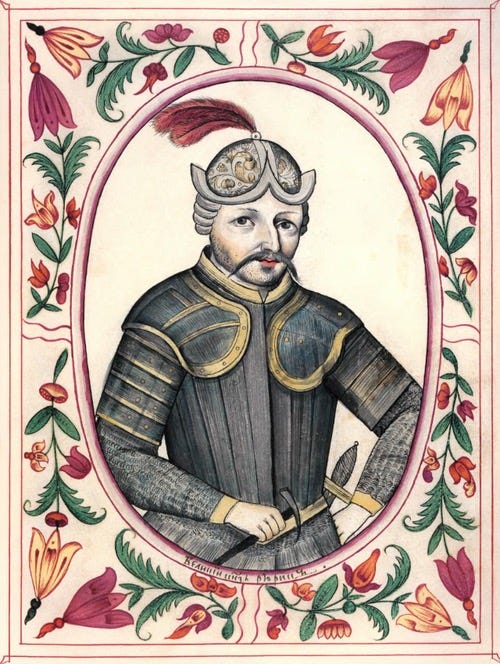
Grand Duke Nicholas Konstantinovich Romanov
Like any Romanov prince, Nicholas spent his childhood in imperial palaces surrounded by servants. Unlike many members of the dynasty, however, he pursued higher education of his own accord. He enrolled in the Nicholas General Staff Academy, becoming the first Romanov to receive a professional higher education by personal choice rather than court tradition. He later joined the prestigious Leib Guard Regiment and, at just twenty-one years old, became commander of a cavalry squadron.
Around this time, fate introduced him to the woman who would change his life forever.
At a masquerade ball in St. Petersburg, Nicholas met the American dancer Fanny Lear (Harriet Blackford). The two were nearly the same age, quickly found common ground, and soon began a passionate love affair. Unsurprisingly, the relationship alarmed the imperial family.

1867. Grand Duke Nicholas Konstantinovich with his family. Seated from left to right: his sister Olga and her fiancé, Prince George of Greece; their mother, Grand Duchess Alexandra Iosifovna. Front row: Grand Dukes Konstantin Konstantinovich, Vyacheslav Konstantinovich, and Dmitry Konstantinovich — the younger brothers of Nicholas Konstantinovich.
Hoping to separate the young Grand Duke from his lover, his parents arranged for him to join the Russian military campaign in Central Asia. Nicholas was sent with the expeditionary forces to Khiva, in present-day Uzbekistan, where he witnessed fierce and bloody fighting.
The campaign left a lasting impression on him — but not in the way his family had hoped.
After returning to St. Petersburg, Nicholas developed a lifelong fascination with the East. He became a member of the Imperial Russian Geographical Society and actively supported numerous expeditions exploring Central Asia, eventually becoming one of their leading patrons.
Yet neither scholarship nor exploration could overshadow his feelings for Fanny Lear. Upon returning home, he resumed the relationship with renewed passion, showering his beloved with expensive gifts.
The Diamond Scandal
In April 1874, Nicholas’s mother, Grand Duchess Alexandra Iosifovna, discovered that several diamonds had disappeared from the jeweled cover of an icon with which Emperor Nicholas I himself had blessed her marriage.
Her husband, Grand Duke Konstantin Nikolaevich, immediately summoned the police, and the missing diamonds were soon traced to a pawnshop.
The investigation led to Nicholas’s aide-de-camp, E. P. Varnakhovsky, who had pawned the jewels. During questioning on April 15, he firmly denied stealing them, insisting that he had merely delivered the stones to the pawnshop on the direct orders of Grand Duke Nicholas Konstantinovich.
Nicholas himself denied any involvement and even swore on the Bible that he had never given such instructions. At the same time, he reportedly attempted to shield his aide from responsibility by accepting blame himself — a decision that only deepened the anger of the imperial family.
Emperor Alexander II took personal control of the investigation and instructed Count Pyotr Shuvalov, the head of the Imperial Gendarmerie, to interrogate the Grand Duke personally.


Fanny Lear
According to the memoirs of Nicholas’s father, the interrogation lasted for several hours. Despite persistent questioning, arguments, and pressure, the prince refused to confess. Nevertheless, investigators eventually concluded that the diamonds had been intended for sale in order to finance lavish gifts for Fanny Lear.
The fate of the disgraced Romanov was then discussed at a family council. Various punishments were proposed. Some favored stripping him of all titles and decorations before sentencing him to hard labor. Others suggested reducing him to the ranks of an ordinary soldier or putting him on public trial.
Instead, the imperial family chose a solution that would cause the least damage to the dynasty’s reputation.
Nicholas Konstantinovich was officially declared mentally ill and permanently exiled from St. Petersburg. As for Fanny Lear, she was expelled from the Russian Empire for life and permanently banned from returning.
She and the Grand Duke would never see each other again.
In reality, Grand Duke Nicholas received two separate sentences.
The first was public. He was officially declared mentally ill, and control of his estate was transferred to his younger brothers.
The second was private — a family sentence. From that moment on, any mention of Nicholas in the official records of the Imperial House was forbidden. He was permanently banished from the capital and ordered to live under constant supervision for the rest of his life.
During his exile, which began in 1874, Nicholas was moved from place to place nearly ten times. He was never allowed to settle for long or establish meaningful connections. Only in 1881 did fortune finally smile upon him, when he was permitted to settle permanently in Tashkent.
Throughout those years of wandering, Nicholas published several scholarly works on the exploration of Central Asia and geographical expeditions. Yet it was in Tashkent that the most remarkable chapter of his life truly began.
Tashkent — The Grand Duke’s City
In Turkestan, Nicholas initially lived under the name Colonel Volynsky before adopting the surname Iskander, which was later officially confirmed by imperial decree and passed on to his descendants.
He was, by nature, an unconventional man who preferred to follow his own path. The Emperor granted him 300,000 rubles to build a private residence. Instead, Nicholas used the money to construct a theatre for the city.
He eventually built his own palace as well. Today, the Romanov Palace in Tashkent remains one of the region’s most beautiful historic buildings and now serves as a museum. But the palace was only one of many contributions he made to the city.

Romanov palace in Tashkent (a post card from 1909)
The exiled Grand Duke established more than ten scholarship programs for talented young people who could not afford to study at the finest universities of the Russian Empire.
He also became a remarkably successful entrepreneur. Nicholas founded soap factories, photography studios, billiard halls, businesses producing kvass, rice-processing enterprises, cotton-related industries, and even opened his own cinema. To avoid attracting unnecessary attention from the authorities, many of these businesses were officially registered under the name of his wife, Nadezhda Alexandrovna Iskander von Dreyer.
Nicholas Konstantinovich proved to possess an exceptional talent for business. He was among the first investors to recognize the enormous potential of cotton processing, which would become one of Turkestan’s most profitable industries.
Nor did he neglect the city itself.
Using his own fortune, he financed the paving of streets, the construction of schools, hospitals, theaters, orphanages, markets, and public squares. Eventually, his private business income greatly exceeded the annual allowance provided by the imperial court. While he officially received 200,000 rubles each year, his commercial ventures sometimes generated as much as 1.5 million rubles annually.
Yet the project that secured his lasting legacy was the irrigation of the Hungry Steppe between Tashkent and Jizzakh.


The irrigation canal in the Hungry Steppe, constructed with funds provided by Grand Duke Nicholas Konstantinovich and General view of the headworks of the Romanov Irrigation Canal in the Hungry Steppe.
At his own expense and on his personal initiative, an irrigation canal was excavated, transforming thousands of acres of barren land into fertile farmland. Approximately 7,000 desyatinas (7,5 thousands hectares) of land were reclaimed from a steppe covering nearly 40,000 desyatinas, giving agriculture across the region an enormous boost.
Construction lasted several years, and all labor was voluntary and paid. Once the canal was completed, exiled Ural Cossacks who had settled near Tashkent began farming the newly irrigated land and founded new villages. By 1913, as many as 119 settlements had emerged along the canal.
The Final Years
The final years of Nicholas’s life were surprisingly peaceful.
With the help of his sister — the Queen of Greece — he gradually reconciled with his family and was even allowed to return briefly to St. Petersburg.
Interestingly, Nicholas welcomed the Russian Revolution and even raised a red flag above his residence. However, he did not live long enough to witness its consequences.
Grand Duke Nicholas Konstantinovich died in January 1918.
In his will, he left most of his fortune to the city and its people, reserving only a small portion for his children. In the end, even they never received their inheritance.
Several of his descendants remained in Russia and became well-known public figures. One of the most famous was his granddaughter, Natalia Androsova, who spent her entire life in the Soviet Union, becoming both a motorcycle sports champion and a celebrated circus performer.
Officially, the Romanovs declared Nicholas Konstantinovich mentally ill and attempted to erase his name from history. Yet it was this “disgraced” Grand Duke who gave Tashkent theaters, schools, hospitals, businesses, and an irrigation canal that transformed the destiny of an entire region.
Sometimes history is far more complicated than the verdicts written in official records.
메타데이터
- post_id
- b2d1f727fe9a
- slug
- the-romanov-prince-declared-insane-for-love-b2d1f727fe9a
- url
- https://medium.com/@v.gomann/the-romanov-prince-declared-insane-for-love-b2d1f727fe9a
- canonical_url
- https://medium.com/@v.gomann/the-romanov-prince-declared-insane-for-love-b2d1f727fe9a
- author_url
- https://medium.com/@v.gomann
- status
- ok
- fetched_at
- 2026-09-07 05:58:54