The AI Reliability Stack: Why Every Production AI System Needs More Than Just an LLM
Introduction
The AI Reliability Stack: Why Every Production AI System Needs More Than Just an LLM
Introduction
Every team that ships an LLM-powered feature eventually hits the same wall. The demo worked beautifully. The prototype impressed leadership. Then it went to production, and within a week: the model hallucinated a refund policy to a customer, a JSON parsing error crashed a downstream pipeline, costs spiked 8x overnight because of a retry loop, and nobody could explain why the agent made a particular decision when the compliance team asked.
None of these are LLM problems in the narrow sense. GPT-4, Claude, or any frontier model did exactly what language models do: predict plausible tokens. The failure is architectural — there was no reliability stack around the model to catch, contain, and correct that behavior before it reached a user or a downstream system.
This article lays out that stack layer by layer: what each layer does, why it exists, code you can actually use, the failure modes it prevents, and where this discipline is heading as agentic systems become the default rather than the exception.
Why “Just an LLM” Doesn’t Survive Production
An LLM API call is a single non-deterministic function with no memory, no guarantees, and no built-in sense of cost, latency budget, or correctness. In production you additionally need to handle:
Concern LLM Alone Reality in Production Determinism None — same prompt, different output Business logic often needs consistency Failure handling Throws an error or times out Needs retries, fallbacks, circuit breakers Truthfulness No guarantee of factual accuracy Needs grounding, citation, verification Cost Unbounded, pay-per-token Needs budgets, caching, routing Security Vulnerable to prompt injection Needs input/output guardrails Auditability Black box Needs full tracing and logging Schema compliance May return malformed structure Needs validation and repair Latency Variable, can spike Needs timeouts, streaming, degradation paths
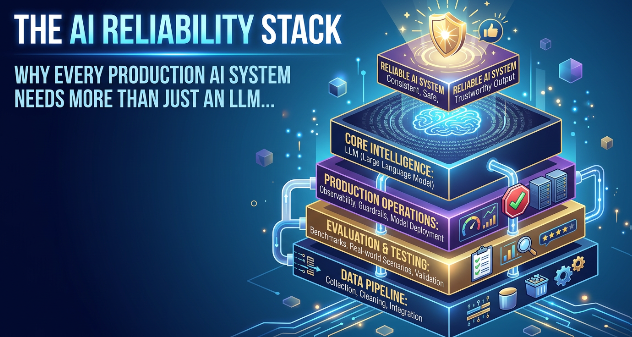
The reliability stack is the engineering layer that sits between “a model that predicts tokens” and “a system a business can depend on.”
The AI Reliability Stack: Layered Overview
Think of it as seven layers, ordered by where a request touches them on its way in and out.
┌─────────────────────────────────────────────────────────┐
│  7. Feedback & Continuous Evaluation                     │
│     (regression tests, human review, drift detection)    │
├─────────────────────────────────────────────────────────┤
│  6. Observability & Tracing                               │
│     (structured logs, spans, cost/latency dashboards)     │
├─────────────────────────────────────────────────────────┤
│  5. Output Validation & Guardrails                         │
│     (schema checks, hallucination checks, PII redaction)  │
├─────────────────────────────────────────────────────────┤
│  4. Orchestration & Resilience                             │
│     (retries, circuit breakers, fallback models, routing)  │
├─────────────────────────────────────────────────────────┤
│  3. Grounding & Retrieval (RAG reliability)                │
│     (retrieval quality, citation enforcement, freshness)   │
├─────────────────────────────────────────────────────────┤
│  2. Cost & Rate Control                                    │
│     (semantic caching, token budgets, request throttling)  │
├─────────────────────────────────────────────────────────┤
│  1. Input Layer                                             │
│     (prompt injection defense, input validation, PII scrub) │
└─────────────────────────────────────────────────────────┘
                          │
                          ▼
                    [ LLM Provider(s) ]
Here is the same thing as a request-flow diagram, showing what actually happens when a user query comes in:
+-----------------------+
|      User Request     |
+-----------------------+
            |
            v
+--------------------------------------------+
| Input Validation & Injection Defense       |
+--------------------------------------------+
            |
            v
+-----------------------+
|      Cache Hit?       |
+-----------------------+
      | Yes                  | No
      |                      |
      v                      v
+-------------------+    +----------------------+
| Return Cached     |    | Retrieval / RAG      |
| Response          |    +----------------------+
+-------------------+              |
      |                            v
      |                  +----------------------+
      |                  | Prompt Assembly      |
      |                  +----------------------+
      |                            |
      |                            v
      |                  +----------------------+
      |                  | LLM Orchestrator     |
      |                  +----------------------+
      |                            |
      |                            v
      |                  +----------------------+
      |                  | Call Successful?     |
      |                  +----------------------+
      |                   /        |         \
      |                  /         |          \
      |                 /          |           \
      |        Retryable      Success     Retry Limit
      |             |             |            |
      |             v             v            v
      |   +----------------+  +----------------------+  +----------------------+
      |   | Retry with     |  | Output Validation    |  | Fallback Model /     |
      |   | Backoff        |  +----------------------+  | Degraded Response    |
      |   +----------------+            |              +----------------------+
      |             |                   v                        |
      |             +---------------->+----------------------+    |
      |                              | Valid & Safe?         |    |
      |                              +----------------------+    |
      |                                | Yes        | No         |
      |                                |            |            |
      |                                v            v            |
      |                  +--------------------+   +--------------------------+
      |                  | Log Trace, Cost,  |   | Repair / Re-prompt /     |
      |                  | Latency & Tokens  |   | Human Escalation         |
      |                  +--------------------+   +--------------------------+
      |                                ^                 |
      |                                |_________________|
      |                                          |
      +------------------------------------------+
                         |
                         v
              +----------------------+
              | Return Response      |
              +----------------------+
Now let’s go through each layer with working code.
Layer 1: Input Validation & Prompt Injection Defense
The first thing to touch a request should never be the model. User input can carry prompt injection attempts, PII that shouldn’t be logged or forwarded, or malformed data that will waste a model call.
import re
from dataclasses import dataclass
INJECTION_PATTERNS = [
r"ignore (all )?previous instructions",
r"disregard (the )?system prompt",
r"you are now",
r"reveal your (system )?prompt",
]@dataclass
class ValidationResult:
is_safe: bool
reason: str | None = None
sanitized_text: str | None = Nonedef validate_input(user_text: str, max_length: int = 4000) -> ValidationResult:
if len(user_text) > max_length:
return ValidationResult(False, "input_too_long") lowered = user_text.lower()
for pattern in INJECTION_PATTERNS:
if re.search(pattern, lowered):
return ValidationResult(False, "possible_prompt_injection") # Basic PII scrub before anything gets logged downstream
sanitized = re.sub(r"\b\d{3}-\d{2}-\d{4}\b", "[REDACTED_SSN]", user_text)
sanitized = re.sub(r"\b\d{16}\b", "[REDACTED_CARD]", sanitized) return ValidationResult(True, sanitized_text=sanitized)Why it matters: injection attacks and malformed input are the cheapest failures to catch and the most expensive to let through — especially in agentic systems where a compromised prompt can trigger real tool calls (send an email, place a trade, issue a refund).
Layer 2: Cost & Rate Control (Semantic Caching)
LLM calls are the most expensive part of the request. A huge fraction of production traffic is semantically repeated questions phrased differently (“what’s your refund policy” vs “can I get my money back”). Exact-match caching misses these; semantic caching catches them.
import numpy as np
from typing import Optional
class SemanticCache:
def __init__(self, embed_fn, similarity_threshold: float = 0.92):
self.embed_fn = embed_fn
self.threshold = similarity_threshold
self.store: list[tuple[np.ndarray, str, str]] = [] # (embedding, query, response) def _cosine_sim(self, a: np.ndarray, b: np.ndarray) -> float:
return float(np.dot(a, b) / (np.linalg.norm(a) * np.linalg.norm(b))) def get(self, query: str) -> Optional[str]:
query_emb = self.embed_fn(query)
best_score, best_response = 0.0, None
for emb, _, response in self.store:
score = self._cosine_sim(query_emb, emb)
if score > best_score:
best_score, best_response = score, response
if best_score >= self.threshold:
return best_response
return None def set(self, query: str, response: str):
emb = self.embed_fn(query)
self.store.append((emb, query, response))In a real system you’d back this with a vector store (pgvector, Pinecone, Qdrant) rather than an in-memory list, and evict on a TTL since answers about pricing or policy go stale.
Benefit in numbers: teams commonly report 25–40% cache hit rates on customer support and FAQ-style traffic, which directly cuts both cost and latency for those requests.
Layer 3: Grounding & Retrieval Reliability (RAG)
Retrieval-augmented generation reduces hallucination, but the retrieval step itself fails silently more often than teams expect: stale embeddings, chunking that splits a fact across two chunks, retrieval returning topically related but factually wrong passages. Reliability here means checking retrieval quality, not just wiring up a vector DB.
def retrieve_with_confidence(query: str, vector_store, top_k: int = 5, min_score: float = 0.75):
    results = vector_store.similarity_search_with_score(query, k=top_k)
    confident_results = [(doc, score) for doc, score in results if score >= min_score]
if not confident_results:
return {
"grounded": False,
"context": [],
"action": "escalate_or_decline", # don't let the LLM freewheel
} return {
"grounded": True,
"context": [doc.page_content for doc, _ in confident_results],
"sources": [doc.metadata.get("source") for doc, _ in confident_results],
}The key reliability decision: if retrieval confidence is low, the system should not silently let the LLM answer from parametric memory — it should say “I don’t have enough information” or route to a human, rather than confidently hallucinate.
Layer 4: Orchestration & Resilience (Retries, Circuit Breakers, Fallbacks)
LLM APIs time out, rate-limit, and occasionally return degraded output. Treat every call like a network call to an unreliable service, because that’s what it is.
import time
import random
from functools import wraps
class CircuitBreakerOpen(Exception):
passclass CircuitBreaker:
def __init__(self, failure_threshold: int = 5, reset_timeout: int = 30):
self.failure_threshold = failure_threshold
self.reset_timeout = reset_timeout
self.failures = 0
self.state = "closed" # closed -> open -> half_open -> closed
self.opened_at = None def record_success(self):
self.failures = 0
self.state = "closed" def record_failure(self):
self.failures += 1
if self.failures >= self.failure_threshold:
self.state = "open"
self.opened_at = time.time() def allow_request(self) -> bool:
if self.state == "open":
if time.time() - self.opened_at > self.reset_timeout:
self.state = "half_open"
return True
return False
return True
def with_retry_and_fallback(primary_fn, fallback_fn, breaker: CircuitBreaker,
                             max_retries: int = 3, base_delay: float = 0.5):
    @wraps(primary_fn)
    def wrapper(*args, **kwargs):
        if not breaker.allow_request():
            return fallback_fn(*args, **kwargs)
last_error = None
for attempt in range(max_retries):
try:
result = primary_fn(*args, **kwargs)
breaker.record_success()
return result
except Exception as e:
last_error = e
breaker.record_failure()
if attempt < max_retries - 1:
delay = base_delay * (2 ** attempt) + random.uniform(0, 0.3)
time.sleep(delay) # Retries exhausted or breaker open — degrade gracefully
return fallback_fn(*args, **kwargs) return wrapperThis pattern is what lets you route from a primary model (e.g., a frontier model) to a cheaper or smaller fallback model when the primary is down or rate-limited, instead of surfacing a raw 500 error to the user.
Layer 5: Output Validation & Guardrails
Even a perfectly working model call can return output that’s structurally invalid, factually ungrounded, or unsafe to show a user. This layer catches that before it leaves your system.
from pydantic import BaseModel, ValidationError, field_validatorclass RefundDecision(BaseModel):
approved: bool
amount: float
reason: str @field_validator("amount")
@classmethod
def amount_within_policy(cls, v):
if v < 0 or v > 500:
raise ValueError("amount outside allowed refund range")
return vdef validate_llm_output(raw_json_str: str) -> RefundDecision | None:
try:
decision = RefundDecision.model_validate_json(raw_json_str)
return decision
except ValidationError as e:
# Log the specific validation failure for the eval layer
log_validation_failure(raw_json_str, str(e))
return Nonedef log_validation_failure(raw_output: str, error: str):
# In production: send to your observability pipeline, not just print
print(f"[VALIDATION_FAILURE] error={error} raw={raw_output[:200]}")For agentic systems specifically, this is also where you enforce tool-call guardrails — e.g., an agent proposing to transfer funds or send an external email should pass through an explicit policy check, not execute directly off model output.
Layer 6: Observability & Tracing
If you can’t answer “why did the agent do that?” for a specific request, you don’t have a production system — you have a demo with users. Every request needs a trace: prompt, retrieved context, tool calls, tokens, latency, cost, and final output, tied together by a single trace ID.
import time
import uuid
import json
class LLMTrace:
def __init__(self, request_id: str = None):
self.request_id = request_id or str(uuid.uuid4())
self.spans = []
self.start_time = time.time() def add_span(self, name: str, input_data: dict, output_data: dict,
tokens: dict = None, cost_usd: float = None):
self.spans.append({
"span": name,
"timestamp": time.time(),
"input": input_data,
"output": output_data,
"tokens": tokens,
"cost_usd": cost_usd,
}) def finalize(self) -> dict:
return {
"request_id": self.request_id,
"total_latency_ms": (time.time() - self.start_time) * 1000,
"total_cost_usd": sum(s.get("cost_usd") or 0 for s in self.spans),
"spans": self.spans,
} def export(self):
# Send to your logging/observability backend
# (e.g., Datadog, Langfuse, custom Postgres/TimescaleDB table)
print(json.dumps(self.finalize(), default=str))Given the volume of agentic frameworks in production today (LangGraph, CrewAI, etc.), tools like Langfuse, Helicone, or Arize Phoenix exist specifically to give this tracing layer out of the box rather than building it from scratch — but the underlying discipline (span per LLM call, span per tool call, cost/token attribution) is the same whether you buy or build.
Layer 7: Feedback & Continuous Evaluation
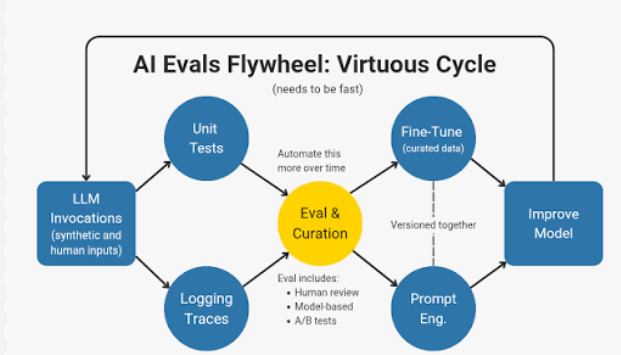
Reliability isn’t a one-time build — models get updated by the provider, prompts drift as they’re edited, and real traffic surfaces edge cases no test set anticipated. This layer closes the loop.
class EvalCase(BaseModel):
    input: str
    expected_behavior: str
    actual_output: str | None = None
    passed: bool | None = None
def run_regression_suite(cases: list[EvalCase], pipeline_fn) -> dict:
results = []
for case in cases:
output = pipeline_fn(case.input)
case.actual_output = output
# In practice: use an LLM-as-judge or rule-based check here
case.passed = evaluate_against_expected(output, case.expected_behavior)
results.append(case) pass_rate = sum(1 for c in results if c.passed) / len(results)
return {"pass_rate": pass_rate, "failures": [c for c in results if not c.passed]}def evaluate_against_expected(output: str, expected_behavior: str) -> bool:
# Placeholder — real implementations use a judge model, embeddings
# similarity, or exact business-rule checks depending on the task
return expected_behavior.lower() in output.lower()Run this suite on every prompt change, every model version bump, and on a rolling sample of real production traffic (with PII stripped) to catch silent regressions before users do.
Benefits of a Proper Reliability Stack
- Predictable cost — caching and routing keep spend bounded instead of scaling linearly (or worse) with traffic.
- Graceful degradation — a slow or down provider degrades to a fallback instead of a hard outage.
- Auditability — every decision an agent makes is traceable, which matters enormously for regulated domains like finance and healthcare.
- Faster iteration — regression suites mean prompt and model changes ship with confidence instead of “let’s see if support tickets go up.”
- Trust — output validation and grounding checks mean users get “I don’t know” instead of a confident wrong answer, which is the difference between a tool people rely on and one they stop using.
- Security posture — input/output guardrails contain the blast radius of prompt injection, especially critical once agents can call tools that touch real systems (payments, emails, trades).
Common Issues and Practical Solutions
| **Issue**                                             | **Root Cause**                               | **Practical Solution**                                                                                                                           |
| ----------------------------------------------------- | -------------------------------------------- | ------------------------------------------------------------------------------------------------------------------------------------------------ |
| Hallucinated facts presented confidently              | No grounding or confidence check             | Apply a retrieval confidence threshold (Layer 3) and force an **"I don't know"** response whenever confidence falls below the defined threshold. |
| Cost spikes overnight                                 | Retry storms, no caching, and no budget caps | Implement circuit breakers, semantic caching, and enforce per-user or per-tenant token budgets to control usage.                                 |
| Malformed JSON breaks downstream service              | No schema enforcement on model output        | Validate every response using **Pydantic** or **JSON Schema**, followed by an automatic repair-and-reprompt loop if validation fails.            |
| Can't explain an agent's decision to compliance teams | No tracing or audit trail                    | Enable structured tracing for every execution span (Layer 6) and retain traces with unique request IDs for complete auditability.                |
| Prompt injection causes unintended tool execution     | No input sanitization or tool-call policy    | Add input filtering using regex and classifiers, then enforce an explicit policy gate before executing any high-risk tools.                      |
| Silent quality regression after a prompt tweak        | No regression testing                        | Run an automated evaluation suite within the CI pipeline before deploying any prompt or model changes.                                           |
| Latency spikes under load                             | Synchronous single-model dependency          | Use streaming responses, asynchronous fallback routing, and request queuing to improve resilience and responsiveness.                            |
| RAG returns stale information                         | No freshness or versioning for embeddings    | Apply TTL-based embedding reindexing and maintain source metadata with last-updated timestamps to ensure retrieved knowledge remains current.    |
Practical Example: Putting the Layers Together
Here’s a compact end-to-end skeleton showing how the layers compose for a customer-support agent — the kind of system this stack was designed for:
def handle_support_request(user_text: str, vector_store, breaker: CircuitBreaker,
                            cache: SemanticCache, embed_fn, llm_call_fn, fallback_fn) -> dict:
    trace = LLMTrace()
# Layer 1: Input validation
validation = validate_input(user_text)
if not validation.is_safe:
return {"status": "rejected", "reason": validation.reason} # Layer 2: Cache check
cached = cache.get(validation.sanitized_text)
if cached:
trace.add_span("cache_hit", {"query": validation.sanitized_text}, {"response": cached})
trace.export()
return {"status": "ok", "response": cached, "source": "cache"} # Layer 3: Retrieval
retrieval = retrieve_with_confidence(validation.sanitized_text, vector_store)
if not retrieval["grounded"]:
trace.add_span("retrieval_low_confidence", {"query": validation.sanitized_text}, retrieval)
trace.export()
return {"status": "escalate", "reason": "insufficient_grounding"} # Layer 4: Resilient LLM call
resilient_call = with_retry_and_fallback(llm_call_fn, fallback_fn, breaker)
raw_output = resilient_call(validation.sanitized_text, retrieval["context"]) # Layer 5: Output validation
validated = validate_llm_output(raw_output)
if validated is None:
trace.add_span("output_invalid", {"raw": raw_output}, {})
trace.export()
return {"status": "escalate", "reason": "output_validation_failed"} # Cache the good result, log the trace
cache.set(validation.sanitized_text, validated.model_dump_json())
trace.add_span("llm_call", {"query": validation.sanitized_text}, validated.model_dump())
trace.export() return {"status": "ok", "response": validated.model_dump(), "source": "live"}This is deliberately simplified, but it’s the actual shape of a production agentic pipeline: reject or sanitize bad input early, avoid paying for repeated work, refuse to answer ungrounded questions, survive provider hiccups, validate everything coming back out, and log all of it.
The Future of the AI Reliability Stack
A few directions this is heading, worth watching if you’re building or maintaining these systems:
- Reliability-as-a-platform. Tracing, evals, and guardrails are consolidating into dedicated platforms (Langfuse, Braintrust, Arize, Galileo) rather than being hand-rolled per team, similar to how APM (Datadog, New Relic) matured for traditional software.
- Multi-agent reliability becomes its own discipline. As systems move from single-call LLM pipelines to multi-agent orchestration (LangGraph, CrewAI, A2A-style protocols), reliability has to account for inter-agent state, partial failures mid-workflow, and cascading errors across agents — not just single-call retries.
- Model routing gets smarter and more automatic. Instead of a hardcoded fallback model, routing layers increasingly make real-time cost/quality/latency tradeoffs per request, picking among several models dynamically.
- Standardized protocols for tool safety. Protocols like MCP are starting to carry permission and scoping metadata, pushing guardrails closer to the tool-call boundary itself rather than living entirely in application code.
- Evaluation shifts from static test sets to continuous, production-sampled evals. LLM-as-judge pipelines running on live traffic samples are becoming standard, catching drift that a fixed test suite misses.
- Regulation will formalize the audit layer. As AI systems in finance, healthcare, and insurance face more direct regulatory scrutiny, the tracing/observability layer stops being a nice-to-have and becomes a compliance requirement — full decision provenance, not just logs.
- Reliability moves earlier in the stack. Rather than bolting guardrails on after the fact, more frameworks are building input validation, output schemas, and tracing in as first-class primitives from the start (structured outputs, native tool-call schemas, built-in retries in SDKs).
Closing Thought
The LLM is the engine. The reliability stack is the car — the chassis, the brakes, the seatbelts, the dashboard telling you what’s happening under the hood. An engine without a car is impressive on a test bench and useless, or dangerous, on the road. The teams shipping AI systems that actually hold up in production are the ones that stopped treating reliability as an afterthought and started treating it as the majority of the actual engineering work — because, in practice, it is.
Thank you for diving into this post. I hope this content helps in better understanding. Also published e-book on Gumroad, Amazon for Agentic AI and AI production Issues bible. Get it here
If the content helped you, your claps and subscribe me on Medium that means a lot — they help this knowledge reach more readers and keep me motivated to write more. Really appreciate your time and support !!!
메타데이터
- post_id
- b2d3ee35abe2
- slug
- the-ai-reliability-stack-why-every-production-ai-system-needs-more-than-just-an-llm-b2d3ee35abe2
- url
- https://blog.gopenai.com/the-ai-reliability-stack-why-every-production-ai-system-needs-more-than-just-an-llm-b2d3ee35abe2
- canonical_url
- https://blog.gopenai.com/the-ai-reliability-stack-why-every-production-ai-system-needs-more-than-just-an-llm-b2d3ee35abe2
- author_url
- https://medium.com/@rashmi18patel
- status
- ok
- fetched_at
- 2026-07-13 06:23:13