AI in SD-WAN: Beyond Performance Scores and Pretty Dashboards
The Truth about “AI-Powered SD-WAN” — Most of it isn’t AI at all
AI in SD-WAN: Beyond Performance Scores and Pretty Dashboards
The Truth about “AI-Powered SD-WAN” — Most of it isn’t AI at all
The Lie: When intelligence becomes decoration
Over the last two years, SD-WAN vendors have rushed to add “AI” into their marketing. Some renamed dashboards. Some added new charts. Some added an “AI score” or “AI assistant.”
But talk to any engineer running real global WAN infrastructure, and you’ll hear the same thing: “The AI doesn’t actually do anything.”
This “marketing AI” simply visualizes. And visualizing is not intelligence.
It doesn’t:
- Predict.
- Recommend.
- Act.
- Learn.
- Adapt.
If SD-WAN is going to survive the next decade of multi-cloud, remote work, encrypted traffic, and unpredictable ISP behaviour, Real AI must move from cosmetic → functional.
Why Today’s SD-WAN Is Breaking Under Pressure
SD-WAN started as a brilliant idea: use overlays to secure and optimize connectivity across the internet.
But as networks grew more dynamic, static SD-WAN struggled with:
- Tunnel/underlay mismatch: Tunnels look fine, but the underlay is deteriorating.
- ISP instability: Performance changes hour by hour.
- Cloud-region variability: Latency between regions fluctuates unpredictably.
- Encrypted traffic explosion: Traditional QoS logic becomes blind.
The world changed. SD-WAN didn’t. Policies written last month might already be outdated today. The industry’s version of “AI” (a performance index, a few anomaly alerts, a bar chart) doesn’t close the loop between observation and action. This is marketing AI, not operational AI.
The Solution: What True AI-Driven SD-WAN Must Do
To earn the title “AI-driven,” SD-WAN must execute three tightly connected capabilities:
✔ Capability 1: Predict
AI must forecast performance issues before users feel them. Prediction transforms firefighting into prevention. For example:
- “This link has an 82% chance of a jitter spike in 10 minutes.”
- “Loss patterns suggest an ISP rebalancing event is imminent.”
- “Path X→Y shows early signs of packet fragmentation.”
✔ Capability 2: Recommend
Once a potential issue is detected, the AI should provide decision intelligence, not just anomaly detection:
- Best path recommendations.
- MTU adjustments or tunnel switching guidance.
- Application-specific routing suggestions.
✔ Capability 3: Act
Autonomous SD-WAN should apply safe, reversible actions:
- Switch from Path A to B.
- Rebalance tunnels or adjust DSCP markings.
- Bypass unstable cloud regions.
Action is the ultimate intelligence layer. Without action, SD-WAN stays manual. With action, SD-WAN becomes autonomous.
Why AI in SD-WAN Is Hard
The WAN is one of the most chaotic systems in modern computing. Building real AI for it is a monumental challenge because:
- Telemetry is extremely noisy: Loss, jitter, RTT all fluctuate unpredictably.
- Underlay instability hides behind overlays: You see a tunnel, but not the physical path beneath it.
- Encryption reduces visibility: DPI signals become limited in QUIC/TLS-first traffic.
- ISP behaviour varies by region and time: A path stable at 10 AM may collapse at 6 PM.
This requires an AI model trained on tens of thousands of real path cycles — across multi-cloud, multi-ISP, multi-region routes. Very few vendors have enough path data to train such models.
How Ticvic Builds Real AI into SD-WAN
At Ticvic, we embed intelligence directly into the SD-WAN decision loop:
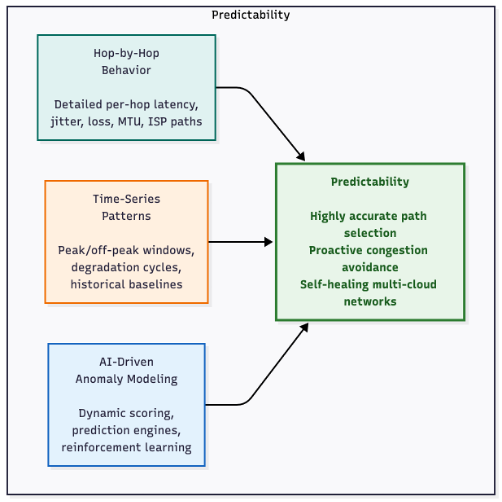
Predictive Path Intelligence (PathiQ): Models that forecast degradation windows with confidence intervals. Click here for more details
- Hop-by-Hop Anomaly Detection: Catching instability long before tunnels fail.
- Autonomous Route Selection: Policies that learn from outcomes, not just configs.
- Overlay-Underlay Correlation: To avoid the “tunnel looks fine but users say it’s broken” paradox.
- RCA Summaries: AI-generated explanations of why a path degraded and what to do next
This is AI that acts, not AI that decorates.
SD-WAN Architecture of the Future
The evolution looks like this:
- Monitoring: “What is happening?”
- Insights: “Why is it happening?”
- Recommendations: “What should I do about it?”
- Autonomy: “Let me do it for you.”
Most vendors are stuck at step 2. Almost none consistently execute step 4. But step 4 is where SD-WAN becomes future-proof.
This is how SD-WAN becomes truly autonomous.
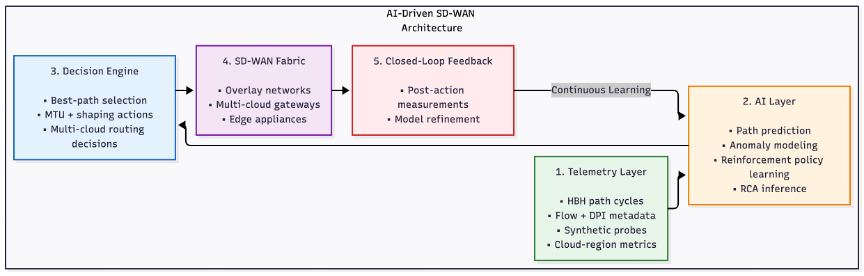
AI-Driven SD-WAN Architecture
Click here to get more details about AI Enabled SDWAN
Final Thought
SD-WAN’s next decade won’t be defined by fancy dashboards or prettier alerts. It will be defined by how intelligently and autonomously the system makes decisions — under real network chaos.
The vendors who embrace functional AI — not cosmetic AI — will lead the future of enterprise networking
메타데이터
- post_id
- b2d94ddadfeb
- slug
- ai-in-sd-wan-beyond-performance-scores-and-pretty-dashboards-b2d94ddadfeb
- url
- https://medium.com/@mas_40032/ai-in-sd-wan-beyond-performance-scores-and-pretty-dashboards-b2d94ddadfeb
- canonical_url
- https://medium.com/@mas_40032/ai-in-sd-wan-beyond-performance-scores-and-pretty-dashboards-b2d94ddadfeb
- author_url
- https://medium.com/@mas_40032
- status
- ok
- fetched_at
- 2026-07-24 17:05:14