Sector Rotation Before the Fed: What a Split Regime Signal Reveals
Sector rotation rarely announces itself. This week it arrived under a calm surface: the S&P 500 rose just +0.34%, VIX fell to 17.68, and…
Sector Rotation Before the Fed: What a Split Regime Signal Reveals
Sector rotation rarely announces itself. This week it arrived under a calm surface: the S&P 500 rose just +0.34%, VIX fell to 17.68, and 91% of sectors closed green — yet the leadership flipped, small caps surged, and a systematic regime model started flashing a rapid-shift warning two trading days before the Fed.
This analysis covers the week’s rotation, the split between in-sample and out-of-sample regime signals, and a tail-risk model that has been running hot — grounded in the EMRA v4.5 systematic methodology (a 12-module engine combining HMM regime classification, GARCH volatility forecasting, and Cornish-Fisher tail adjustment).

Leadership rotated out of the year’s winners and into Materials, Staples and Real Estate.
A broad week with leadership quietly flipping
SPY closed at $741.75 (+9.07% year-to-date), QQQ at $721.34 (+17.57%), and the Dow added +0.82%. The headline move, though, was small caps: IWM rose +3.11% and now leads the majors at +19.22% YTD. Breadth was strong — 91% of the eleven S&P sectors finished positive — but the spread between best and worst was a wide 5.78%. Broad participation plus wide dispersion is the signature of a stock-picker’s market, not a single-factor rally.

What the volatility regime model actually says
VIX fell 1.24 to 17.68 (NORMAL), with the futures curve in contango at the 33rd percentile. Quiet — until you look at the regime engine.
In-sample, the Hidden Markov Model classifies the tape as low-volatility mean-reverting, with high stability and a modest 15.2% shift probability. The walk-forward (out-of-sample) validation agrees on the label with full confidence — but its underlying probability vector is 99.9% weighted to low-volatility trending. The probability-weighted adjustments that follow are more cautious than the discrete read: a smaller trade-confidence score and a 0.75x position-size multiplier. Transition momentum trips a rapid-shift alert. Importantly, no adverse high-volatility momentum is building, so this is a shift within the low-vol family — not a break toward stress. The practical implication is to reduce size, not to de-risk entirely.

GARCH corroborates: a 17.9% annualized volatility forecast, persistence near 0.97, and a ~22-day half-life. Volatility is moderate and would decay slowly after any shock.
Sector rotation: the week’s real signal
The weekly leaders were Materials (+4.44%), Consumer Staples (+3.31%) and Real Estate (+3.02%), followed by Financials and Utilities. The laggards were the year’s champions: Technology (+0.34%) and Energy (−1.34%), which nonetheless still hold the top two YTD positions (Energy +29.56%, Tech +28.52%).
This is classic rotation — capital leaving extended winners for laggards and defensives while breadth stays broad. With average pairwise correlation at just 0.178, these are idiosyncratic moves. In a low-correlation, wide-dispersion tape, selection matters far more than market direction.

Why miscalibrated tail risk matters here
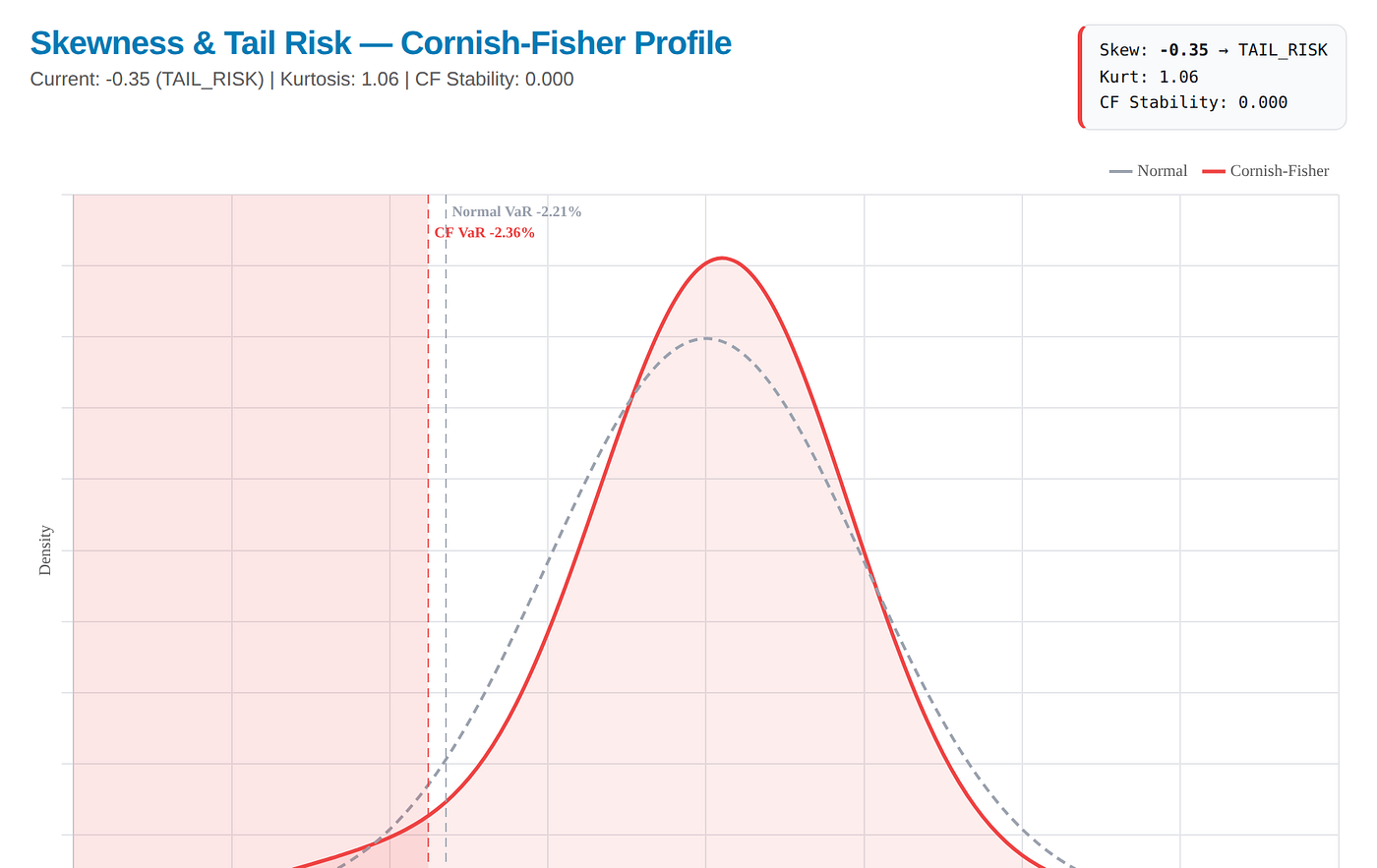
Cornish-Fisher flags negative skew (−0.21) and excess kurtosis (1.40), lifting the 5-day 95% Value-at-Risk to −2.58% and CVaR to −3.47%. The backtest is the key finding: across 499 out-of-sample days, both the 95% and 99% CF VaR bands were miscalibrated — breached far more often than expected (9.4% vs 5%; 2.8% vs 1%), with the Kupiec test rejecting calibration at both levels. The adjustment still beats a naïve normal assumption, but realized downside has been fatter than even the fat-tail model predicted, and the tail parameters have been unstable. The lesson is to size for tails you cannot precisely measure — favoring defined-risk structures over open-ended directional exposure.

The catalyst that frames everything: a coin-flip FOMC
The Federal Reserve decision lands June 16–17, two trading days out. The engine’s scenario split is nearly even: 54.4% to a “dovish-enough hold” where breadth persists, and 45.6% to a “hawkish dot-plot repricing” with a volatility spike. The shift toward the hawkish path after the tail adjustment reflects fat tails redistributing probability to the downside.

Key Takeaways
- Leadership rotated out of 2026’s winners (Tech, Energy) into Materials, Staples and Real Estate — with 91% breadth and a +3.1% small-cap surge.
- The tape is idiosyncratic (correlation 0.18, dispersion 5.8%): selection beats beta.
- The regime signal is split — in-sample mean-revert, out-of-sample trending — with a rapid-shift flag; the model’s response is to cut size to 0.75x.
- Tail-risk models are miscalibrated to the downside; favor defined risk over directional bets.
- A coin-flip FOMC (54/46) two days out is the dominant near-term catalyst.
The calm surface is real, but it is masking a market that is rotating and repricing. The systematic read is to travel lighter into the Fed, respect the tails, and watch whether the rotation broadens or reverses afterward.
For weekly systematic analysis, subscribe on Substack — all charts and methodology are freely available to subscribers.
About the Author
Tandel Quant Analytics publishes systematic market analysis using quantitative frameworks including EMRA, EEMRA, GMRO, and U-VCT. For informational purposes only. Not financial advice.
메타데이터
- post_id
- b2e7a051a448
- slug
- sector-rotation-before-the-fed-what-a-split-regime-signal-reveals-b2e7a051a448
- url
- https://medium.com/@tandel/sector-rotation-before-the-fed-what-a-split-regime-signal-reveals-b2e7a051a448
- canonical_url
- https://medium.com/@tandel/sector-rotation-before-the-fed-what-a-split-regime-signal-reveals-b2e7a051a448
- author_url
- https://medium.com/@tandel
- status
- ok
- fetched_at
- 2026-06-16 19:09:56