What exactly happens when a country runs out of money?
And why it’s not as simple as printing more money
What exactly happens when a country runs out of money?
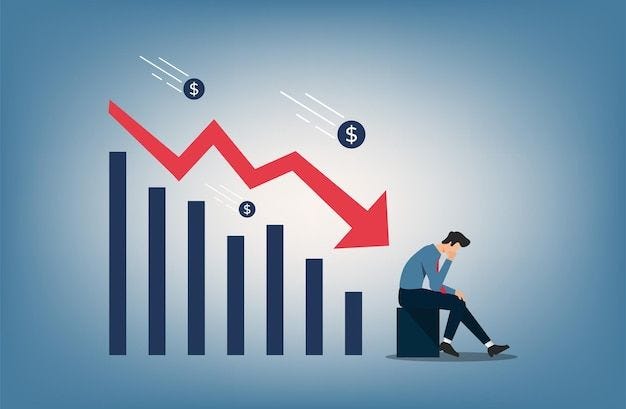
And why it’s not as simple as printing more money
A few months ago I went to buy cooking oil and came back with half the amount for the same price. My friend was planning to study abroad , but the rupee crashed so fast that his tuition fee doubled overnight. We didn’t need a finance minister to tell us — we could feel it. The country was running out of money.
So, what does it mean that a country has money on paper, but still, it can’t import fuel, pay debt, or stabilize it’s currency ?
Many imagine that it looks like a collapsed government, empty banks , or a nation declaring bankruptcy overnight but in reality it’s not just a financial crisis-it’s a breakdown in how a country manages its resources , it’s priorities, and it’s promises.
But how does a country even reach that point ? What causes a nation’s economy to slip into a state where it can no longer afford basic necessities, let alone growth or development ?
To answer that , you need to look beyond the headlines and understand what “ running out of money “ really means for a country-and why it happens far more often than we think.
When a Country Feels Broke — But It’s Not About Cash
We often think a country’s economy is powered by its own currency.
But here’s the truth:
When it comes to global trade, your local currency doesn’t get you very far. If a country wants to buy oil, wheat, medicine, or machinery from abroad, it can’t pay in its own money. Why? Because most other countries and global suppliers don’t accept it. They want a strong, stable currency — usually US dollars, euros, or yuan. This is why countries rely on foreign exchange reserves — their emergency stash of internationally accepted currency.
🔹 What Is Foreign Exchange?
Foreign exchange (often called forex) refers to the system where countries buy, sell, and hold foreign currencies so they can trade with each other. Just like you might exchange your local money for dollars when you travel, countries do the same to pay for goods and services across borders.
🔹 Why Can’t Countries Use Their Own Money?
Let’s say Pakistan wants to buy oil from Saudi Arabia. Saudi Arabia won’t accept Pakistani rupees. Instead, it demands payment in US dollars — a currency trusted worldwide. That’s the case for most international transactions. Local currencies stay within borders, but foreign currencies are what actually move the global economy.
🔹 What Are Foreign Exchange Reserves?
Foreign exchange reserves are the total amount of foreign currency (like dollars, euros, or pounds) held by a country’s central bank.
These reserves are used to:
- Pay for imports like oil, food, and medicine
- Repay international loans or interest
- Stabilize the national currency during economic stress
- Build trust among investors and trading partners
Think of it as the country’s global wallet. Without enough in it, a nation simply can’t afford to participate in the world economy.
True Stories from the Past Few Years:
- In Sri Lanka (2022), fuel stations shut down because the government couldn’t pay oil suppliers. Schools closed. Final exams were postponed. Protests spread across the country.
- In Lebanon, banks froze people’s savings, and the local currency lost over 90% of its value. Daily groceries became unaffordable.
- In Argentina, inflation crossed 100%, and people rushed to convert their money into dollars or gold before it lost more value.
In each case, the country didn’t technically run out of money — but it ran out of the money that mattered internationally. That’s when life starts to get harder for everyone.
The world’s Emergency Lender
When a country runs dangerously low on foreign currency, can’t pay for fuel or food imports , and is facing a credit crisis — there’s one place almost every government turns to: The International Monetary Fund (IMF)
The International Monetary Fund (IMF) :

The International Monetary Fund (IMF) : a global institution that steps in when countries face severe financial crises
It is a global financial institution established in 1944 to promote international economic stability and growth. With 190 member countries, its core mission is to ensure the smooth functioning of the global monetary system: that is, the system whose primary role is :
It provides short-term financial assistance to countries experiencing balance of payments crises.
In simpler terms: when a country is running dangerously low on foreign currency and is unable to pay for critical imports or meet its debt obligations, the IMF steps in to help.
But it is not as simple as it looks, why ? Well, let me explain with analogy:
IMF as the “Strict Friend Who Lends You Money”
Imagine your friend is broke. They’ve been spending too much, taking loans from everyone, and now no one trusts them. They come to you for help.
You say:
“Okay, I’ll lend you money — but you need to stop overspending, track your expenses, and pay me back on time. Otherwise, no deal.”
That’s the IMF. It gives loans, but only if you follow strict rules to fix your spending habits. Some friends get better. Others struggle more because the rules are tough.
What’s Next?
The IMF might help a country survive a crisis — but the real question is : Does it help countries stand on their own feet? Or keep them stuck in a cycle of debt and dependency?
This was the first article in a series where I break down complex economic issues into simple, everyday language — whether you’re an economics student or just someone curious about how the world works.
Stay tuned.
메타데이터
- post_id
- b2e8daf204e7
- slug
- what-exactly-happens-when-a-country-runs-out-of-money-b2e8daf204e7
- url
- https://medium.com/@fatimashahid1092/what-exactly-happens-when-a-country-runs-out-of-money-b2e8daf204e7
- canonical_url
- https://medium.com/@fatimashahid1092/what-exactly-happens-when-a-country-runs-out-of-money-b2e8daf204e7
- author_url
- https://medium.com/@fatimashahid1092
- status
- ok
- fetched_at
- 2026-06-22 17:31:34



