When the Immune System Shuts Down Blood: A Real-Time Look Inside the Bone Marrow
What happens when your body forgets that your own cells are yours?
When the Immune System Shuts Down Blood: A Real-Time Look Inside the Bone Marrow
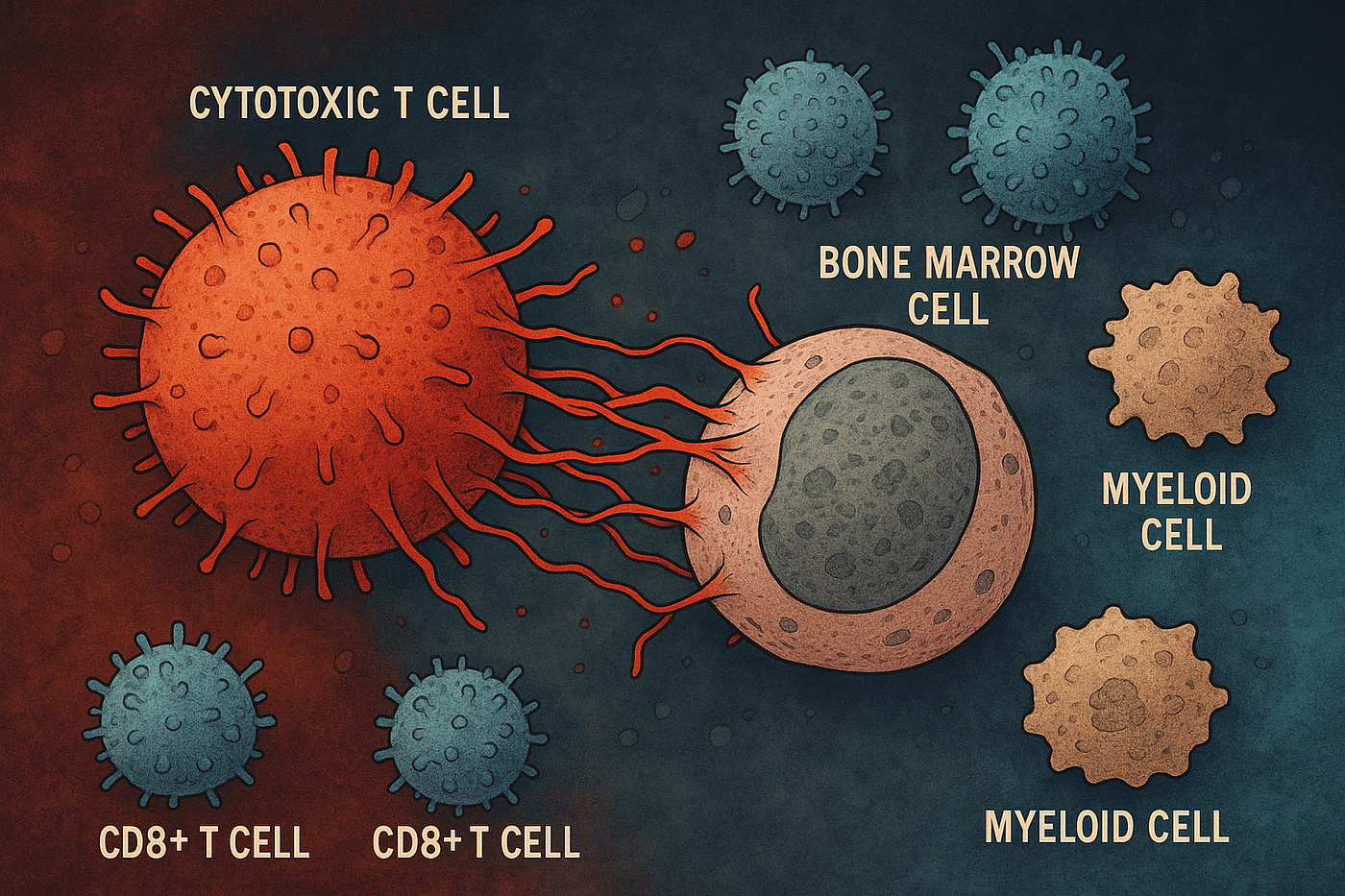
Image created by the author
What happens when your body forgets that your own cells are yours?
In a rare but deadly disease called severe aplastic anemia (SAA), that’s exactly what occurs. The immune system — the same system that defends us from viruses, bacteria, and cancer — mistakenly targets the stem cells inside your bone marrow, shutting down blood production. Red cells, white cells, platelets — gone. No backup. No natural fix.
The result? A life-threatening shortage of blood.
But a new study, led by scientists at the NIH and King’s College London, offers the clearest picture yet of how that self-destruction unfolds — and how treatment tries, often imperfectly, to stop it.
They used state-of-the-art tools to watch the disease in action, at single-cell resolution, before and after therapy. Their findings could change how we treat not just SAA, but autoimmune diseases more broadly.
The Disease That Kills Blood
Aplastic anemia is not cancer, but it can be just as deadly. If untreated, it’s often fatal. Even today, many patients rely on immunosuppressive therapy (IST) or stem cell transplants to survive.
This study followed 20 patients who received a standard combination therapy: hATG (horse anti-thymocyte globulin), cyclosporine, and eltrombopag. The research team collected samples of bone marrow before and after treatment, then analyzed them using powerful techniques like:
- Single-cell RNA sequencing to track gene activity in individual cells
- CyTOF (mass cytometry) to study protein levels on each cell
- TCR sequencing to monitor which immune cells were expanding and what they might be reacting to
The goal? To watch, cell by cell, how the immune system attacks — and how recovery happens.
Before Treatment: A Marrow Under Siege
Before treatment, the bone marrow looked like a war zone.
One type of immune cell stood out: CD8+ T cells, known for their ability to kill other cells. These T cells were hyperactive. Many had morphed into “effector memory” cells — a kind of battle-hardened, long-lived fighter.
At the same time, the population of healthy blood-making cells was nearly wiped out, especially the early stem cells that give rise to all blood types.
This paints a grim picture: a small army of killer T cells effectively shut down the entire blood production factory.
After Treatment: Some Relief, but New Dangers
Treatment worked — at least partly. The most aggressive T cells retreated. Myeloid cells (which become things like neutrophils and platelets) began to recover. The bone marrow became more balanced.
But something unexpected happened.
New T cell clones appeared. These weren’t the same cells as before — they had new genetic fingerprints. But they looked familiar in function. Many were just as aggressive, just as inflammatory.
This suggests the immune system wasn’t just healing. It was rearming.
Even though therapy suppressed the original attack, the system regenerated new attackers. And in some patients, these new immune cells were linked to poor recovery or even relapse.
A Clue in the Cytokine Fog
A chemical signal called interferon gamma (IFN-γ) played a starring role.
This molecule helps coordinate immune responses, but in SAA, it seemed to do more harm than good. The study found that:
- Before treatment, interferon gamma levels were high — no surprise, given the ongoing attack.
- After treatment, patients who still had high IFN-γ did worse.
- T cell clones that resisted treatment had higher IFN-γ and cytotoxic gene expression, suggesting these cells remained aggressive even when others quieted down.
IFN-γ could be both a biomarker and a therapeutic target in future treatments.
The Recovery Came from Plan B Cells
Here’s another twist. The earliest stem cells — the ones typically responsible for maintaining blood over a lifetime — did not bounce back well after treatment.
Instead, recovery came from more mature “progenitor” cells, which are further along the path to becoming specific blood cells.
This raises an interesting question: is the immune system more likely to target early stem cells than later ones? And if so, what does that mean for bone marrow regeneration — and the long-term risk of relapse or even secondary cancers?
A Shared Target, Still Unknown
One of the most intriguing findings was that the new T cell clones resembled the old ones, both in function and in what they might be reacting to.
This suggests that the immune system might still be targeting the same (unknown) antigen, possibly a self-protein. But the study couldn’t identify the trigger. Genetic differences between patients, including HLA types, made it hard to pin down the source.
Still, the pattern was clear: new clones rise where old ones fell, and they carry a similar signature of attack.
What This Means — and What Comes Next
This study gives us the clearest cellular picture yet of autoimmune marrow failure.
It shows that:
- Immunosuppression helps, but may not wipe the slate clean
- The immune system can regenerate its mistake
- Full recovery depends on stopping not just the first wave, but future ones too
The implications go beyond aplastic anemia. Many autoimmune diseases — from type 1 diabetes to multiple sclerosis — may follow similar patterns of relapse driven by new immune clones.
If we can figure out what these clones are targeting, and when they emerge, we may be able to predict and prevent flares before they start.
For now, this work reminds us of a simple, powerful truth: with the right tools, we can watch disease unfold, one cell at a time — and maybe, just maybe, get ahead of it.
Study details:
- 📌 “Human autoimmunity at single cell resolution in aplastic anemia before and after effective immunotherapy”
- 🧪 Published in Nature Communications, May 2025
- 🧬 Authors: Wu, Gao, Feng, et al.
- 🏥 Teams: NIH (National Heart, Lung, and Blood Institute) and King’s College London
- 🔬 Clinical trial: NCT01623167
Disclaimer: This article reflects my own interpretation of the study. The original authors are not responsible for any errors or conclusions presented here.
Note: I used Grammarly.
메타데이터
- post_id
- b2ef55153e1d
- slug
- when-the-immune-system-shuts-down-blood-a-real-time-look-inside-the-bone-marrow-b2ef55153e1d
- url
- https://medium.com/@bioinsights/when-the-immune-system-shuts-down-blood-a-real-time-look-inside-the-bone-marrow-b2ef55153e1d
- canonical_url
- https://medium.com/@bioinsights/when-the-immune-system-shuts-down-blood-a-real-time-look-inside-the-bone-marrow-b2ef55153e1d
- author_url
- https://medium.com/@bioinsights
- status
- ok
- fetched_at
- 2026-06-27 07:40:21