Perpetual License Gone: What ColdFusion 2025’s Subscription Model Costs Your Business
Adobe ColdFusion 2025 (released February 25, 2025) is the first ColdFusion release in the product’s history available exclusively through…
Perpetual License Gone: What ColdFusion 2025’s Subscription Model Costs Your Business
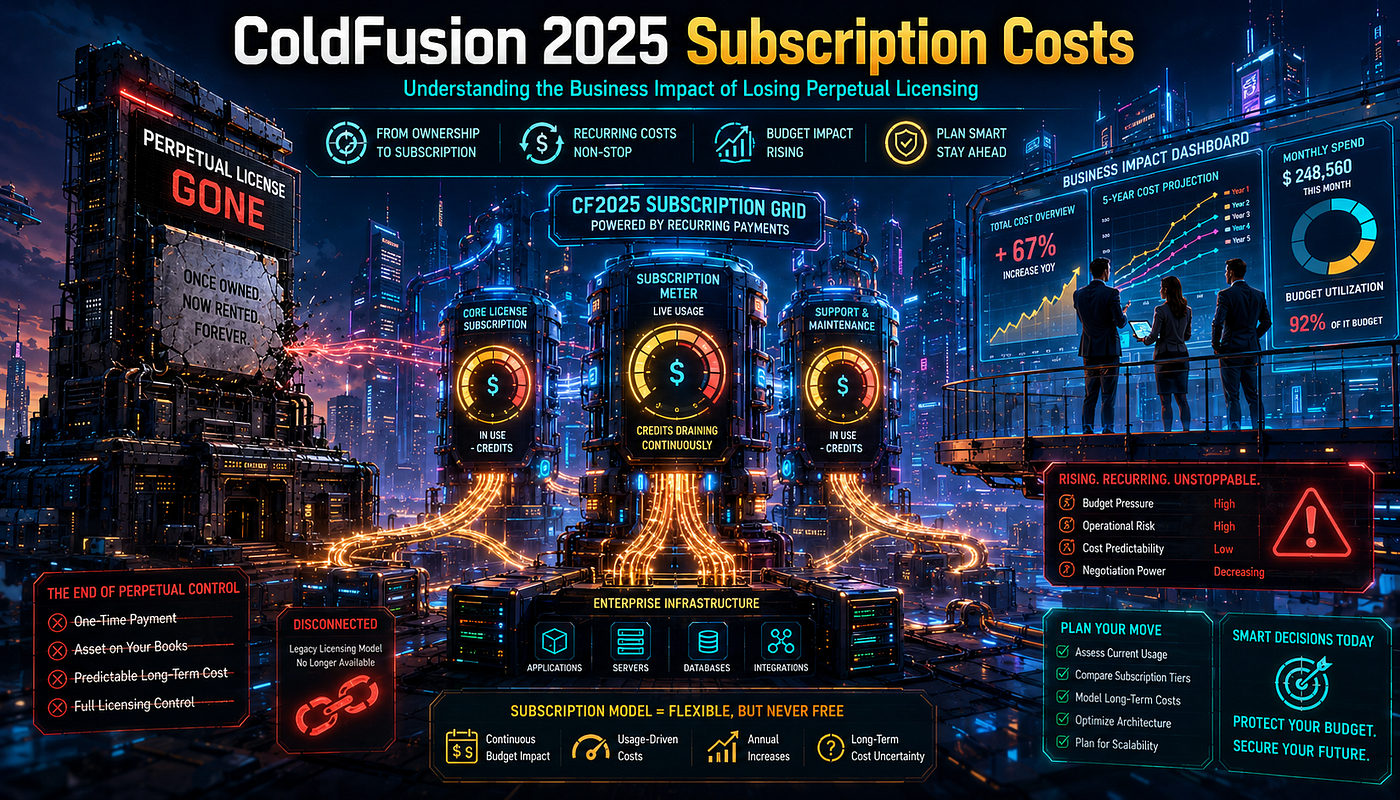
Adobe ColdFusion 2025 (released February 25, 2025) is the first ColdFusion release in the product’s history available exclusively through annual subscription — perpetual licensing has been discontinued for all future versions. Verified Adobe direct-store pricing: Standard Edition at $760/year per server license, Enterprise Edition at $2,930/year per server license — with the per-core licensing requirement (you must license enough to cover all CPU cores or vCores on each server) carrying forward from prior versions. Existing CF 2021 and CF 2023 perpetual licenses remain valid and continue to work; the subscription model applies only to CF 2025 and later. Licenses are managed through the Adobe Admin Console (no more serial keys), and if a subscription lapses, ColdFusion will eventually deactivate after a documented but unspecified grace period. The business impact: capital expenditure has become operational expenditure forever, costs are now recurring and predictable, and for organizations running multiple production CF servers the multi-year TCO comparison with open-source alternatives (Lucee, BoxLang) has changed materially. The cost picture is more complex than the headline numbers suggest — per-core math, cloud licensing interpretations, and reseller variability all matter.
Perpetual License Gone: What ColdFusion 2025’s Subscription Model Costs Your Business
The End of an Era
In February 2025, at the Adobe ColdFusion Summit in Las Vegas, Adobe announced a change that ended a chapter of the platform’s 30-year history: ColdFusion 2025 would be available only on subscription. There would be no perpetual license option.
Per Adobe’s own published buying guides at adobe.com/products/coldfusion-family/buying-guide.html and adobe.com/products/coldfusion-standard/buying-guide.html, the position is unambiguous: perpetual licensing is no longer available for any version of Adobe ColdFusion. The CF 2025 release on February 25, 2025 was the cutover. Customers who wanted to secure a final perpetual license had until late February 2025 — per FusionReactor's reporting, a final opportunity through reseller channels extended to February 28, 2025.
For organizations that have run ColdFusion for a decade or more under perpetual-license accounting, this is more than a pricing change. It’s a fundamental shift in how the platform is procured, budgeted, depreciated, and audited. Where ColdFusion used to be a capital expense — a one-time purchase amortized over years — it has now become a recurring operational expense, indefinitely.
This post lays out the verified pricing, walks through realistic TCO scenarios from single-server to multi-region enterprise deployments, covers the cloud-licensing wrinkle that’s catching teams unaware, and frames the alternatives that suddenly look more competitive in the new economic landscape.
What Changed and What Didn’t
To start with the facts before the analysis:
What Changed
- No more perpetual licenses. Every CF 2025 license — and every license for whatever Adobe releases after CF 2025 — is a subscription. Pay annually or lose access.
- License management moved to Adobe Admin Console. Per the Buy Adobe Software FAQ documentation, CF 2025 uses online activation via the Adobe Admin Console. No serial keys are issued. Customers receive an email from
messages@Adobe.comwithin three days of purchase with a link to the Admin Console where the license is registered and the installer can be downloaded. - Named User Licensing is the default. Licenses are tied to an Adobe ID rather than to a server identifier.
- Subscriptions auto-renew unless cancelled in advance (when purchased through Adobe VIP Marketplace, per Buy Adobe Software’s FAQ).
What Didn’t Change
Three things are worth being explicit about because they’re commonly misunderstood:
- Existing CF 2021 and CF 2023 perpetual licenses remain valid. Per Adobe’s own FAQ at
helpx.adobe.com/coldfusion/enterprise/faq.html, your existing CF 2021 or CF 2023 install continues to operate under your perpetual license. The subscription change applies only to CF 2025 and later versions. You don't have to move to CF 2025 immediately. - The Adobe ColdFusion EULA is essentially unchanged from CF 2023. Per Charlie Arehart’s authoritative coverage at
carehart.org/blog/2025/2/25/coldfusion_2025_released, the structural terms of the EULA — what's allowed, what's prohibited, the per-server-per-core model — are about the same as CF 2023, which was about the same as CF 2021. The single material change in 2025 is subscription-only. - Developer Edition is still free. Per the cfguide.io CF 2025 FAQ, the Adobe ColdFusion Developer Edition remains free for development and testing purposes — used to evaluate before purchase or to support non-production environments.
This distinction matters: organizations don’t have to immediately migrate from CF 2021 or CF 2023 just because subscription pricing arrived. They can run their perpetual installs to end of support (November 10, 2025 for CF 2021’s core support, May 16, 2028 for CF 2023’s core support). The decision is when to move to subscription, not whether.
The Verified Pricing
The base numbers, sourced from multiple primary references and cross-verified:
Adobe Direct-Store Prices (Verified)
- ColdFusion 2025 Standard Edition: $760 per year per license (per Adobe’s own FAQ at
helpx.adobe.com/coldfusion/enterprise/faq.html, Charlie Arehart's coverage atcarehart.org, and ITLandMark's analysis atitlandmark.com/blog/adobe-coldfusion-2025/). - ColdFusion 2025 Enterprise Edition: $2,930 per year per license (same multiple sources).
These are Adobe’s direct-store prices in the United States, before tax. Adobe’s own buying guides note that reseller prices may vary.
The Per-Core Licensing Requirement
Per the Buy Adobe Software FAQ documentation, the licensing rule on top of the per-license price is straightforward: 1 license per server, and you must license enough to cover all CPU cores (or vCores) on that server. This is the same per-core requirement that existed under perpetual licensing — but now it applies on an annual recurring basis.
What this means in practice depends on your server configuration. A small dev box with 2 cores and a production server with 16 cores carry very different total annual costs even before edition differences. The mismatch between “list price per license” and “what your fleet actually costs” can be material — and is the area where many organizations are most surprised when they receive their first detailed quote.
Educational and Volume Pricing
Per Adobe’s FAQ, educational pricing for the CF 2025 release is available at a discount. The specifics vary by institution; contact Adobe Sales for current educational pricing.
Beyond Adobe Direct, three subscription program structures exist for larger deployments:
- Named User Licensing — the standard subscription model, online activation via Adobe Admin Console, individual subscriptions accessed via Adobe ID.
- Feature Restricted Licensing — for environments that need offline activation (air-gapped systems, secure government environments, regulated production environments where outbound internet from CF servers isn’t allowed). Per Adobe’s buying guides, this is the only path to entirely offline ColdFusion 2025 operation.
- VIP (Value Incentive Plan) — Adobe’s volume licensing program with discount tiers that increase with additional licenses. Available exclusively through Feature Restricted Licensing.
- ETLA (Enterprise Term License Agreement) — a three-year term with one annual payment due on the same date each year. Available exclusively through Feature Restricted Licensing, designed for larger centralized organizational deployments.
The Buy Adobe Software FAQ notes that subscriptions through Adobe VIP Marketplace auto-renew unless cancelled in advance. This is a procurement-discipline issue worth being explicit about — finance teams accustomed to perpetual-license one-time purchases will need to add subscription renewal management to their recurring obligations review.
The Real TCO Math: Walking Through Server Counts
The headline prices look almost reasonable. The compounding effects across multi-server deployments and multi-year horizons are what make the financial picture sting. Below are illustrative scenarios using Adobe’s direct-store list prices. Actual organizational costs will vary based on reseller terms, VIP tier, ETLA discounts, and per-core counts — these scenarios use the Adobe-direct base prices for illustration.
Scenario 1: A Single Production Server (Standard Edition)
A small business running one ColdFusion 2025 Standard production server with 2 CPU cores:
- Annual subscription: $760/year
- Three-year cost: $2,280
- Five-year cost: $3,800
For a hobby project or single-tenant small business, the cost is real but not catastrophic. The biggest impact: where this previously could have been a one-time $1,000-$2,000 perpetual purchase amortized over 7–10 years, it’s now a recurring annual line item that never goes away.
Scenario 2: A Standard Production + Dev/Staging (Standard Edition)
A small-to-mid-sized business with one production CF server, one staging CF server, and one development CF server (Developer Edition is free, but staging often runs a paid license to match production behavior exactly):
- Production Standard: $760/year
- Staging Standard: $760/year
- Development: $0 (Developer Edition is free)
- Annual total: $1,520/year
- Five-year cost: $7,600
Scenario 3: Four-Server Enterprise Cluster
Per the LegacyLeap modernization analysis published April 2026, a four-server CF Enterprise cluster — a common pattern for medium-sized enterprises with HA requirements — was previously a one-time capital expenditure of approximately $38,000 under perpetual licensing. Under CF 2025 subscription:
- Four servers × $2,930/year = $11,720/year
- Three-year cost: $35,160
- Five-year cost: $58,600
- Ten-year cost: $117,200
The CapEx-to-OpEx conversion is the headline metric here. The four-server cluster crosses the “previously-paid” $38,000 threshold around year 3–3.5 of subscription. Every year after that is net-new spend that wouldn’t have existed under the perpetual model.
Scenario 4: Larger Enterprise Fleet With Per-Core Math
A larger enterprise running eight production CF 2025 Enterprise servers, with each server having 8 cores (a common cloud-instance configuration). Under Adobe’s “1 license per server plus license enough to cover all cores” model:
- The mechanics depend on the specifics of your license terms — talk to your Adobe rep about how core counts apply to your specific server configuration. List-price math for illustration only: 8 servers × $2,930/year list price = $23,440/year at base; per-core requirements can substantially adjust this depending on how your specific licensing arrangement maps cores to license counts.
- Three-year cost (base only): $70,320
- Five-year cost (base only): $117,200
This is the scenario where engaging Adobe Sales for a formal quote — and where considering the ETLA three-year term with potential volume discounts — typically pays off. List-price math is illustrative; negotiated enterprise pricing typically differs from list, sometimes substantially.
Scenario 5: Multi-Region, Multi-Environment Enterprise
A global enterprise running CF 2025 in multiple AWS regions with full dev/staging/UAT/production parallel environments — typical for regulated industries — quickly accumulates into the high tens or low hundreds of thousands of dollars per year before negotiated VIP/ETLA terms. The exact number depends on every parameter: number of regions, environments, instances, cores per instance, edition mix.
For organizations in this scenario, the cost analysis isn’t “look at the list price” — it’s “compare the multi-year Adobe quote against the engineering cost of migrating to an open-source alternative.” That’s the comparison Lucee, BoxLang, and full platform-migration options have to win on now.
The Cloud Licensing Wrinkle
A specific licensing interpretation has been catching teams off guard in 2025 and 2026. It deserves its own section because it materially changes the numbers for cloud deployments.
Per Charlie Arehart’s published blog and the comment thread at carehart.org/blog/2025/2/25/coldfusion_2025_released, a customer reported in September 2025 that when they sought a CF 2025 quote for their cloud-deployed server with 2 CPU cores, Adobe sales told them:
- Standard Edition is not supported in the cloud per Adobe sales’s interpretation of the EULA.
- They needed to purchase Enterprise Edition.
- The minimum core count Adobe sales would quote against was 8 cores, “as the smallest servers we see are 8 pcores.”
- The initial quote was approximately $4,000 per year, negotiated down to approximately $1,700 per year.
- The same customer reported their CF 2025 subscription cost was approximately a 22× increase compared to their three-year CF 2021 perpetual cost.
Charlie’s response, in the same comment thread, is important context: this licensing tension is not new to CF 2025. The CF 2025 EULA is essentially unchanged from CF 2023’s, which was unchanged from CF 2021’s. The cloud licensing interpretation has been a “longstanding challenge of how some in Adobe sales interpret that EULA, especially regarding some vague wording about networks and service bureaus.”
What this means for your organization:
- The published list prices ($760 / $2,930) may not be applicable to your specific cloud deployment depending on how Adobe sales interprets your environment.
- Get a formal Adobe Sales quote early in any migration planning. Don’t budget against list price; budget against the actual quote you receive.
- Negotiate aggressively. Per the same Charlie Arehart comment thread, customers have reported significant reductions from initial quotes when they push back.
- The EULA language is the source of the interpretation, not a CF 2025-specific change. This same dynamic applied under perpetual licensing — but it didn’t recur annually. Under subscription, you pay the negotiated outcome every year.
This is the single biggest “gotcha” in the CF 2025 cost picture that’s not visible in the headline list prices.
What Happens If You Stop Paying
A natural question, asked frequently and answered explicitly:
Per ITLandMark’s CF 2025 analysis: if the subscription is not renewed, ColdFusion will deactivate. This is fundamentally different from perpetual-licensed CF, where the software continued to function indefinitely after the license was activated.
Per the Buy Adobe Software FAQ documentation, Adobe has implemented a grace period to avoid sudden service disruptions when subscriptions lapse. Specific timelines are documented in the EULA or Admin Console notifications rather than published at large. The practical posture: you have some buffer, but not unlimited buffer, and the deactivation is a hard event when it happens.
Adobe’s own buying guide states it plainly: access to Adobe ColdFusion — including updates and technical support — will discontinue at the end of your subscription period.
The implications for operations teams:
- Subscription renewal is now a tier-1 operational concern. A missed renewal causes production outage, not just “no new patches.” Build the renewal date into your CMDB, ticketing alerts, and finance team’s recurring obligations review.
- Procurement bottlenecks become production risks. If your procurement team takes 60 days to approve renewals and your subscription has a 30-day grace period, you can take production down through procurement inaction alone.
- The “let the contract lapse and stay on the old version” backup plan no longer exists. Under perpetual licensing, an organization that disagreed with Adobe’s renewal terms could decline the new contract and keep running the previously-purchased software. Under subscription, declining renewal terminates the software.
The procurement and operations alignment this requires — making sure subscription renewals are tracked, approved, and processed before the grace period expires — is a real organizational discipline that didn’t matter under perpetual licensing and now does.
The Hidden Costs
The headline pricing is the most visible line item, but it’s not the only one. A complete TCO analysis includes:
1. Mandatory JDK Updates (Separate Workstream)
Per our prior post on CF JDK updates and Adobe’s own published guidance, applying Adobe’s quarterly security bulletins (APSB) does not update the underlying Oracle JDK. The JDK must be updated separately — manually, quarterly. This is engineering time that’s required for security posture but invisible in the subscription line item.
Estimated incremental annual cost: 8–16 hours of senior engineering time per quarter (32–64 hours/year), per environment that needs the JDK update applied. For a multi-environment fleet, this multiplies quickly. Most organizations underestimate this until they see a CISA KEV listing for a JDK CVE and have to rush.
2. FusionReactor and APM Licenses
Adobe’s built-in Performance Monitoring Toolset (PMT) is included with both Standard and Enterprise editions (per Adobe’s CF 2025 FAQ at helpx.adobe.com/coldfusion/enterprise/faq.html). However, many organizations still pay for FusionReactor as the preferred CFML APM tool — per the cfguide.io TCO calculator, FusionReactor lists at approximately $79/server/month, or roughly $948/server/year. For a four-server cluster, that's about $3,792/year on top of the $11,720 CF subscription.
3. Migration Cost From Earlier CF Versions
The biggest “hidden” line item for many organizations. Migrating from CF 11, CF 2018, or even CF 2021 to CF 2025 is a real engineering project — see our earlier posts on the CF 11 → CF 2025 migration for the full breakdown. Realistic ranges:
- Small applications (under 50k LOC): 2–4 months of engineering time.
- Mid-sized (50k-250k LOC): 3–6 months.
- Large enterprise (250k-1M+ LOC): 6–18 months.
If your organization isn’t currently on CF 2023, your CF 2025 subscription budgeting needs to include the one-time migration project cost on top of the recurring license cost.
4. Compliance and Audit Overhead
Subscription licensing creates new compliance touchpoints:
- License audit support — proving you have the correct number of licenses for your core count.
- Adobe Admin Console access management — who has access to manage licenses, MFA on Adobe IDs, federated SSO setup.
- Procurement audit trail — invoices, renewal records, contract terms.
- Vendor management reviews — Adobe is now a recurring critical vendor.
For regulated environments (PCI, HIPAA, FedRAMP, SOC 2), each of these adds to the annual control evidence package. Budget the time of your GRC team accordingly.
5. Subscription Management Overhead
The least quantifiable but real cost: someone has to actively manage the subscription. Tracking renewal dates, reviewing utilization, comparing pricing options, negotiating with Adobe Sales, processing invoices, reconciling license counts against deployed servers. For a small organization with one CF server, this is a few hours per year. For a large enterprise with dozens of CF servers across geographies, this is a small fraction of an FTE indefinitely.
The Five-Year Financial Picture
Putting it all together for a representative mid-sized enterprise scenario — a four-server CF 2025 Enterprise cluster plus the hidden costs above:

These are illustrative numbers using list prices and rough labor estimates. Real organizational figures will vary substantially based on negotiated pricing, in-house labor rates, environment count, and migration scope. No specific dollar figure in the above table should be treated as authoritative for your organization — it’s a structural illustration of the shape of the spend.
The structural shape is what matters: the recurring annual cost stays high; there is no “post-amortization” period like perpetual licensing offered. Year 10 looks like year 1.
The Alternatives That Suddenly Look More Attractive
The CF 2025 subscription pricing has changed the comparative economics with open-source CFML alternatives meaningfully. The honest comparison, with appropriate caveats:
Lucee (LGPL Open Source)
Per our prior CF-to-Lucee migration guide and the Lucee project’s own documentation, Lucee is licensed under LGPL — no per-server fees, no annual subscription, no per-core math. The Lucee Association Switzerland stewards the project; commercial support is available from independent vendors (TeraTech, Ortus Solutions, Webapper) for organizations that want a paid support relationship.
Honest trade-off analysis:
- Cost: $0 in license fees vs $11,720+/year for a four-server CF Enterprise cluster. Even with paid commercial support, total cost is typically a fraction of CF subscription cost.
- Compatibility: “Highly compatible” per Lucee’s own docs — most CFML ports without changes, some refactoring required (see our Lucee migration post for the verified list of incompatibilities).
- Migration cost: Real one-time engineering investment, similar in shape to a CF version upgrade. Recouped quickly through licensing savings for most organizations.
- Support: Community-driven by default; commercial available from independents. No Adobe support contract.
BoxLang (Ortus Solutions)
Per the Ortus Solutions announcements at Into The Box 2026, BoxLang is a JVM language with native CFML compatibility that has been in production-grade status since version 1.13 (April 2026). Commercial support and consulting are available from Ortus directly.
Honest trade-off analysis:
- Cost: Commercial pricing varies; Ortus offers paid plans plus open-source community tier. Generally substantially lower than CF subscription.
- Compatibility: Achieved through dedicated compatibility modules (
bx-compat-rest,bx-compat-soap— both first stable releases announced at Into The Box 2026); CFML codebases require some refactoring but Ortus markets transitions as "minimal and in some cases no code changes." - Migration cost: Real engineering investment; potentially similar to Lucee depending on application specifics.
- Support: Commercial support directly from Ortus Solutions.
Staying on Existing Perpetual CF (CF 2021 or CF 2023)
A legitimate near-term option for organizations that have valid perpetual licenses for CF 2021 or CF 2023. Per Adobe’s own FAQ, these continue to operate under their perpetual terms.
Important caveats:
- CF 2021 left core support on November 10, 2025. Per Adobe’s lifecycle documentation, extended support continues through November 10, 2026 — but extended support does not include security patches per Adobe’s published lifecycle terms. CF 2021 in production after November 2025 is running unpatched code for any new CVE discovered.
- CF 2023 core support continues through May 16, 2028. Plenty of runway, but the migration project to CF 2025 (or to Lucee, or to BoxLang) needs to be planned before that date.
- No new features. You’re frozen at the feature set of whatever update level you last applied.
For organizations not ready to commit to subscription yet, CF 2023 perpetual is a viable bridge for 2–3 years while alternatives are evaluated. It is not a long-term answer.
Migration to a Non-CFML Platform
For some organizations, the right answer is to use the migration moment to move off CFML entirely — to .NET, Java/Spring, Node.js, or another modern stack. This is the highest-effort option (full rewrite, often 12–36 months) and only makes economic sense when the CFML talent pool concerns or organizational strategic direction make the platform itself the wrong answer.
For most organizations with significant CFML investment, Lucee or staying on Adobe CF (subscribed) is more economic than a full rewrite. But the option exists.
The Decision Framework: When Does Subscription Make Sense?
Adobe CF 2025 subscription is the right answer for some organizations, the wrong answer for others. A pragmatic decision framework:
Subscription Makes Sense When:
- You’re a single-application shop with one or two production CF servers and the recurring cost is small compared to engineering reorganization cost.
- You need Adobe’s specific Enterprise features that don’t have clean Lucee or BoxLang equivalents (specific clustering implementations, specific Adobe-administered integrations).
- Your compliance framework requires commercial vendor support contracts that Adobe satisfies more readily than open-source alternatives.
- You’re in a regulated industry where vendor risk reviews favor large incumbent vendors like Adobe over smaller open-source organizations.
- Your engineering team is small and dedicated migration time isn’t available — staying with Adobe CF subscription preserves the platform you know.
- Your TCO analysis genuinely comes out favorable for Adobe at your specific scale and configuration after negotiated pricing.
Subscription Doesn’t Make Sense When:
- You run a large multi-server fleet where the per-server math compounds annually into significant recurring expense.
- Your applications use mostly portable CFML without heavy dependence on Adobe-CF-specific features.
- Your organization has internal engineering capacity to absorb a Lucee or BoxLang migration.
- Your compliance framework accepts open-source software with documented commercial support contracts (most modern frameworks do).
- You’re already planning major modernization work for other reasons (CF 11 EOL, infrastructure refresh, cloud migration) — migration to an alternative engine is a marginal addition to work you’re already doing.
The “Honest Middle” Position
Many organizations end up in a hybrid steady state — Adobe CF subscription for one or two compliance-critical applications, Lucee for the volume customer-facing applications, BoxLang for new green-field projects. This is a legitimate end state, not a failure to commit. The strangler-pattern principles from our prior CF-to-AWS migration post apply: migrate per-application, not per-organization.
Special Considerations for Enterprise Teams
- Procurement cycle alignment. Add CF 2025 subscription renewal to your annual procurement calendar. Don’t let the grace period expire because POs are stuck in approval.
- Adobe Admin Console access management. Treat Adobe IDs with CF licensing access like any other privileged-access identity. MFA, regular access reviews, federated SSO from your IdP if available.
- ETLA evaluation for larger deployments. The three-year ETLA with annual payments provides budget predictability and typically carries volume-discount benefits. Worth modeling against pay-as-you-go subscription for fleets of 5+ servers.
- Reseller negotiation. Adobe’s direct-store prices are list. Through authorized resellers, negotiated pricing is often available. The Buy Adobe Software, Coalesce Solutions, and other Adobe reseller channels are worth engaging for quotes alongside Adobe Direct.
- License audit readiness. Subscription doesn’t eliminate license audits — Adobe can still audit your core counts against deployed servers. Maintain accurate inventory and reconcile quarterly.
- Multi-region considerations. Each region’s CF servers need their own licensing. If you operate in jurisdictions with different currencies (USD vs EUR billing), confirm Adobe’s regional pricing structure with your account rep.
- Disaster recovery licensing. Standby / failover instances generally require licensing too, though some agreements have cold-standby provisions. Verify with Adobe Sales how DR-only instances are licensed under your specific agreement.
- Cyber-insurance implications. Many cyber-insurance carriers ask specifically about software supply-chain practices. Documenting your CF subscription, JDK update cadence, and support relationship is increasingly material to renewal terms.
What to Do If You’re Locked Into Adobe CF
If migration off Adobe ColdFusion isn’t realistic in your timeframe, several disciplines minimize the cost impact:
- Negotiate hard. List price is the starting point, not the destination. Push for volume discounts, multi-year agreements (ETLA), reseller-channel quotes alongside Adobe Direct.
- Right-size your core counts. Per-core licensing means that running an 8-core CF server on workload that would be fine on 4 cores is paying double the license cost. Right-size your instances based on actual utilization, not historical defaults.
- Eliminate environments where possible. Every paid-licensed staging / UAT / DR instance adds to the bill. Use Developer Edition (free) in environments where you can, consolidate where you can.
- Consolidate workloads onto fewer larger servers. Per-server licensing means two 8-core servers cost more than one 16-core server, all else equal. Workload consolidation can reduce license count.
- Use the JDK update discipline. A patched stack is a stack worth paying for. An unpatched Adobe CF subscription is paying for the brand but not the protection.
- Lock in pricing. A three-year ETLA at today’s prices is protection against potential future price increases.
- Maintain credible exit options. Even if you stay on Adobe CF this year, having a “migrate to Lucee” plan in your back pocket strengthens your negotiating position at every renewal.
ColdFusion 2025 Subscription Pricing FAQ
What does Adobe ColdFusion 2025 actually cost per year?
Per Adobe’s published direct-store pricing: ColdFusion 2025 Standard Edition is $760/year per server license; ColdFusion 2025 Enterprise Edition is $2,930/year per server license. These are list prices in U.S. dollars before tax. Adobe’s buying guides explicitly note that reseller prices may vary. The per-core licensing requirement (each server must be licensed for enough cores to cover its total CPU count) carries forward from prior versions and affects the total cost depending on server configuration.
Are these per-server or per-core?
Per the Buy Adobe Software FAQ documentation: 1 license per server, with a requirement to license enough to cover all CPU cores (or vCores) on each server. The base “$760” or “$2,930” figure is the per-license price; total cost depends on your specific server configurations and licensing arrangement with Adobe.
When did the perpetual license option end?
Adobe announced the change at the Adobe ColdFusion Summit in Las Vegas in February 2025. ColdFusion 2025 was released February 25, 2025 — the first version available only on subscription. Per FusionReactor’s coverage, the final opportunity to secure a perpetual ColdFusion license through reseller channels extended to February 28, 2025.
What happens to my existing CF 2021 or CF 2023 perpetual license?
Per Adobe’s own FAQ, existing CF 2021 and CF 2023 perpetual licenses remain valid and continue to work. The subscription change applies only to ColdFusion 2025 and later. You don’t have to migrate to CF 2025 immediately just because the licensing model changed — though CF 2021 left core support November 10, 2025 (security patches discontinue) and CF 2023 core support ends May 16, 2028.
What happens if my CF 2025 subscription lapses?
Per ITLandMark and the Buy Adobe Software FAQ, ColdFusion 2025 will eventually deactivate if the subscription is not renewed. Adobe has implemented a grace period documented in the EULA / Admin Console notifications, but the deactivation is a hard event when it occurs — different from perpetual licensing, where the software continued to operate indefinitely after activation. Operations teams should treat subscription renewal as a tier-1 operational concern.
Is ColdFusion 2025 Standard supported in cloud deployments?
This is where careful sourcing matters. Per a customer-reported case in the Charlie Arehart blog comment thread (September 2025), Adobe sales told that customer that Standard Edition is not supported in the cloud for their deployment, requiring them to purchase Enterprise. Adobe’s published EULA language has been described by Arehart as “essentially unchanged from CF 2023” but with longstanding interpretation variability around cloud usage and “networks and service bureaus.” Bottom line: get a formal quote from Adobe Sales for your specific cloud scenario rather than assuming list-price economics apply.
Are there discounts or volume pricing options?
Per Adobe’s published buying guides, three structures exist beyond standard Named User Licensing: the Value Incentive Plan (VIP) with volume discount tiers, Enterprise Term License Agreement (ETLA) with three-year terms and one annual payment, and Feature Restricted Licensing for offline / regulated environments. Educational pricing is also available at a discount. Reseller-channel pricing may vary from Adobe Direct list prices. Contact Adobe Sales or an authorized reseller for current discount structures applicable to your deployment.
What’s the difference between Standard and Enterprise editions?
Per Adobe’s product documentation, Enterprise Edition is designed for large-scale applications and includes advanced security features, scalability options, API management capabilities, and other enterprise-grade features not included in Standard. Both editions include the Performance Monitoring Toolset and support migration from CF 2016, 2018, 2021, and 2023. The pricing difference ($760 vs $2,930) reflects the feature gap.
Can I still use the Developer Edition for free?
Yes. Per the cfguide.io CF 2025 FAQ, the ColdFusion 2025 Developer Edition remains free for development and testing purposes. Used to evaluate the product before purchase or to support non-production developer environments. The Developer Edition is not licensed for production use.
How do I activate a CF 2025 license?
Per the Buy Adobe Software FAQ: CF 2025 uses online activation via the Adobe Admin Console rather than serial keys. After purchase, you receive an email from messages@Adobe.com within three days with a link to the Admin Console where the license is registered and the installer can be downloaded. The license is assigned to your Adobe Admin Console account. For air-gapped or offline-only environments, Feature Restricted Licensing provides offline activation paths.
How does Adobe ColdFusion subscription cost compare to Lucee?
Lucee is LGPL-licensed open-source software — no per-server fees, no annual subscription, no per-core math. The comparison shifts to migration cost and operational support model. For organizations running multiple CF servers, the recurring license savings from moving to Lucee typically recover the one-time migration cost within 12–24 months. Whether that comparison favors Lucee depends on the organization’s specific application portfolio, compliance requirements, and engineering capacity. See our prior post on Lucee migration for the detailed analysis.
Will Adobe raise CF 2025 prices in future years?
Adobe has not publicly committed to a price-stability policy for ColdFusion subscription. Software-industry subscription pricing has historically trended upward over multi-year periods. For organizations sensitive to this, ETLA (with three-year term pricing locked at signing) provides some price protection. Annual subscriptions are exposed to renewal-time price increases — though Adobe has not announced any specific upcoming increase at the time of writing.
Can I move from subscription back to perpetual later?
No. Per Adobe’s buying guide: “Perpetual licensing is no longer available for any version of Adobe ColdFusion.” The decision is one-way. Once you’re on subscription, the alternatives are: stay on subscription, freeze on an existing perpetual install (if you have one and accept the EOL timeline), or migrate to a non-Adobe CFML engine (Lucee, BoxLang).
Conclusion: A Different Cost Calculus for a New Era
Adobe ColdFusion’s shift to subscription-only licensing isn’t a software industry anomaly — it’s the same direction Adobe has taken with Creative Cloud, Adobe Experience Manager, and most of their portfolio. For most CFML-running businesses, the question isn’t “will Adobe go back to perpetual” but “what’s the right multi-year strategy now that they haven’t?”
The honest answer depends on your specific situation. For a small business with one CF server, the $760-$2,930 annual line item is a manageable operational expense. For a multi-server enterprise, the recurring annual cost becomes a serious budget item that compares to non-trivial software-development investments. For organizations running on legacy CF 11 or CF 2018, the subscription pricing is one more pressure pushing toward modernization — whether that modernization lands on CF 2025 subscription, Lucee, BoxLang, or a different platform entirely.
Three disciplines separate organizations navigating this well from those caught flat-footed:
- They got formal Adobe Sales quotes before assuming list-price economics. Cloud licensing interpretations, core-count math, and negotiated discounts vary enormously from list. Quote-driven budgeting beats list-price budgeting every time.
- They evaluated alternatives in parallel, not as a backup plan. Lucee and BoxLang aren’t “what we’d do if Adobe gets greedier.” They’re current options with current production deployments at scale. Run the comparison at every renewal.
- They built subscription renewal into operational discipline. Calendar dates, procurement timelines, grace-period awareness — the operational change is just as material as the financial change.
For organizations without dedicated CFML procurement and modernization expertise in-house, this is exactly the kind of strategic evaluation a specialist **ColdFusion development** and security partner is well-positioned to support: licensing assessment, alternative platform evaluation, migration project scoping, and ongoing modernization as a single coordinated engagement. The engagement cost is typically recovered within the first year of optimized licensing decisions.
The perpetual license era is over. The subscription era is here. The question for every CFML-running organization is no longer “is this the right time to think about it” but “what’s the multi-year plan.”
Further Reading (Primary Sources, verified May 2026)
- Adobe — ColdFusion Family Buying Guide —
adobe.com/products/coldfusion-family/buying-guide.html - Adobe — ColdFusion Standard Buying Guide —
adobe.com/products/coldfusion-standard/buying-guide.html - Adobe — ColdFusion Enterprise Buying Guide —
adobe.com/products/coldfusion-enterprise/buying-guide.html - Adobe — ColdFusion 2025 FAQ —
helpx.adobe.com/coldfusion/enterprise/faq.html - Charlie Arehart — ColdFusion 2025 released, Feb 25 2025 (with comment threads on licensing) —
carehart.org/blog/2025/2/25/coldfusion_2025_released - FusionReactor — Secure Your ColdFusion Perpetual License Before Adobe’s Subscription-Only Switch —
fusion-reactor.com/blog/secure-your-coldfusion-perpetual-license-before-adobes-subscription-only-switch/ - ITLandMark — Adobe ColdFusion 2025: Latest Features, Key Enhancements —
itlandmark.com/blog/adobe-coldfusion-2025/ - cfguide.io — ColdFusion 2025 FAQ —
cfguide.io/coldfusion-2025-faq - cfguide.io — ColdFusion TCO Calculator —
cfguide.io/coldfusion-tco-calculator - Buy Adobe Software (Reseller) — ColdFusion FAQ —
buy-adobe-software.com/coldfusion-faq/ - LegacyLeap — ColdFusion Modernization: The Enterprise Decision Guide —
legacyleap.ai/blog/coldfusion-modernization/ - Adobe — Product Lifecycle Documentation —
helpx.adobe.com/support/programs/eol-matrix.html
Sitting on a procurement decision about whether to renew Adobe ColdFusion subscription, migrate to Lucee or BoxLang, or stay on existing perpetual CF until end-of-support? A specialist **ColdFusion development** and security team can absorb this analysis as a single coordinated engagement — licensing assessment, alternative platform evaluation, migration project scoping, total cost modeling, and ongoing modernization as required. The engagement cost is typically recovered within the first year of optimized licensing decisions.
Verification Disclosure Notes
- Adobe Standard Edition pricing ($760/year per license) and Enterprise Edition pricing ($2,930/year per license) — verified from Adobe’s own FAQ at
helpx.adobe.com/coldfusion/enterprise/faq.html, Charlie Arehart's blog atcarehart.org, and ITLandMark's CF 2025 analysis. Adobe's buying guide explicitly notes these are direct-store prices and that reseller prices may vary. - Subscription-only model effective with CF 2025 — verified from Adobe’s own FAQ and buying guides (“Perpetual licensing is no longer available for any version of Adobe ColdFusion”).
- CF 2025 release date (February 25, 2025) — verified from Charlie Arehart’s blog and the FusionReactor blog.
- Announcement at Adobe ColdFusion Summit in Las Vegas — verified from the FusionReactor blog.
- Final perpetual license opportunity through February 28, 2025 — verified from the FusionReactor blog.
- Existing CF 2021 and CF 2023 perpetual licenses remain valid — verified from Adobe’s own FAQ and the Buy Adobe Software reseller FAQ.
- License management via Adobe Admin Console, no serial keys — verified from the Buy Adobe Software reseller FAQ.
- Per-server + per-core licensing requirement — verified from the Buy Adobe Software reseller FAQ (“The licensing is 1 license per server. Additionally, you must license enough to cover your cores (or vCores)”).
- Named User Licensing default, Feature Restricted Licensing for offline scenarios, VIP, ETLA program — verified from Adobe’s buying guides.
- ETLA three-year term with one annual payment — verified from Adobe’s buying guides.
- Subscription auto-renew unless cancelled (via VIP Marketplace) — verified from the Buy Adobe Software reseller FAQ.
- Lapse mechanics — deactivation after grace period — verified from ITLandMark’s analysis and the Buy Adobe Software FAQ.
- Developer Edition remains free — verified from the cfguide.io CF 2025 FAQ.
- Performance Monitoring Toolset included in both Standard and Enterprise — verified from Adobe’s own FAQ at
helpx.adobe.com/coldfusion/enterprise/faq.html. - EULA essentially unchanged from CF 2023 (which was similar to CF 2021) — sourced from Charlie Arehart’s blog.
- The customer-reported cloud licensing case (Standard not supported per Adobe sales, 8-core minimum, 22× perpetual increase) — sourced from a customer comment in the comment thread on Charlie Arehart’s CF 2025 blog post, with Charlie’s own response contextualizing it as “longstanding challenge of how some in Adobe sales interpret that EULA.” This is presented in the post as a customer-reported case, not as an Adobe-confirmed policy.
The illustrative TCO scenarios and the five-year financial picture table use Adobe’s published list prices and rough labor-cost estimates — explicitly flagged in the post text as illustrative, not authoritative. Real organizational figures will vary materially.
Adobe pricing, terms, and program structures may change at any time. URLs follow standard Adobe / vendor patterns at time of writing but should be click-tested before publication.
메타데이터
- post_id
- b2f130f4da5d
- slug
- perpetual-license-gone-what-coldfusion-2025s-subscription-model-costs-your-business-b2f130f4da5d
- url
- https://medium.com/@Deepak_Sir/perpetual-license-gone-what-coldfusion-2025s-subscription-model-costs-your-business-b2f130f4da5d
- canonical_url
- https://medium.com/@Deepak_Sir/perpetual-license-gone-what-coldfusion-2025s-subscription-model-costs-your-business-b2f130f4da5d
- author_url
- https://medium.com/@Deepak_Sir
- status
- ok
- fetched_at
- 2026-06-09 15:37:30