Locked Out of Democracy
Sabu, son of a tapioca farmer, had made a great name for himself by landing a government job. He would wake up early, cycle to the Supreme…
Locked Out of Democracy
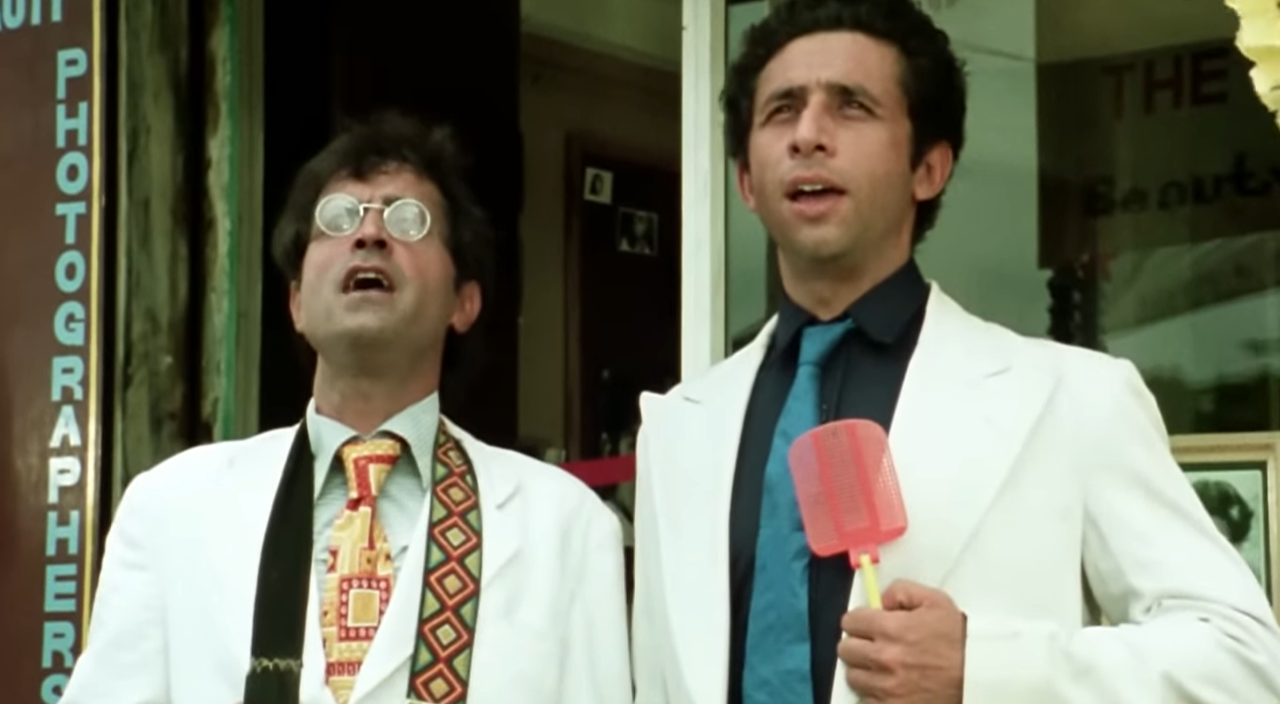
Jaane Bhi Do Yaaro (1983)
Sabu, son of a tapioca farmer, had made a great name for himself by landing a government job. He would wake up early, cycle to the Supreme Court, open its doors and then do the same for the Parliament. That was, officially, his entire contribution to democracy. Then he would attentively sit outside Parliament, making sure that only appointed members and no unappointed miscreants entered the premises. He always had these huge rings of keys hanging from his belt loops. Yes, rings. Sabu had once read ‘one must not keep all their eggs in the same basket’. A pretty standard proverb to anyone else, but to Sabu, it was constitutional wisdom. He was quick to realise that the proverb does not have to be exclusively about eggs. It applies to eggs and keys. He separated the duplicates into a separate ring, but the two rings traveled together. One must not keep all their eggs in one basket, but you can keep them in separate baskets and stack the two baskets together.
Sabu, a man holding the keys to fifty percent of the pillars of democracy, could not control himself at the sight of a kulfi cart. The kulfi vendor, knowing this, would ring his bell extra loudly around the parliament. A Pavlovian response from Kulfiwala’s Sabu. One late evening, a similar thing happened, and Sabu flew out of his chair. He lost his footing and took a hard fall. A ring of keys went flying and dived straight into the gutter. The local minister, a member of parliament himself, had promised the locals that he would cover all the manholes and gutters in the locality. Sabu got to it before he could. He picked himself up, dusted his clothes and stood bowing with his hands on his knees, trying to spot the keys in the gutter. The viscous black liquid had gulped the keys by then. At that moment, Sabu needed his emotional support kulfi. He bought one, but the kulfiwala did not leave because he knew Sabu by now. Sabu wolfed down the stick clean and bought another one. While he was gobbling up the second kulfi, he spotted a keymaker on the opposite side of the street. After locking the doors to the court and the parliament that night, Sabu went straight to the keymaker.
“Hi, I am CC. You hold the keys to your happiness. I make the duplicates,” said the keymaker.
“Hello. Can you please make a duplicate of these keys?”
“Can I? Can I?” CC said, offended.
Assuming the keymaker was hard of hearing, Sabu repeated the question, this time slowly.
“You have heard of the photocopy paradox, right? You keep making photocopies of a photocopy, and eventually all you have is black paper. Well, I solved that by creating a duplicate so good that you cannot tell it apart from the original.”
“Oh, you also do Xerox?”
Talking to Sabu felt like going to a slow, amateur dentist. You came out exhausted and wish you hadn’t opened your mouth in the first place. CC quickly realised that and dropped the self-aggrandizing talk.
“Yes. I can make a duplicate of those keys. Do you have an ID card?”
Sabu quickly produced his Parliament Employee Card.
“Not this one. I need a government ID card.”
“This is it. With this card, I can access the Parliament, the Supreme Court and the Government Storage rooms. Everything shy of the second-floor washroom. What else do you need?”
“Aadhaar card? Do you at least have it on your phone?”
“I don’t own a smartphone. Also, this is a hush-hush job. As the Primary Custodian of Critical National Access Points, I have strong instructions to always maintain a duplicate set of keys. I am also instructed to never duplicate the keys. Currently, I don’t have a duplicate pair, and I am duplicating the keys. So I am in violation of all the rules. So please make an exception.”
“I’m strictly instructed to only duplicate keys with a valid Government ID, for record purposes. And I take my records very seriously… I currently hold the state record for holding the most government ID photocopies. I did not get my name in the Guinness Book only because they couldn’t verify my address proof and also because I hate beer.”
“Fine. If it’s for your record, I will go get it. Till then, keep the duplicates ready.”
Sabu cycled home only to realise his house keys were in the same bunch that he had left at the keymaker’s shop. CC now had access to 50% of Indian democracy and 100% of Sabu’s pressure cookers. Sabu’s dog stared at him through the window and was really confused when he saw Sabu get off the cycle, feel his pocket, get back on the cycle and leave again. Is it tomorrow already?
Sabu reached CC’s shop, and he was sitting outside the shop with his head buried in his palms. If the eyebrow sweat dripping in his own eyes was not bad enough, Sabu was just told that his bunch of keys had been stolen.
“But how?” he asked.
“I went home to collect my dinner, and when I came back, everything in my shop was gone. Even my state-level record. You know what the worst part is? The robber did not have to break in forcefully; he had duplicates of my shop keys. I am the only one in the area who knows how to copy keys.”
“Forget about your record. Where did my keys go? You know how important they are. You could not have lost a more important bunch of keys.”
“Can you not kick me while I am down and not in the mood to get kicked? Just break the locks and change them.”
“Break the locks to the Parliament and the Supreme Court? Do you think those locks are breakable? We got them made in France by Swiss lockmakers. You need the keys, then a biometric, then a retina scan, and finally, you have to offer the lock high-fat milk every morning.”
“Oh, what are you going to do?”
“Me? No. We both have to find the keys before the Parliament session tomorrow morning. They also have a court hearing on the 20-year-old land dispute. We find the robber. I get the keys to the nation back, and you get your record back.”
“Win and a slightly larger win.”
“Not respectively, yes. One national crisis resolved, one personal tragedy avenged. Think about how we are going to find it.” Sabu loved outsourcing thinking. Once, during a long weekend, he went nearly thirty-six hours without thinking a single thought.
“Most people wait for 10 minutes while I copy the keys, but some drop them off. And if they don’t have an ID xerox on them, I ask them to WhatsApp me a photo of the ID, and I tie a paper with their name and address to the key. You understand where I am going with this?”
Sabu shook his head.
“We go to the police, give them a list of addresses from the IDs, and we ask them to man these locations secretly. The person will come to one of these locations to commit a robbery. That’s where we catch him.”
Sabu was impressed. They promptly went to the police station. A police officer was sitting at his desk eating his tiffin. Sabu and CC walked over to his desk, and the officer quickly closed the tiffin. CC handed the officer a paper listing the addresses. The officer thanked him, wiped the daal off his hands with the paper, crumpled it and threw it in the dustbin.
“Yes. How may I help you now?”
Sabu was baffled, but CC swiftly pulled out a second copy of the paper.
“Sir, I am a keymaker. There was a robbery at my shop. The key to the parliament and the supreme court is also stolen. This is a list of all the addresses where the robber might rob tonight. You need to catch him.”
“Firstly, don’t teach me my job. Secondly, how will we catch him?” the officer asked.
“I am just thinking out loud here..”
The officer interrupted, “No good idea ever follows the sentence ‘I am just thinking out loud.’ It is always followed by an idea that definitely should have been thought silently and internally. But now that you have begun, I have two ears.”
“You, along with your team, spread out and man each of these addresses. When the robber comes, you nab him, and we get all the keys from him.”
“Don’t teach me my job. Why should we do it?”
“It is your job.”
“Fair enough. Why is he here? Who is he?” the officer asked, pointing at Sabu.
“Hi. A fellow government employee here. I am the Primary Custodian of Critical National Access Points. Sabu. Sir, if we don’t get my keys, we won’t be able to open the parliament tomorrow. Neither does the Supreme Court.”
“Do not worry. We will find your keys. My boys and I, we are experts at an undercover job. You see that man in civilian clothes? Finest undercover officer I’ve ever worked with. We don’t know his name, rank, or department. Hey! Are you a police officer?”
“No,” the man replied.
“Excellent. Didn’t break character once.”
So, it was decided. The policemen and one strange man would go undercover. The team split up, and a pair went to each of their assigned locations. Sabu and CC were to accompany the commanding officer.
They reached their location. The officer, now dressed in civil-clothes as opposed to his otherwise ill-mannered khakis, went up to the house that had its key stolen and knocked. The homeowner opened the door.
“Sir, you are safe now,” said the officer.
The homeowner who had actually felt quite safe earlier was now quite scared. The policemen were unaware of how long the night would be. They waited and waited. No signs of the robber. Every once in a while, the officer would check in with the other pairs. No one had any luck. They sat there until dawn. At dawn, the officer picked up the walkie-talkie and said, “He did not strike today. Maybe he will come out tomorrow. Let’s get him then. Tomorrow, same time, same location.”
It was a slow ride back. Sabu sat tensely in the back seat. What will I say to the Prime Minister? And the sub-prime ministers? The vice-important people? And the Supreme judge? All these questions had engulfed him. The policemen dropped CC and him at the shop. Sabu wanted Earth to open up and eat him, or at least offer him a kulfi. The clock slowly but surely struck 9 a.m. The ministers started showing up at the Parliament. Soon enough, the opposition party leader was there. The Prime Minister arrived as well.
“Why is the gate locked? Where’s the Primary Custodian of Critical National Access Points?” asked a minister.
Sabu heard from across the street and said, “I am here.”
The Prime Minister crossed the road. The opposition leader raced him there. Gradually, all the ministers followed.
“What happened, Sabu?” the PM asked.
“I dropped the keys in the gutter, and the duplicate bunch was stolen yesterday. Sir, will I still have my job?”
“You had one job. Key holding.”
“I know, sir, but I slipped, and the keys went flying in the gutter.”
“Wait a minute. Weren’t you supposed to cover all the gutters?” the opposition leader asked one of the ministers.
“The covering ceremony was completed. We had specifically called the religious leaders of the “manhole covering” sect and performed the rituals. The covers themselves are in phase two,” the minister replied.
Shortly after, the Supreme Court judges arrived. They were informed by their friends in the ministry. The judges were followed by the lawyers and the feuding parties.
“What do we do now?” a Judge asked.
“We were out all night trying to find him. A huge team of police officers is involved. They will try to find him again tonight.”
The PM personally contacted the police officer and asked him to expedite the process, as democracy has come to a halt.
“Now we wait,” the PM said.
One of the two feuding parties got bored with waiting on the street. They pulled the second party aside.
“Okay. I just had the craziest idea. Why don’t we split the land 50–50?”
“Why did we not think of that sooner? Yes, absolutely.”
They shook hands and said to the judge, “Sir, we have reached a compromise. We will split the land equally. We are withdrawing the case.”
Many parties followed suit and withdrew their cases. People who had spent decades suing one another had quietly settled disputes on the pavement. The judges and the lawyers were baffled. For the first time in years, the number of backlog cases had reduced. Soon, the crowd reduced. With no more cases to settle for the day, the lawyers and the judges went home.
“Sir, what about all the bills that we had to pass today?” a minister asked the PM.
“Like we were going to let you,” the opposition minister replied.
With no means of changing the course of the nation, the ministers had lost the zeal in their faces. They had arrived at the parliament with well-ironed kurtas of their favourite colour and oil-combed hair. By now, the kurtas had crumpled up, and the afternoon heat and occasional wind had given them all new hairstyles.
By afternoon, the city had begun adjusting surprisingly well to the closure of Parliament. Television debates were shorter, traffic near the government district had eased, and for the first time in years, no one had stormed out of a session demanding an apology. By evening, several news anchors had regained their normal speaking voices, having spent an entire day without shouting over panelists or declaring the nation to be “at a historic crossroads” every few minutes. The opposition and ruling party leaders, unable to enter the building, had exhausted themselves arguing outside CC’s shop and were now sharing tea in silence. Shopkeepers reported better sales, office workers claimed their blood pressure had improved, and one newspaper cautiously published an editorial titled: ‘Have We Considered Losing The Keys More Often?’.
“Sir, do I still have my job?” Sabu asked. The ministers just smiled. They all sat in their cars and left soon after.
“Let’s go to the police station,” CC said when the streets were starting to get dark.
Tired of all the chaos and being unsure whether he had his job anymore, Sabu said he would retire home for the day.
“But you don’t have the keys,” CC said.
“I will break the back door down.”
Listening to this, CC had a look of epiphany on his face. He thought he had just had a great idea. For the first time, anticipating what someone might be thinking, Sabu replied, “No, the Parliament or the Supreme Court do not have back doors.”
Sabu returned home. His dog did not come to greet him. What’s even the point? He comes, and he leaves. What even is time? Sabu broke down the back door. He did not iron his clothes for the office the next day and went straight to bed. At the same time, CC and the policemen were staking out their assigned addresses. Everything about the night was similar to the previous night, minus the presence of Sabu. No suspicious person was seen, though several entirely normal-looking suspicious people were observed. The walkie-talkies came on once in a while, only to report that there were no signs of the robber. The night grew darker. On the opposite side of the city, Sabu slept peacefully. CC had provided the police with a list of all the addresses, but he forgot to include one. Somewhere in the city, someone now possessed enough access to overthrow a government or steal a pressure cooker. At 3 in the night, Sabu’s door opened to a familiar key.
메타데이터
- post_id
- b2fe85ebcc90
- slug
- locked-out-of-democracy-b2fe85ebcc90
- url
- https://medium.com/@omdeshmukh211/locked-out-of-democracy-b2fe85ebcc90
- canonical_url
- https://medium.com/@omdeshmukh211/locked-out-of-democracy-b2fe85ebcc90
- author_url
- https://medium.com/@omdeshmukh211
- status
- ok
- fetched_at
- 2026-06-09 15:37:30