Microsoft IQ: The Intelligence Layer Behind Modern Data Engineering
In today’s engineering landscape, intelligence is no longer just a human trait — it’s becoming a system capability.
Microsoft IQ: The Intelligence Layer Behind Modern Data Engineering
In today’s engineering landscape, intelligence is no longer just a human trait — it’s becoming a system capability.
Through my work on Defender data pipelines, Kusto (ADX), and Microsoft Fabric migrations, I’ve seen a consistent transformation:
We’re moving from systems that store and process data → to systems that understand, predict, and act on it.
This evolution is what I call Microsoft IQ.
What is Microsoft IQ?
Microsoft IQ is the intelligence fabric built across Microsoft’s ecosystem that combines data, AI, and context to enable smarter, faster decisions.
It is not a single product.
It emerges from how systems like:
- Azure Data Factory (ADF)
- Azure Data Explorer (ADX / Kusto)
- Microsoft Fabric
- Defender
- Copilot
…work together to create context-rich, real-time intelligence.
Why This Matters (From a Data Engineer’s Lens)
In traditional data engineering, our focus was:
- Build pipelines
- Move data reliably
- Create dashboards
But in practice — especially in large-scale systems like Defender — we encounter challenges such as:
- Pipeline failures happening silently
- Schema drift impacting downstream systems
- Delayed insights due to batch processing
- High manual effort in debugging incidents
The problem isn’t lack of data — it’s lack of intelligence around the data.
Microsoft IQ in Action: A Real Pipeline Scenario
Let’s ground this in a familiar situation.
Before (Traditional Workflow)
When managing pipelines:
- Pipeline fails → alert triggered
- Engineer investigates logs manually
- Root cause identified after time delay
- Fix applied and monitored manually
This approach is:
- Reactive
- Time-consuming
- Dependent on individual expertise
After (Microsoft IQ-Driven Workflow)
Now imagine the same flow with Microsoft IQ:
- Anomaly detected proactively in pipeline metrics
- System correlates:
- Upstream delays
- Schema changes
- Historical failure patterns
- Copilot suggests likely root cause
- Remediation steps are generated
- Incident is enriched with full context
Outcome:
- Faster triage
- Reduced MTTR
- Lower cognitive load
Architecture View: Microsoft IQ Layer
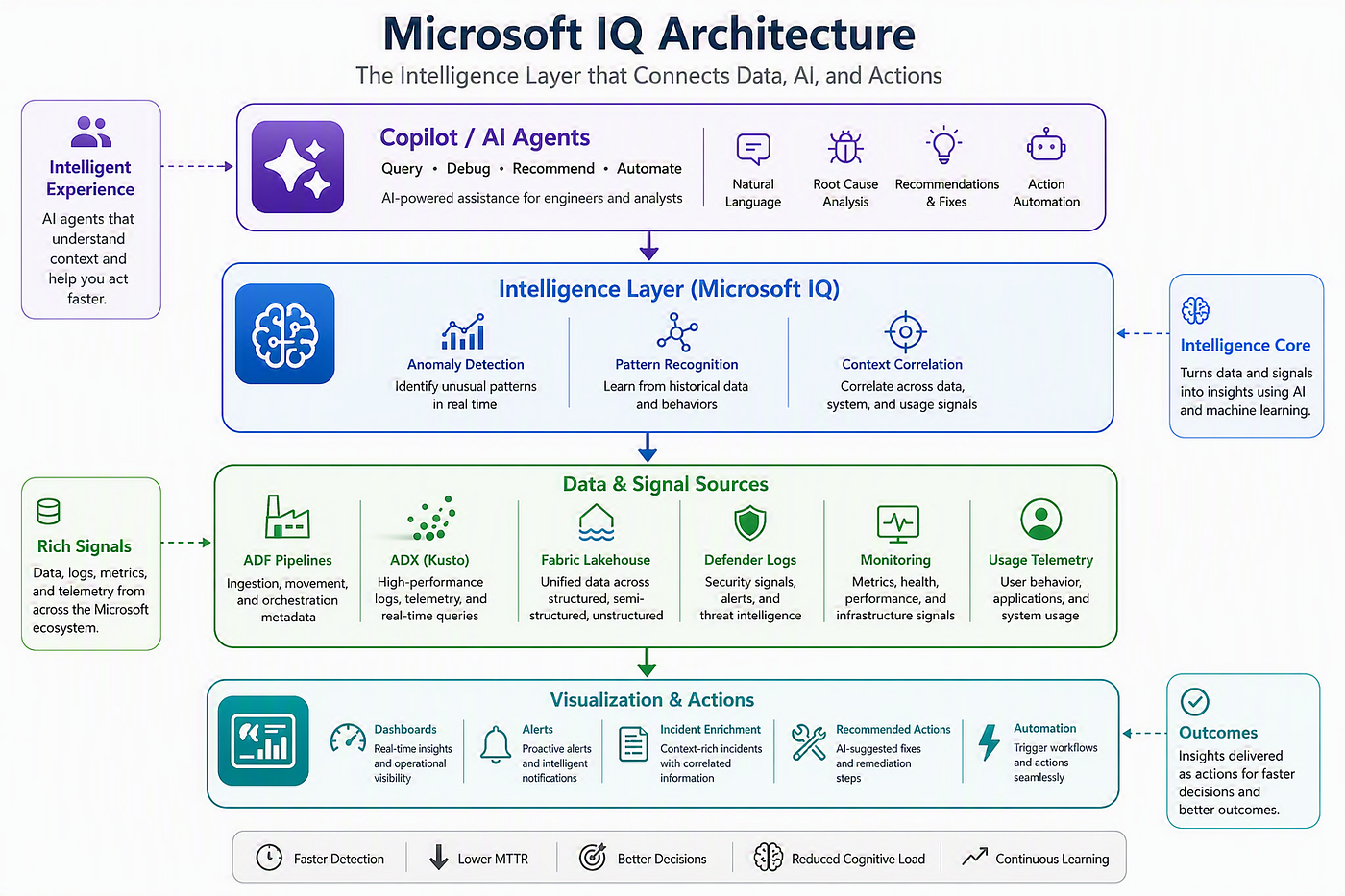
The 4 Pillars of Microsoft IQ (Applied)
1. Context-Aware Intelligence
Not just:
“Job failed”
But:
“Job failed due to upstream schema mismatch introduced 2 hours ago”
2. Integrated Ecosystem
Your data flow already reflects this:
- ADF → Data movement
- ADX → Real-time querying
- Fabric → Unified analytics
- Dashboards → Insights
Microsoft IQ connects all of these seamlessly.
3. AI-Augmented Engineering
With Copilot and AI tools:
- Generate Kusto queries
- Detect anomalies
- Suggest optimizations
Shift:
Engineer executes everything → Engineer orchestrates intelligence
4. Continuous Learning
Every incident improves the system:
- Better anomaly detection
- Smarter recommendations
- Fewer repeated failures
Microsoft IQ + Fabric: The Inflection Point
Your ongoing Fabric migration efforts highlight where Microsoft IQ becomes truly powerful.
Fabric enables:
- Unified data and analytics
- Real-time signal integration
- Built-in intelligence across workloads
This reduces:
- Tool fragmentation
- Duplicate logic
- Delayed insights
And enables:
- Stronger correlation across systems
- Faster decision-making
Final Thoughts
Microsoft IQ is not something you “turn on.”
It’s something you design into your systems:
- Through better observability
- Through integrated platforms
- Through AI-assisted workflows
From my experience working across Defender pipelines and Fabric adoption:
The biggest gains are not just in scale or performance — they are in clarity, speed of decision-making, and reduced operational friction.
As engineers, we’re no longer just building pipelines. We’re building systems that observe, learn, and guide decisions.
That is the true power of Microsoft IQ.
About the Author
Mahesh Kuhile is a technology enthusiast with a strong interest in cybersecurity, artificial intelligence, and emerging technologies. Passionate about simplifying complex technical topics, he enjoys writing beginner-friendly content that helps readers understand modern cybersecurity trends, AI innovations, and the future of digital security. Through his articles, he aims to make advanced technology concepts more accessible, practical, and engaging for students, professionals, and tech enthusiasts.
메타데이터
- post_id
- b30a69aa8a4e
- slug
- microsoft-iq-the-intelligence-layer-behind-modern-data-engineering-b30a69aa8a4e
- url
- https://medium.com/@mahesh.kuhile/microsoft-iq-the-intelligence-layer-behind-modern-data-engineering-b30a69aa8a4e
- canonical_url
- https://medium.com/@mahesh.kuhile/microsoft-iq-the-intelligence-layer-behind-modern-data-engineering-b30a69aa8a4e
- author_url
- https://medium.com/@mahesh.kuhile
- status
- ok
- fetched_at
- 2026-06-17 08:20:12