Why Accurate State of Charge (SOC) Matters More Than Battery Capacity
When homeowners compare energy storage systems, capacity often dominates the conversation. A 10 kWh battery is assumed to be better than a…
Why Accurate State of Charge (SOC) Matters More Than Battery Capacity
When homeowners compare energy storage systems, capacity often dominates the conversation. A 10 kWh battery is assumed to be better than a 7 kWh one. But in daily operation, capacity alone does not determine how much energy is actually usable.
What truly defines real-world performance is how accurately the system understands its own State of Charge (SOC).
SOC represents the battery’s estimate of remaining usable energy. When that estimate is inaccurate, the system either shuts down earlier than expected or operates conservatively, leaving capacity unused. In both cases, the battery delivers less value than its specification suggests.
Capacity Is Theoretical, SOC Is Practical
Battery capacity is measured under controlled laboratory conditions. SOC accuracy, by contrast, is tested in daily life — under fluctuating loads, varying temperatures, and irregular charge cycles.
Two batteries with the same rated capacity can behave very differently depending on how precisely their SOC is calculated. A poorly estimated SOC forces safety buffers to be larger than necessary, reducing usable depth of discharge and backup duration.
In short: Capacity defines what is possible. SOC defines what is reliable.
Why SOC Estimation Is Technically Difficult
SOC cannot be measured directly. Unlike voltage or current, it must be inferred.
Basic systems rely heavily on voltage-based estimation. This approach works reasonably well at rest, but becomes unreliable under load or as the battery ages. Voltage curves flatten, temperature effects distort readings, and small errors accumulate over time.
More advanced systems combine coulomb counting with voltage curve modeling. By tracking energy flow in and out of the battery while periodically correcting estimates against known reference points, SOC accuracy improves significantly.
This is where modern Battery Management Systems (BMS) begin to differentiate themselves.
The Hidden Cost of Inaccurate SOC
Inaccurate SOC affects more than just user confidence.
It leads to:
- Unexpected shutdowns during backup operation
- Conservative charge limits that reduce usable energy
- Inconsistent inverter behavior
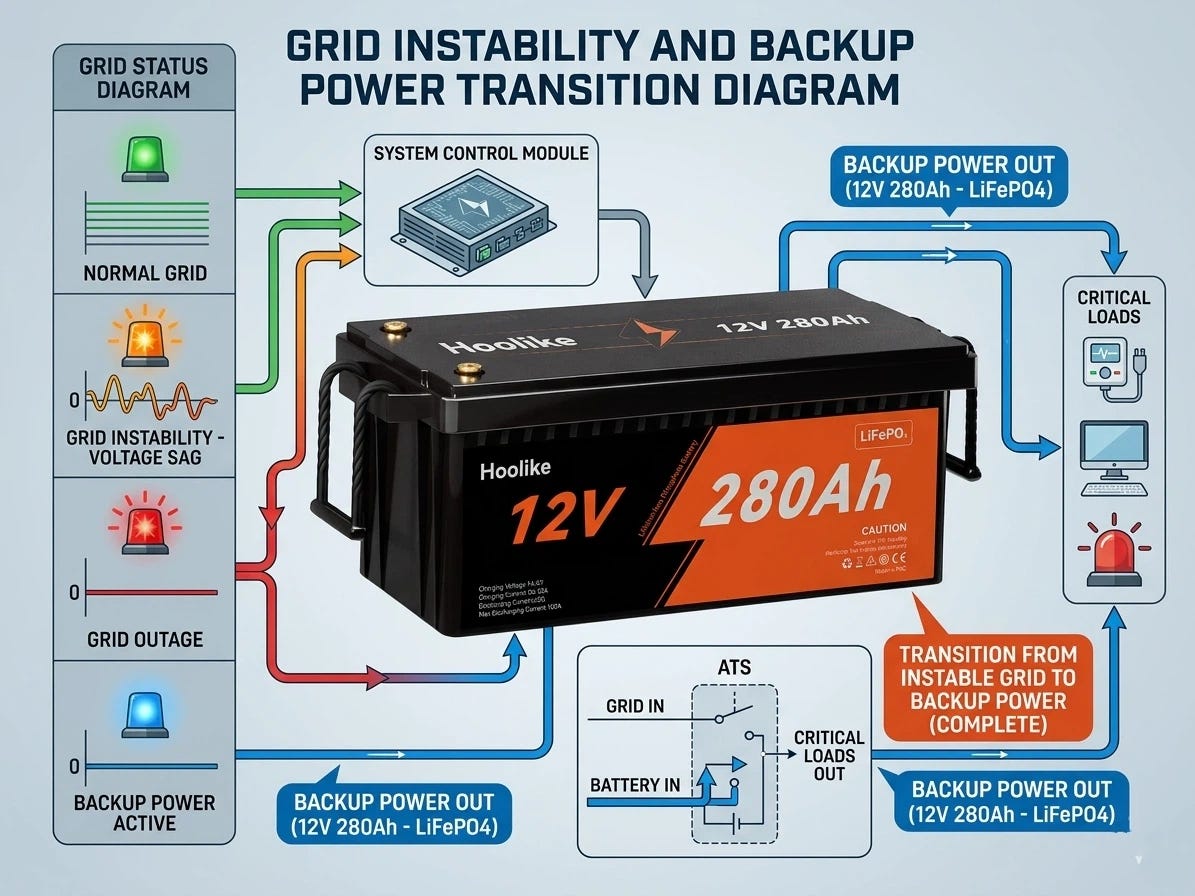
- Reduced trust in system autonomy during outages
Over time, users may compensate manually — by oversizing systems or avoiding deep discharge altogether — both of which increase cost without improving efficiency.
SOC Accuracy and Long-Term Planning
Accurate SOC estimation also plays a role in long-term battery management. Reliable SOC data supports:
- Consistent cycle depth control
- More predictable aging behavior
- Better alignment between battery and inverter logic
As energy systems become more data-driven, SOC accuracy shifts from a convenience feature to a foundational requirement.
This is especially relevant as European regulations move toward greater transparency and lifecycle documentation for residential batteries.
Why SOC Is Closely Linked To Smart BMS Design
SOC accuracy does not exist in isolation. It depends on:
- Cell-level voltage monitoring
- Temperature awareness
- Historical data logging
- Integration with inverter control logic
Systems designed around smart BMS architectures treat SOC as a continuously refined estimate, not a static number.
For readers interested in how these elements work together in modern residential storage systems, this in-depth guide on smart BMS and real-time monitoring provides a comprehensive technical breakdown.👉
A Practical Takeaway
When evaluating home energy storage, asking “How accurate is the SOC?” is often more revealing than asking “How big is the battery?”
In real operation, confidence comes from predictability. And predictability starts with a system that understands its own state — clearly, continuously, and accurately.
Modern LiFePO₄ systems built around smart BMS platforms, such as those designed by **Hoolike**, increasingly reflect this shift toward data-driven reliability rather than headline specifications alone.
메타데이터
- post_id
- b31d09ed284d
- slug
- why-accurate-state-of-charge-soc-matters-more-than-battery-capacity-b31d09ed284d
- url
- https://medium.com/@berryli6768/why-accurate-state-of-charge-soc-matters-more-than-battery-capacity-b31d09ed284d
- canonical_url
- https://medium.com/@berryli6768/why-accurate-state-of-charge-soc-matters-more-than-battery-capacity-b31d09ed284d
- author_url
- https://medium.com/@berryli6768
- status
- ok
- fetched_at
- 2026-06-12 07:40:50