Why Digital Identity Verification Keeps Failing Across Borders — A Global Weak Point Behind eKYC
A structural analysis of how regulatory gaps, simplified digital onboarding, and static trust assumptions create systemic financial risk.
Why Digital Identity Verification Keeps Failing Across Borders — A Global Weak Point Behind eKYC
How regulatory fragmentation, digital onboarding, and static trust assumptions are turning identity verification into a global attack surface
We are told that digital identity is becoming more standardized globally, but the reality is quite the opposite. Ironically, the more each nation tightens its unique eKYC regulations, the wider the ‘cracks’ become for cross-border fraud and identity theft to slip through.
Why is it that even with the most advanced AI technology, we still cannot break through this ‘border wall’? The answer lies in a fundamental flaw in our approach: we have been treating identity as nothing more than static data.
This article reflects the regulatory landscape as of February 2026, based on publicly available international standards, legal frameworks, and supervisory reports.
AML/CFT regulations and FATF evaluations continue to evolve. Readers are encouraged to consult official sources for the most current information.
References to “grey-listed” or monitored jurisdictions are used solely to illustrate structural differences in regulatory implementation, not to assign permanent labels to specific nations.
1. The Forensic Starting Point: VCAM Suspicion
In a recent forensic analysis, inconsistencies were observed between virtual camera (VCAM) behavior and video input streams.
(Detailed technical analysis is provided in a separate article.) The implication was simple:
“Live video” in eKYC does not necessarily guarantee liveness.
However, this article is not primarily about VCAM as a technical exploit. The deeper question is:
Under what regulatory environments does such spoofing transform from a technical anomaly into a structural risk?
2. The International Framework: FATF and Digital Identity
No discussion of eKYC can avoid the standards established by the Financial Action Task Force (FATF).
2.1 FATF Recommendations (Updated October 2025)
The FATF publishes the FATF Recommendations as the global standard for anti-money laundering (AML) and counter-terrorist financing (CFT).
Particularly relevant are:
- Recommendation 10: Customer Due Diligence (CDD)
- Ongoing monitoring obligations
- The Risk-Based Approach (RBA)
Jurisdictions are expected to implement these recommendations into domestic law. However, FATF issues recommendations — not uniform enforcement mechanisms. Implementation varies.
2.2 Guidance on Digital Identity (2020)
In March 2020, FATF released Guidance on Digital Identity, addressing:
- Digital identity risk assessment
- Identity proofing risk
- Authentication risk
- Governance reliability
Importantly, FATF explicitly recognizes:
Digital identity systems can be abused if poorly designed or improperly operated.
3. Structural Financial Crime Patterns Reported by International Agencies
Reports from:
- United Nations Office on Drugs and Crime (UNODC)
- Europol
describe:
- Fraud networks operating from Southeast Asia
- Relay usage of digital accounts
- Distributed cross-border fund movement
A typical flow:
High-regulation country (victim)
↓
Low-friction digital account (online onboarding)
↓
Multi-jurisdictional fund dispersion
↓
Final beneficiary
Crucially:
Onboarding succeeds.

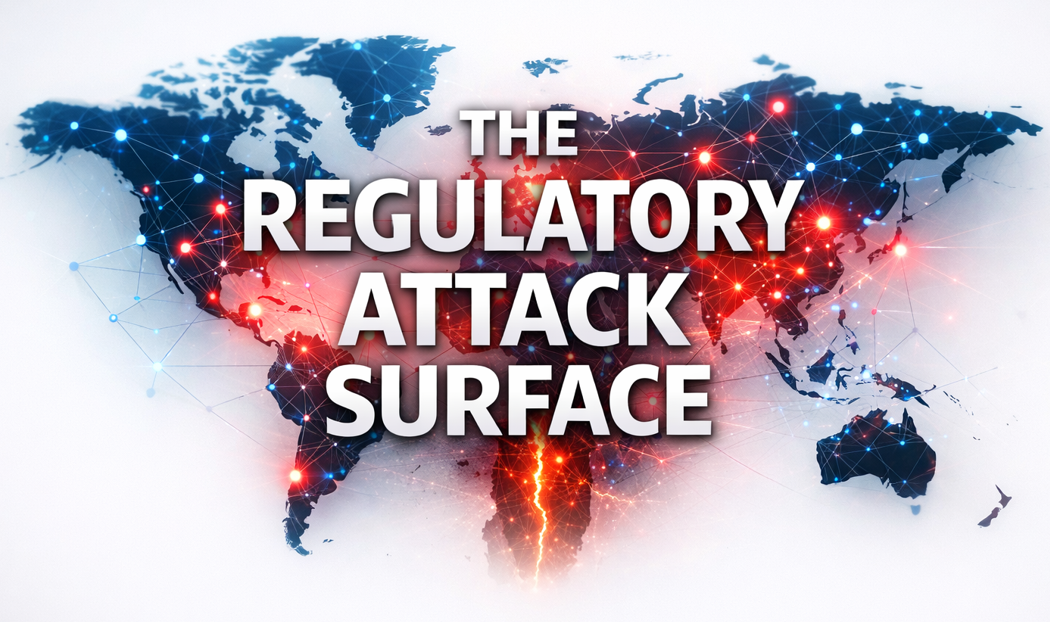
Figure 1. Conceptual model of a Regulatory Attack Surface: funds originating in high-regulation jurisdictions flow into low-friction digital accounts, where simplified eKYC and weak monitoring create structural exposure before reaching the final beneficiary. AI-generated conceptual illustration for analytical purposes.
4. Regulatory Attack Surface (Conceptual Model)
The vulnerability here is not purely technical.
It is structural:
High-regulation jurisdiction
- Strong FATF implementation
- Ongoing monitoring obligations

  ↓ Victim funds

Low-friction digital account
- Simplified eKYC
- Weak monitoring

  ↓ Relay

Final beneficiary / recovery jurisdiction
VCAM or fake video acts merely as the entry point.
The deeper problem lies in:
- Regulatory asymmetry
- Static trust anchoring
- Absence of continuous evaluation
This is the Regulatory Attack Surface.
5. The Core Problem
eKYC is an event.
Yet many architectures convert:
Strong authentication → Long-term trustIn reality:
- Authentication is momentary
- Devices change
- Intent changes
- Funds cross borders
- Regulation remains jurisdiction-bound
Here lies the:
Authorization Gap
6. Conclusion
VCAM suspicion is not just a technical anomaly.
When connected to:
- FATF-identified digital ID risks
- Implementation divergence across countries
- Transnational financial crime structures
it becomes part of a broader:
Regulatory Attack Surface
eKYC is not necessarily “broken.” The problem arises when eKYC is treated as the final trust anchor. Static trust assumptions generate attack surfaces.
7. [Appendix] Regulatory Divergence Across Jurisdictions
While FATF standards are global, implementation is not uniform.
7.1 🇯🇵 Japan
7.1.1 AML Framework and Supervisory Effectiveness
Japan imposes Customer Due Diligence obligations under the Act on Prevention of Transfer of Criminal Proceeds. Remote identity verification (online eKYC) has been institutionalized, expanding digital onboarding. The Financial Services Agency (FSA) emphasizes a risk-based approach in its AML/CFT guidelines. However, during the FATF Fourth Mutual Evaluation, Japan was advised to strengthen:
- Supervisory effectiveness
- Ongoing monitoring sophistication
- Risk assessment refinement
Japan is therefore a jurisdiction implementing international standards while continuously being evaluated for effectiveness.
7.1.2 JPKI: Reducing the Attack Surface Through a Physical Anchor
Japan’s most powerful countermeasure against video-spoofing attacks such as VCAM is the Public Key Infrastructure (JPKI) embedded in the My Number Card. The fundamental difference between video-based eKYC and JPKI lies in the trust anchor:
Video-based eKYC
- Verifies face and ID documents through a camera
- Relies on a vulnerable intermediary layer: the video stream
- Exposes a Regulatory Attack Surface to VCAM and deepfake interference
JPKI (Public Personal Authentication Service)
- Reads cryptographic certificates stored in an IC chip
- Anchored in physical possession and digital signatures
- Does not rely on video streams
By adopting JPKI, a key portion of the Regulatory Attack Surface — the video manipulation layer — is dramatically reduced.
However:
- Not all devices support IC chip reading
- Operational costs remain higher
- Market demand for frictionless video-based eKYC persists
This sustains regulatory asymmetry.
7.2 🇪🇺 European Union
Under eIDAS and AML Directives:
- Legal recognition of electronic identification
- Ongoing customer due diligence
- Ultimate Beneficial Owner (UBO) verification
are institutionalized. However, enforcement intensity varies across member states.
7.3 🇬🇧 United Kingdom
Under FCA supervision, digital onboarding is permitted. The National Crime Agency has repeatedly warned about:
- Rising money mule accounts
- Abuse of online-opened bank accounts
Strict regulation alone does not eliminate abuse if ongoing monitoring is insufficient.
7.4 🇮🇳 India
India’s Aadhaar-based eKYC infrastructure is widely deployed. Yet reported abuses include OTP-sharing fraud. This highlights a core principle:
Successful authentication ≠ guaranteed control by the legitimate subject.
7.5 🌏 FATF Grey-Listed and Monitored Jurisdictions
FATF periodically identifies jurisdictions under increased monitoring.
Evaluations consider:
- CDD effectiveness
- Supervisory robustness
- Strength of ongoing monitoring
The premise is clear:
Regulatory effectiveness differs across jurisdictions.
7.6 Timeline of Regulatory Responses (Overview)
Below is a high-level overview of key regulatory developments related to eKYC and AML/CFT frameworks. The purpose is not to provide an exhaustive legal history, but to illustrate how regulatory responses have evolved over time — and not always synchronously across jurisdictions.
🇯🇵 Japan
- 2018: Amendment to the Act on Prevention of Transfer of Criminal Proceeds, reorganizing non-face-to-face identity verification methods and formalizing online identity verification (so-called “Ho-method” categories).
- 2021: Publication of the results of Japan’s 4th FATF Mutual Evaluation.
- From 2022 onward: Progressive strengthening of risk-based supervision and effectiveness measures by the Financial Services Agency (FSA).
Japan’s AML/CFT regime has therefore evolved in stages, responding both to technological adoption and international evaluation outcomes.
🇪🇺 European Union
- 2014: Adoption of the eIDAS Regulation, establishing a legal framework for electronic identification and trust services.
- 2018: Entry into force of the 5th Anti-Money Laundering Directive (AMLD5).
- From 2023 onward: Advancement of the EU AML package and strengthened supervisory coordination at the Union level.
While the EU provides a harmonized framework, enforcement intensity and supervisory capacity vary among member states.
🇬🇧 United Kingdom
- 2017: Amendment of the Money Laundering Regulations.
- 2020s: Expansion of digital onboarding practices alongside intensified efforts to address money mule activity and online-enabled financial crime.
The UK demonstrates how digital identity adoption and fraud mitigation measures often develop in parallel.
🇮🇳 India
- 2010s: Rapid expansion of Aadhaar-based eKYC infrastructure.
- 2020s: Ongoing regulatory and supervisory adjustments concerning digital identity verification and OTP-based authentication mechanisms.
India represents a large-scale implementation model where convenience, inclusion, and risk management must be continuously balanced.
🌏 FATF (Global Standard-Setter)
- 2012: Adoption of the current FATF Recommendations framework.
- 2020: Publication of Guidance on Digital Identity.
- 2025: Latest amendments to the FATF Recommendations.
FATF’s evolving guidance reflects the increasing importance of digital identity technologies within AML/CFT risk frameworks.
About the Author

Consultation & Project Inquiries:
Ryu360 is a System Architect and Digital Forensics Specialist pioneering the field of Adversarial Architecture Review.
He specializes in uncovering structural vulnerabilities within “formally correct” systems — specifically the Authorization Gap in digital identity, biometrics, and eKYC frameworks. Through forensic log analysis, he identifies “unnatural silences” where system design inadvertently assists in its own sabotage, enabling attackers to bypass high-assurance security through semantic manipulation.
Ryu360 advises organizations on transitioning from simple identity verification to high-assurance Intent Lock models to neutralize AI-driven logic mapping attacks.
Expertise & Services:
- Adversarial Architecture Audits: Identifying hidden design risks in mobile and financial ecosystems.
- Forensic Investigation: Deep-dive analysis of security anomalies and “structural destruction” traces.
- Strategic Security Design: Blueprints for Intent-based Authorization and Signed Camera Feeds.
References (Accessed February 2026)
International Standards
- Financial Action Task Force (FATF) FATF Recommendations (Updated October 2025) https://www.fatf-gafi.org/en/publications/Fatfrecommendations/Fatf-recommendations.html
- Financial Action Task Force (FATF) Guidance on Digital Identity (March 2020) https://www.fatf-gafi.org/content/dam/fatf-gafi/guidance/Guidance-on-Digital-Identity.pdf
- United Nations Office on Drugs and Crime (UNODC) Reports on Transnational Organized Crime https://www.unodc.org/unodc/en/organized-crime/index.html
- Europol Internet Organised Crime Threat Assessment (IOCTA) https://www.europol.europa.eu/publications-events/main-reports/internet-organised-crime-threat-assessment-iocta
Europe and the United Kingdom
- European Union Regulation (EU) No 910/2014 (eIDAS Regulation) https://eur-lex.europa.eu/legal-content/EN/TXT/?uri=CELEX:32014R0910
- European Commission Anti-Money Laundering Directives (AMLD Framework) https://finance.ec.europa.eu/financial-crime/anti-money-laundering-and-countering-financing-terrorism_en
- National Crime Agency (UK) Money Mule Threats https://www.nationalcrimeagency.gov.uk/what-we-do/crime-threats/fraud-and-economic-crime/money-mules
🇯🇵 Japan: Legal Framework and Supervisory Authorities
- Act on Prevention of Transfer of Criminal Proceeds (Japan) https://elaws.e-gov.go.jp/document?lawid=419AC0000000022
- Financial Services Agency (Japan) Guidelines for Anti-Money Laundering and Countering the Financing of Terrorism https://www.fsa.go.jp/common/law/amlcft/
- National Police Agency (Japan) National Risk Assessment on Money Laundering and Terrorist Financing https://www.npa.go.jp/sosikihanzai/jafic/nenzihokoku/risk/
- Digital Agency (Japan) Public Personal Authentication Service (JPKI) Materials https://www.digital.go.jp/policies/mynumber/
- National Institute of Standards and Technology (NIST) Digital Identity Guidelines (SP 800–63 Series) https://pages.nist.gov/800-63-3/
Your Business — On AutoPilot with DDImedia AI Assistant (Join Our Waitlist)
Visit us at *DataDrivenInvestor.com*
Join our creator ecosystem *here*.
DDI Official Telegram Channel: https://t.me/+tafUp6ecEys4YjQ1
Follow us on *LinkedIn, [Twitter](https://twitter.com/@DDInvestorHQ), [YouTube](https://www.youtube.com/c/datadriveninvestor), and [Facebook](https://www.facebook.com/datadriveninvestor)*.
메타데이터
- post_id
- b32e5065b0ca
- slug
- where-is-ekyc-being-broken-the-regulatory-attack-surface-behind-digital-identity-b32e5065b0ca
- url
- https://medium.datadriveninvestor.com/where-is-ekyc-being-broken-the-regulatory-attack-surface-behind-digital-identity-b32e5065b0ca
- canonical_url
- https://medium.datadriveninvestor.com/where-is-ekyc-being-broken-the-regulatory-attack-surface-behind-digital-identity-b32e5065b0ca
- author_url
- https://medium.com/@ryu360i
- status
- ok
- fetched_at
- 2026-06-24 11:06:28