Revisiting BioShock as an Adult
I wouldn’t really call myself a gamer. Compared to my friends, I barely play. My range is somewhere between Pokémon and Zelda: Breath of…
Revisiting BioShock as an Adult
I wouldn’t really call myself a gamer.
Compared to most of my friends, I barely play anything. My range is somewhere between Pokémon, Zelda: Breath of the Wild, and the occasional Assassin’s Creed whenever I want to feel smarter than I actually am.
But BioShock was different.
I first played it when I was still in middle school, long before I understood terms like objectivism, transhumanism, or even philosophy itself. At the time, I just thought it was a cool underwater dystopian game.
Years later, I realized that was probably the least interesting thing about it.
What stayed with me was never really the gameplay. It was the atmosphere, the ideas, and the feeling that the game was trying to say something much bigger beneath all the violence and horror.
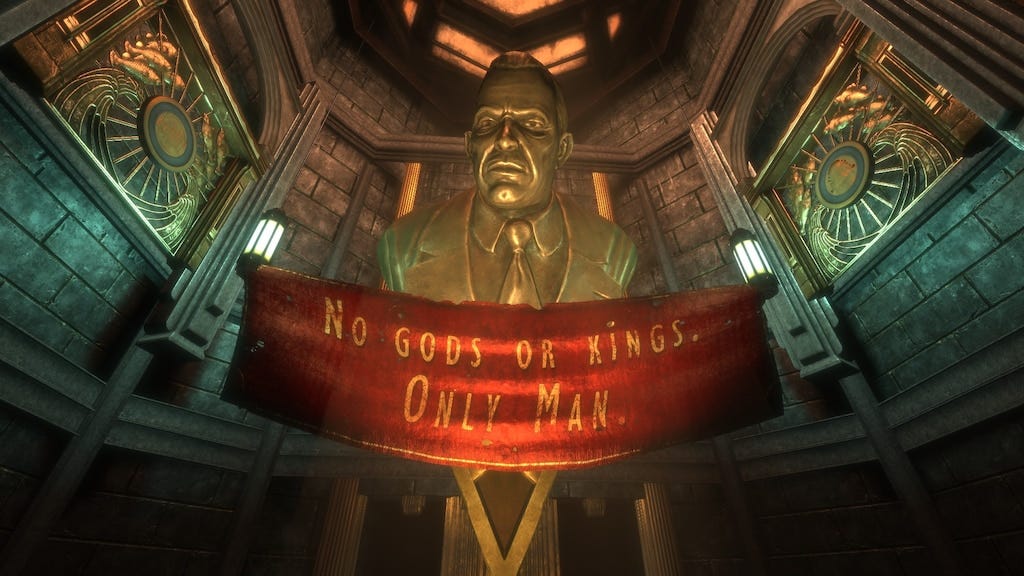
I still remember the descent into Rapture for the first time: the ocean outside the glass, the art deco architecture, Andrew Ryan’s giant statue, and the line:
“No gods or kings. Only man.”
Even as a kid, that moment felt strangely important.
At the time, I couldn’t fully explain why. But looking back now, I think BioShock was the first time I realized games could function like literature or philosophy — not just entertainment, but reflections of human ideas taken to their extreme conclusions.
And honestly, for someone who already loved books like 1984 and Brave New World, Rapture felt immediately familiar.

Rapture and the Fantasy of Perfection
Every utopia begins with belief.
Rapture was Andrew Ryan’s belief that humanity could perfect itself through freedom, ambition, and intellect alone. No governments. No religion. No moral interference. Just human achievement operating without restraint.
At first, the idea sounds almost admirable.
Ryan asks:
“Is a man not entitled to the sweat of his brow?”
And honestly, when I first played the game, part of me agreed with him. The game intentionally makes his philosophy sound appealing before slowly exposing its contradictions.
That’s what makes BioShock interesting to me even now. It doesn’t present evil as something cartoonish. Rapture collapses because human beings remain human no matter how idealistic the system becomes.

The scientists become obsessed. The artists become vain. The citizens become addicted. Freedom slowly turns into indulgence.
What Ryan forgets is that intelligence alone does not erase ego, greed, jealousy, or loneliness.
The city itself reflects that perfectly. Rapture is beautiful, but in a fragile way. Even while walking through its golden halls, everything already feels like it’s quietly falling apart.
And maybe that is why the setting stayed with me for so many years. Rapture is not frightening because it feels unrealistic. It is frightening because parts of it feel recognizable.
Becoming More Than Human
One of BioShock’s central ideas is transhumanism: the belief that technology and science can improve humanity beyond its natural limits.
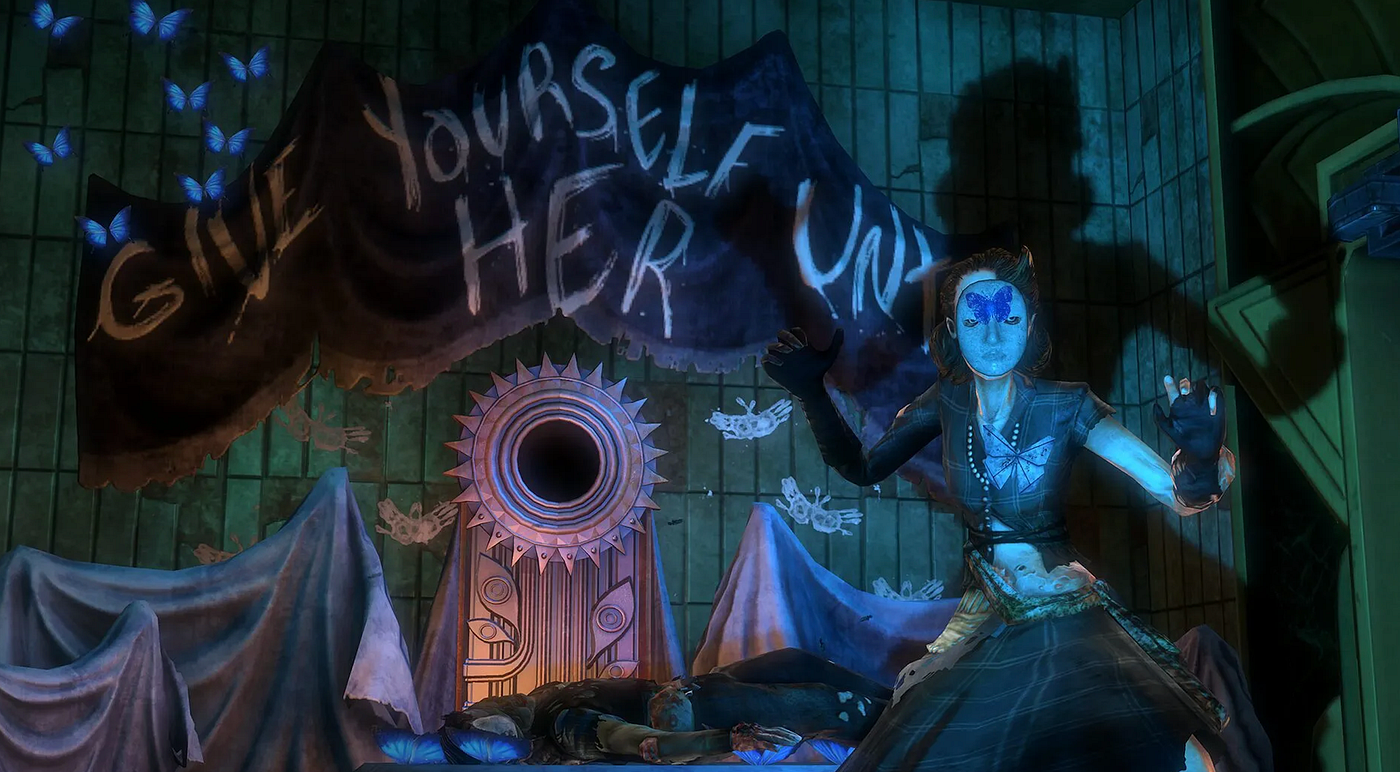
In Rapture, that dream takes the form of ADAM, a substance that allows people to genetically modify themselves. Stronger bodies. Greater intelligence. Extraordinary abilities.
At first, it sounds empowering.
Then it becomes horrifying.
The people of Rapture slowly destroy themselves chasing perfection. The Splicers, the game’s enemies, are tragic because they were once ordinary people trying to become something “better.”
BioShock never really argues against progress itself. It questions the belief that human beings can solve their own flaws purely through power, technology, or ambition while ignoring emotional and moral consequences entirely.
Underneath all the science fiction elements, the game keeps returning to the same uncomfortable idea: human beings are not nearly as rational as we like to imagine.

“Would You Kindly?”
The moment that completely changed the way I viewed the game happens much later.
Throughout BioShock, a man named Atlas guides you through Rapture over the radio. He sounds trustworthy, helpful, almost comforting in a city full of madness. Naturally, you follow his instructions without questioning them too much.
Then the game reveals the truth: you were psychologically conditioned to obey him whenever he says the phrase:
“Would you kindly?”
Suddenly, every decision you thought you made freely turns out to have been manipulation.
That twist stayed with me for years.
It was clever, and it quietly transforms BioShock from a story about politics and ideology into something much more personal: a story about control.
The game starts asking uncomfortable questions: How much of our behavior is actually chosen? How often do people obey systems, authority, or expectations simply because they are conditioned to? How easily can control disguise itself as kindness?
That realization changes the meaning of the entire game.
Andrew Ryan famously says:
“A man chooses. A slave obeys.”
But BioShock complicates that statement immediately. Most people believe they are choosing freely, even while being shaped by systems, environments, fears, desires, and voices they barely notice.
Why I Still Think About It
What makes BioShock memorable to me is not that it has philosophy in it. Plenty of stories do. It’s the way the game uses philosophy to explore ordinary human weaknesses: pride, ambition, obedience, ego, fear, and the desire to become something greater than we are.
And despite all its horror, there is something strangely sad about Rapture.
The city failed because it tried to erase contradiction from human nature. It wanted brilliance without empathy, freedom without responsibility, ambition without limits. Eventually, the system collapsed under the weight of its own certainty.
Years later, I still think about BioShock sometimes when I look at the world around me. Not because I believe society is literally becoming Rapture, but because the game understood something timeless about people: human beings are very good at convincing themselves they are in control. Even when they are not.
Maybe that is why the game still stays with me after all these years. Because underneath the politics, the science fiction, and the horror, BioShock was always asking a very human question:
How much of our lives are genuinely chosen, and how much are we simply taught to obey?
But Rapture was only the beginning.
Because years later, another city appeared. This time it is not beneath the ocean, but it is floating above the clouds. A place called Columbia, where faith replaced science, and patriotism replaced reason. If Rapture was about man trying to become god, BioShock Infinite is about god pretending to be man.
But that, I think, is a story for another day.
메타데이터
- post_id
- b335fea7c5ad
- slug
- would-you-kindly-philosophize-why-bioshock-still-haunts-me-b335fea7c5ad
- url
- https://medium.com/@seriesofcasualthoughts/would-you-kindly-philosophize-why-bioshock-still-haunts-me-b335fea7c5ad
- canonical_url
- https://medium.com/@seriesofcasualthoughts/would-you-kindly-philosophize-why-bioshock-still-haunts-me-b335fea7c5ad
- author_url
- https://medium.com/@seriesofcasualthoughts
- status
- ok
- fetched_at
- 2026-08-08 16:37:30