Why Most Skaters Tie Their Skates Wrong (and How It Affects Your Ankles)
Figure skating is full of technical details that seem small but quietly control everything. Blade sharpening, boot stiffness, warm-up…
Why Most Skaters Tie Their Skates Wrong (and How It Affects Your Ankles)
Figure skating is full of technical details that seem small but quietly control everything. Blade sharpening, boot stiffness, warm-up routines. One of the most overlooked details is also one of the most damaging: how skaters tie their skates.
Most skaters learn one lacing method early in their skating life and never question it. Pull the laces as tight as possible, lock the ankle, crank the hooks, wrap the top, step on the ice. It feels secure, controlled, and “correct.” But in reality, this habit creates restricted ankle movement, weaker edges, poor knee bend, heavier jumps, unstable spins, and long-term joint stress.
How you lace your skates directly affects ankle mobility, balance, power transfer, injury risk, and overall skating quality.
The Tight-Skate Myth in Figure Skating
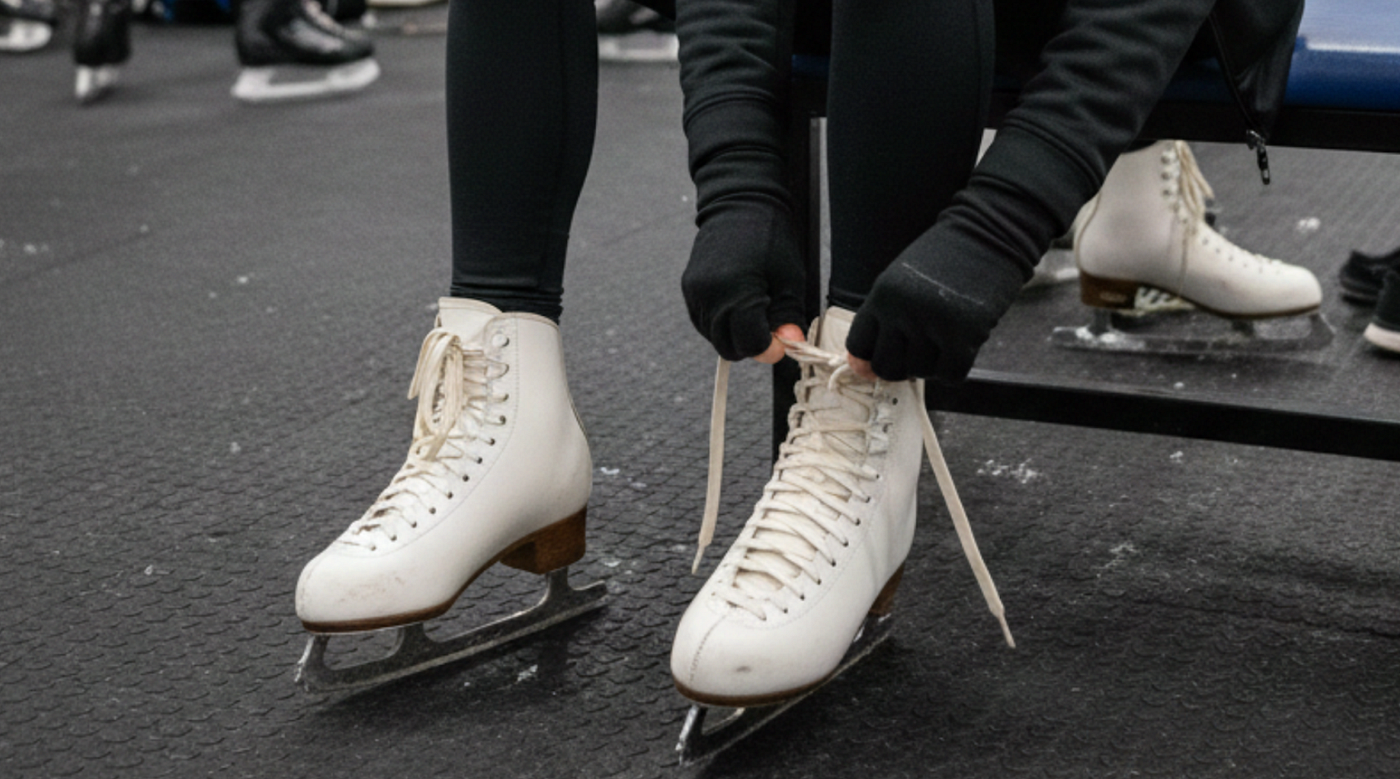
One of the most common myths in figure skating is that tighter skates equal better support. Skaters often believe that if their ankles feel locked, they are protected and stable. In practice, overtightening causes the opposite effect.
When skates are tied too tightly, ankle flexion is blocked, knee bend becomes limited, edges engage late, landings become stiff, power generation drops, and balance corrections slow down. Instead of supporting movement, the boot starts to fight it.
Ankles are not designed to be immobilized. In skating, stability comes from controlled motion, not rigidity.
What Ankles Are Designed to Do on the Ice
The ankle is one of the most important joints in figure skating. It functions as a shock absorber, balance regulator, and communication point between the blade and the ice. For efficient skating, ankles must allow forward flexion for proper knee bend, subtle side-to-side movement for clean edge control, constant micro-adjustments for balance, smooth absorption on landings, and fast responsiveness during take-offs, turns, and transitions.
When laces are pulled tight across every part of the boot, these functions are restricted. The ankle loses sensitivity and mobility, forcing other joints to compensate.
This is why skaters with overly tight skates often feel “stuck” on their edges or unstable during simple skills.
Common Skate Lacing Mistakes That Harm Ankles
Most skaters make the same lacing errors without realizing it: crushing the toes and midfoot until circulation is reduced, locking the ankle bend completely, pulling aggressively at the hooks for extra “support,” and tightening the top to create a rigid shell around the leg.
These habits lead to stiff ankles, delayed knee bend, shallow edges, loud landings, inconsistent spins, chronic calf tension, lace bite, numb toes, and frequent discomfort. Over time, they also increase the risk of tendon irritation and overuse injuries.
Once ankle movement is restricted, the body compensates automatically. Knees absorb more stress, hips overwork to create power, arches collapse to find balance, and overall efficiency drops. Many skaters blame weak ankles or bad boots, when the real issue is excessive lace tension.
How Incorrect Lacing Affects Jumps and Spins
Jump technique is highly dependent on ankle mobility. Take-offs require ankle compression, coordinated knee bend, and elastic rebound. When skates are tied too tightly, take-off timing becomes delayed, vertical push is reduced, rotation setup feels slower, and landings become heavy and harsh.
Spins are just as sensitive. Clean spins rely on subtle ankle control for centering, edge precision, and balance adjustments. Locked ankles cause spins to travel, delay edge changes, and reduce stability, making even basic spin positions harder to control.
Many skaters try to solve these issues by training harder or adding more ice time, but without restoring ankle function, progress remains limited.
A Smarter Way to Tie Figure Skates
Effective skate lacing should provide support without sacrificing mobility. Instead of equal tightness everywhere, think in zones. Keep the toe area slightly looser for circulation and blade feel, the midfoot snug for stability, the ankle bend flexible enough to allow forward movement, the hooks supportive without being restrictive, and the top secure without cutting off motion.
At first, this approach may feel unfamiliar, especially for skaters who have relied on very tight skates for years. You may notice more ankle awareness, increased movement, or temporary instability. This is not weakness — it is your nervous system reactivating stabilizing muscles that were previously restricted.
With time, controlled movement replaces stiffness, and skating becomes more efficient and comfortable.
Signs Your Skates Are Tied Too Tight
Common warning signs include burning or sore ankles, numb toes, lace bite, chronic calf tension, difficulty bending the knees, loud landings, inconsistent edges, early fatigue, and discomfort that no boot change seems to fix. These symptoms are signals that your ankles are being restricted, not that they are weak.
Skate tying is not just a habit — it is a technical skill that directly influences performance and longevity in the sport. Your ankles don’t need to be trapped to be strong. They need freedom to move, muscles to activate, and space to absorb impact and maintain balance.
Before blaming your body, your boots, or your talent, look closely at how you tie your skates. Sometimes the simplest adjustment leads to the biggest breakthrough.
Recommendation for Skaters Who Want to Progress
As a figure skating coach, I often see skaters who are motivated and hardworking but sometimes feel stuck with certain skills. In many cases, the issue isn’t a lack of effort — it’s simply not having enough technical feedback or exposure to different training approaches. Figure skating is full of small details, and sometimes one explanation or correction from another coach can suddenly make a skill feel much clearer.

Recently, I also discovered **VSA | vsaworld.com, and one thing I found interesting is that they offer [structured training plans for different levels](https://vsaworld.online/package/index.html). These include programs focused on flexibility, spins, jumps, and ballet specifically designed for figure skaters. I personally started trying their ballet training plan for skaters** and have been following it for about two months now. It’s been a nice way to add structured off-ice work that directly supports skating technique.
For skaters who want to keep improving outside of regular rink sessions, having access to organized training plans like this can be very helpful. Sometimes small, consistent off-ice work — especially things like ballet, flexibility, and jump preparation — can make a noticeable difference in how you feel and move on the ice.
메타데이터
- post_id
- b36076f842fd
- slug
- why-most-skaters-tie-their-skates-wrong-and-how-it-affects-your-ankles-b36076f842fd
- url
- https://medium.com/@figureskatingmylove/why-most-skaters-tie-their-skates-wrong-and-how-it-affects-your-ankles-b36076f842fd
- canonical_url
- https://medium.com/@figureskatingmylove/why-most-skaters-tie-their-skates-wrong-and-how-it-affects-your-ankles-b36076f842fd
- author_url
- https://medium.com/@figureskatingmylove
- status
- ok
- fetched_at
- 2026-07-11 16:28:17