Open-Sourcing the Universe’s Code: A Topological Light State Trapped at a Density Domain Wall
Fundamental Density Theory (FDT): Dragging Physics Kicking and Screaming Out of a Century-Long Rabbit Hole and Back to Reality.
Open-Sourcing the Universe’s Code: A Topological Light State Trapped at a Density Domain Wall
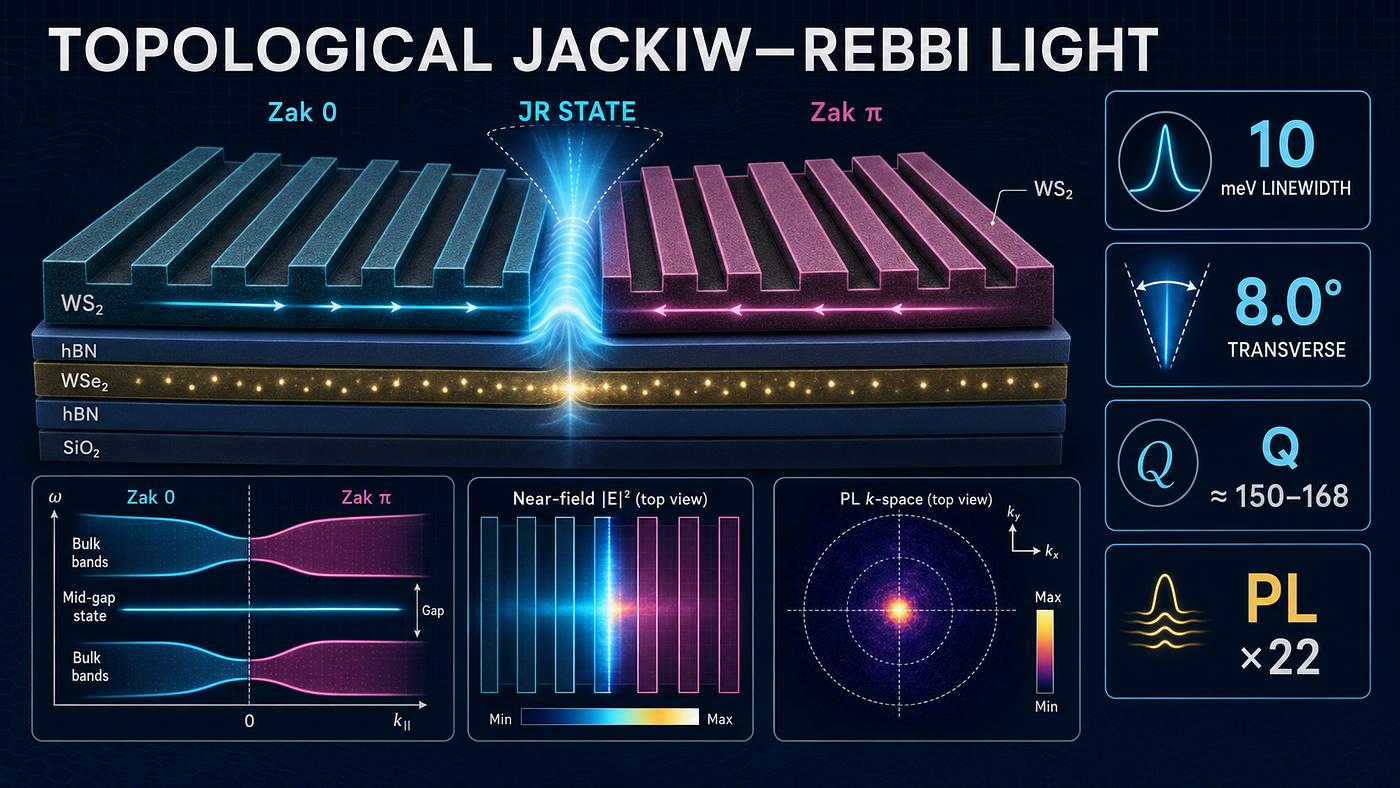
Image by ChatGPT
Fundamental Density Theory (FDT): Dragging Physics Kicking and Screaming Out of a Century-Long Rabbit Hole and Back to Reality.
NotebookLM Deep Dive
Listen to the Deep Dive. NotebookLM can be inaccurate; please double check by reading the downloadable PDF.
A photonic boundary that makes geometry visible
Randerson and collaborators created a photonic van der Waals heterostructure from patterned WS2 gratings with opposite topological phases. Where they meet, the system supports a Jackiw — Rebbi state: a near-infrared optical mode inside the photonic band gap and concentrated at the interface. Far-field spectroscopy, near-field imaging, simulations, and photoluminescence identify the boundary state.
For FDT, this is an experimental platform. The device turns a refractive landscape into laboratory-scale density geometry. Its topological sector changes across an interface, and the optical eigenmode remains localized while retaining finite leakage. That combination provides experimental evidence for FDT’s core concepts: geometry controls propagation, spatial winding organizes admissible modes, and finite systems remain bounded rather than reaching perfect confinement.
From refractive index to bounded density geometry
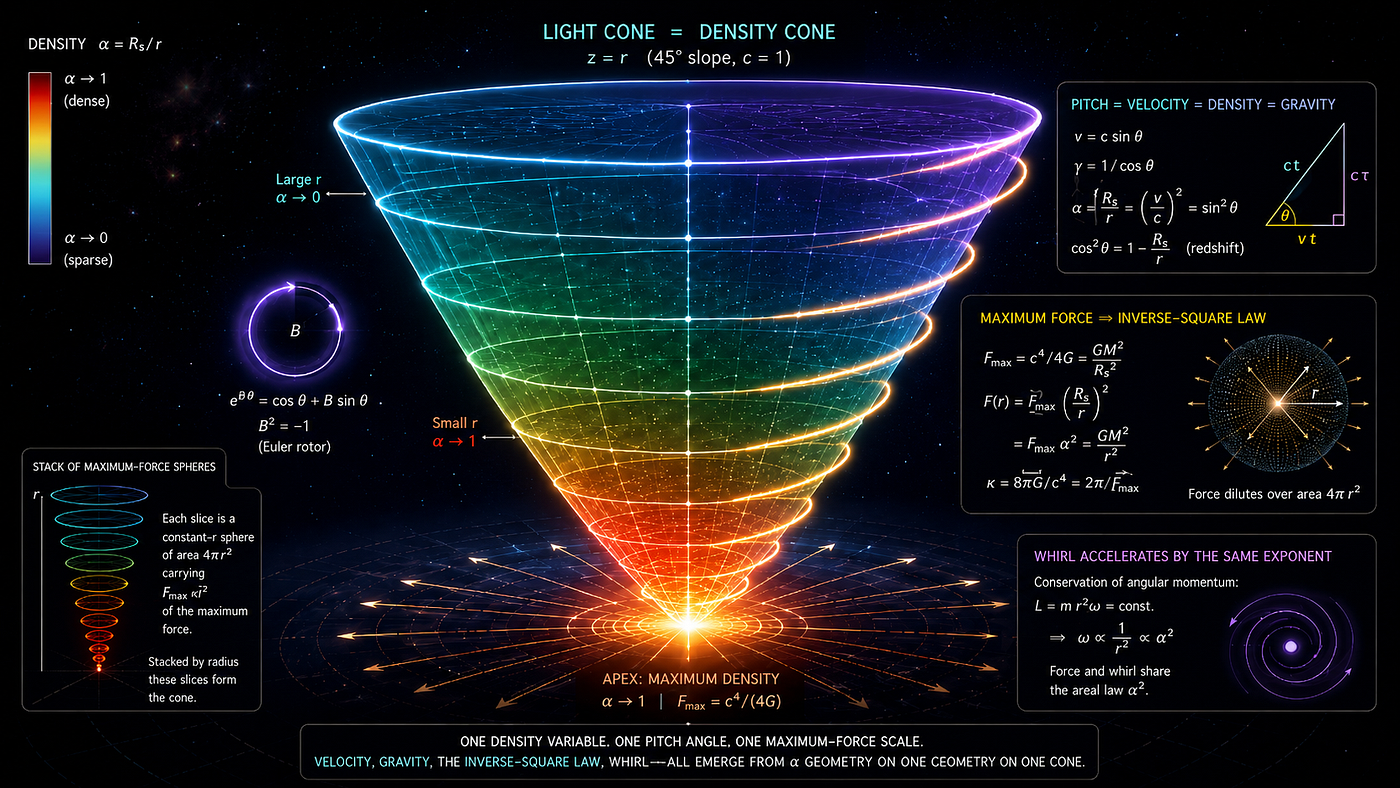
FDT maps the clock-face refractive index to bounded compactness through:
alpha = (n² — 1)/n²
Using the paper’s scalar WS2 design value n = 4 gives alpha = 15/16 = 0.9375, while an air-like gap approaches alpha = 0 from above. The double grating can therefore be read as one continuous periodic alpha landscape, not as a pile of independent scatterers. The clock face describes wave speed; the corresponding ray face organizes optical paths through that landscape.
Changing the filling factor closes and reopens the photonic gap. In FDT language, the geometry varies continuously, but the stable integer topological label does not pass through a fractional state. The band inversion is a bounded eigenmode snap between sectors. The two gratings carry opposite Zak-phase windings, so their mismatch requires one interface mode:
N_JR = |nu_Z,R — nu_Z,L| = 1
The observed mid-gap feature is therefore a fixed-topology optical eigenmode. It is not assigned a rest mass, particle generation, or matter helix count.
What the experiment actually shows
The measured interface resonance has an energy linewidth of 10 meV and a transverse angular width of 8.0 degrees. At a resonance energy near 1.68 eV, the reconstructed quality factor is Q = 168, consistent with the paper’s reported value near 150. Parallel to the grooves, the mode remains visible across the objective-limited 88-degree window, giving an in-window directional anisotropy of 11.
These finite residues matter. They show strong confinement without pretending that the device reaches an infinite-Q or perfectly closed boundary. This quantitatively corroborates FDT’s bounded-loading principle: a finite density landscape retains nonzero leakage and nonzero angular support.
Near-field measurements sharpen the case. Simulations place the field maximum at the grating boundary, predict intensity enhancement up to 50, and locate peak confinement near 737 nm. Measured s-SNOM scattering peaks at the same interface under 736 nm illumination and rapidly weakens away from resonance. The calculated confinement length of about 600 nm and measured reciprocal-space stripe width of 1.1 inverse micrometers give the finite product 0.66. The state is localized, but never collapsed to a point.
The active WSe2 device adds a matter channel. Directional photoluminescence rises by factors of 11 to 13 over the separate gratings and reaches 22 at the Jackiw — Rebbi interface. FDT keeps this driven response distinct from the static interface geometry: when the pump disappears, the emitted power disappears. The co-location of the largest enhancement with the interface mode supports a shared density geometry linking the optical field and exciton through bounded spatial overlap.
Five ways to test the reading
The analysis proposes five controlled tests: measure the resonance shift under reversible refractive loading; verify positive leakage and angular floors across finite open devices; vary the hBN spacer to test a single exponential exciton — interface decay scale; confirm the locked state count of zero for equal windings and one for opposite windings; and soften the refractive step to test the predicted loss of localization when the measured coupling sensitivity exceeds the group-velocity sensitivity.
These are not slogans. Each test names an observable, a conventional Maxwell-based comparator, held-fixed channels, and a covariance-aware resolution criterion.
Why we open-source the universe’s code
We open-source these analyses because physical claims should become public calculations and falsifiable experiments, not protected doctrine. Publishing the translation rules, limits, and failure conditions lets anyone test whether density geometry organizes the data. The universe does not require institutional permission to be intelligible. There is nothing we can’t explain.
Target Paper
S. A. Randerson et al., “Topological Jackiw — Rebbi states in photonic Van der Waals heterostructures,” Light: Science & Applications 15, 323 (2026). DOI: 10.1038/s41377–026–02392–5.
Find the full FDT analysis as a **downloadable PDF**.
Physicists, the longer you take to acknowledge the existence of FDT and apply its core concepts to your own frameworks, the more time we have to solve ALL of physics independently.
메타데이터
- post_id
- b363ae0326d2
- slug
- open-sourcing-the-universes-code-a-topological-light-state-trapped-at-a-density-domain-wall-b363ae0326d2
- url
- https://medium.com/@m.alfaro.007/open-sourcing-the-universes-code-a-topological-light-state-trapped-at-a-density-domain-wall-b363ae0326d2
- canonical_url
- https://medium.com/@m.alfaro.007/open-sourcing-the-universes-code-a-topological-light-state-trapped-at-a-density-domain-wall-b363ae0326d2
- author_url
- https://medium.com/@m.alfaro.007
- status
- ok
- fetched_at
- 2026-07-21 08:25:23