Why Hard Water Changes Everything in Soap and Cleaning Systems
Most people don’t think about water when they think about cleaning. They think about the soap. The detergent. The brand. The fragrance. But…
Why Hard Water Changes Everything in Soap and Cleaning Systems
Most people don’t think about water when they think about cleaning. They think about the soap. The detergent. The brand. The fragrance. But the reality is much simpler — and more frustrating: The water itself can quietly decide whether your cleaning works… or fails.
If you’ve ever noticed soap not lathering well, clothes feeling stiff after washing, or a strange film left behind on surfaces, there’s a good chance hard water is involved. These aren’t random issues. They are consistent, predictable outcomes of how water chemistry interacts with cleaning systems.
And once you understand what’s happening, a lot of everyday “mysteries” suddenly start making sense.
What Is Hard Water, Really?
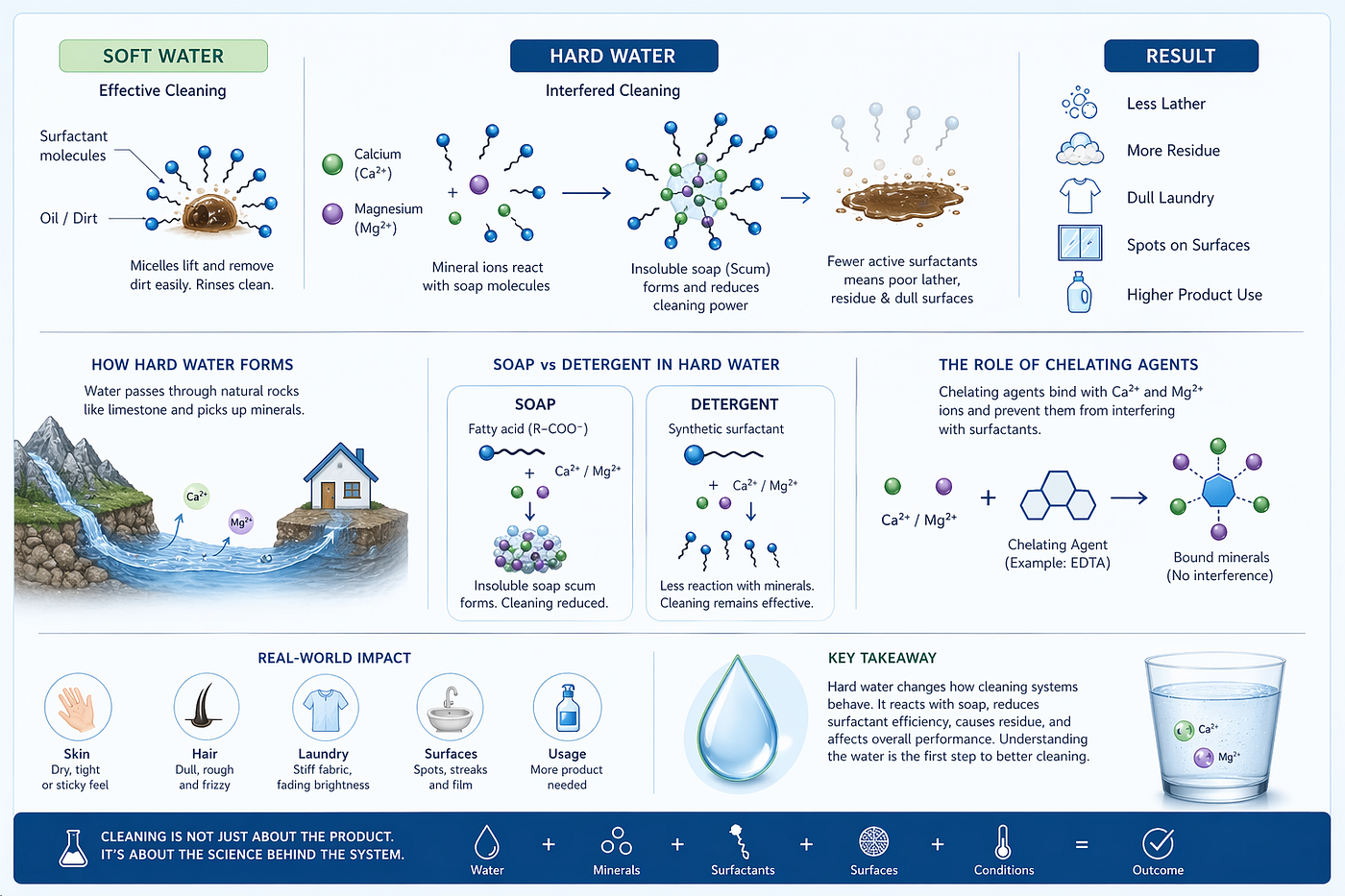
Hard water is simply water that contains dissolved minerals — mainly calcium (Ca²⁺) and magnesium (Mg²⁺).
These minerals come from natural sources like limestone and underground rock formations. As water moves through these materials, it picks up mineral ions along the way.
A simple way to think about it:
Water Type | Mineral Content | Cleaning Behavior Soft water low mineral content easy lather and clean rinse
Moderately hard water medium mineral content reduced lather and slight residue
Hard water high mineral content poor lather and visible buildup
Hardness is usually measured in ppm (parts per million):
- 0–60 ppm → Soft
- 61–120 ppm → Moderately hard
- 121–180 ppm → Hard
- 180+ ppm → Very hard
These numbers might seem technical, but their effects are very real in daily life.
Why Soap Stops Working Properly
Soap is not just “cleaning liquid.” It is a chemical system designed to interact with oils, dirt, and water.
In soft water, soap molecules stay active and available. They surround oils and allow them to rinse away easily.
In hard water, something different happens.
Calcium and magnesium ions react with soap molecules and form insoluble compounds — often called soap scum.
Instead of helping clean, part of your soap gets “used up” reacting with minerals.
This creates three immediate effects:
- Less effective cleaning
- Reduced foam or lather
- Residue left behind on surfaces
So when people say “this soap doesn’t lather well,” it’s often not the soap — it’s the water interfering with it.
The Hidden Formation of Residue
One of the most confusing things about hard water is residue.
Surfaces look clean when wet, but once they dry, a dull film appears.
This happens because:
- Soap + minerals = insoluble deposits
- Water evaporates
- Deposits remain on the surface
This residue can show up as:
- White spots on glass
- Sticky feel on skin
- Dull fabrics after washing
- Build-up in sinks and showers
Over time, this is not just a cosmetic issue — it becomes structural.
Layers build up. Cleaning becomes harder. More product is used. Results get worse.
Detergents vs Soap: Why They Behave Differently
Modern detergents are designed to handle hard water better than traditional soap.
Unlike soap, many detergents use synthetic surfactants that are less reactive with calcium and magnesium.
That’s why:
- Laundry detergents still work in hard water (to a degree)
- Dishwashing liquids maintain foam better
- Shampoo formulations include stabilizers
But even detergents are not immune.
Hard water can still:
- Reduce efficiency
- Increase required dosage
- Cause residue buildup
- Affect rinsing performance
So the system adapts — but the problem never fully disappears.
The Role of Chelating Agents
To counter hard water, many cleaning products include something called a chelating agent.
These molecules bind to calcium and magnesium ions, preventing them from interfering with the cleaning system.
Common examples include:
- EDTA (Ethylenediaminetetraacetic acid)
- Sodium citrate
- Phosphates (in some formulations)
Their role is simple but critical:
They “capture” mineral ions so surfactants can do their job properly.
Without them, cleaning systems would struggle significantly in hard water conditions.
Real-World Impact You Can Actually Feel
you can actually feel the difference in daily use
on skin it may feel dry or slightly tight on hair it often looks dull and less smooth laundry can turn stiff and lose brightness surfaces develop spots and streaks and you usually end up using more soap than expected
Why More Soap Doesn’t Solve the Problem
A common reaction to poor cleaning performance is simple:
Use more product.
But in hard water, this often makes things worse.
More soap means:
- More reaction with minerals
- More residue formation
- More difficult rinsing
Instead of solving the problem, it amplifies it.
This is why understanding the system matters more than just adjusting quantity.
Thinking Beyond Products: It’s a System
The biggest shift happens when you stop thinking in terms of products and start thinking in terms of systems.
Cleaning is not just:
Soap → Dirt → Clean
It’s actually:
Water + Minerals + Surfactants + Surfaces + Conditions → Outcome
Hard water changes one key part of that system, and everything else adjusts around it.
Once you see it this way, patterns become clearer:
- Why some homes struggle with cleaning despite good products
- Why certain formulations perform differently in different regions
- Why results vary even when using the same method
Conclusion
Hard water is not a small variable. It’s a foundational one.
It doesn’t just reduce cleaning efficiency — it reshapes how the entire system behaves.
Most cleaning problems people try to solve at the product level are actually rooted in water chemistry.
And once you understand that, you stop chasing better products… and start understanding better systems.
That’s where things begin to make sense.
메타데이터
- post_id
- b368cab321cf
- slug
- why-hard-water-changes-everything-in-soap-and-cleaning-systems-b368cab321cf
- url
- https://medium.com/@parvaiz13/why-hard-water-changes-everything-in-soap-and-cleaning-systems-b368cab321cf
- canonical_url
- https://medium.com/@parvaiz13/why-hard-water-changes-everything-in-soap-and-cleaning-systems-b368cab321cf
- author_url
- https://medium.com/@parvaiz13
- status
- ok
- fetched_at
- 2026-07-08 01:19:27